
Wednesday | January 6, 2010
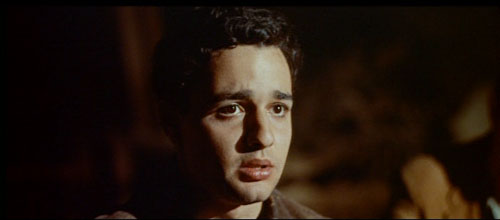
Exodus.
DB here:
Watching the film adaptation of Stieg Larsson’s Girl with the Dragon Tattoo reminded me how common fragmentary flashbacks have become. Granted, we’re living in a period of flashback frenzy, one comparable to the delirious 1940s and 1960s. But the format of the flashbacks has changed a bit. The Girl with the Dragon Tattoo, like many other films, gives us mere glimpses of earlier events–literally, flashes back to the past.
The technique is actually quite old. American films of the 1910s often interrupted present-time scenes to remind us of actions we’ve already seen or been told about. But the fragmentary flashback waned during the heyday of sound cinema. There conversations did nearly all the work. Of course there were flashbacks, as I’ve discussed in an earlier entry. But those flashbacks tended to be extended scenes, not the jagged bursts we get now.
A cynic might say that today’s audiences are so thick-headed and impatient that simply mentioning what happened earlier isn’t enough. Viewers now would chafe at the long interrogations in The Maltese Falcon and The Big Sleep. The scenes would need to be split up by images showing what the characters were explaining. The new rule: Add redundancy, but dress it up in whipcrack visuals.
So are the flurries of mini-flashbacks there just because filmmakers doubt that viewers can follow a twisty intrigue given in dialogue? Not necessarily. I suspect that these flourishes are traceable to a piece of current screenwriting advice. It’s usually formulated as Show, don’t tell.
The very distinction has some ancient ancestry. Plato and Aristotle both distinguished between verbal narration, as in the Homeric epics, and theatrical presentation. Aristotle, always more interested in craft than Plato, went on to point out that the distinction couldn’t be absolute. Epic narration could include simulated conversations, for example. Aristotle did not, so far as I can tell, urge composers of epics to avoid “showing” or dramatists to avoid having characters report offstage action.
Today’s bias in favor of “showing” is probably traceable to the emergence of the modern novel. “Dramatize, dramatize!” Henry James (a failed playwright) advised the novelist. That is, make the action on the page seem vivid and palpable. It was Joseph Conrad, not D. W. Griffith, who first claimed that his purpose was “to make you see.” A major trend in the theory of prose fiction ca. 1900 was the effort to turn words on the page into a surrogate for visual storytelling; hence the very term “point of view” and James’ comparison of unfolding narrative to a “corridor” that we traverse. It remained for Percy Lubbock, in The Craft of Fiction (1921) to sum up this trend. “A novel is a picture,” he claimed, and he suggested that novels, either “panoramic” ones like Vanity Fair or “dramatic” ones like The Awkward Age, can make us forget that they are actually verbal contraptions:
The art of fiction does not begin until the novelist thinks of his story as a matter to be shown, to be so exhibited that it will tell itself.
Screenplay manuals have picked up on the general advice, even while modifying it to suit the particularities of film. Novices are advised to reduce dialogue to the minimum. Even a novel committed to “showing” will rely on conversation, but in cinema long stretches of dialogue, and especially, God forbid, monologue are uncinematic and run the risk of boring the audience. Cinema, the reasoning goes, is a visual medium, and whenever you can replace a word, or a string of them, by images you should try to do so. The aim is what we now call visual storytelling.
Now I’m all for presenting the story through pictures. Show, don’t tell can challenge the screenwriter and director to get story points across through imagery and character behavior rather than expository dialogue. One mark of filmmaking skill is to guide the audience to make inferences rather than simply take in bald information.The question is: How far to go?
In their urge to picture every bit of action, contemporary filmmakers may be missing a chance to exploit another resource of cinema: the sustained scene in which a character talks about a past event without any visual supplement. A long verbal account of the past has unique virtues.
In other words: Filmmakers, consider telling and not showing what’s told.
Talking it through
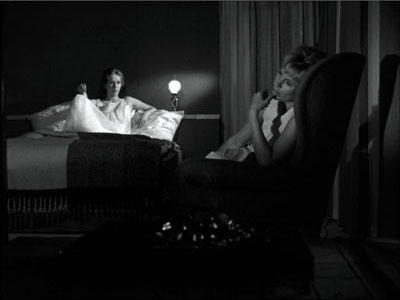
In Persona, the nurse Alma has grown more intimate with her patient Elisabeth, a famous actress who has frozen on stage and now refuses to speak. During their time together, Elisabeth’s treatment becomes therapy for Alma. Compelled to fill the silences, she gradually reveals more about herself. Tonight, a little drunk, Alma confesses something shocking. Once, while her lover was away, she and a girlfriend had sex with a couple of young men. Her telling of it makes her more and more distraught, until she breaks down weeping in Elisabeth’s arms.
In this nearly seven-minute monologue, Alma describes the incident. She mentions a few details, such as the weather on the isolated beach and the blue ribbon on her straw hat. Mostly, though, she simply describes what happened, in laconic but vivid sentences. The result is an anecdote of absorbing eroticism. Lacking any images of the events, we get to imagine the scene of sexual exchange. Bergman releases us from what James once called “weak specificity”: perhaps no imagery this side of pornography could be as arousing as this bare-bones account.
But the fairly neutral words are given emotional coloration through Alma’s manner of telling. Her reaction mixes astonishment at the pleasure, guilt at betraying her lover, and shame in telling it to Elisabeth. By the end, she collapses into weeping confusion; the incident has made her doubt what sort of person she is. Here Bibi Andersson’s performance is crucial, with trembling sincerity giving way to anguish and self-reproach.
In sum, by presenting this monologue wholly in the present, Bergman gives us two layers of action simultaneously, a charged sex scene and its long-range emotional consequences. But there’s more. Had he given us flashbacks, he could not preserve the flow of the present-time action. The staging and cutting during Alma’s confession use simple film techniques, but they add another layer to the scene.
The master shot, seen above, gives us the two women as Alma begins her tale. Then straightforward analytical editing isolates each woman.
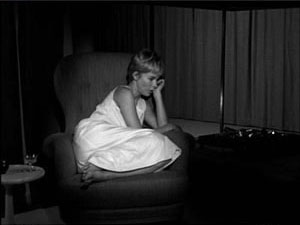 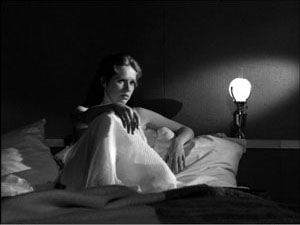
In a classic gesture of intensification, the next shots of Alma and Elisabeth are closer than the earlier ones. This pair of shots accompanies the highest point of what Alma is telling us—the first couplings.
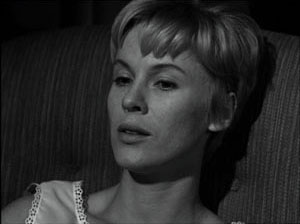 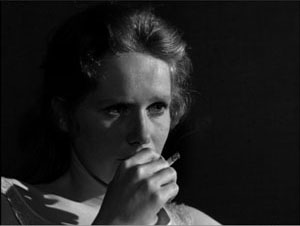
The tight shot of Alma, in which she describes achieving orgasm, lasts almost two minutes and is the lengthiest shot in the sequence. Then the action pauses as Alma nervously curls over to grab a cigarette, goes toward a distant window to light it, then settles on the sill to resume her story.
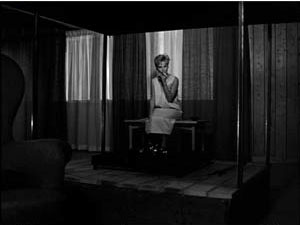
The earlier close shot of Elisabeth had hidden her reaction behind her hand. Now she watches Alma in a sort of enjoyment. Friendly empathy or triumph at eliciting a damaging admission? It’s hard to say. Alma retreats to another window and turns away, as if responding to Elisabeth’s smile.
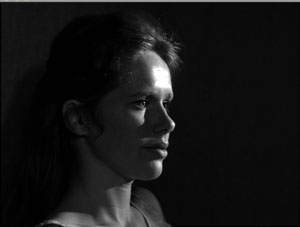 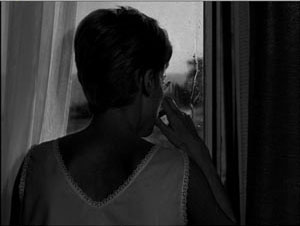
Alma finishes her tale by saying that that night, reunited with her lover, she had the most pleasurable sex of their relationship. Turning from the window, her face is angled in such a way that her confession seems at once indifferent to Elisabeth (the eyeline doesn’t seem angled toward the bed) and challenging to her: “Can you understand that?”
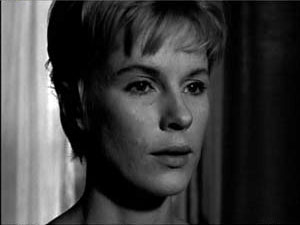
The next line of dialogue—“And I got pregnant of course”—introduces a rupture in the action’s space and time.
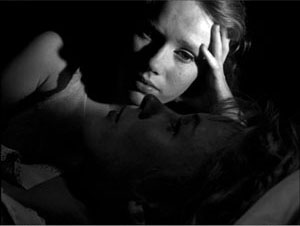
Now Alma is in bed with Elisabeth, as if her question had impelled her to the closest physical contact yet. As Alma twists in pathetic uncertainty, weeping, Elisabeth’s reaction is again initially suppressed (Alma’s arm blocks her patient’s eyes) before finally revealing Elizabeth’s face during the embrace. Yet the expression remains ambiguous—sympathetic, or victorious in having exposed her nurse’s inner life.
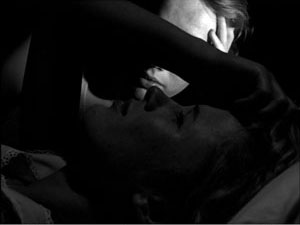 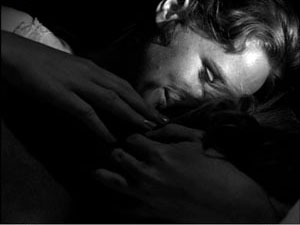
Later we will learn that Elisabeth’s caresses aren’t as affectionate as they might first appear. In any event, given the tenor of Alma’s revelation, it is hard not to see them as erotic gestures in the present, parallel to those Alma recounted.
By telling rather than showing, then, Bergman has been able to tell and show. Bergman lets Alma’s telling provide a sort of virtual flashback, while he also creates a ripening interchange between characters in the present. Instead of simply sandwiching fragments of the past into the present action, he has built up two smooth arcs of action, one that we imagine and one that is set before us in precise detail, with its own emotional modulation. The bliss of the past events is refracted through the pain of telling them.
Telling as therapy
Part of the rationale for telling rather than showing the beach orgy is, of course, the fact that much of it couldn’t be presented so literally on film; censors would object. More important is the fact that showing a heavy-breathing sexual encounter would be likely to undercut the developing revelation of Alma’s present feelings, the tension between the memory of uninhibited pleasure and the lingering shame and confusion.
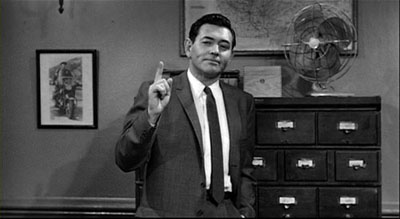
The issue of what should be shown comes up in another classic scene of confession, the moment in Exodus when the Jewish teenager Dov Landau admits that he was an accomplice in running a concentration camp. Again the result is a tearful breakdown. Here, however, a conversational partner coaxes out the truth by quietly corrosive questions.
Dov is trying to join the Irgun, a guerrilla band seeking to drive the British out of Palestine. The senior officer, Akiva Ben Canaan, lets the cocky youth expand on his boast that he began fighting Nazis in the Warsaw ghetto but then was captured and sent to Auschwitz. At first Akiva probes gently. How did the camp officials decide who would live? And what did the Nazis do to the girls? Dov starts to shift uneasily. How was the killing accomplished?
Like Bergman, Preminger employs the standard method of providing closer views as the tension rises. Dov starts to relax as Akiva provides softball questions, but then he has to confess that the bodies were dumped in mass graves. Who dug the graves? Dov admits that demolition squads used dynamite to blow out trenches. Akiva induces him to admit that this was Dov’s job.
In the course of all this, Akiva moves around the room and leans closer to Dov, but the boy remains motionless in the same setup. The fixed framing accentuates his subtly changing expressions across the scene.
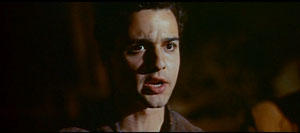
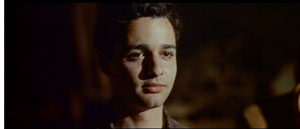
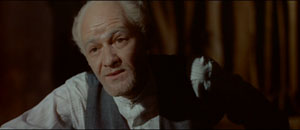
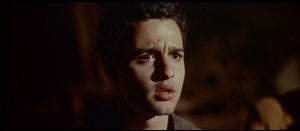
Akiva retells what Dov must have done: shave heads, collect bodies, harvest gold fillings. Dov crumples like a child under the admission (see the frame surmounting this entry), and like Alma at key points in her monologue hides his face in shame. “What could I do?”
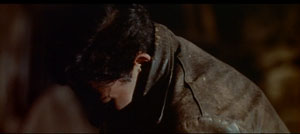
What else has he to confess? Dov won’t say, until he collapses again: “They used me . . . like you use a woman.”
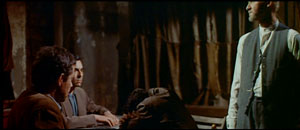
The distant framing here prepares for the scene’s final phase: the men rise and swear Dov into their group.
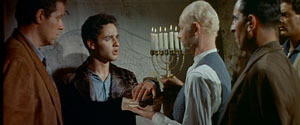
Today a filmmaker would be tempted to show at least some of what Dov tells us. We could get glimpses of life in the camp, along with subjectively distorted imagery of sexual abuse, perhaps from Dov’s point of view. But this could turn out to be James’ “weak specificity.” “Let the reader think the evil,” James advised. Accordingly, Preminger sticks obstinately to what Dov says and how Akiva’s softly voiced but damning interrogation brings out the truth.
Again, the scene’s power comes from the character’s emotional development during the telling. We can imagine the horrors that Dov faced as a boy, and our pity comes from empathizing with his changing expressions–bravado, ruffled concern, realization that he has been caught lying, revulsion at his betrayal and the sexual assault. That is, we sympathize through his response now, rather than through direct vision of what he encountered. We react to his reactions.
By the end, Dov seems dazed that his confession has been accepted. Partly this is surprise that he isn’t being rejected, but also it’s as if he has awakened from a dream–that of himself as a resistance hero. Akiva Ben Canaan forces him to confront what he had not faced. Once more, the confession becomes a talking cure.
As in Persona, the confession also characterizes the interlocutor. Akiva ‘s gentle manner fuses wisdom and severity, making him a quietly stern father confessor. He’s also a shrewd exponent of psychology, one who picks the moment of the boy’s greatest self-revulsion to declare that Dov is accepted into the Irgun. The confession has broken him; the Irgun will remake him. Having surrendered himself utterly he will prove a more loyal soldier than any recruit with an innocent past.
Again, the scene of telling has given us two continuous emotional arcs in two time frames, one concrete and one virtual: a past event we’re cued to imagine and a present stripping away of the teller’s defenses. People who complain that the dialogue scenes in Inglourious Basterds are overlong should consider the tradition of movies like Exodus and Persona.
Psycho babble
Persona and Exodus suggest two virtues of sustained recounting: arousing the viewer’s imagination, and providing an unbroken arc of present-time action that can generate sympathy through face, gesture, and voice. There’s one more advantage that isn’t perhaps so evident nowadays.
Current films give us “lying flashbacks” fairly often. But in the old days, with very few exceptions like courtroom films and tales like Rashomon, a flashback was veridical. In recounting a story action, a character might lie or make mistakes, but if the film’s narration showed us that action, we could trust that as the truth. As a result, many detective stories presented suspects’ versions of events through question and answer but climaxed in a flashback that showed us what really happened.
If, however, you want to induce doubt about what really happened, you might have the detective’s climactic explanation pricked by inconsistencies. This is what seems to me to be happening at the finale of Psycho. (Do I really have to warn about spoilers here?)
After Norman Bates has been captured, halted in another murder attempt, the psychiatrist Dr Richmond explains the young man’s split personality—part Norman, part Mrs. Bates, his mother. Richmond claims to have gotten the truth “from the mother.” At this point, he says, the Mom part of Norman has taken over wholly, a claim confirmed when we hear Norman speak in an old lady’s voice in the epilogue. Richmond goes on to claim that his questioning determined that Mother “killed the girl.” To get literal, it was as Mother that Norman murdered Marion Crane.
A contemporary film would very likely replay the murder so as to validate the psychiatrist’s analysis: Norman dressing up as his mother, assuming a cackling old-bat accent, killing Marion in images that fill in the silhouette that we saw in the shower sequence. We would see that Norman-as-Mother is the culprit.
But this visual confirmation of Richmond’s diagnosis would be made problematic by the epilogue that Hitchcock includes. In the final sequence we see Norman, staring out at the camera, and hear Mother’s voice declaring that her son committed the murders. According to her, Norman is the culprit; she wouldn’t hurt a fly. How then can Richmond declare that Mother told him that she killed the girl?
We might say that the doctor is extrapolating: the truth he took from the mother is that she is dissembling, shifting the guilt to Norman. But Richmond could have stated that was his reasoning, and he doesn’t. The incompatibility between his explanation and Mother’s soliloquy opens up the possibility that he has not probed to the depths of Norman’s madness.
Despite the fact that the psychiatrist’s analysis arrives at the moment when a conventional movie delivers the whole truth, the very last minutes of the film incline me to doubt Richmond’s ability to grasp the whole situation. It’s as if our parting vision of the character disturbs the smug certainties of the diagnosis.
I haven’t dived deeply into the Talmudic sea of Psycho commentary, so it’s likely that this issue has been hashed out extensively. Perhaps my construal won’t stand up. Take it, then, as a possible instance of the ways in which a verbal recounting, “unconfirmed” by a tangible flashback, can stand as only a candidate explanation rather than the whole truth. In general, telling and refusing to show can induce what Meir Sternberg calls “anticipatory caution,” a warning that the telling is only one, and not necessarily the most truthful, version of events.
Show, don’t tell is usually good advice. But I’m suggesting a codicil. Consider showing the telling. Fill it out. Pack it with actorly detail and psychological implication. Stage and shoot and cut it so as to create an engrossing, unfolding rhythm. That’s visual storytelling too, and it requires fine judgment. Who knows? More scenes relying on telling might also teach audiences to be a little patient.
The best modern account I know of the subtle differences between showing and telling, and the cases when the categories blur and fracture, can be found in Meir Sternberg’s Expositional Modes and Temporal Ordering in Fiction. I talk a little about the distinction in Chapter Two of Narration in the Fiction Film. See also The Way Hollywood Tells It for some comments on today’s vogue for unreliable flashbacks. And way back in 2006 Matt Zoller Seitz wrote a passionate attack on the idea of “Show, don’t tell” while defending the value of voice-over narration.
N. B. I’m not ignoring the possibility that film can present showing and telling in two simultaneous streams: imagery of the present situation accompanied, perhaps alongside, by continuing imagery of the past scene, as in Suddenly Last Summer. This can be a fruitful option, but it relieves the spectator of the obligation to imagine the past—an important advantage of the pure telling. There’s also the tricky matter of giving the two streams of information enough density. The past event needs to gain enough body to be more than a simple illustration, while the present-time telling could become merely a prop for the flashback. In the dual-presentation mode, the filmmaker risks dividing our attention and thinning the texture of each time frame, with the result that both lose vividness. That seems to me to happen in Suddenly Last Summer.
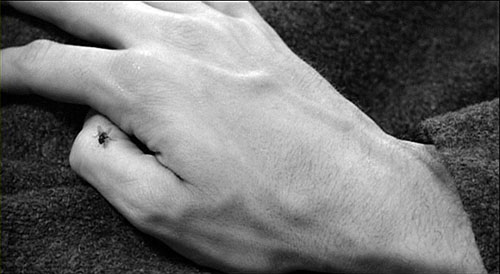
Psycho.
Posted in Directors: Bergman, Directors: Hitchcock, Directors: Preminger, Film and other media, Film comments, Film history, Film technique, Film theory, Narrative strategies, Screenwriting |  open printable version
| No Comments » open printable version
| No Comments »
Wednesday | December 30, 2009
KT here, with some help from DB:
Two entries are enough to create a tradition. Once again, at a time of year when critics are picking their 10-best lists for 2009, we jump back ninety years and give our choices for 1919.
(For our 1917 list, see here, and here for 1918.)
I remarked in last year’s post that it was a bit difficult to come up with ten films, a result perhaps of accidents of preservation or slackening of activity by certain major filmmakers. There was no such problem for 1919, and films had to be bumped off the initial list to keep it to ten. (In fact, you’ll notice we didn’t quite manage to keep it to ten.) Since some people may take these lists as a guide to exploring the cinema of the teens, we’re adding some also-rans at the end, all very much worth watching.
With 1919, we’re approaching the decade when many of the most widely known silent classics were made. Some titles on this year’s list will be very familiar. Erich von Stroheim’s first film came out in 1919, as did Carl Dreyer’s. Ernst Lubitsch, always a prolific director, was particularly busy that year. Other titles are less well-known, still being largely the province of silent-film festivals and archival research.
Three, sadly, are not available on DVD, and some others have to be ordered from sources in their countries of origin. In this day of internet sales around the world, such orders are not difficult. You need, however, a multi-region DVD player.
Charles Chaplin had long since left his knockabout comedy behind and was making more controlled, poetic films by 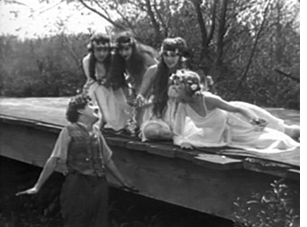 this point. The Little Tramp was beloved around the world, and numerous impersonators were turning out films to cash in on his popularity. Sunnyside is his most highly regarded film of 1919, in large part because of a dream sequence in which the Tramp wakes up by a little bridge to find himself welcomed by a bevy of wispily dressed young ladies. The subsequent open-air dance displays Chaplin’s extraordinary ability to inject humor into such a scene without marring its lyricism. (The only DVD version currently available in the U.S. is a fuzzy copy.) this point. The Little Tramp was beloved around the world, and numerous impersonators were turning out films to cash in on his popularity. Sunnyside is his most highly regarded film of 1919, in large part because of a dream sequence in which the Tramp wakes up by a little bridge to find himself welcomed by a bevy of wispily dressed young ladies. The subsequent open-air dance displays Chaplin’s extraordinary ability to inject humor into such a scene without marring its lyricism. (The only DVD version currently available in the U.S. is a fuzzy copy.)
Cecil B. De Mille had begun his series of high-society battle-of-the-sexes films by this point. Male and Female differs from the others in that it is based on a prominent literary source, The Admirable Crichton, J. M. Barrie’s successful 1902 play. The plot involved the butler of a wealthy British family. He becomes their leader when the pampered group is cast away on an unpopulated island. A romance develops between the spoiled daughter, Lady Mary (Gloria Swanson), and Crichton (Thomas Meighan).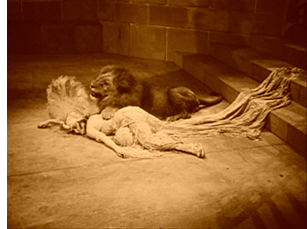
De Mille spiced up the story with a fantasy scene based on William Ernest Henley’s popular poem of 1888, “I was a King in Babylon.” It dealt with reincarnation, one of several spiritualist fads of the period, which also included psychic contact with the dead and the fairy photographs that deluded Sir Arthur Conan Doyle. Crichton refers to the poem, leading into a scene of him as king in a Babylon. When a Christian slave girl rejects his advances, he orders her thrown to the lions. The scene providesa glimpse of the costume-epic style that De Mille would increasingly turn to as his career advanced.
Henley, by the way, is largely forgotten today, but another of his poems, “Invictus,” inspired Nelson Mandela and lends its name to the latest Clint Eastwood film.
D. W. Griffith released an impressive lineup of features in 1919, despite the fact that he was also acting as the producer for other directors. His output includes a charming set of pastoral stories A Romance of Happy Valley, True Heart Susie, and The Greatest Question; a belated war film, The Girl Who Stayed at Home; a Western, Scarlet Days; and a melodrama that ranks among his most admired films, Broken Blossoms. Griffith’s status within the industry was 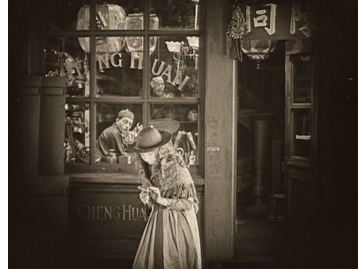 reflected by the fact that this same year same the formation of United Artists as a company to distribute films by him and the other founders, Chaplin, Mary Pickford, and Douglas Fairbanks. reflected by the fact that this same year same the formation of United Artists as a company to distribute films by him and the other founders, Chaplin, Mary Pickford, and Douglas Fairbanks.
Broken Blossoms owes its simplicity to the fact that Griffith was then making a series of films based on short stories. The title of Thomas Burke’s “The Chink and the Child” sounds offensive today, but it was an ironic reference to the epithet forced upon an idealistic young Chinese man who comes to London’s grim Limehouse district and becomes disillusioned. He falls in love with the delicate Lucy, abused by her violent, drunken father. These three form the main characters. Another Chinese man lusts after Lucy, but for once in Griffith’s work, the sexual threat to the innocent heroine takes second place to her abuse by her father. Lillian Gish and Richard Barthelmess convey the quiet resignation that at intervals gives way to Donald Crisp’s vicious outbursts.
Apart from the strong performances from the three leads, the film was perhaps the first to consistently use the “soft style” of cinematography, an approach that borrowed from a recently established trend in still photography. The hazy views of the Chinese setting in the opening and of the Limehouse docks later on would be enormously influential on films of the 1920s.
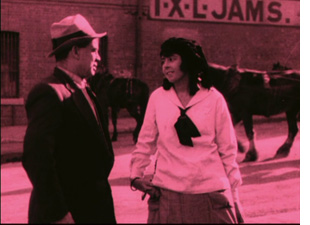 Raymond Longford is far and away the least known of the directors in this list. Films were increasingly being made in countries outside the U.S. and Europe, but few have survived. Longford’s The Sentimental Bloke is widely held to be the first major Australian film and perhaps the best of the silent era. Based on a verse poem using vernacular language and serialized from 1909 to 1915, it was set among working-class characters and filmed on location in an inner-city district of Sydney. It follows the reformation of the Bloke, a drinking, gambling man reformed by his love for Doreen. The film’s original intertitles, based on the poem and told in first person by the hero, were too colloquial for Americans to comprehend, and the film failed there, even after a new set of intertitles were substituted. Raymond Longford is far and away the least known of the directors in this list. Films were increasingly being made in countries outside the U.S. and Europe, but few have survived. Longford’s The Sentimental Bloke is widely held to be the first major Australian film and perhaps the best of the silent era. Based on a verse poem using vernacular language and serialized from 1909 to 1915, it was set among working-class characters and filmed on location in an inner-city district of Sydney. It follows the reformation of the Bloke, a drinking, gambling man reformed by his love for Doreen. The film’s original intertitles, based on the poem and told in first person by the hero, were too colloquial for Americans to comprehend, and the film failed there, even after a new set of intertitles were substituted.
The Sentimental Bloke was restored in 2004 and this past April appeared in a DVD set prepared by the Australian National Film & Sound Archive. A supplementary disc includes historical material, information on the new musical accompaniment, and an interview with Longford. A book of historical essays is also included in the box, which is available directly from the DVD company Madman. (Note that although there is no region coding, it is in the PAL format.)
When I was studying film in graduate school, Ernst Lubitsch’s German period was known mainly for the 1919 historical epic Madame Dubarry. There was little known about the two comedies that came out that year, perhaps the most amusing and delightful of all his German films in this genre: Die Austernprinzessin (“The Oyster Princess,” though seldom called by that title) and Die Puppe (“The Doll,” also a little-used name).
It’s hard to choose which of these three is Lubitsch’s best for the year. Ironically Madame Dubarry isn’t watched much any more, and it’s not on the recent DVD set “Lubitsch in Berlin,” though the two comedies are. Complete prints are rare, due in part to censorship. (If the print you see ends with a close-up of the heroine’s head held up after she is executed, you’ve probably been watching a reasonably complete version.) It may seem a bit stodgy upon first viewing, but I warmed up to it during repeated screenings while researching my book on Lubitsch’s silent films. There are many excellent moments: the extended series of eyeline matches when Louis XV first sees Jeanne, the masterfully timed and staged long take when Choiseul refuses to let Jeanne accompany Louis’s coffin, and a meeting among the revolutionaries that ends as Jeanne reacts in horror to their bloodthirsty plans, backing dramatically into shadow in the background (below).
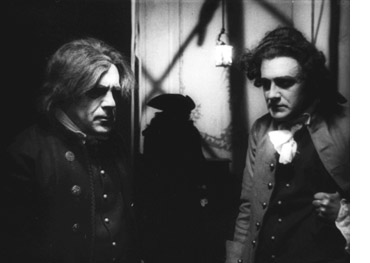
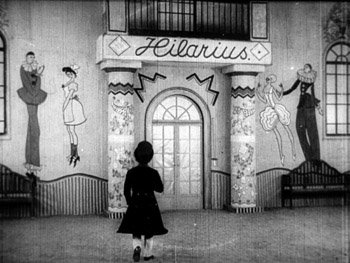
Given how different these films are, I’m going to declare a tie between Madame Dubarry and one of the comedies. Wonderful though The Oyster Princess is, I’m opting for Die Puppe (above). Its story-book opening and stylization are charming. The hilarious scenes in the doll workshop and the monastery full of greedy monks fill out the plot, making it considerably denser than that of Die Austernprinzessin.
As with Lubitsch, when I was first studying film and for many years thereafter, Swedish director Mauritz Stiller was known mainly for one film, Sir Arne’s Treasure (Herr Arnes Pengar), though an abridged version of The Saga of Gösta Berling also circulated. Sir Arne’s Treasure was assumed to be his masterpiece. The gradual rediscovery and restoration of other Stiller films from the 1910s has considerably broadened our view of him. Perhaps Sir Arne’s Treasure is not the solitary, towering masterpiece it was long thought to be. Still, it holds up well upon revisiting.
It is a period piece set in a small seaside community. A group of foreign men massacre most of a family, in search of their mythical riches. They are forced to remain in the village when the ship in which they are to sail becomes 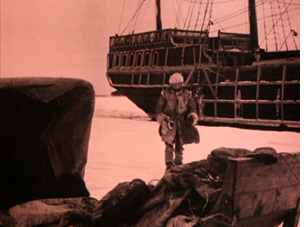 icebound. The surviving daughter of the family unwittingly falls in love with one of the killers. icebound. The surviving daughter of the family unwittingly falls in love with one of the killers.
Sir Arne’s Treasure was one of the films which gained the Swedish cinema of the 1910s the reputation for brilliantly exploiting natural landscapes. Few silent films have exploited actual winter settings so well. The actors are clearly working in genuine snow; one can sometimes see their breath fog as they speak. Atmospheric shots show the wind sweeping snow across the ice. Stiller uses the blank backgrounds created by the snow to create stark, simple compositions of dark figures and objects.
Kino’s DVD release uses a print from Svensk Filmindustri’s own archives. To my eye, the tinting used is too dark, especially since much of the action naturally takes place in the dark of the northern winter days. Deep blues somewhat obscure parts of the action. Still, the darkness adds to the brooding tone that pervades the story.
Erich von Stroheim’s first film, Blind Husbands, is the only one he completed that has come down to us in more or less its original version. As the director’s artistic ambitions expanded, his studios’ willingness to accommodate the growing 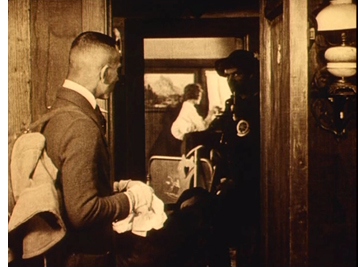 length and scope of his films diminished. His features of the 1920s were re-edited without his consent, most notoriously when the eight-hour naturalistic film Greed (1924) was released in a version that ran little more than two hours. For many the original remains at the top of the wish list for lost films to be recovered someday. (Number one on my list is Lubitsch’s Kiss Me Again, released in 1925 just before his masterpiece, Lady Windermere’s Fan.) length and scope of his films diminished. His features of the 1920s were re-edited without his consent, most notoriously when the eight-hour naturalistic film Greed (1924) was released in a version that ran little more than two hours. For many the original remains at the top of the wish list for lost films to be recovered someday. (Number one on my list is Lubitsch’s Kiss Me Again, released in 1925 just before his masterpiece, Lady Windermere’s Fan.)
Blind Husbands is my favorite among von Stroheim’s films. It tells its story of sin and punishment with a lighter touch than his later films would. The director plays a would-be seducer of a neglected wife when the group converges in a village for a mountain-climbing vacation. Von Stroheim’s eye for striking compositions against the snow-clad landscapes and his skillful use of the inn’s hallways and doors to convey the characters’ shifting relationships show an already mature grasp of the art form. (See right, where the villain eyes the heroine in her room but is himself watched by the protective guide in the hallway between the rooms.)
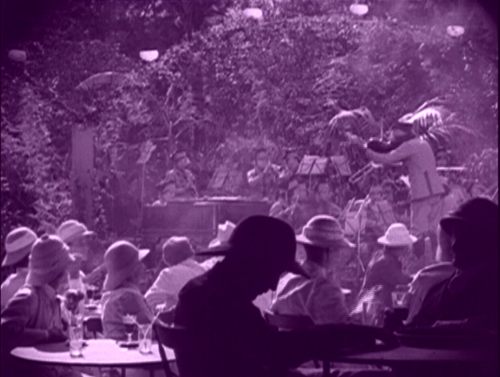
Maurice Tourneur’s Victory runs a mere 63 minutes in its current version, but the original footage count suggests that what we have is substantially complete. That’s somewhat short for a feature by a major director at this point in history, but the simple, intense plot, based on a Joseph Conrad short story, benefits from the compression. The protagonist is a man who has escaped his past and lives as a virtual hermit on a South Seas island. Attracted despite himself, he befriends a young woman playing in a visiting orchestra and rescues her from the abuse of the orchestra’s owner and the lustful advances of the local hotel owner. Returning with the woman to his lonely island, he faces the intrusion of three thugs deceived by the vengeful hotel owner into thinking that the hero has riches hidden on his island.
By this point Tourneur has fully mastered the “rules” of classical continuity style and of three-point lighting. Many of the compositions in Victory look like they could have been made in the 1930s. When I first saw the film about thirty years ago, I found the earliest case of true over-the-shoulder shot/reverse shot that I had ever seen:
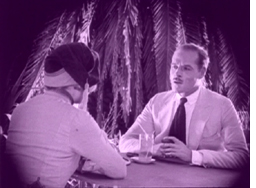 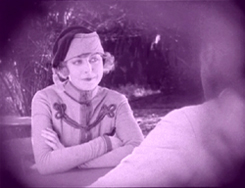
Since then, David has found an earlier one that sort of qualifies (maybe more on this in an upcoming entry), but this is a purer case.
Tourneur had also developed a distinctive approach to filming settings in long shot with framing elements within the mise-en-scene and figures silhouetted in the foreground (see top). In general the lighting is superb. Few Hollywood directors had reached this level of sophistication by 1919.
Victory has been released on DVD largely because it features Lon Chaney as one of the thugs. Image offers it paired it with another Chaney film. For some reason the titles are out of focus, but the rest of the film fortunately is in good condition and presents Tourneur’s visual style well.
DB’s picks:
Carl Theodor Dreyer began his film career writing scripts at the powerful Danish studio Nordisk. When he started directing, however, World War I had destroyed Nordisk’s markets, and the American cinema was on the rise. Dreyer’s generation was the first to register the impact of the emerging Hollywood cinema, and he displayed his understanding of Griffithian technique in The President (Praesidenten).
The English title should probably be something like “The Head Magistrate” or “The Presiding Judge,” and the plot appropriately sets up a tension between justice and personal obligation. One of Nordisk’s favored genres was the “nobility film,” in which illicit passion plunges a wealthy man or woman into the lower depths of society. Dreyer gave the studio a nobility film squared, using flashbacks to show how two generations of men in a family have seduced working-class women. The present-day drama displays the crisis that ensues when a respected judge realizes that the woman to be tried for infanticide is his illegitimate daughter. Dreyer’s abiding concern for the exploitation of women under patriarchy begins in his very first film.
From the early 1910s, Danish films displayed a mastery of tableau staging and careful pacing. But The President bears the mark of American technique in its bold close-ups and reliance on editing to build up its scenes. (There are nearly 600 shots in the film, yielding a rate of about 8.8 seconds per shot—quite swift for a European film of the era.) Perhaps more important are Dreyer’s efforts to shove aside the heavy furnishings of bourgeois melodrama. Compare the overstuffed set of Hard-Bought Glitter (Dyrekobt Glimmer, 1911) to this daringly bare one, with its sweep of cameos.
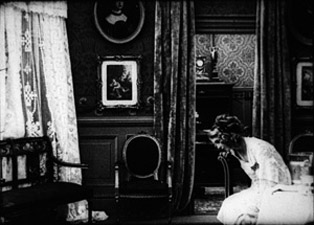 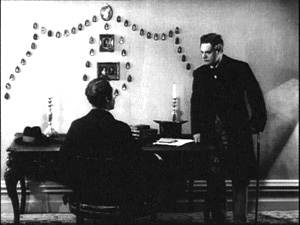
In the late teens, other Danish directors were moving toward simpler settings, but The President carries this tendency to geometrical extremes. Dreyer’s walls, bare or starkly patterned, isolate the players’ gestures and heighten moments of stasis. The result is one of the most adventurously designed film of its time, and if some of its experiments do not quite come off, already we can see that impulse toward abstraction that would be given full rein ten years later in La Passion de Jeanne d’Arc. The all-region DVD from the Danish Film Institute provides a somewhat dark tinted copy with original intertitles and English translations.
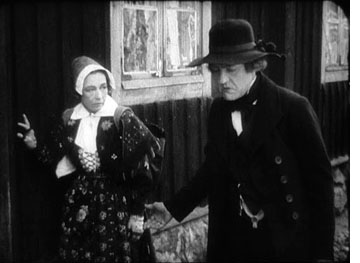 Dreyer deeply admired Victor Sjöström, who had already given Swedish cinema some of its enduring masterpieces: Ingeborg Holm (1913), Terje Vigen (1917), The Girl from Stormycroft (1917), and The Outlaw and His Wife (1918). Sjöström would go on to make The Phantom Carriage (1921), The Scarlet Letter (1926), and The Wind (1928). Several other outstanding movies he signed remain little known; worth watching for are The Girl from Stormycroft (1917), Karin Ingmarsdotter (1920), and the deeply moving Mästerman (1920; look for this on our list next year). Among these unofficial classics Sons of Ingmar (Ingmarssönerna, 1919) stands out especially. Dreyer deeply admired Victor Sjöström, who had already given Swedish cinema some of its enduring masterpieces: Ingeborg Holm (1913), Terje Vigen (1917), The Girl from Stormycroft (1917), and The Outlaw and His Wife (1918). Sjöström would go on to make The Phantom Carriage (1921), The Scarlet Letter (1926), and The Wind (1928). Several other outstanding movies he signed remain little known; worth watching for are The Girl from Stormycroft (1917), Karin Ingmarsdotter (1920), and the deeply moving Mästerman (1920; look for this on our list next year). Among these unofficial classics Sons of Ingmar (Ingmarssönerna, 1919) stands out especially.
A prologue shows lumbering, somewhat thick-headed Ingmar climbing a ladder to heaven, where generations of Ingmars sit in dignity around a massive meeting-room (see below). There his father tells him that he must find a wife. But Ingmar then explains that he once took a wife, with unhappy results. Some long flashbacks ensue, showing Ingmar forcing a young woman to marry him. The plot takes some doleful turns, with the result that the woman is sent to prison.
Running over two hours (and initially released in two parts), Sons of Ingmar has a fittingly lengthy climax that portrays the pains of reconciliation between a sensitive woman and an inarticulate man. In the film’s final scenes, Sjöström risks a delicate emotional modulation that would daunt a director today. Using Hollywood continuity cutting with a casual assurance, he relies on subtly timed cuts and changes of shot scale to trace the couple’s wavering guilts and hopes. These last scenes have a human-scale gravity that balances the weighty paternal authority of the heavenly sequences. In Theatre to Cinema our colleagues Lea Jacobs and Ben Brewster have written a penetrating analysis of the performances of Sjöström as Ingmar and Harriet Bossa as Brita.
Unhappily, we know of no video version of this wonderful film. It should be a top priority for DVD companies specializing in silent cinema.
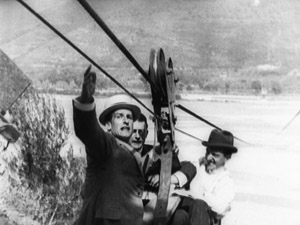 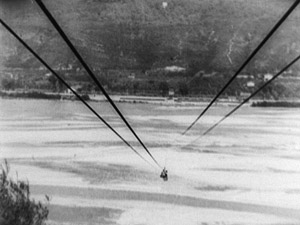
Another 1919 candidate for ambitious DVD purveyors is Louis Feuillade’s great serial Tih Minh. It has been overshadowed by Fantômas (1913-1914), Les Vampires (1915-1916), and Judex (1917), but it has a playful charm of its own. It is, in a way, the anti-Vampires. Instead of chronicling the triumphs of an all-powerful secret society, this six-hour saga gives us a few ill-assorted conspirators who inevitably fail at every scheme they try. The plot is no less far-fetched than that of the earlier serial, but the twists are more comic than thrilling. (Which is not to say that we’re denied some astonishing real-time stunt work performed by the actors, as above.) The film’s genial tone assures us that nothing bad will happen to the poor girl Tih Minh, but the villains will get enjoyably harsh punishment. In the course of the adventure three couples are formed, the routines of provincial life are filled in with leisurely detail, and the whole thing ends with a big wedding.
Unlike the Paris-bound serials, Tih Minh allowed Feuillade to apply his elegant staging skills to natural landscapes. By now he was filming in Nice, and the chases and fistfights are enhanced by gorgeous mountains, vistas of water, and hairpin roads. More than one connoisseur has confessed to me that this is their favorite Feuillade serial, and it’s hard to disagree. I always find that viewers are carried away by its zestful tale of good people who come to a good end.
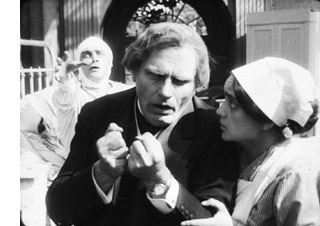 DB’s runner-ups: Perhaps not as fine as the above, but definitely of bizarre interest, are two Robert Reinert films from 1919. The title of Opium pretty much sums up this fevered movie. It includes sinister Asians, drug-addled doctors, a lions’ den, and Conrad Veidt in a suicide-haunted performance that makes his Cesare role in Caligari look underplayed (see right). Later in the same year Reinert gave us an even more overwrought tale, Nerven. This is a movie about collapse–the collapse of a community, of a business, and of the tormented minds of buttoned-up citizens. Reinert renders melodrama in images of controlled frenzy unlike any others I know from the period. Had his films been as widely seen as the official Expressionist classics, I think he would be much admired today. I analyze these two movies in Poetics of Cinema, and say a bit about them in this entry. A DVD of Nerven is available from the Munich Film Archive. DB’s runner-ups: Perhaps not as fine as the above, but definitely of bizarre interest, are two Robert Reinert films from 1919. The title of Opium pretty much sums up this fevered movie. It includes sinister Asians, drug-addled doctors, a lions’ den, and Conrad Veidt in a suicide-haunted performance that makes his Cesare role in Caligari look underplayed (see right). Later in the same year Reinert gave us an even more overwrought tale, Nerven. This is a movie about collapse–the collapse of a community, of a business, and of the tormented minds of buttoned-up citizens. Reinert renders melodrama in images of controlled frenzy unlike any others I know from the period. Had his films been as widely seen as the official Expressionist classics, I think he would be much admired today. I analyze these two movies in Poetics of Cinema, and say a bit about them in this entry. A DVD of Nerven is available from the Munich Film Archive.
KT’s runners-up: I suppose that there will be some tongue-clicking over the fact that Abel Gance’s J’accuse! is not present in our list. There’s no doubt it’s historically important and influential, but it’s also heavy-handed and doesn’t add the leavening of humor to its melodrama, as some of the above films do. But it does deserve a mention in an overview of 1919. (I’ve posted about what I see as Gance’s limitations here.)
Last year I put Marshall Neilan’s Mary Pickford vehicle, Stella Maris, in the top ten. I’d be tempted to do the same with his (and her) Daddy-Long-Legs, but this year there’s a lot more competition. But it’s a charming film, and the great cinematographer Charles Rosher provides another series of beautiful images using the new three-point lighting system. It was the first Pickford film into Germany after the war and considerably influenced Lubitsch and other German directors.
Similarly, in a year with fewer major films, Victor Fleming’s When the Clouds Roll By, a wacky, inventive tale of superstition and psychological manipulation starring Douglas Fairbanks, would make the main list. David illustrated some of that inventiveness in his epic entry on Fairbanks.
Within a few years, compiling our 90-year picks will become increasingly difficult. Experimental cinema will blossom, as will animation. The Soviet Montage and German Expressionist movements will get started, and French Impressionism, still a minor trend in the late teens, will expand. Filmmakers like Murnau, Lang, Vidor, and Borzage will gain a higher profile, and more films by veteran directors like Ford will survive. Maybe we’ll have to expand the annual list even further. . . .
A very happy New Year to all our readers! Assuming we make it through the security lines, we shall be celebrating New Year’s Eve on a plane bound for Paris, where David will be doing a lecture series over the first few weeks of January. Paris is the world capital of cinema, at least as far as the diversity of films on offer goes, so we shall no doubt find occasion to blog while there.
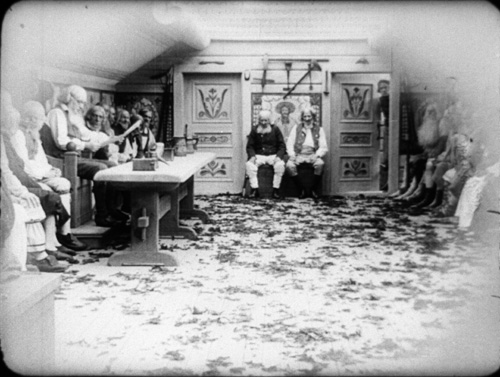
Sons of Ingmar.
Posted in Directors: Chaplin, Directors: Dreyer, Directors: Feuillade, Directors: Griffith, Directors: Lubitsch, Directors: Sjöström, Film comments, Film history, Film technique, Film technique: Editing, Hollywood: Artistic traditions, National cinemas: Denmark, National cinemas: France, National cinemas: Germany, Silent film, The Ten Best Films of... | open printable version
| No Comments »
Tuesday | December 22, 2009
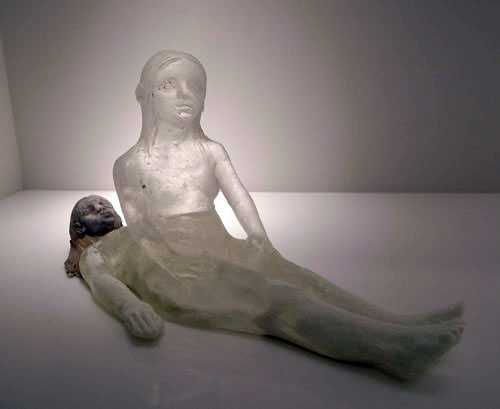
Christa Bothwell, While You Are Sleeping (2007).
Db here:
I must be obsessive. Whenever I get into a museum, I see movies hovering over the exhibits. You want proof? Go here or here or here. Kristin has dabbled in such speculation too, here.
The most recent example came last week. My sister Darlene is recovering from surgery, and as an excursion she, Kristin, and I visited the magnificent Corning Glass Museum in the southeastern tier of New York state. I hadn’t been there since the 1950s, when I was a kid. The museum was flooded in 1972, but after successive, ever more ambitious restorations, it is now a landmark. Its dignified modernist façade houses a sensory extravaganza.
Glass as an artistic medium is usually associated with either well-designed practical objects, like bottles and glassware, or sculpture, as in the Studio Glass movement founded by Harvey Littleton, who worked right here at the University of Wisconsin—Madison. Beyond that, what I know about glass you can put in—well, a shot glass. So I was pleased to learn how glass art connects to some issues that interest me about the visual arts generally and film in particular.
Take illusionism. We’re familiar with the ways that the paintings of Dalí and Magritte use the rules of perspective to create hallucinatory landscapes. And we know about classic trompe l’oeil pictures like this seventeenth-century painted letterboard by Cornelis Gijbrechts.
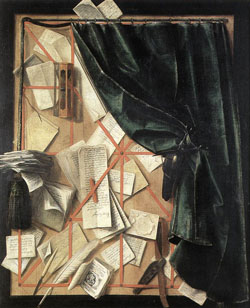
But I didn’t expect to find trompe l’oeil in glass.

This is Cup in Cup (1986) by Ann (Wärff) Wolff . The spectral little cup is inscribed in the surface. Like all good trompe l’oeil, this is best seen from a single standpoint.
Glass is literally all around us, as the stuff of our windows. In a 1976 image, Richard Posner (no, not the judge) creates a film-like scene by leaving crucial information out of frame. Another Look at My Beef with the Government, from the “Picture Window” series, shows him in traction while cattle, and the artist himself outside the window, look on.
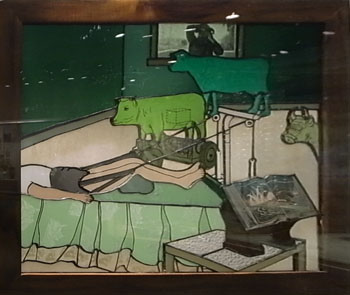
This is part of a series called “Picture Window.” The image pictures a window, and it gives us a window onto the scene, but the phrase also suggests that a window can itself be a picture. In this case, it’s Posner’s comment on serving as a conscientious objector during the Vietnam War.
There’s an ongoing debate about whether to consider glass a solid or a very viscous liquid, sort of the ultimate maple syrup. Its fluid qualities make it ideal for evoking movement. Swirls, waves, bursts, and sprouting capillaries are everywhere in the Corning collections. One of the best examples is Littleton’s now-classic Red/Amber Sliced Descending Form (1984).

The slickness of the surfaces lends a palpable wriggling to the snakelike forms of Dale Chihuly’s Cadmium Yellow-Orange Venetian #398 (1990).
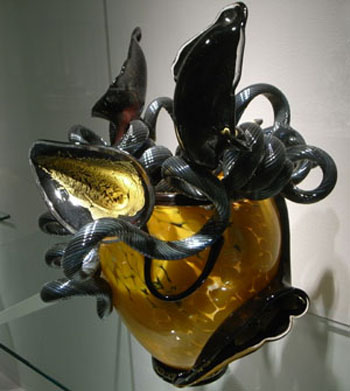
Glass makes these coils glisten.

Chihuly was another Madisonian; a more cheerful twisty work graces our campus’s Kohl Center.
Another sort of movement: Silvia Levinson’s It’s Raining Knives (1996-2004) shows stalactite-like daggers bearing down on a suburban landscape. The slender wires suggest danger hanging by a thread, but they also evoke speed lines, as if the knives are caught in mid-flight.
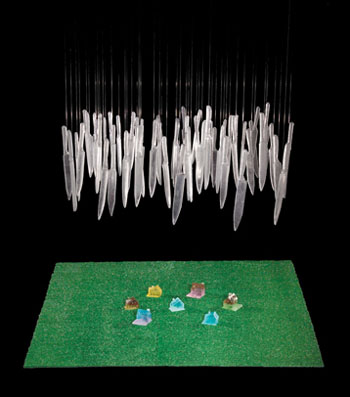
Levinson is Argentine, and the piece responds to the dictatorship that displaced Juan Perón—during which many of her family vanished or were imprisoned. You can read more about the background to the piece here.
Finally, probably the most filmlike thing I saw: An impression of interrupted movement is combined with an old-fashioned superimposition in Christina Bothwell’s While You Are Sleeping, which surmounts this entry.
After four hours of dazzlement, I was re-persuaded that Eisenstein was right: All the arts are connected, in devious ways, to film.
The Museum has listed many of the items on exhibit, including illustrations, in various pages and pdf files here. Most of the shots here were taken by me, but the Littleton and the Levinson images come from the Museum website.
Coming soon: Our list of the best films of 1919.
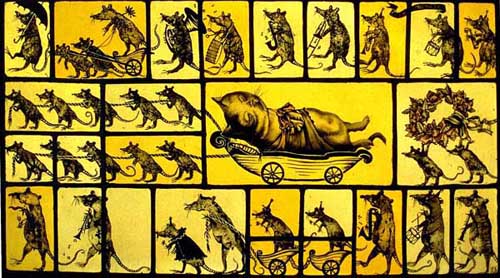
Judith Schaechter, Jazz Funeral for Didi (1994). Not in the Corning collection, but proto-cinematic in a Marey-and-Muybridge way. (And, I admit, reminiscent of Chris Ware.) See other lively Schaechter stained-glass work here and in her book Extra Virgin.
Posted in Film and other media, Film comments | open printable version
| No Comments »
Saturday | December 19, 2009
DB here:
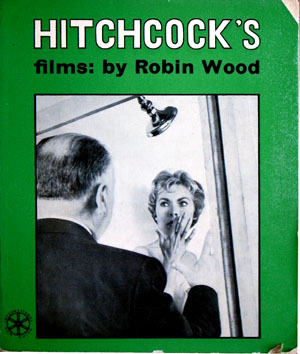
Robin Wood has just died. Kristin and I knew him a little; we recall a convivial dinner with Robin and Richard Lippe in New York during the 1970s. We knew him chiefly on the page, as a writer whom we valued enormously. I take this moment to acknowledge his death, to suggest his importance, and to praise his memory.
Today it’s hard to imagine the impact that Wood had on film criticism in the late 1960s and early 1970s. I first encountered his writing while I was in high school. I desperately wanted to know more about movies, but the nearest towns had no libraries. So I wrote to every film magazine I had heard of and said I was considering subscribing. Could they please send me a sample copy? The issues that came through included, most memorably, the Sarris “American Directors” issue of Film Culture and the Howard Hawks issue of Movie. Both changed me forever.
The Hawks issue contained Wood’s essay on Rio Bravo, a sort of draft for what would become one of his most important statements.
Hawks, like Shakespeare, is an artist earning his living in a popular, commercialized medium, producing work for the most diverse audiences in a wide variety of genres. Those who complain that he “compromises” by including “comic relief” and songs in Rio Bravo call to mind the eighteenth century critics who saw Shakespeare’s clowns as mere vulgar irrelevancies stuck in to please the “ignorant” masses. Had they been contemporaries of the first Elizabeth, they would doubtless have preferred Sir Philip Sydney (analogous evaluations are made quarterly in Sight and Sound). Hawks, like Shakespeare, uses his clowns and his songs for fundamentally serious purposes, integrating them in the thematic structure. His acceptance of the underlying conventions gives Rio Bravo, like Shakespeare’s plays, the timeless, universal quality of myth or fable.
Nearly every Wood virtue is already here. He takes it for granted that conventions are crucial to understanding and judging cinema. He refuses an evaluative split between high culture and popular culture. He insists that worthy films have serious thematic implications—in Rio Bravo, a link between self-respect and peer respect. He shows the film’s complexity through shrewd comparison (in the book on Hawks, High Noon will provide the telling contrast). And he gives the whole thing a polemical edge with the sideswipe at Sight and Sound, a target for many years to come.
But it was the books, in an apparently unending flow, that established Wood as a leading voice, and not only for me. I can’t convey the excitement that was ignited by Hitchcock’s Films (1965), Howard Hawks (1968), and Ingmar Bergman (1969), quickly followed by the monographs on Penn (1970) and Ray’s Apu Trilogy (1971). Nearly all books of film criticism were then simply collections of reviews. Wood’s stood as through-written, pondered over, carefully carpentered monographs, comparable to the best literary analysis. These studies showed, in incisive detail, what most auteur criticism simply proclaimed: great directors expressed their personal vision of life in and through cinema. Wood showed, scene by scene and sometimes shot by shot, that movies harbored layers of feeling and implication in their finest grain of detail. Without fanfare he introduced “close reading” to film criticism. Although never academic in the narrow sense, he took cinema as seriously as did critics of art or music or literature.
In fact, the word “serious,” a tonal center of the Rio Bravo essay, might be the keyword of his career. Partly that seriousness is intellectual. From the start Wood’s prose had a rectitude that was argumentative in the best sense. The Hitchcock book begins by imagining the best case one can make against the director; he then demolishes it piece by piece. The author does not try to woo us. He respects his reader enough to spell out his claims and to invite a skeptical reply. At last, we thought: An honest man.
The idea of seriousness took on a deeper import, one shaped by the indelible influence of F. R. Leavis. For Wood as for Leavis, great art inevitably grappled with the ultimate demands of living. Close analysis was nothing unless it revealed the author’s felt engagement with human values. This state of affairs imposed equally stringent obligations on the critic. Nothing could be farther from the snappy badinage and instant turnaround of Netwriting than Wood’s obstinate gravity. Flippancy and showing off had no place in serious criticism. Being a critic, analyzing and interpreting and judging, was a heavy responsibility, and every word had to be weighed. The very status of film as art, indeed the status of art itself, was at stake.
In a passage I cannot find on short notice, Wood once observed that a critic could not write “seriously” about Hou Hsiao-hsien’s Flowers of Shanghai after one viewing. Accordingly, not until he could study the film on DVD did he produce a characteristically penetrating essay. It’s a piece that anyone would be proud to sign, but Wood concludes:
I’m afraid the above analysis, in spelling things out, may have suggested that the film is more schematic than it actually is. Its “scheme” is in fact so subtly worked that it has taken me at least six complete viewings (together with more replays of individual scenes and moments than I can count) to disentangle it from all the detail of the realization. The above account is offered humbly, as a beginning.
This passion for nuance did not lead to a sort of scientific objectivity. The responsibility of criticism made writing inescapably personal. The critic responds to the work as a living being, as a “whole man alive”—a Leavis phrase that Wood was wont to quote. Personal Views, the title of Wood’s first collection of essays, signalled both the artistic visions expressed in the films he studied and the sincerity with which he advocated for or inveighed against a film, a trend, or a system of ideas.
I don’t know any critic whose intellectual and political horizons expanded as much as Wood’s did in the 1970s. Since criticism was for him a form of living, he took his readers along as he discovered structuralist theory (which he had once attacked), accepted some tenets of psychoanalytic theory, and launched ferocious attacks on patriarchy and capitalism. The same moral fervor that informed his 1960s writing became focused upon the political oppression of women, gays, the poor, and free thought. Now, he suggested, the apparent stability of “ordinary” life relied upon psychological and social repression. If one theme runs through his work—that of the precariousness of decent human relations in the face of disorder—it finds its late expression in his belief that conservative politics, in the name of maintaining order, is implacably bent upon destroying our kinship with others. In a sense, CineAction, the journal that he co-founded, was his latter-day Movie, a forum for his new commitment to criticism that promoted progressive social change.
The art he cared most about, I believe, laid bare the struggle between order and disorder. In his first book, he argues that Hitchcock shows comfortable “ordinary” people faced with a world coming to pieces. Across his career Wood ceaselessly questioned what exactly this normal order consists of. Coming out as a gay man, he devoted his finely meshed attention to reading films politically. Now those social forces that he once defined simply as threats to stability, such as the war in Bergman’s Shame, revealed themselves as products of warped political systems. The horror film presents disorder as a monstrous threat to bourgeois norms, yet it can become a powerful force in questioning those conceptions. For nearly four decades Wood recorded his efforts to grasp the concrete social implications behind the films he loved and those, increasingly from Hollywood, he found evasive and duplicitous. In all, complacent acceptance of the status quo was the enemy of the seriousness he prized. When he died he was at work on a study of Michael Haneke.
The seriousness of great artists, he came to believe, was inescapably political. Yet while this made him reevaluate Hawks and Hitchcock, it did not lead him to absolute repudiations. Always a believer in the validity of intuitive response, Wood would trust his sensibility more than the dictates of academic “frameworks” and theoretical systems. A 2004 set of notes on Ozu concludes:
These late Ozu films are detailed and highly intelligent critical studies in cultural change which ultimately defy the application of such terms as “progressive,” “regressive,” “conservative,” etc. . . . “Change” is not necessarily for the better (though our current culture is constantly telling us that of course it is) . . .—an obvious ploy of corporate capitalism, which depends upon the mystification for selling its products. If we gain new freedoms, we should also beware of casually casting off the past without asking ourselves what in it—what standards of seriousness, what beliefs, what aspects of our lives—might be worth preserving. I find all these thoughts in Ozu, incomparably expressed.
Through all the constant reappraisals of films, all the unsparing reconsiderations of his own judgments, one hears the same forthright, urgent voice. Leavis suggested that the good critic always asked, in effect, “This is so, isn’t it?” Wood’s writing consists of firm assertions accompanied by challenges to respond as an equal. The invitation is set out in an impassioned conversational cadence, complete with italics and appositional phrases. In search of clarity, Wood is prepared to argue and dissect forever; who else would produce not one but two books rethinking his defense of Hitchcock? Yet this brisk voice can also move us by its simplicity, as in the sentences concluding that little book on the Apu trilogy.
Suddenly the boy relaxes, and rushes forward into his father’s arms. The film ends with him seated on Apu’s shoulders as Apu walks away towards the future. In accepting the child, he has accepted life, has accepted the death of Aparna. Whether or not he is going back to become a great novelist is immaterial: he is going back to live.
Wood’s essay on Rio Bravo is in Movie no. 5 (undated, 1963?), 25-27. His “Flowers of Shanghai” appears in CineAction no. 56 (September 2001), 11-19. “Notes toward a Reading of Tokyo Twilight (Tokyo boshoku)” is in CineAction no. 63 (April 2004), 57-58.
For a wide-ranging and growing set of links to eulogies for Robin Wood, visit David Hudson at The Auteurs Daily and Catherine Grant at Film Studies for Free. A recent interview framed by enlightening commentary is Armen Svadjian’s 2006 tribute, “A Life in Film Criticism: Robin Wood at 75.” Wood’s 2008 list of the films he most valued is on the Criterion site here. D. K. Holm maintains an invaluable, continually updated bibliography of Wood’s writings here.
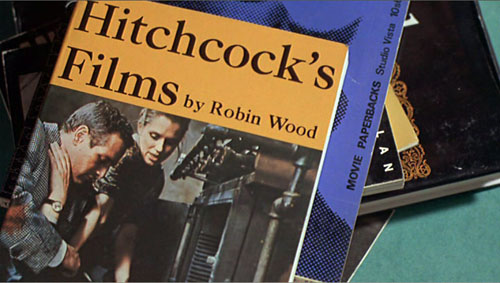
François Truffaut, Day for Night (1973).
Posted in Directors: Hawks, Directors: Hitchcock, Directors: Ozu Yasujiro, Directors: Ray, Satyajit, Film comments, Film criticism, Film theory | open printable version
| No Comments »
|


















