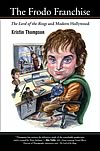
by Kristin Thompson. Berkeley: University of California
Press, 2007.
400 pages, 6 × 9 inches, 12 color illustrations;
36 b/w illustrations.
[go
to Amazon | go to The Frodo Franchise blog]
Every year I buy a used paperback of John le Carré’s The Honourable Schoolboy (1977) and take it to Hong Kong with me, to be left for someone else when I pack up to leave. One year I left a copy, then returned the following year to the same hotel. The desk clerk remembered my name and ran to the back room, where last year’s copy had been carefully retained.
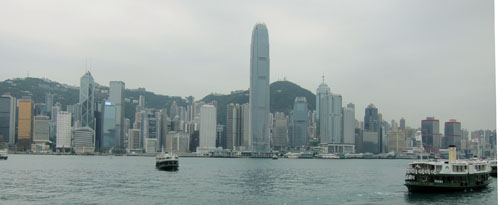
During my first trip in spring of 1995, I found The Honourable Schoolboy remaindered in a Silvercord bookshop that has long since vanished. Reading the novel while I encountered HK for the first time was an exhilarating experience because, of course, the story is set there. Le Carré aficionados know that it’s the second in the Quest for Karla trilogy launched by Tinker, Tailor, Soldier, Spy and completed by Smiley’s People. In this middle installment, we see how the mole who infiltrated the highest reaches of British intelligence wrecked the spy setup in the Crown Colony. A youngish agent, Jerry Westerby, is sent there to pursue the possibility that a member of Hong Kong’s business elite might be representing Soviet interests. Eventually, since this is Hong Kong, opium and the People’s Republic push their way into the picture.
The particular enjoyment I get from this novel during my visits owes a lot to its evocation of a city in the seventies that remains recognizable today.
Star Heights was the newest and tallest apartment block in the Midlevels, built on the round, and by night jammed like a huge lighted pencil into the soft darkness of the Peak. A winding causeway led to it, but the only pavement was a line of curbstone six inches wide between the causeway and the cliff. At Star Heights, pedestrians were in bad taste.
Yet the pleasures go far beyond acute observation of local detail. Everything that makes le Carré a splendid storyteller appears at full stretch in The Honourable Schoolboy.
The novel shows how intelligence missions, no matter how carefully planned, spin out of control because of human frailties, administrative rivalries, budget cuts, and political expediency. Sound familiar in the America of today? Like its mates in the Karla trilogy, the book begins on the periphery of the action, filling in secondary characters before building patiently towards a widely-ramifying plot. Le Carré manipulates point of view in a way that few novelists can manage, giving us a sense of circles of power made up of unnamed observers commenting on things they don’t understand. Here are the opening sentences of the first three paragraphs.
Afterward, in the dusty little corners where London’s secret servants drink together, there was argument about where the Dolphin case history should really begin. One crowd, led by a blimpish fellow in charge of microphone transcription, went so far as to claim that the fitting date was some sixty years ago. . . .
To less-flowery minds, the true genesis was Haydon’s unmasking by George Smiley and Smiley’s consequent appointment as caretaker chief of the betrayed service, which occurred in the late November of 1973.
One scholarly soul, a researcher of some sort—in the jargon, a “burrower”—even insisted, in his cups, upon January 26, 1841, as the natural date, when a certain Captain Elliott of the Royal Navy took a landing party to a fog-laden rock called Hong Kong at the mouth of the Pearl River and a few days later proclaimed it a British colony.
Our unidentified chronicler has the omniscience of an urbane insider. This is institutional memory as rumor, half-baked opinion, and shreds of fact, flavored with a touch of sarcasm. At the same time, this first page is a call to adventure. You can’t miss the rumble of kettledrums and thunder in the distance. This story will unfold in a spacious, even leisurely, manner, but will be no less suspenseful for that.
A page along we read:
The debate continues wherever old comrades meet, though the name of Jerry Westerby, understandably, is seldom mentioned. Occasionally, it is true, somebody does, out of foolhardiness or sentiment or plain forgetfulness, dredge it up, and there is atmosphere for a moment; but it passes. Only the other day. . . .
The worrisome chord is struck in a single word: understandably: At this point we understand no such thing, but five hundred pages later we will. Only then will this passage, reread, deliver its full charge of pathos.
Our chronicler’s tradecraft is impeccable. Most narratives consist of taking someone from one place to another and having him or her talk to somebody else. This poses several problems: (a) creating a vivid scene of character interchange; (b) using that interchange to summon up past events with clarity; and (c) pushing the story forward by having us understand what is gleaned from the conversation. Le Carré’s masterwork in this regard is probably Smiley’s People, which is almost Jamesian in suggesting that nearly all the important action is over, and what matters is how it has changed people’s lives. But The Honourable Schoolboy solves the problem no less deftly. Today’s spy novel would be unlikely to devote twenty pages to the questioning of the slightly gaga Reverend Hibbert, served tea by his scowling daughter. Yet it is a whole short story in itself.
Like other le Carré novels of the period, The Honourable Schoolboy displays an almost Dickensian relish in human variety. Every character is a little magnified, endowed not only with memorable tags, speeches, and bits of behavior but a pervasive attitude toward life that shifts our perspective on the main action. It’s as if the stolidity and self-containment of spymaster George Smiley calls forth extravagance in the portrayal of nearly all his staff. Connie Sachs, the bubbling, arthritic Soviet expert who carries her dog with her everywhere; de Salis, the Chinese specialist who tugs his hair and writhes as he reports; Fawn, Smiley’s devoted little bodyguard, who will grin while he breaks a man’s arms—the characters have something that most of today’s novelists, committed to the mundane, fail to give us: eccentric vitality.
The characters’ colliding attitudes emerge most starkly in a situation in which le Carré rules supreme. That is the administrative meeting. No writer I know is better at tracing the ripples of jealousy, showoffishness, toadying, and side-switching set loose when rather colorless men (it is always men) sit around a table and struggle for bureaucratic power. Le Carré is especially good on American arrogance.
One of the quiet men used the work name Murphy. Murphy was so fair he was nearly albino. Taking a folder from the rosewood table, Murphy began reading from it aloud with great respect in his voice. He held each page singly between his clean fingers.
Lest it be thought from these books, and from le Carré’s outrage against the Iraq war, that he is a reflexive anti-American, it should be said that he is no less severe with the Brits. One of his most scathing nonfiction pieces is his introduction to The Philby Conspiracy, where he denounces English snobbery and complacency for facilitating the real-life counterspying that formed the basis of his trilogy. Throughout his work, le Carré asks whether decency and kindness can survive the cynicism and compromises of a life built on deceit. Whether anyone, schoolboy or not, can retain honor in the Great Game is the central question of his Hong Kong novel.
Le Carré manages to show the bureaucrats’ tabletop swordplay as at once petty, springing from vanity and professional spite, and momentous. The world, or at least some big part of it, really is at stake. By the end of The Honourable Schoolboy, Westerby is at the end of his rope and he contemplates the betrayals and innocent deaths at which he has connived. Through his bitter disillusionment, we see an apocalypse.
As he gazed through the rear window of the car, it seemed to him that the very world that he was moving through had also been abandoned. The street markets were deserted, the pavements, even the doorways. Above them the Peak loomed fruitfully, its crocodile spine daubed by a ragged moon.
It’s the Colony’s last day, he decided: Peking has made its proverbial telephone call. “Get out, party over.” The last hotel was closing; he saw the empty Rolls-Royces lying like scrap around the harbour, and the last blue-rinse round-eye matron, laden with her tax-free furs and jewellery, tottering up the gangway of the last cruise ship; the last China-watcher frantically feeding his last miscalculations into the shredder; the looted shops, the empty city waiting like a carcass for the hordes. For a moment it was all one vanishing world; here, Phnom Penh, Saigon, London—a world on loan, with the creditors standing at the door and Jerry himself, in some unfathomable way, a part of the debt that was owed.
The end of empire has seldom been evoked so chillingly, and any day now the creditors whom Jerry imagines, moving toward hypermodernization, will be calling for payment.
The first and last novels in the trilogy became BBC adaptations, and they’re watchable, largely because of Alec Guinness as Smiley. They were shot in 16mm, largely on location, and the visual drabness fits the atmosphere of the books. (See the opening of Tinker, Tailorhere.) It was evidently beyond the BBC’s budget to film The Honourable Schoolboy in Hong Kong, Cambodia, and Thailand, or plausible facsimiles thereof.
There is a BBC radio version, but I still hope for a film adaptation some day. The story can stand independently of the trilogy, and with its multiple viewpoints, sympathetic protagonist, geopolitical themes, vivid settings, and side trips to Southeast Asian theatres of war, it could in respectful hands make for a strong feature.
In the meantime, we have the book. Granting my special fondness for its locale, I still think it one of the great novels—not great “genre” novels, but just great novels—of the century just past.
Once more, Hong Kong. Still a spellbinding place, although the municipality is doing whatever it can to force pedestrians underground and surrender the streets to cars. Even a dragon has to wait for the pedestrian light. And now, thanks to the sandstorms in China, the air is thick with pollution. I have taken defensive measures. My students probably wished I’d worn one of these more often.
Yes, that is the Boy Scout logo behind me. Why? Answer here.
I’ve already seen a few films at the Hong Kong International Film Festival, but I’ll try as usual to fold my viewings into a few thematically related entries. In the meantime, amateur reportage and celebrity gawking take over. I’m surface-skimming, I grant you, but it’s quite a surface.
For some years now, the festival has meshed with Filmart, the regional film market and trade show, and the Asian Film Awards. So you need badges.
For most of this week, the big events take place at the Hong Kong Convention Centre.
The opening reception for the festival offered all the glitter you can ask for, literally, when a cascade of sparkling paper showered down on the group photo of the organizers.
Among those present: Tang Wei, star of Lust, Caution and featured alongside Jacky Cheung in Ivy Ho’s festival-opener Crossing Hennessy.
Then there was Lisa Lu, radiant as ever. She was a wonderful star in Shaws’ golden age and continues to visit the festival annually, while sustaining her acting career.
Clara Law, director of one of the opening films, Like a Dream, embraces Lisa while Nansun Shi, herself a legendary and still central Hong Kong producer, looks on.
Filmart this year teemed with mainland Chinese media firms, but the classic Hong Kong companies also put in their appearance.
It’s reassuring to see that Wong Jing, the brains behind Naked Killer and Naked Weapon, hasn’t abandoned his old ways.
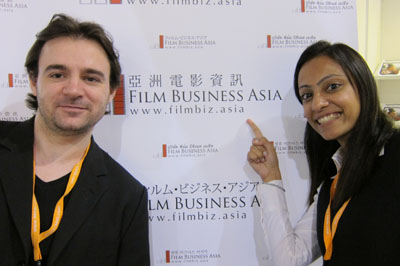
New regional enterprises are emerging. Patrick Frater and Steven Cremin, old Asian hands, have created FilmBusinessAsia as a resource of news, industry analysis, and in-depth information. Based in Hong Kong, they are ably teamed with Business Development Executive Gurjeet Chima, who speaks five languages.
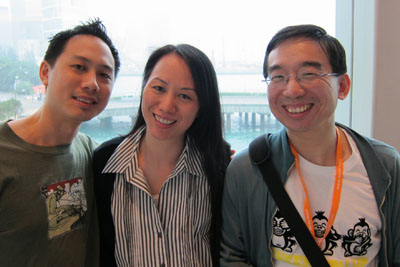
Two more entrepreneurs are Joey Leung and Linh La of Terracotta Distribution, a London-based outfit with an already impressive library. I met them through King Wei-chu, on the right, a programmer for Montreal’s FantAsia.
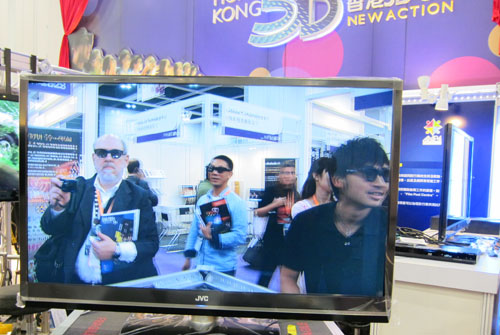
Three-dimensional film and TV were all over Filmart. Take a look at a 3D setup using the Red HD camera.
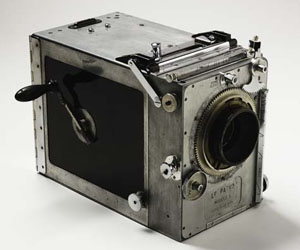
What a contraption! To shoot Potemkin, Napoleon, and a host of other 1920s films, you just needed a Debrie Parvo, that model of Style Moderne design.
Still, 3D television seems more or less ready for prime time. Can you tell the difference between reality and a 3D image?
Also at the Convention Centre was the Asian Film Awards ceremony, which whizzed by in two hours. On the red carpet runway you could see some celebrities, such as Wai Ying-hung, a Shaw Brothers ingenue and kung-fu warrior from the 1980s who would win for best supporting actress in Ho Yuhang‘s At the End of Daybreak.
Among the slinky models and standard-issue teen idols on the red carpet, a note of dignity was struck by Amitabh Bachchan, who got a lifetime achievement award. He might as well officially change his name to Megastar Amitabh Bachchan.
For a complete rundown on the award winners, you can go here. We wrote about three of them in earlier blog entries: Bong Joon-ho‘s Mother (best picture, best actress, best screenplay), Ho Yuhang‘s At the End of Daybreak (best newcomer, best supporting actress) and Chris Chong‘s Karaoke (best editing). Among the nominees, we also wrote about Love Exposure, About Elly (I really wish it had won something), Cow, Air Doll, and Breathless. I was particularly struck by the cheers and whoops the audience gave Wang Xueqi of Bodyguards and Assassins, which I caught up with today. He’s an actor of gravity, who unlike most Hong Kong performers believes that less (hamming) is more (engrossing).
With the big launching events over, we can get down to the real business: Watching movies and discovering some sublimity in them. More entries, as usual, to come.
This is a follow-up to David’s latest entry on the supposed death of film criticism.
As academics rather than reviewers, we’ve tried to take advantage of the benefits offered by the Internet. In our pre-blogging days, David used his website to post articles. They came out faster than they would if submitted to a print journal, and they would reach a larger audience, at least in the short run. When we added a blog to the site, it became, as David wrote, “our own magazine.”
For a while putting a lot of entries no place but on the blog seemed fine. Our stat-counter tells us that a lot of the older entries get read. Either a teacher assigns them or someone finds an old link or discovers the blog for the first time through a new entry and then clicks around on a lot of the older pages. So it’s not as though the pieces disappear a few weeks or so after they’re written. The blog has become a large resource by now.
But what about the really long run? I tend to want to see my prose in print. It’s unlikely that the blog will completely crash, but what if it did happen? And what becomes of all the material on the blog in the distant (I hope) future when we’re not around to keep an eye on it?
Ironically, the internet has proved to be a good way of extending the life of our print books. David’s Ozu and the Poetics of Cinema went out of print, and now it’s online, improved with better pictures, many in color. My Exporting Entertainment was in print for such a short time that few knew I had written it; now it has found a home on the website. Now Planet Hong Kong is out of print as well. David plans to update it and post the new version on the website as well.
Ironically, just as we were contemplating the migration of our books from print to pixels, Rodney Powell, of the University of Chicago Press, inquired as to whether we would be interested in turning a selection of our blog entries into a book. It wouldn’t be necessary to take down the original entries, he assured us. We couldn’t have done that anyway, since our textbook Film Art has just added a feature that alerts teachers and students to relevant essays via URLs in the margins. But we agreed to such a collection, and we’ve just sent in the manuscript for copy-editing. The result, called Minding Movies, should be out next spring.
There hasn’t exactly been a stampede to collect blog entries as books, but some presses, including Chicago, are trying out this new genre. Profile Books has just published classicist Mary Beard’s It’s a Don’s Life, based on her blog of the same name. (I highly recommend her book, The Fires of Vesuvius.) Economists Gary S. Becker and Richard A. Posner’s Uncommon Sense(also the University of Chicago Press) culls items from The Becker-Posner Blog.
Apart from blog-based books, the University of Chicago Press has some more traditional books of film criticism in press. One is a collection of Dave Kehr’s reviews from his days with the Chicago Reader (1974-1986). In September it will also publish a book gathering writings by Jonathan Rosenbaum (some of which have also been posted on his website) called Goodbye Cinema, Hello Cinephilia: Film Culture in Transition. Chicago has announced a third volume of Roger Ebert’s Great Movies for October of this year. Although some of these pieces have been posted on the authors’ websites after their initial print publication, Minding Movies is unusual in that its entire contents, like those of the Becker-Posner book, were written designedly for the Internet.
Will people want books of blog material that’s available for free online? From our standpoint it seems odd. True, some people just don’t like reading anything longer than a few paragraphs on a computer screen. But choosing the entries to put into the book made us realize how big the blog has become over three and a half years. It’s not easy to just browse through.
This entry marks post number 320 on Observations on Film Art. We were able to include 31 of that total in the book, which will be around 96,000 words. The inescapable conclusion is that we have posted ten volumes’ worth of stuff on the blog. Whew!
Not that we would want to put everything on Observations on Film Art into print. There are a lot of relatively topical items like festival coverage and reports on lectures and conferences and DVD supplements. My piece on the “I Drink Your Milkshake” phenomenon brought us our single busiest day ever (over 20,000 page loads), but it dealt with a fad and certainly doesn’t deserve to go between the covers of a book. Still, quite a few of the entries do reflect research and analysis of the sort that we would ordinarily put into our articles.
Even before it ever occurred to us that we could put together a blog collection, colleagues had said, “Your stuff deserves to be published as a book.” Maybe that’s a sign of the lingering sense that print publication is still more serious than blogging. Another implication seems to be that, while pieces written to be posted online may be excellent and worthy of publication in any format, they also need to be rescued from the vastness that is the Internet. Yes, Google can help people find David’s entry on staging in There Will Be Blood in a flash. But if the reader doesn’t have any particular film or other specific topic in mind and just wants to see our best pieces, it’s not that easy.
Incidentally, “Hands (and faces) across the Table,” the There Will Be Blood piece, won’t be in the book. It contains too many pictures, which becomes more of a concern in print. There will be a few of the heavily illustrated entries in the book, but we had to balance those with others that don’t depend on images.
Whether books based on film and other media-related blogs will become a lasting genre has yet to be seen. Perhaps after a period of adjustment to the Internet as a venue for film criticism, we will return to the practice of the 1960s and 1970s, when Andrew Sarris, Pauline Kael, and other critics routinely saw their material collected as books. We might end up concluding that the Internet has not harmed books in the way that it has some newspapers and magazines.
If blog-based books do catch on, they will provide further counter-evidence to the notion that film criticism is dying out. If they don’t, the failure won’t prove that film criticism is dead, only that now it probably flourishes best online.
[March 22: Coincidentally, TV historian and critic Jason Mittell posted a related entry on his blog today. It’s entitled “Why a Book?” and ponders the pros and cons of publishing a scholarly book or putting the same material online. The piece doesn’t deal with the idea of a book collecting blog entries, but it touches on factors like long-range availability.]
Before the Internets, did people fret as much about movie criticism as they do now? The dialogue has become as predictable as a minuet at Versailles.
Film criticism is dead.
No, it’s not! It’s alive and well on the Web.
Hah! Call that criticism? Nobody can be a movie critic unless they (a) write for print publication; (b) have been doing it for x years; (c) are a member of a critics’ professional society; and/ or (d) get paid for it.
Well, the track record of the official movie critics isn’t that great. Most of their writings are forgotten the minute they’re published.
Infinitely more awful is what you read on the Net. At least print critics kept up standards; there were gatekeepers (also called editors) and a literate public.
The result being….? When has a print critic of recent years equaled the greats of the past—Agee, Farber, Sarris, Kael?
Same thing goes for the Net. Blogs and websites don’t show me anything like that level of achievement. What I see is amateur hour.
Yeah? Well, bloggers and netwriters have passion!
But not a passion for using Spellcheck.
So if print criticism is so valuable, how come all those professional critics are getting fired?
Film criticism is dead.
Repeat as often as you like.
I thought I had watched this rondelay often enough from the wallflower section, but I got dragged onto the dance floor by Tom Doherty. In his piece for the Chronicle of Higher Education, Tom offered another eulogy for serious film criticism. Dead again, as Jim Emerson notes; killed by those wretched netizens.
To watch their backs and retain their 401(k)’s, most print critics have been forced into sleeping with the enemy. As a form of ancillary outreach, blogs, podcasts, and chat-room discussions have become a required part of the job description for print reviewers. Or maybe the print part of the gig is now the ancillary outreach.
Feeling the same heat, academic critics have also plunged into the brash new world. The film-studies panjandrum David Bordwell—think Knowles with chops in postmodern theory—runs one of the most closely watched blogs at David Bordwell’s Website on Cinema (http://davidbordwell.net/blog). The impact of the academic bloggers on Hollywood’s box-office gross is negligible (sorry, David), but the online work of the digital hordes is already making a substantial contribution to film scholarship—in the spirited parry and thrust of the dialogues, in the instant retrieval of past research, and in the factoid jackpots provided by the film databases.
I’m sure Tom means to be complimentary, but just to get mundane: No heat forced Kristin and me to the Web. I set up a bare-bones site in 2000, including a vitae and a statement about what studying film meant to me, because people were sometimes writing me asking for such information. Then, inspired by Philip Steadman’s stylish site extending the arguments in his book Vermeer’s Camera, I used mine to supplement my books, putting in corrections, second thoughts, and pictures. Then I began to write longish essays that build on things in the books.
When I retired in 2006, Kristin and I decided to recast the site as a supplement to our best-known book, Film Art: An Introduction. Our publisher McGraw-Hill funded an upgrade. But our efforts quickly went beyond spinning off the textbook. We treated Observations as our own magazine, with no pesky editors to tell us that a piece was too long or had too many stills. It offered a way to get our ideas out to a new audience, or maybe a bigger one. Just as important, after years spent writing books, I enjoy the recreation of writing shorter pieces. When you’re 62, sprints look better than marathons. Actually, because I’m a compulsive overwriter, some of my blog-sprints are like marathons.
Unhappily, none of this enhanced our 401(k)s.
Some other quibbles: Tom intended “panjandrum” as praise, but as many friends have pointed out, I’m probably the last person you’d associate with PoMo. I’m stuck in pre-post-modernism. Still, Tom is right on one point. My efforts to erode the box-office takings of Babel, The Departed, and The Dark Knightfailed utterly. On the other hand, I may have considerably boosted Cloverfield’s first-dollar gross.
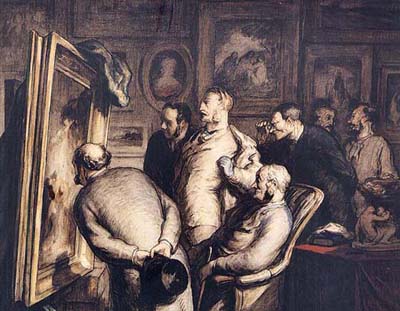
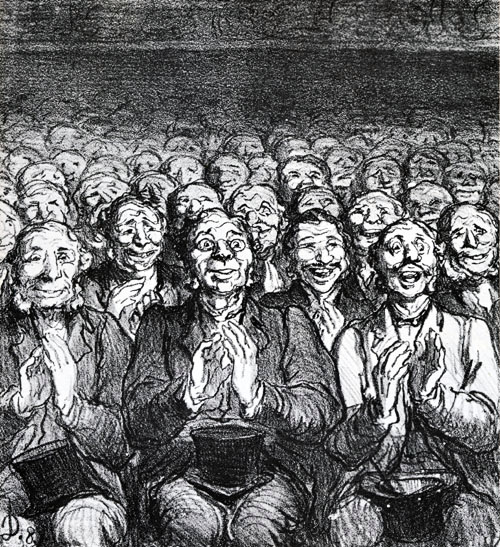
Nothing if not critical
Daumier, Les critiques (1862)
Tom’s piece, its place of publication, the comments on it, and his reply to those comments invite me to revive some points I made around this season in 2008 and 2009. (Is it a rite of spring?)
Film criticism takes many forms. Tom identifies criticism with being paid to review movies that have just come out. This is a form of arts journalism, and like all journalism it is being squeezed by the decline in advertising revenue. So yes, print-based paid reviewing is waning.
But criticism includes more activities than rapid-response reviewing. It includes what we might call haute journalism, as practiced in literary quarterlies, film magazines like Cineaste and Cinema Scope, and even occasionally in the New York Review of Books (which just got around to noticing Sokurov’s 2005 The Sun). There’s also reseach-based criticism, published in specialized venues like Cinema Journal and in semi-specialized journals like Film Quarterly (which seems to be moving toward haute journalism). And of course academics have written whole volumes of film criticism—through-composed books, not collections of published reviews.
Each of these modes of criticism has its own conventions. I try to characterize them here. I think Tom should have made some of these distinctions, because it doesn’t help film culture to encourage readers of the Chronicle to limit their conception of criticism to what they get in The New Yorker or Salon.
Insofar as we think of criticism as evaluation, we need to distinguish between taste (preferences, educated or not) and criteria for excellence. I may like a film a lot, but that doesn’t make it good. For arguments, go here again. Criteria are intersubjective standards that we can discuss; taste is what you feel in your bones. A critical piece that merits serious thinking tends to appeal to criteria that readers can recognize, and dispute if they choose.
Enough with the love, already.My only real quarrel with Gerry Peary’s film For the Love of Movies is that it seems to place “love of cinema” at the center of the critical activity. But everybody loves film. The real question is: What does this love lead to? Gossip? Infighting and insults? A desire to take chances and watch films you might hate? A desire to stretch and nuance one’s viewing? An urge to learn something subtle about cinema more generally?
Opinions need balancing with information and ideas. The best critics wear their knowledge lightly, but it’s there. To be able to compare films delicately, to trace their historical antecedents, to explain the creative craft of cinema to non-specialists: the critical essay is an ideal vehicle for such information. The critic is, in this respect, a teacher.
Which means that the critic traffics in ideas too. A critic of lasting value offers a vision of cinema, of the arts more generally, of society or politics or something beyond the individual movie. For Sarris, the key idea was directorial authorship. For Parker Tyler, it was the idea that popular culture spasmodically threw up surrealistic material. For Farber it was the prospect that the studio system nurtured films, or moments, that hinted at speed, harshness, and darkness. Sontag clung to the hope that cinema could carry on the program of post-World-War-II modernism. For Ebert, what seems central is the belief that cinema can yield humane wisdom that forms a guide for living. Beyond our shores there were Arnheim, Bazin, Eisenstein (yes, he wrote film criticism), the Cahiers and Positif crews, and many more. Their powerful and provocative ideas yielded new ways to think about any movie.
Last year I moderated an Ebertfest panel consisting of a dozen or so critics. A student from the audience said he wanted to be a critic too. Instead of advising him to get into a more financially rewarding form of endeavor, like selling consumer electronics off the back of a truck, the panelists encouraged him. This form of altruism, in which you help people to become your competitor, is alarmingly common in the arts.
A moderator doesn’t get to talk much, so I couldn’t respond. What I wanted to say was: Forget about becoming a film critic. Become an intellectual, a person to whom ideas matter. Read in history, science, politics, and the arts generally. Develop your own ideas, and see what sparks they strike in relation to films.
Writing style is overrated. Many people think that good reviewing amounts to personal opinions whipped up in frothy prose. Perhaps the snazzy styles of Farber and Kael have led people to weight style too much. Granted, the Web has revealed that a lot of people are excellent writers, and without the Web they would probably never have found an audience. Although lively writing is always welcome, it gets heft and endurance through its arguments, and that comes back to ideas and information as much as opinion.
Hollywood, still declining
As often happens, a current controversy sends me backward, and to books. Ezra Goodman’s Fifty-Year Decline and Fall of Hollywood was published in the momentous year 1960, as was Beth Day’s This Was Hollywood. Both wrote finis to the glory days of American studio cinema. But if Day was nostalgic, Goodman was sour, and racy.
He worked as reporter, publicist, and reviewer, most notably for Time. By 1960, he must have felt he never needed an LA job again, so he castigates every specimen of Hollywoodite, from press agents to stars. Buddy Adler, who for a while ran production at Twentieth Century-Fox was no more than “a dutiful office boy.” Humphrey Bogart had “as a result of four marriages, innumerable bouts with the bottle, and a paucity of food and sleep developed what was described as a look of intelligent depravity. . . .”
Goodman includes a long chapter on film reviewers, which launches with a decidedly contemporary ring:
It has been said that there are sometimes more clichés in movie reviews than in the movies they are discussing. Sample review phrases: “sure-fire,” “stunning,” “taut with suspense,” “lavish and exciting,” “sumptuous,” “captures the imagination,” “moving,” “significant drama,” “sheer screen artistry,” “uncommonly good performance,” “dramatic urgency,” “enormous compulsion,” “spectacular finish,” and once in a while, “ineptly directed,” “singularly dull.”
Fifty years later, Goodman would have to add jaw-dropping, adrenalin-charged, mind-bending, hellish/ hellacious, resonance/ resonate, lush, dark, incredible, intensely personal, pitch-perfect, and our two all-purpose adjectives of praise, amazing and terrific. You’d think that we were staggering around astounded all the time.
Yet reading Fifty-Year Decline and Fall confirms my hunch that we have made progress. I would say that the best film writing in all registers–daily/ weekly reviewing, haute journalism, “think pieces,” personal essays, research studies, whether on the web or off– is much better today than it was in Goodman’s era. Then the New York Times had Bosley Crowther; now it has Dargis and Scott. Richard Schickel has hurt his reputation with some insulting remarks he made recently, but read his book on Fairbanks, His Picture in the Papers, or his scathing The Disney Version, and you’ll find a keen eye and a nonconformist intelligence. Riding above the oceanic fizz of infotainment, there are many sharp writers both journalistic and academic. Start clicking our link-list for examples.
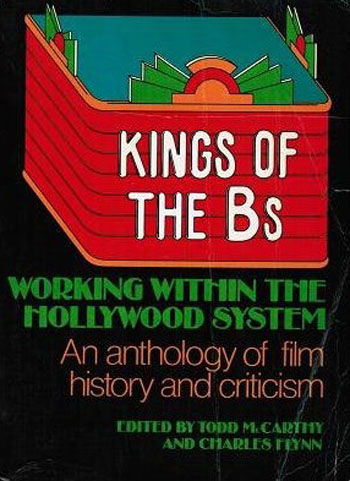
Which makes it all the more lamentable that two of our finest writers have lost their platform. Todd McCarthy’s work for Variety long exemplified the virtues I’ve itemized. He writes a brisk prose that isn’t showoffish. His reviews, often in a few deft words, situate the film historically; he’s one of those guys who has simply seen and read everything. He has as well a guiding idea of cinema—roughly, I think, the premise that straightforward classical storytelling is an inexhaustible resource—but he doesn’t deploy it as a bludgeon. McCarthy’s respect for studio history and the tradition of expressive narrative can be found in his and Charles Flynn’s indispensible collection Kings of the Bs (where you can see what a Republic budget sheet looked like) and in his biography of Howard Hawks. There are also his documentaries on filmmaking (e.g., Visions of Light) and film culture (Man of Cinema: Pierre Rissient), which allow him the leisure to probe subjects in depth.
Or consider Derek Elley. He is one of the most knowledgeable writers on Asian cinema, and his reviews skillfully tie a new film to a trend or earlier work by the same director. Few critics have his ability to supply a translation of a Chinese film’s original title, or to explain a crucial local custom. By dismissing McCarthy and Elley as contract writers, Variety has dealt a blow to informative, thoughtful film writing, whether you call it criticism or not.







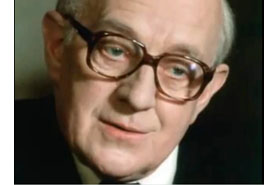 The first and last novels in the trilogy became BBC adaptations, and they’re watchable, largely because of Alec Guinness as Smiley. They were shot in 16mm, largely on location, and the visual drabness fits the atmosphere of the books. (See the opening of Tinker, Tailor here.) It was evidently beyond the BBC’s budget to film The Honourable Schoolboy in Hong Kong, Cambodia, and Thailand, or plausible facsimiles thereof.