Kristin here:
A few days ago I was reading the February 24 issue of Entertainment Weekly. I started subscribing to EW during the days when I was working on The Frodo Franchise. Being a Time Warner publication, it tended to feature The Lord of the Rings a lot (Time Warner also owns New Line Cinema). I was trying to keep track of the popular-press coverage of the film, and EW was a helpful source. It also used to be a bit more substantive in those days. In recent years it has become more fluffy. Still, it’s handy for reading over lunch or when brushing one’s teeth.
Turning to page 66, I found Chris Nashawaty’s “The Most Overrated Best Picture Winners.” The double-page spread was slathered with photos of My Fair Lady, Out of Africa, Gandhi, The King’s Speech, and Shakespeare in Love. (The piece is online, but as a gallery rather than an article, lacking the introduction.)
I like putdowns of overrated and/or over-rewarded films as much as anyone, so I settled in to read. I was shocked, however, to find that the first film on the list was How Green Was My Valley.
I happen to think the How Green is one of the very greatest American films. Probably no Best Picture winner in the history of the Oscars has been a more fitting recipient of that award. Why lump it in with Shakespeare in Love?! (I think you know what’s coming.)
Nashawaty gives his reasons. He admits that How Green has three pluses going for it: “It’s got beautiful cinematography, John Ford as a director, and a three-hankie plot about a Welsh mining village.” He goes on: “The minuses: mismatched accents and the still-outrageous fact that it beat Citizen Kane.”
Mismatched accents as a reason not to win Best Picture? The notion belittles the brilliant ensemble acting in Ford’s film, with Donald Crisp, Sarah Allgood, Barry Fitzgerald, Maureen O’Hara, Walter Pigeon, and many others giving fabulous performances, career bests in some cases. It is a joy to watch them interact. Of course most of these people sound more Irish than Welsh, but frankly, who cares?
By the way, I’m assuming Nashawaty means the mismatch of Irish accents to a Welsh setting, not a miscellany of accents among the cast, which is common in Hollywood films. Besides, isn’t accuracy of accents—think Meryl Streep—one of the criteria used to judge the very Oscar-winners that Nashawaty is decrying? I’ve never seen Gandhi, but I’ll bet Ben Kingsley did a heck of an authentic accent. Accents are one of the easiest aspects of performances to notice, so it’s not surprising that they are so often a factor in Oscar-nominated and -winning roles.
But it’s not really the accents that bother people about How Green. No, it’s really the “beat Citizen Kane” part that grates on film fans. Quite possibly it has led them to dismiss or undervalue one of Ford’s greatest films.
I’m going to be heretical and say that How Green deserved to win over Kane.
For years Kane has been sitting atop many lists of the greatest films of all times, including polls of professional film critics. The notion that Kane really is the greatest film of all time has become so engrained that people seem seldom to question it. Back when that idea arose, critics were unaware of the films of Yasujiro Ozu, probably the world’s greatest film director to date. Play Time was for years ignored and only recently has begun to be recognized for the masterpiece it is. With the rise of film restoration in the 1970s and the spread of film festivals and retrospectives, we now know vastly more about world cinema than we did before. Yet Kane has settled into its top slot for many people, including entertainment journalists. I can think of many films I would rank above Kane.
No doubt it’s a great film, with a marvelously tricky plot, another great ensemble of actors, splendidly distinctive cinematography, and innovative special effects masquerading as cinematography. It was hugely influential at the time and remains so to this day. Of course, Welles has declared time and again that he learned filmmaking by watching Stagecoach over and over, so Kane would probably not be as good as it is without Ford’s influence. Not that such influence proves that How Green is better than Kane, but it shows Welles’s respect for Ford. More on that below.
Middlebrow and proud of it
I think another reason why How Green tends to be dismissed as merely the film that cheated Kane out of its best-picture Oscar is that it is resolutely middlebrow. Indeed, in that way it fits in with all the other films Nashawaty writes about. They’re all resolutely middlebrow, too. Middlebrow films are for those people who look down upon popular genres and want to feel they’re seeing something worthwhile.
Despite this attitude, most of the great American films fit into popular genres: Keaton’s The General (or substitute your favorite Keaton film), Kelly and Donen’s Singin’ in the Rain, and Hitchcock’s Rear Window (or, if you will, Shadow of a Doubt or Notorious or Psycho). This is one thing that the auteur theory, somewhat indirectly, taught us. Howard Hawks’s modern reputation rests partly on his ability to waltz into any American genre and make one of its best entries. The Godfather is technically a gangster film, but one could argue that by taking it from a bestseller and making it into a glossy A picture, Coppola pushed his film into the middlebrow range far enough for the Academy to dub it Best Picture—twice. The one Best-Picture winner of recent decades that arguably did thoroughly deserve the prize was a serial-killer thriller, The Silence of the Lambs. I think a lot of people were surprised that the strait-laced Academy members could accept such subject matter in a nominee, let alone a winner.
Like Hawks, Ford moved easily among genres and excelled at least once in every one he touched. He made arguably the greatest war film ever, the underrated They Were Expendable, and the greatest Western, The Man Who Shot Liberty Valance (or Stagecoach or My Darling Clementine). He also pulled the turgid middlebrow genre of the 1930s biopic into greatness with Young Mister Lincoln. There’s no doubt that Ford was an uneven director, and arguably his worst films arose from his attempts to go for middlebrow respectability. The Fugitive is almost unwatchable in its pretentiousness, and the mid-1930s brought forth such items as Mary of Scotland and The Informer. But starting in 1939, he produced an almost unbroken string of masterpieces and near masterpieces, culminating in They Were Expendable and My Darling Clementine.
We should recall also that Welles himself adapted a middlebrow bestseller for the film he made directly after Kane: The Magnificent Ambersons. Had the studio not meddled so extensively with it, it probably would have been one of the American cinema’s great middlebrow classics, fit to sit alongside How Green.
Earned sentimentality
Welles himself probably would have felt honored by that comparison. In a 1967 interview he described his taste in films:
Old masters—by which I mean John Ford, John Ford, and John Ford. With Ford at his best, you feel that the movie has lived and breathed in a real world—even though it may have been written by Mother Machree.
In other words, Welles recognized that sentiment did not take away from the brilliance of Ford’s best work, and How Green is definitely in that category. Welles was too big an egotist not to have been annoyed at losing the Best Picture award to Ford, but he probably understood why How Green won better than most people do today. Today, apart from groups of women who go to see heartwarming female-oriented fare, audiences tend to shy away from sentimentality.
To his credit, Nashawaty lists sentimentality as a plus for How Green. (“Three-hankie plot” has a dismissive ring to it, but I’ll chalk that up to the requirements of infotainment journalese.) But I’m sure that many people who underrate How Green do so because it’s essentially a family melodrama where everything starts out in an Edenic state and the situation slowly goes downhill to a distinctly unhappy ending for all concerned. A lot of people simply dismiss sentimentality in all its manifestations, presumably as too naive, hitting us below the belt for an easy emotional appeal. In this day and age, it is much easier to admire cynicism than unembarrassed emotion. Despite its subject matter of environmental depredation by greedy companies, How Green is resolutely focused on the joys and sorrows of the family. Kane is cynical in a very modern way. Yet I cannot believe that we care nearly as much about the characters in Kane, even Susan, as we do in How Green.
Sentimentality is not a bad thing in itself. Sure, it’s an easy thing to evoke. Easy sentimentality is banal and cloying because there’s so little underpinning it except conventional romance and cute babies and long-suffering mothers and the like. Then there is what I call earned sentimentality. (A similar distinction is often made between sentiment and sentimentality.) Films with this quality are rich with original characters and situations that might make even a viewer who dismisses easy sentimentality pull out a hankie. The sentimentality in Chaplin’s films sometimes achieves this, and his Little Tramp character has been widely praised over the decades for his mastery of this emotion. Even those who dismiss sentimentality can forgive Chaplin, since humor usually undercuts the cloying quality just a bit. In a less obvious way, Harold Lloyd sometimes proves himself a master of sentimentality, as in The Kid Brother. And earned sentiment is not dead. It pervades Big Fish, another film that has been underrated or at least largely forgotten, perhaps in part due to its sentimentality. It has eccentrics galore and an original plot idea, but it doesn’t have that edgy, weird quality that sophisticated viewers treasure in Tim Burton’s work. There’s even sentimentality in the Wallace & Gromit films, though again humor makes the emotion palatable. Art cinema has its own sentimental masterpieces: Bicycle Thieves, Jules et Jim, Tokyo Story, Sansho the Bailiff, Distant Voices, Still Lives, and the list could go on and on. True, all these films are grimmer in part or in whole than the average Hollywood film, but so is How Green.
By the way, Welles himself delivers one of the sublime sentimental passages of world literature in the heartbreakingly nostalgic “chimes at midnight” speech in Falstaff, which has other passages of the same emotion. The Magnificent Ambersons is a sentimental film of a different sort.
For my money, How Green earns its sentimentality as well as any film ever made.
On everyone’s syllabus
You may be asking at this point, if How Green is so fantastic, why didn’t Bordwell and Thompson use it as their central example of a narrative film in Film Art? Why is Kane in that spot? There’s a simple answer to that: Kane is a very teachable film, and How Green, to say the least, is not. Our challenge was to find a film that most teachers used, or would happily start to use, and that demonstrated many concepts about film narrative and style that we wanted to describe.
Some films are just more teachable than others. They use a lot of different techniques, both stylistic and formal, in a way that students can notice. Hitchcock is probably the most teachable director overall, and I would bet that his films show up on introductory-film-class syllabi more often than any other director’s. It’s just that with Hitchcock, there’s no one film that’s self-evidently more useful for teachers than others. I sometimes think that one could almost write an entire introductory textbook using nothing but examples from Lang’s M. There are other classics like that. But Kane beats them all: a complex but clear flashback structure, obvious and varied technique, a complex soundtrack born of Welles’s radio experience, and examples of many things teachers want their students to learn about. It’s a classical Hollywood film, but it has touches of art-cinema ambiguity about it. It’s entertaining, at least to motivated students, so they’re likely to pay attention rather than dismissing it. They may come into the class knowing that it’s a revered classic and hence be interested in seeing it. It may even reconcile them to watching black-and-white films.
How Green, however, is difficult to teach. David has found this to be true. Our colleague Lea Jacobs occasionally offers a seminar on Ford, and How Green is among the most challenging films by a director whom students tend to be slow to warm up to. She attributes this partly to changing tastes and partly to the subtlety of the style of its cinematography. It’s very hard to make students, and indeed almost anyone who isn’t already a believer, see why How Green is a masterpiece.
Kane is not only teachable, but it’s highly conducive to analysis, and no doubt these two traits are closely related. David’s first widely seen article was a study of Kane, and I wrote the sections of chapters in Film Art dealing with it. I don’t mean that it’s simple; Kane is a complex film that has provided material for many different essays and books. But How Green has so many ineffable qualities that it resists cold, precise analysis. It has been one of my favorite films for over three decades, and occasionally I have contemplated writing something in-depth about it. I can’t, however, think what one could possibly write. One would just have to throw up one’s hands and say, “You either get it or you don’t.”
It reminds me of when I was nearing the end of my undergraduate career. I didn’t “get” Godard. I found his work pretentious and boring. But given how many people whose opinions I respected admired Godard, I persisted. I think I suffered through seven features, and at about number eight (Weekend), I got Godard. Maybe Ford, at least for his non-Western films, is somewhat the same sort of challenge. I’ve written analyses of two of Godard’s more difficult films, Tout va bien and Sauve qui peut (la vie). I’m still scared to try to deal with How Green.
(Stagecoach is much easier. For several editions of Film Art we included an analysis of it, which I wrote. Eventually it got replaced, but it’s still available here.)
A few hints
Since I doubt I will ever thoroughly analyze How Green, here I’ll offer just a few hints as to why it deserved to take home Best Picture and leave Kane an also-ran.
Nashawaty mentions the beautiful cinematography. Arthur C. Miller was 20th Century-Fox’s A-list cinematographer, having shot some of the Shirley Temple films in the 1930s, films that kept the studio afloat during the Depression. He teamed with Ford only on Tobacco Road and How Green, though he apparently helped with Young Mr. Lincoln uncredited. Miller won his first Oscar for How Green, his second for Henry King’s The Song of Bernadette (the main virtue of which is it looks a lot like How Green), and his third for Anna and the King of Siam. Few of Miller’s non-Ford films like The Ox-Bow Incident and Gentlemen’s Agreement are watched much today. He did lens somewhat minor films by major directors (Hitchcock’s Lifeboat, Preminger’s Whirlpool), but he is less famous than he deserves.
Just a few examples. How Green contains some of the same techniques that are so admired in Kane, but in a less flamboyant fashion. Deep focus, for example:
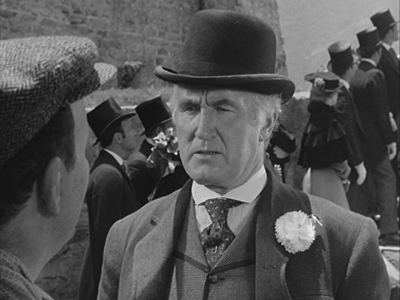
Admittedly, the people at the right rear are slightly out of focus, but the shot was done in-camera. No special effects.
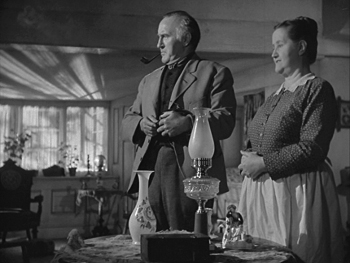
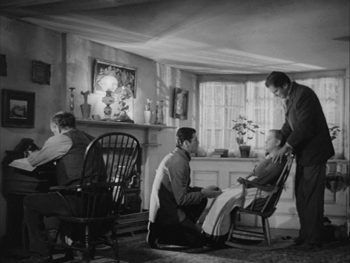
The interiors of How Green have a distinctive touch: patches of light on the ceilings. Implausible, when you start to think about where the light must be coming from, but beautiful nonetheless. Miller (or at least Fox) almost had a patent on this way of lighting a room. With Kane getting so much credit for adding ceilings to sets, we should remember that Ford has done so in Stagecoach and does it here as well. It’s not as in-your-face as Kane’s ceilings, but it’s an example of the subtlety that pervades How Green. The first shot (below) is part of the series of scenes at the beginning setting up the happy home life of the large and relatively prosperous Morgan family; the father is about to dole out allowances to his sons on payday. The second comes much later, as the last two grown sons prepare to depart abroad in search of work after the mine has declined.
Kane is admired for both its long takes and its dynamic editing. Ford seldom used either. He held a shot long enough to be effective but not long enough to turn into showing-off. Take the scene after Angharad’s marriage to the wealthy mine-owner’s son. Mr. Gruffydd, the minister whom she actually loves, has performed the ceremony. As has been pointed out many times, Ford filmed the final shot without doing any close views to be cut in later. (Indeed, most of How Green was edited in the camera by Ford, so that most of the footage he shot ended up on the final version. It was his way of keeping control over his film.) By happy accident, a breeze caught Angharad’s veil, sending it soaring and twisting through the shot. Perhaps it was a reflex gesture on the part of the actor playing the mine-owner’s son, but he reaches out and holds the veil down as his bride climbs into the coach; it perfectly captures his cold, proper nature. For a split second before the coach pulls away out right, Angharad glances back toward the church, where Gruffydd remains inside. Once the coach is gone, Ford holds, and Gruffydd appears on the hillside at the rear, watching and then turning to go inside. No cut-in mars the perfection of the shot.
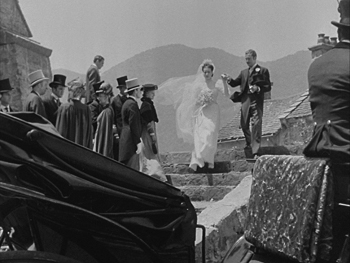
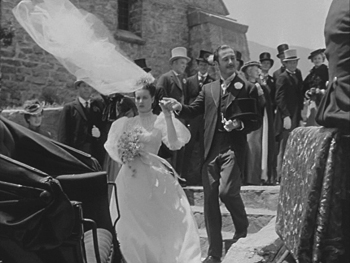
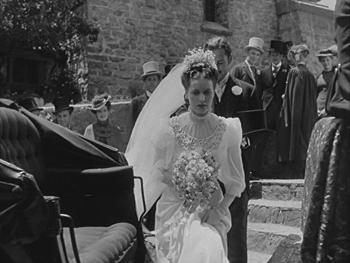
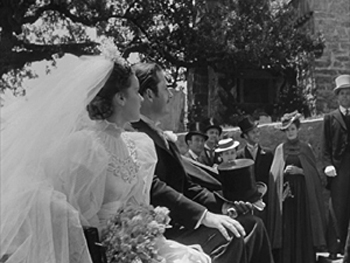
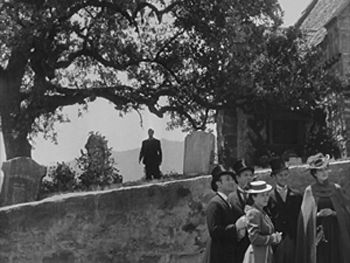
There’s one of the hankie moments. I get tears in my eyes during this scene, partly out of sympathy of the sundered couple and partly from aesthetic pleasure. If ever there was a single shot that exemplifies Ford’s combination of sentiment and discretion, this is it.
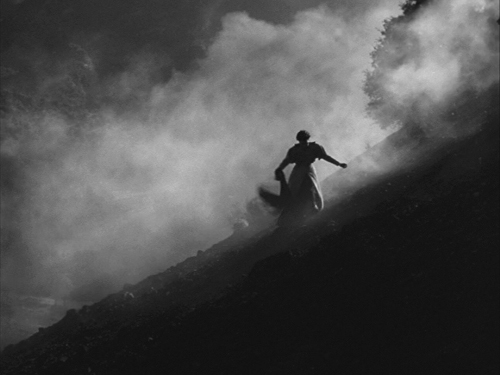
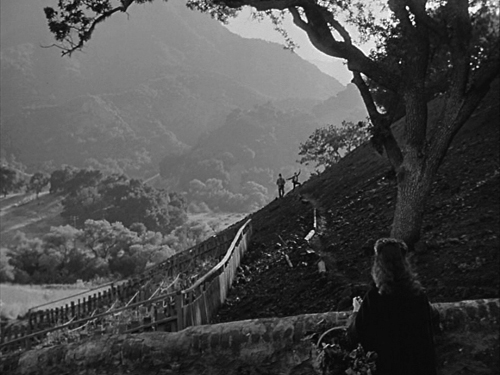
The last of these five frames belongs to the visual motif that appears in the opening sequence, as Angharad waves to her father and Huw on the beautiful distant hillside (see above), as well as in the final scene, where Angharad struggles in her fine clothes across a similar hillside, swathed in smoke, to reach the mine after the disaster that traps her father (see below). Such moments create a quiet measure of the gradual degradation of the valley and the dwindling of the family’s happiness.
Did Ford realize how brilliant this shot was? We can be confident that Welles was well aware of how daring and wonderful his techniques in Kane were. It shows in the film. With Ford, one can only suspect that he knew exactly what he had accomplished here and elsewhere.
Another thing How Green shares with Kane is a flashback structure. It largely consists of one big flashback told by the protagonist, not a series of embedded stories by witnesses. Nevertheless it’s unusual, since we never come out of the flashback. The tale opens with the valley in severe decline, the village nearly deserted, and the hero about to depart for a better life. We witness the decline of his family as he grows, gets educated, and opts to follow his father and brothers into a job in the mine. By the end his elder brothers have scattered all over the world, his father is dead, and we don’t know what has become of his mother and sister. (One plausible assumption is that his mother has recently died, prompting his departure in the opening scene.) Yet the ending gives us a series of shots of the family as they had been in their prime, with the protagonist-narrator declaring, “Men like my father can never die.” Like Kane, it is a film about the power of memory, but in this case the power to comfort rather than to baffle.
One thing that makes How Green stand apart from some of Ford’s other films is that it for once controls the director’s penchant for mixing in broad humor. His stable of supporting actors playing minor characters who love to drink and fight can be trying. There is a particularly ill-advised moment in The Searchers when, after the epiphanic moment when Ethan has lifted Debbie as if to kill her and then embraced her, Ford cuts to the Ward Bond character having a wound on his posterior dressed, to the derision of his comrades. That Ford should undercut such a scene with a vulgar moment of comedy combines with another flaw or two in the film keep if off my list of Ford’s very best films. And much though I love the first three-quarters of The Quiet Man, that climactic brawl just goes on and on.
In How Green, the characters Dai Bando and Cyfartha provide humor, but they are held in check. They play reasonably significant roles in the action, helping Huw deal with the school bullies and his sadistic teacher. Many of the family scenes involve amusing moments as well, moments that arise naturally from the situations and have no air of mere comic relief. In screenwriter Philip Dunne’s introduction to the published version of his screenplay, he finds fault with several scenes and actors. Maybe he’s right that the scene when the mine owner visits the Morgan family is played for broad comedy, but it’s not as broad as elsewhere in Ford’s work. Luckily Ford’s brother Francis does not return for yet another of his bit parts as a drunk.
In 1972, when Ford was dying of cancer, the Directors Guild held an evening gathering to honor him. He was asked to choose one of his films to be projected, and he named How Green. He had consistently said he considered it his finest film.
There’s no budging Kane
I doubt that the notion of Citizen Kane as the Greatest Film of All Time will go away anytime soon. Changing (and unchanging) tastes are reflected in the decadal Sight & Sound poll of critics concerning the ten greatest films of all times. They started in 1952 and have continued to 2002, with another due this year. The lists reflect the fact that apparently critics can somewhat agree on the greatest older classic, though fashions in these come and go, but they cannot agree on much of anything that has been made since 1970:
1952
- 1. Bicycle Thieves (De Sica)
- 2. City Lights (Chaplin)
- 2. The Gold Rush (Chaplin)
- 4. Battleship Potemkin (Eisenstein)
- 5. Intolerance (Griffith)
- 5. Louisiana Story (Flaherty)
- 7. Greed (von Stroheim)
- 7. Le Jour se lève (Carné)
- 7. The Passion of Joan of Arc (Dreyer)
- 10. Brief Encounter (Lean)
- 10. La Règle du jeu (Renoir)
1962
- 1. Citizen Kane (Welles)
- 2. L’avventura (Antonioni)
- 3. La Règle du jeu (Renoir)
- 4. Greed (von Stroheim)
- 4. Ugetsu Monogatari (Mizoguchi)
- 6. Battleship Potemkin (Eisenstein)
- 7. Bicycle Thieves (De Sica)
- 7. Ivan the Terrible (Eisenstein)
- 9. La terra trema (Visconti)
- 10. L’Atalante (Vigo)
1972
- 1. Citizen Kane (Welles)
- 2. La Règle du jeu (Renoir)
- 3. Battleship Potemkin (Eisenstein)
- 4. 8½ (Fellini)
- 5. L’avventura (Antonioni)
- 5. Persona (Bergman)
- 7. The Passion of Joan of Arc (Dreyer)
- 8. The General (Keaton)
- 8. The Magnificent Ambersons (Welles)
- 10. Ugetsu Monogatari (Mizoguchi)
- 10. Wild Strawberries (Bergman)
1982
- 1. Citizen Kane (Welles)
- 2. La Règle du jeu (Renoir)
- 3. Seven Samurai (Kurosawa)
- 3. Singin’ in the Rain (Kelly, Donen)
- 5. 8½ (Fellini)
- 6. Battleship Potemkin (Eisenstein)
- 7. L’avventura (Antonioni)
- 7. The Magnificent Ambersons (Welles)
- 7. Vertigo (Hitchcock)
- 10. The General (Keaton)
- 10. The Searchers (Ford)
1992
- 1. Citizen Kane (Welles)
- 2. La Regle du Jeu (Renoir)
- 3. Tokyo Story (Ozu)
- 4. Vertigo (Hitchcock)
- 5. The Searchers (Ford)
- 6. L’Atalante (Vigo)
- 6. The Passion of Joan of Arc (Dreyer)
- 6. Pather Panchali (Ray)
- 6. Battleship Potemkin (Eisenstein)
- 10. 2001: A Space Odyssey (Kubrick)
2002
- 1. Citizen Kane (Welles)
- 2. Vertigo (Hitchcock)
- 3. La Regle du Jeu (Renoir)
- 4. The Godfather, parts I and II (Coppola)
- 5. Tokyo Story (Ozu)
- 6. 2001: A Space Odyssey (Kubrick)
- 7. Battleship Potemkin (Eisenstein)
- 7. Sunrise (Murnau)
- 9. 8 ½ (Fellini)
- 10. Singin’ in the Rain (Kelly and Donen)
There is much that could be said about these lists. Most readers will probably be astonished to see Bicycle Thieves at the head of the first list, with Kane not even present. Brief Encounter above La Regle du jeu. Louisiana Story, of all things, and Le Jour se léve. By 1962, tastes had changed. Italians won the day, with three films, while Eisenstein, whose Ivan the Terrible, Part 2 had finally been released in 1957, had two films chosen. Two French films and two American. But it was in this year that Kane appeared, immediately bouncing to number one, a position from which it has never budged. I suspect it will sit atop the 2012 list, simply because now so many critics assume it’s the best film ever–and even if they don’t assume that, they won’t be able to agree on an alternative.
Ford has had only one film on the lists, The Searchers, in 1982 and 1992. For a time it was the Ford film du jour, until in 1992 Hitchcock zipped past it with Vertigo, which settled into the second spot after Kane in 2002. Mizoguchi has been on only one list, in 1972 with Ugetsu Monogatari. Ozu’s first film to became well known in the west didn’t make the list until decades later, in 1992, and yet despite the discovery of Late Spring and Early Summer and An Autumn Afternoon, Tokyo Story remains the Ozu film. Tati has never appeared on the list. Neither has Bresson. I’ll buy the idea that critics are out there voting for Bresson like mad, but all for different films. But Play Time, surely one of the very greatest films ever made, should be easy to converge around. Finally, the only post-1970 film on here (and not by much) is the Godfather pair. I was still working on my master’s degree when the first one came out.
I suppose by now, with so many smaller countries starting to make movies and so many festivals making them widely available, it becomes impossible to anoint new classics in the way critics used to. Kiarostami’s Koker Trilogy, in whole or in part, would seem to be such a classic, but there are so many great competing films. Does one have enough perspective to choose more recent films when others, like Sunrise, have stood the test of time? Play Time is 45 years old now, and I think it’s a greater film than most of those on the 2002 list–certainly including the number one. Possibly it will make the list this year.
Why is Kane so fixed at the top, when other films move up and down and ladder, and some appear and disappear? Perhaps the simple assumption that if it has been up there so long, it must really be the greatest film ever made.
I think this business of polls and lists for the greatest films of all times would be much more interesting if each film could only appear once. Having gained the honor of being on the list, each title could be retired, and a whole new set concocted ten years later. The point of such lists, if there is one, is presumably to introduce people who are interested in good films to new ones they may not have seen or even known about.
Such an approach is not wholly unthinkable. Each year the National Film Registry maintained by the Library of Congress chooses 25 films deemed to be national treasures worthy of special priority in preservation. There’s probably some assumption that the best films were on the early lists and that each new 25, especially coming annually rather than at longer intervals, must be of less interest than its predecessors. But on the whole it’s a pretty egalitarian exercise, one that treats all kinds of films as fair game, not just fiction features, and it really does draw attention to obscure films that deserve to be better known. Given how many films have been made in the USA, it will be a long time before the Registry is scraping the bottom of the cinematic barrel. The entire world could supply so many more.
At any rate, I don’t insist that justice will not be done until How Green or some comparable Ford masterpiece appears on Sight & Sound‘s poll, any more than I would say that it’s having won the Best Picture Oscar proves that it’s a great film. I think we all know that the whims of the Academy members are hard to fathom, then and perhaps even more so now. But why call it overrated just because it beat Kane for that dubious honor? If anything, How Green is underrated for that very reason. Had it been made in a different year and won the Oscar against some other films that weren’t Kane, would it be any better or worse?
If you have never seen How Green and are not wholly opposed to earned sentimentality, give it a try. Just make sure you have at least three hankies handy.
PS March 8, 2012. Our friend Antti Alanen points out that Maureen O’Hara said the shot with the veil was carefully planned. She disagrees with Philip Dunne’s claim that the wind catching it was a happy accident, as Joseph McBride recounts in Searching for John Ford:
Dunne thought Ford had “one of the greatest strokes of luck a director ever had” when the wedding veil suddenly caught a gust of wind and billowed behind Mareen O’Hara as she walked down the steps from the church. O’Hara recalled, “Everybody said, ‘Oh, that Ford luck! How wonderful that was! What an effect it has!’ Rubbish! It wasn’t ‘Ford luck.’ It was three wind machines placed by John Ford, and I had to walk up and down those steps many times while he worked out that the wind machine would do exactly that.” As she climbs into the carriage, the ator playing her husband, Marten Lamont, reaches out to catch her veil. Dunne thought, “The man shouldn’t have touched it when the veil spiraled up. My God, what a shot! Luckily, Joe LaShelle, who was the operator, just gave it a little tilt with the camera.” I told Dunne I thought the gesture of restraining the veil (probably planned by Ford, like the rest of this meticulously composed shot) is an eloquent metaphor for the repressiveness of Angharad’s loveless marriage. “Well, I guess so,” the screenwriter responded. “I didn’t think beyond that. I said, ‘My God, you get a break like that, you leave it alone.'” (p. 332)
PPS March 11, 2012. Thanks to Przemek Kantyka for pointing out that Ugetsu actually figured on the 1962 and 1972 lists.