




Archive for the 'Readers’ Favorite Entries' Category
Uncle Walt the artist
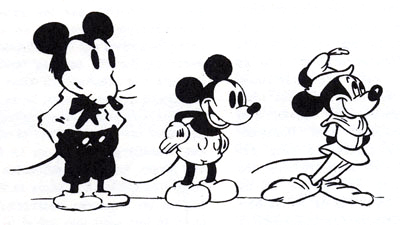
From Robert Benayoun, Le Dessin animé après Walt Disney.
The epos of Chaplin is the Paradise Lost of today. The epos of Disney is Paradise Regained.
Sergei Eisenstein
DB here:
 I’m not qualified to write a comprehensive or penetrating review of Neal Gabler’s biography Walt Disney: The Triumph of the American Imagination. For that you can go to Mike Barrier, one of our finest historians of US animation. Barrier’s own Disney biography will come out this spring, with apparently little overlap with Gabler’s.
I found Gabler’s book a thorough, somewhat cautious bio, even-handed about Disney and judicious about such controversial matters as Walt’s reputation as an anti-Semite. A lot of it reads like a notecard book, with quotes, paraphrases, and commentary dutifully snipped and pasted in, packing each paragraph. Chronology, not concept, rules. Still, I learned a lot.
Gabler’s book reminded me how much I admire Disney films. The attachment started–as for most of us–in childhood. Peter Pan (1953) was the first one I remember seeing in a theatre, but when I saw a reissue of Snow White later, parts looked so familiar that it must have impressed itself on me at an earlier time. Of course it still scared the hell out of me.
In 1973, when I was doing dissertation research in New York City, I attended a massive Disney retrospective at MoMA. As a twenty-five-year-old bearded guy among moms and kids, I felt obscurely criminal just being there, like a character in a Patricia Highsmith novel. But what I saw, in excellent prints, showed me that Disney was important on both cultural and artistic levels. So I designed a Disney unit into my first Introduction to Film course, taught here at University of Wisconsin–Madison to 300-400 souls whom fate cast my way.
I wanted to talk about film’s relation to society, and Disney was a touchstone for all my students. No matter where they came from, they knew Mickey, Donald, Snow White, Fantasia, and the rest. I showed early films, like Flowers and Trees, The Band Concert, and The Old Mill, as well as a True-Life Adventure nature doc, and the extraordinary Trip through the Disney Studio which was originally attached to The Reluctant Dragon. Students were able to see, I hope, how the ideology at work in Disney films could shape a conception of the world, of American life, and of their childhood.
Our assigned reading was Richard Schickel’s The Disney Version (1969); it’s a coruscating study, perfectly crystallizing that era’s feelings about Disney’s debasement of popular culture. At about the same time, Armand Mattelart’s Marxist critique How to Read Donald Duck was informing most film academics’ study of Disney. As Gabler indicates, intellectuals fell out of love with Disney in the 1940s. He handled labor disputes at the studio in a high-handed, paranoid way. He also seemed to personify the blandness of postwar consensus culture, and Disneyland became the theme-park equivalent of Norman Rockwell Americana. Even though hippies were turning on to re-releases of Alice in Wonderland and Fantasia, most cultural critics treated Disney pretty roughly. My friends and I goggled at Wally Wood’s 1967 Realist cartoon showing Walt’s whole gang engaging in a panoply of naughty sexual encounters.
Today the academic study of Disney is well-established, producing far too much for me to keep up with. A lot of it is cultural critique. For something funnier and even more scurrilous, see Carl Hiaasen’s Team Rodent. Despite all there is to read about Walt’s empire and its cultural consequences, I want something else as well.
Even when I was conducting my Disney Demystification Exercise, I tried to point out that these cartoons were artistically very strong. I still admire the powerfully emotional storytelling that, like that found in other fairy tales, preys so mercilessly on childhood fears. Schickel claims that after screenings of Snow White at Radio City Music Hall, the seats had to be cleaned because the Witch had scared kids into emptying their bladders.
Then too there’s the dynamism and grace of the animation, which remains unsurpassed. For Sergei Eisenstein Disney exemplified the contagious power of expressive movement on the screen. Many have disdained “Mickey-Mousing,” the close matchup between a film image and the accompanying music. But Eisenstein saw this as “synchronization of senses,” a primal, visceral unity that could move the spectator involuntarily. He sought this subconscious synchronization in his own sound films, and Alexander Nevsky and Ivan the Terrible show the strong influence of Disney.
Eisenstein was well aware of the delusional aspects of Disney, claiming that the cartoons lulled people into forgetting the harm done by capitalism. But as an artist, Disney was unique:
I’m sometimes frightened when I watch his films. Frightened because of some absolute perfection in what he does. This man seems to know not only the magic of all technical means, but also all the most secret strands of human thought, images, ideas, feelings…. He creates somewhere in the realm of the very purest and most primal depths.[1]
Disney’s art seems magical, but if it’s not a miracle, we ought to be able to study it systematically. How?
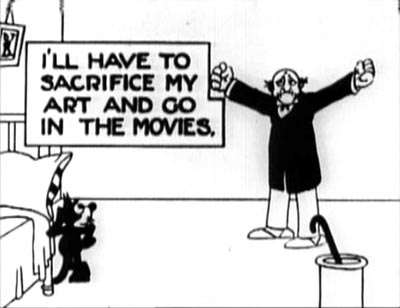 Felix in Hollywood (1923)
For the Jung at heart
Gabler’s is a sturdy, readable volume teeming with fascinating background material. As an EEG of the ups and downs of the studio, it’s extremely valuable. Gabler also aims to give a portrait of Disney the visionary, a man of boundless Protestant energy who sought to take animated film to ever higher levels. I think the portrait is disappointing, though, in its reliance on conventional psychobiography and Zeitgeist explanations.
Disney, Gabler claims, was dominated by a psychological drive to create a world wholly of his own. He was a control freak. “It had always been about control, about crafting a better reality than the one outside the studio, and about demonstrating that one had the capacity to do so. That was what Walt Disney provided to America–not escape, as so many analysts would surmise, but control and the vicarious empowerment that accompanied it.”
Commentators have long noted that Disney expanded the films’ fantasy world in his theme park. Just as films idealized reality, “so would Disneyland, the creation of a wounded man who expunged what he saw as the darker passages of his past by devising a better world of his imagination, though one that was obviously colored by the images of Hollywood.”
One has to wonder whether this characterization is particular to Uncle Walt. Lots of artists, from architects and topiary gardeners to designers of world’s fairs, have sought to create imaginary worlds over which they rule. Balzac, Faulkner, Lewis Carroll, and J. R. R. Tolkien conjured up imaginary realms populated by dozens of their own creatures. Graphic artist Ho Che Anderson writes:
For the control freak, there are few places better than comics. . . . Pick up a pen and piece of paper and you too can effectively play God. I suspect this love of God-play is the blood that keeps the hearts of many a cartoonist beating.[2]
Moreover, is the desire to build a parallel world necessarily a sign of a wounded past, or dark imaginings? Maybe it’s just one awesome creative challenge for ambitious artists. Granted, Disney took this impulse in a particular direction, toward a vision of life combining technical progress (the multiplane camera, Tomorrowland) with idealized notions of small-town community. But then we have to explain those idiosyncratic factors too.
Gabler goes the psychological route, but we could balance this account with cultural factors in Disney’s immediate milieu. There was the rise of the Technocracy movement. There was Hollywood’s belief that filmmaking would progress through new technologies. There was growing evidence during and after World War II that America’s might would be built on new machines. (One of the most hair-raising movies I saw at the 1973 MoMA Disney fest was Victory through Air Power, an educational short arguing for investment in airborne warfare.) Disney was, along many dimensions, a techie impresario, the Steve Jobs of his day, complete with his unique reality-distortion field.
The other big-picture explanation Gabler offers is a Zeitgeist model. Disney represents the American imagination. By tapping into Jungian archetypes, his 1930s films could both “capture and then soothe the national malaise.” More generally: “In both Disney’s imagination and the American imagination, one could assert one’s will on the world . . . . Indeed, in a typically American formulation, nothing but goodness and will mattered.” Disney’s desire to retreat into a controlled world echoes his country’s self-absorped conception of itself.
Despite these claims, Gabler doesn’t dwell much on the ways the studio seized what he calls “the American psyche,” perhaps because he senses that such explanations tend to be uninformative. One can grab almost any cluster of traits, find them in American popular art, and assert them as quintessentially American. This is how mainstream journalists make current Hollywood releases worth writing about: treating them not as artworks with distinctive appeals and a place in traditions and histories, but as reflections of whatever immediate social trends the writer chooses to pick out.
I won’t extend my criticism of Zeitgeist explanations here; it’s developed in the first essay in my forthcoming Poetics of Cinema. I’ll just say that I think we need more precise explanations than we get from easy juxtapositions of this or that film and some collective mood, sentiment, fantasy, or anxiety that we postulate as existing out there. Is there an American psyche? I’m not convinced.
An alternative to psychological speculation and Zeitgeist thinking is to look for more immediate causal connections. For example, Gabler traces how, around 1932, Disney began a new division of labor among his staff. He created a fairly strict set of specialties (story, gags, continuity sketches) and a chain of command in which head animators would become directors, overseeing particular projects. What’s the explanation of this change of policy? For Gabler, the new rationalization reflects not only the need to manage a bigger staff but also Walt’s effort in “reinventing and perfecting the system under which animations were produced.”
Gabler doesn’t mention that reorganizing the division of labor was going on throughout Hollywood at the same time. Most major studios were moving from a central producer system (this parallels the previous Disney lineup, with Walt at the top) to what Janet Staiger has called the producer-unit system, in which each man was charged with several productions.[3] Mentioning this doesn’t take away from Disney’s resourcefulness, but it does indicate that models for organizing his company were emerging right under his nose.
Similar issues could be examined by looking at Disney’s place in the overall ecology of Hollywood, as the premiere supplier of short subjects. His firm, Douglas Gomery argues, kept RKO afloat for many years. Gomery’s Hollywood Studio System: A History gives a cogent account of Disney’s role in the industry, and he goes somewhat beyond Gabler in tracing the studio’s emergence as in the 1950s as the prototype of modern conglomerate filmmaking.
Life in the cel
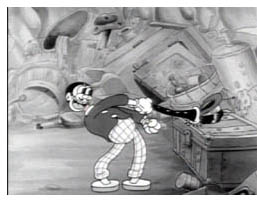 For Gabler, what made Walt reorganize production, and indeed what made him do nearly everything, was his obsessive pursuit of “quality” animation. But this quality itself remains fairly mysterious.
Gabler indicates that Disney moved away from the “rubber-hose” style of most cartoons, with their balloon heads, swollen paunches, and elastic arms and legs. (Even the clarinet goes limp in Harman-Ising’s A Great Big Bunch of You, from 1932, shown here.) Floppy limbs were fairly easy to animate. Gabler briskly summarizes Team Disney’s well-known innovations in naturalism, such as the studio’s emphasis on anatomy and life drawing, the breakdown of gestures, complex perspectives, and the rotoscoping of human figures.
Yet Gabler, a former movie critic for television, oddly doesn’t engage with the result of the technical innovations. He summarizes how journalists, critics, and academics have interpreted the movies’ cultural impact, but what he thinks about them as movies, rather than social or psychological symptoms, is almost completely suppressed. Does he admire Snow White or Dumbo or Pinocchio? Does he hate them? Has he studied them in preparation for the book? You will find more sensitive appreciation and critique in Leonard Maltin’s The Disney Films than in all of Gabler’s doorstop tome.
Gabler implicitly acknowledges the technical achievements of Snow White, Pinocchio, Fantasia, Dumbo, and Bambi, but after that he merely chronicles release after release with deadpan indifference. For example, he offers us nothing on the brilliant character animation of Song of the South (1946)–a film no longer in circulation because of its racial stereotyping.
Gabler follows tradition in suggesting that the UPA studio movies challenged Disney’s hyperrealism, but Disney was already moving toward something quite stylized. Gabler doesn’t observe the zesty play with color and line of Melody Time‘s “Blame It on the Samba” episode (1948). Eisenstein would have been pleased to see that the handling of Donald and Jose literalizes the metaphor feeling blue.
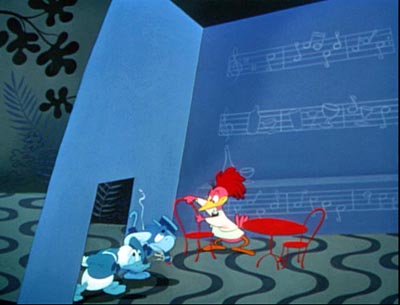
Working with lower budgets in the 1940s, the animators let their imaginations run wild. What a pleasure it must have been for Ward Kimball to come up with the funhouse nuttiness of the Serape song in The Three Caballeros (1945).
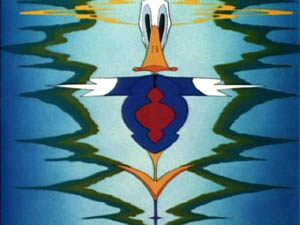

Kimball must have been quite a character; his parody book Art Afterpieces doesn’t spare the studio’s creatures. More generally, when Disney animators turned to illustrating pop music, they didn’t abandon the wilder sides of Fantasia.
There would be several fruitful ways to study the Art of Uncle Walt. One would require what I call rhapsodic criticism, writing that tries to evoke the movie’s look and feel through energetic, sensuous description. (This is, I think, what Susan Sontag meant in calling for “an erotics of art.”) Here is Don Crafton on the Felix the Cat cartoons:
Perhaps the most appealing aspect of Felix was his use of expressive body parts–a tail that forms gratuitous curlicues when he walks, or ears that click together like scissors. . . . He can mold himself into a mantel clock and have his nose mistakenly wound up; his tail can be an umbrella, a sword, or a clarinet, or Chaplin’s cane. He can use the tail as a bow to play a tune on his whiskers, then take one of the rising notes and use it for a doorkey. His skin is detachable. In Felix Trifles with Time (1925), a tailor flays him, then outfits a client with his pelt. When the man goes swimming, “naked” Felix retrieves his hide from the beach. [4]
In brief compass Crafton brings Felix alive for us. You don’t have to love Disney to write this way about his films; you do need a good eye, some pluck and gusto, plus a gift for language. Nothing like this is to be found in Gabler’s book.
Another way to get closer to Disney’s art is to just look at things more analytically. How does Disney create that expressive movement that Eisenstein admired? Partly, it seems, through having his figures move all over, and at the same instant. Reacting to a line of dialogue, a character can twist his waist, arch his back, swivel his shoulders, lift his head, arch his eyebrows, and raise a forefinger–all in a second or two. Two successive frames from Melody Time show Johnny Appleseed’s guardian angel in action, working his legs, arms, shoulders, jaw, and eyeballs simultaneously.
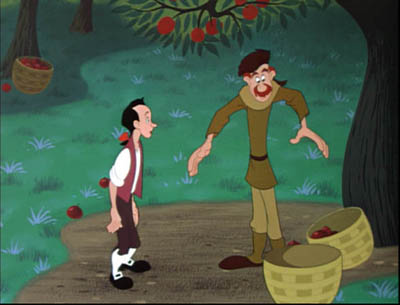
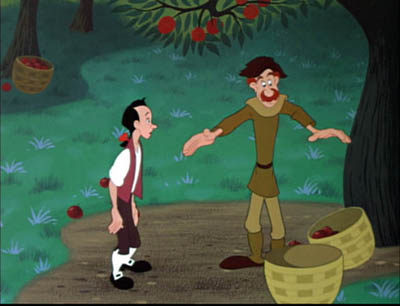
This is far from the minimal animation to which we became accustomed in the TV era. Treating gesture as a taut, rolling movement helps give Disney characters their unique volume and springiness, so different from the flabby postures of the rubber-hose style.
Or consider pacing, at which the Disney cartoons excel. Most studio animation of the period, constrained by smaller budgets than Disney had, speeded up production by filming each frame twice. That way only 12 cel drawings were needed for the 24 frames that consumed a second of film. One way Disney achieved expressive action, and the high quality to which Gabler refers, was to devote single frames–and cels–to details of particular movements. This choice, though expensive, allowed for exact adjustments in rhythm.
Sometimes there’s more than one movement per frame. You can occasionally find this strategy at work in other studios’ cartoons too, as Kristin has explained in an essay she mentions elsewhere in our blog. But Disney’s animators certainly used the technique with great panache. When Johnny, balancing on a branch, is caught in a rain of apples, he sweeps them up with lighting speed–a deft swirl made possible by multiplying character poses on each cel. If that means giving Johnny many arms and even detaching his hands, so be it.
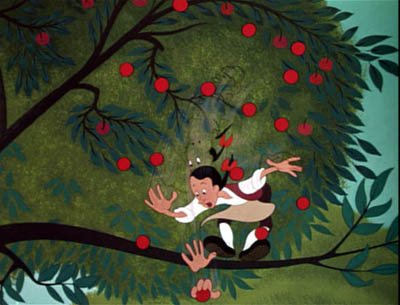
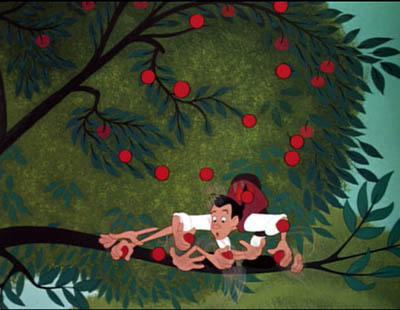
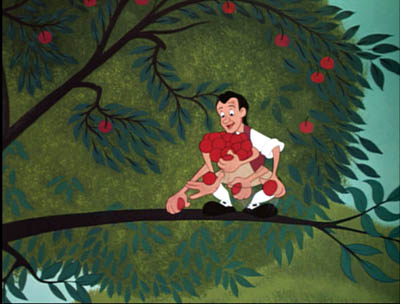
Johnny’s arms and hands proliferate more quickly and widely as he scoops up the apples, but their number is reduced as he gathers them in to his chest, so the rhythm accelerates and decelerates. Through trial and error Disney’s animators learned that rather strange single images will look exactly right on the screen; these men were practical perceptual psychologists.
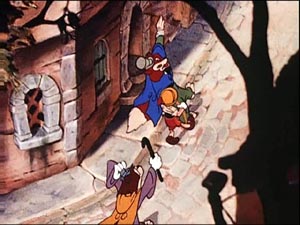
There are so many aspects of Disney’s art that need attention: the skill with line and contour; the sort of soft caricature that some consider cutesy but has enormous bounce and vibrancy; the ingenious use of color; and of course, Eisenstein’s “synchronization of senses” between image and music. There’s also Disney’s appropriation of developing live-action techniques, as in the proto-Wellesian crane shot in Pinocchio
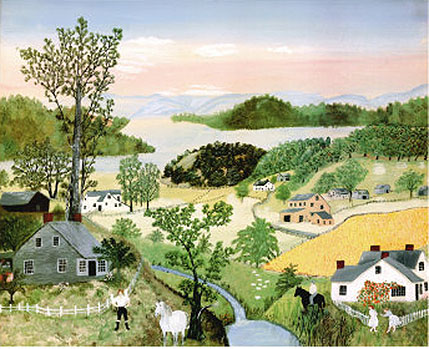
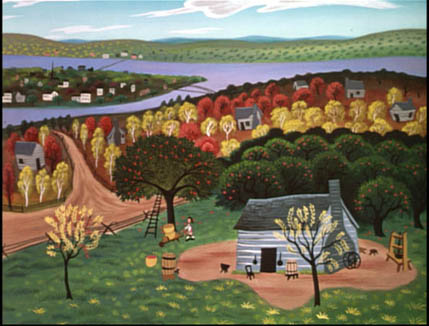
One could also study the studio’s borrowing of high-art motifs and styles. Instead of dismissing the 1940s and early 1950s Disneys as greeting-card kitsch, we can note that they evidently borrowed from the likes of WPA landscape art, American regionalist painting, and the naive-art look of Grandma Moses. (Her painting A Beautiful World, 1948 resembles Disney’s Johnny Appleseed of the same year.)
I’m a duffer in animation matters, so I’ve merely indicated some areas that intrigue me. The key source on the studio’s craft practice remains the gorgeous book The Illusion of Life: Disney Animation (1981, rev. 1995), by two of the great Nine Old Men, Frank Thomas and Ollie Johnson. And I expect lots of discoveries in years to come from experts like Barrier, Maureen Furness, Paul Welles, Norman M. Klein, and many others. Since Gabler draws heavily on the research of others, often without naming names, he might have borrowed a bit more from scholars of animation aesthetics.
In fact, you could argue that without the artistic imagination displayed by Disney and his brilliant staff, these films couldn’t have captivated the American imagination. Whatever that is.
[1] Eisenstein on Disney, ed. Jay Leyda, trans. Alan Upchurch (Calcutta: Seagull, 1986), 2.
[2] “Career Tips for Control Freaks,” in The Education of a Comics Artist, ed. Michael Dooley and Steven Heller (New York: Allworth, 2005), 124-125.
[3] Janet Staiger, “The Producer-Unit System: Management by Specialization after 1931, in David Bordwell, Janet Staiger, and Kristin Thompson, The Classical Hollywood Cinema: Film Style and Mode of Production to 1960 (New York: Columbia University Press, 1985), 320.
[4] Donald Crafton, Before Mickey: The Animated Film 1898-1928 (Chicago: University of Chicago Press, 1993; orig. 1982), 327, 328.
An appetite for artifice
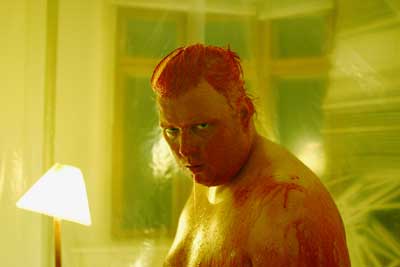
Offscreen (Christoffer Boe)
DB here (no, not above):
Catching up with several of the fall’s films, I was struck by how often they played quite self-consciously with the overall shape of their plots. Here are some examples.
Network narratives. This is the label I applied in The Way Hollywood Tells It to those films highlighting several protagonists inhabiting distinct, but intermingling, story lines. In Poetics of Cinema, I have an essay examining the conventions of this format. Several films I saw this fall continued this tradition.
*Bobby used the familiar device of gathering everyone in a single spot–a hotel–within a short time frame and interweaving personal stories with a fateful climax. I thought the film was fairly clumsy, but I was still moved. In 1964 I filmed RFK when he stumped our town for the presidential nomination, and in college, though leaning toward Gene McCarthy I thought Bobby was the only candidate who could beat the Republicans. “Dump the Hump!” (Hubert Humphrey) was the rallying cry.) His assassination, during the same year Martin Luther King was killed, was very traumatic to young idealists. Estevez’s film becomes most powerful, I think, by simply replaying footage and speeches, reminding us that there was once a rich politician who talked incessantly about helping the poor. Just as Stone’s JFK positioned Jack as the man who could have averted the Vietnam War, Bobby makes RFK the anti-Bush.
*Fast Food Nation was for me a more satisfying use of the network narrative format. Here the time scheme is more diffuse because Linklater is tracing a large-scale process, the burger from the hoof to the Happy Meal. By starting with the middle-management character (Greg Kinnear) and then easing us into the harsh working life facing Mexican illegals, the film builds sympathy for the immigrants. Gradually, the illegals’ stories take over, and the social conscience of one of the burger chain’s teenage workers is ignited.
The plotting makes some thoughtful moves. A more literal approach would have shown us the meat-processing plant’s killing floor early, as part of the step-by-step process. But here the shocking material isn’t presented until the very climax of the film, as the fate to which the immigrant working woman must submit. Likewise, the film drops the Kinnear character about halfway through, a ploy that conceals from us how he’ll act on his new knowledge. Will he blow the whistle on the plant, and endanger his job? A European film might have left his whole line of action open, but Linklater adheres to the tendency of American films to resolve a plotline one way or another. He does it, however, in an epilogue which leaves us with a sharpened sense of the acute problems of the system.
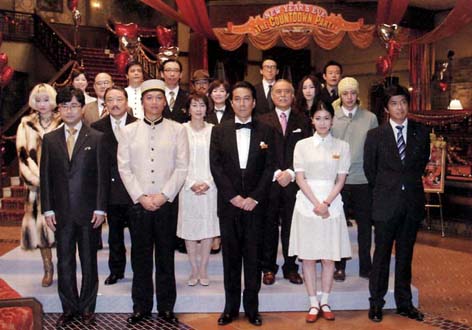
*The Uchoten Hotel (aka Suite Dreams, Japan, 2006). In the vein of Tampopo and Shall We Dance?, Mitani Koki offers gentle humor mixed with satiric social observation. Confusion reigns at the Avanti Hotel on New Year’s Eve, as a philandering professor, a corrupt Senator, low-end showbiz types, and the hotel staff become embroiled in one another’s lives. Lively long takes display subtle staging, and there’s a ventriloquist’s duck. A tribute to Grand Hotel, Billy Wilder, and Jacques Tati, this good-hearted survey of human aspirations was the most uncynical movie I saw all year.
Many critics seem to feel that the network format is tired out. At indieWire, Nick Schager calls for “a moratorium on second-rate Nashville-style ensemble pieces that seem increasingly to be the province of every Tom, Dick, and Emilio.” The key words are “second-rate”: Like any storytelling pattern, the network option can be used well or badly. Linklater and Mitani use it with flair.
The point I’d stress is that although the network model can claim to be a realistic device (in our world, our projects commingle), it’s almost always presented through a series of conventions–traffic accidents, people brushing past each other, narration that holds back information about the characters’ relationships, and so on. We recognize these as part of the artifice in this tradition of storytelling.
Broken Timelines. During his DVD commentary for Basic, John McTiernan uses this phrase to explain the film’s flashbacks and replays. In the terms we use in Film Art, the linear story action is scrambled or rearranged in the plot that that the film presents to us.
Screenwriters used to urge novices to avoid breaking up the timeline, but in the 1940s through the mid-1950s, films began to play around with story order. Citizen Kane (1941) probably encouraged the flashback form, as did film noir’s emphasis on mystery and crime detection. Siodmak’s fine The Killers offers a prototype. (I discuss its plot maneuvers in Narration in the Fiction Film.)
We don’t lack for flashbacks in contemporary films, but things are getting complicated. Today a film may open with a quite mystifying sequence, before backtracking to acquaint us with the situation. In itself, this isn’t very unusual, since flashback-based films have often opened at a point of crisis and then taken us back to the beginning of the action. The Big Clock and Written on the Wind are instances. The new wrinkle is to actually replay the opening situation or just the images from it in a new context.
*The Fountain by Darren Aronofsky offers one example. Using three time layers, it can keep replaying the opening portions in ways that recontextualize the material we saw at first. In its out-of-this-world realm, as well as its suggestion that the story is in some sense being written as we see it, it reminded me of Slaughterhouse-Five (1972)–another indication that these innovations aren’t brand new.
*Another instance: The opening image of Christoffer Boe’s Offscreen (2006), with a bloody Nicolas Bro in close-up advancing to the camera, gets explained only at the grisly climax.
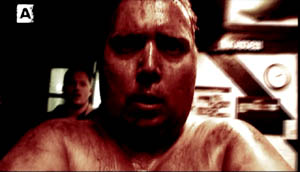
*The recontextualizing replay isn’t an avant-garde device. Tony Scott’s well-done thriller Déjà Vu uses it in the context of a time-travel plot. It replays the opening sequence in a way that suggests both a branching or alternative future and a deeper understanding of what we saw initially. A similar pattern is found in Flags of Our Fathers, in which we reinterpret the opening differently now that we know the characters more fully. I suppose that Pulp Fiction‘s opening became a powerful influence on this formal choice.
When an action is replayed, it can be shown from different characters’ perspectives. Again, this was explored a lot in the 1940s, as in Mildred Pierce (a replay of the opening) and Crossfire (a replay of the crucial incident). The device is on display in The Killing and The Man Who Shot Liberty Valance as well. Kurosawa’s Rashomon made the technique more ambiguous, by not confirming which version of events is accurate. The same idea guides the money exchange in Tarantino’s Jackie Brown, which we discuss in the new edition of Film Art.
*The broken timeline of Three Burials of Melquiades Estrada uses multiple points of attachment mildly, in the murder scene. The replays are more significant and fragmentary in The Prestige. More films in this vein are in preparation, including Vantage Point, which shows an assassination attempt on a US president as seen from five characters’ points of view, “unfolding in 15-minute increments.”
Companion films. Back in the 1960s, Fox announced that it wanted to make Tora! Tora! Tora! with two directors, one Japanese and one American. My friends and I indulged in a game: Whom should they pick? (I favored Ozu and Samuel Fuller.) As you probably know, Kurosawa’s collaboration came to naught (though he did shoot some footage, discussed by Richard Fleischer in his book and his DVD commentary on the film). Fukasaku Kinji and evidently some other directors contributed to the Japan-based footage.
Now, instead of one film with two directors, Clint Eastwood gave us two complementary films from a single hand. I haven’t yet seen Letters from Iwo Jima, but the very idea of showing the same battle from opposite sides in two movies acknowledges a level of artifice.
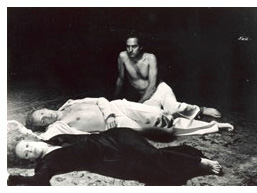 The French got here first, I think. Marguerite Duras made a companion film to her mesmerizing India Song (on right) called Son nom de Venise dans Calcutta desert. Son nom had exactly the same soundtrack as India Song but a wholly different image track–only landscapes around the site of action, empty (as I recall) of all human presence. A comparable instance is the alternate-worlds pairing by Alain Resnais, Smoking/ No Smoking, adapted from a cylce of Alan Ayckbourn plays.
The companion-film concept seems to be expanding. Red Road, directed by Andrea Arnold, is launching a series of films to based in Scotland and all featuring the same group of characters, but filmed by different directors. The characters are conceived by filmmakers Lone Scherfig (Wilbur Wants to Kill Himself) and Anders Thomas Jensen (Brothers). In a way, a sort of episodic-television idea applied to feature films.
What’s behind this? Why are today’s movies using such self-conscious artifice in their plotting? Is form the new content, the way gray is the new black?
Complex storytelling can be found in a lot of other media today. It’s common to point to Hill Street Blues and later TV shows as reinforcing tendencies toward network narratives in film. Jason Mittell discusses the tendency in Velvet Light Trap no. 58. His article “Narrative Complexity in Contemporary American Television” (available here), makes the case that shows like 24, Arrested Development, Buffy, Malcolm in the Middle, and so on have offered viewers ways “to be actively engaged in the story and successfully surprised through the storytelling’s manipulations”–a good way to describe some of the strategies I’ve been sketching.
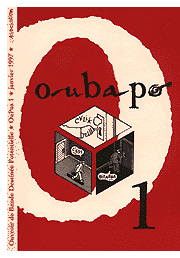 In graphic novels and comic art we’re seeing the same tendencies. Daniel Clowes and Chris Ware manipulate time and space in virtuoso ways, as does the highly formalized movement known as OuBaPo. You can check out an American version of OuBaPo in Matt Madden’s 99 Ways to Tell a Story.
In Everything Bad Is Good for You, Steven Johnson argues that people are just getting smarter, and so popular culture is pitched at a more sophisticated level. But quite complex artifice can be found in mass media of earlier eras. As I mention in The Way, we can find backward-told stories in popular fiction long before Memento, and Grand Hotel is an early prototype of the network narrative. Our ancestors weren’t necessarily dumber than we are, and popular art has long harbored experimental impulses.
I’d hypothesize some other causes. Regardless of IQ, more members of the audience have been to college today than in early eras. More of the creators have studied modern art and literature and are ready to borrow experimental devices they’ve encountered in other media. This process has a familiar ring. American filmmaking has often renewed itself by absorbing all manner of experiment, from German Expressionism (for 1930s horror films) to serial music (for 1950s psychological dramas). Usually, I feel compelled to add, the experimental devices are absorbed into existing forms, like classical script structure, genres, or stylistic principles.
I suspect as well that the new genre hierarchy that emerged in the last couple of decades cranked up the artifice level. The rise of science fiction, mystery, fantasy, horror, and comic-book movies probably encouraged clever juggling with story order, point of view, and states of knowledge. So did the rise of indie cinema, which needs narrative innovation to set itself apart from the mainstream. Again, Pulp Fiction fuses the two strands: an indie neo-noir that attracted attention through its bold manipulation of story/ plot relations.
At the same time, filmmakers in other countries have been eager to push the boundaries. Many of the broken-timeline devices have their sources in art cinema of the 1950s and 1960s. Younger European directors like Boe and Tom Tykwer (Run Lola Run) have revived this adventurous attitude toward storytelling, putting them somewhat in sync with American directors. Asian experimentalists like Wong Kar-wai and Hou Hsiao-hsien continue to exercise a comparable influence.
We need to think more about where this impulse toward innovation comes from and how it shows itself, but it seems likely that the flourishing trade in self-conscious storytelling will be with us for some time yet. Hollywood cinema has long been self-consciously, almost fussily formal, and it has a vast appetite for artifice.
Can they make ’em like they used to? continued

DB here:
In the wake of discussions of The Good German, on this site and elsewhere, the idea of a retro-looking movie has surfaced again. American Cinematographer‘s coverage of Casino Royale is very intriguing.
Phil Méheux, the cinematographer, decided that the opening sequence, a black-and-white passage showing Bond earning his 00 status, would pay homage to 1960s Techniscope. Techniscope was an optical process that produced 2.35:1 images without anamorphic lenses. It allowed great depth of field because it could take advantage of the wide-angle lenses available for non-anamorphic cinematography. The most familiar Techniscope images are probably those in Sergio Leone’s westerns.
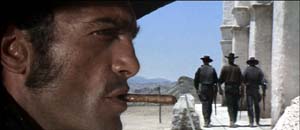 For a Few Dollars More.
Mehaux explains what he wanted for Casino Royale:
With Techniscope, the increased depth of field meant they were able to put things like lampshades and telephone boxes in the foreground, and they didn’t appear amoebic–you could actually see depth in them. In The Ipcress File, there’s a shot where a table lamp is huge in the frame and a man’s face is in the top right-hand corner. I really like that look. Part of the dialogue in our opening sequence was done with very carefully controlled shots that have huge things in the foreground and faces pushed to the corners of the frame. Little things like that echo the Cold War period of spy films.
But, but….
1. In the print of Casino Royale I saw in my local, the opening office scene didn’t really exploit sharp-focus foregrounds. There weren’t that many objects in the foreground, and they weren’t in discernible focus. Of course the cutting was so rapid that it was hard to concentrate on foreground/ background relations.
2. It’s fall of 1965, in Albany, New York. A film geek literally fresh off the farm is in his freshman year of college and goes to every movie in town. He sees The Ipcress File not once but three times. He’s fascinated by its flamboyant technique. He’s just seen Citizen Kane, so he’s impressed by deep staging and big foregrounds in this unheralded spy pic.
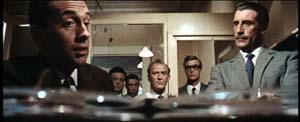
There’s even wilder stuff: a murder victim seen through a hanging lamp, for example.
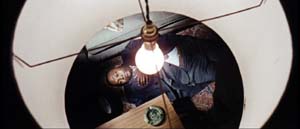
The Geek reads up on long lenses, wide-angle lenses, and so on. Knowing nothing about Techniscope, he wonders how these extravagant shots got made. Just as important, why are they here (apart from looking cool)?
(Spoilers coming up. Skip to 3 if want to retain your innocence.)
After a couple viewings, the Geek begins to get a hunch about what those lampshades are doing there. Throughout the movie, actors are shot in juxtaposition to looming shapes–doors, lecterns, tabletops–which mask large stretches of the set.
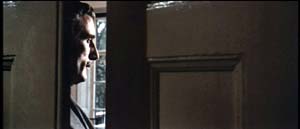
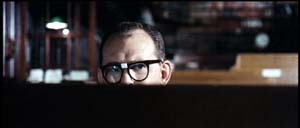
And sometimes those blocking objects are lampshades.
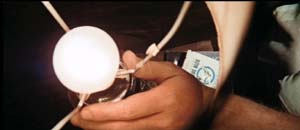
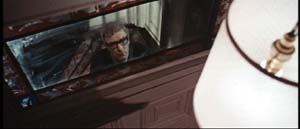
At a climactic moment, our hero escapes from torture and calls his superior officer, who’s framed in the usual off-center way, with a lampshade dominating the shot. It works as a sheer (and pretty) block of solid color.
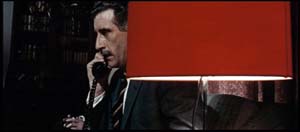
Turns out, however, that this time the shade actually conceals something important. The officer withdraws behind the shade and out pops a guest sitting alongside him.
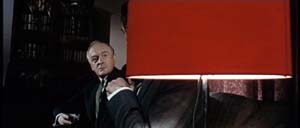
The guest is the arch-villain. Now we know the officer is a traitor.
The Geek dimly realizes three things.
*A movie sets up visual “rules” it will follow or violate. (Later the Geek will call these intrinsic norms.)
*Visual motifs build up across a film, sometimes asking the viewer to notice them.
*A motif can seem gratuitous but that very gratuitousness can be exploited for storytelling purposes. When we see the red lampshade, we assume that it’s another decorative flourish, not a way of hiding information. Earlier sequences suggest that the device is a mannered tic but at the climax it helps spring a surprise. Motifs, the Geek would realize eventually, can fulfill narrational functions–that is, motifs can shape the ongoing flow of story information.
3. Sidney J. Furie was considered a showoffish filmmaker. Michael Caine said he belonged to the look-Ma-I’m-directing school. Certainly the outrageous compositions involving Marlon Brando’s sombrero in The Appaloosa back up that charge.
But like Richard Lester, Ken Russell, and other fancy-pants pictorialists, Furie can at least get us to notice technique. Not bad to cut your cinephile teeth on. Or at least so the Geek thinks, forty years afterward.
4. The AC article also talks about the problem of making poker games interesting. Hong Kong filmmakers figured this out long ago. Martin Campbell, director of the new 007 adventure, should study the crisp card sequences in Wong Jing’s God of Gamblers series. Filmed on a minuscule budget, they put the strained and blandly shot poker scenes of Casino Royale to shame. Incidentally, Wong’s use of diopters yields the sort of nifty depth that Meheux liked in Ipcress.
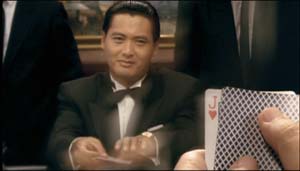 God of Gamblers.
PS: Casino Royale didn’t learn the lessons of the 1960s well enough, in my view. After the sparkling opening credits, it was all downhill. The usual problems: overcut scenes, overcloseupped acting, incoherent chases and fights, uninspired dialogue you recite just before the actor says the line. One landing-strip truck fracas amalgamates Road Warrior, Raiders of the Lost Ark, and Die Hard 2. The makers have indeed updated the Bond franchise. After a series of lame 1970s-looking movies, the franchise has given us a lame contemporary-looking movie.
Granted, I never cared much for the Bond pictures. The Geek liked From Russia and Goldfinger, and Diamonds Are Forever is enjoyable in its wacko way. But for Machiavellian intrigue, Fritz Lang’s Spies remains the gold standard. No one can make ’em like he used to.
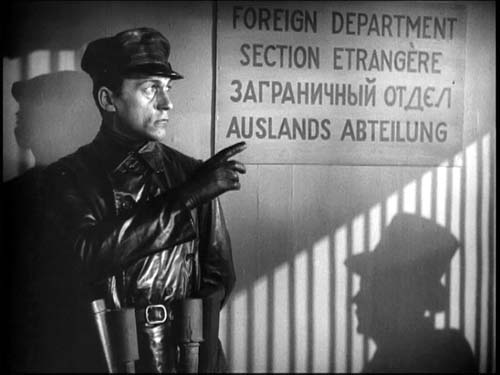 Spies
Spies
Good Actors spell Good Acting
Kristin here–
I suppose all movie-lovers have favorite quotations that become part of their everyday conversation. Norman Bates’s “One by one you drop the formalities” fits a surprising number of situations. The film-studies professors here in Madison often communicate with each other using lines from Howard Hawks films, especially Rio Bravo. “Let’s take a turn around the town,” “We’ll remember you said that,” and, of course, “It’s nice to see a smart kid for a change.” Any time David or I get a particularly small royalty check, we echo Hildie Johnson’s sour “Buy yourself an annuity.”
One of our favorite everyday-life quotations comes not from a movie but from the endlessly hilarious SCTV series. It’s a skit in which Steve Roman (played by John Candy) promotes his new TV show, Juan Cortez, Courtroom Judge. He explains part of its appeal: “It’s got good actors, and that spells good acting.” (Fifth season, episode 110, for you SCTV buffs.)
Almost invariably we use this line when we come across one of those films that receive highly positive reviews largely because of one great performance. You know the kind: Charlize Theron in Monster, Halle Berry in Monster’s Ball, Hillary Swank in Boys Don’t Cry, and more recently Forest Whitaker in The Last King of Scotland and Helen Mirren in The Queen.
Usually I avoid such films, because the reviews tend to plant the idea that they are primarily actors’ vehicles. I enjoy good acting as much as the next person, but I want the rest of the film to be interesting as well.
Are there any film classics that are truly great solely for the acting? It’s hard to think of any. Maybe The Gold Rush, which is stylistically fairly pedestrian but which is redeemed by Chaplin’s inspired performance. Maybe Duck Soup, also quite undistinguished for much of anything other than the Marx Brothers cutting loose without being saddled with the sort of plots involving young, singing lovers that MGM would soon foist upon them. Maybe a few others. Usually, though, we tend not to think of a performance, however dazzling, as adding up to a great film.
Still, when I think of some of the finest performances ever put on film, I think of Falconetti in La Passion de Jeanne d’Arc by Carl Dreyer. There her luminous portrayal of determination and religious devotion is embedded in an equally extraordinary film, with its minimalist sets by Herman Warm, its insistently tight framings on faces, and its vertiginous camera movements. Similarly, Nicolai Cherkasov as Ivan the Terrible in Eisenstein’s film poses against the shapes of the settings, moves to the music of Prokofiev, and casts great shadows on the walls. Buster Keaton, though not as popular in his day as Chaplin, had an instinctive feel for both the flat space of the screen and the depth of the represented image, and his films are exciting in themselves and not simply as backgrounds to his clowning.
We’re now well into the time of year when the studios bring out the films they hope will garner Oscar nominations and even wins. Journalists covering film, reviewers and feature writers alike, can get some copy out of speculating about the Oscars. That speculation seems to start earlier and earlier each year, like Christmas shopping. Given that the public is a lot more interested in acting than cinematography or screenwriting, perhaps it’s not surprising that reviewers focus so much on star turns. But in doing so, do they slight other aspects of those films? Do they unfairly scare off those of us who are wary of Oscar bait?
I decided to do my part for the good of the blog and see The Queen. I’m not a huge fan of Stephen Frears, but My Beautiful Launderette is a good film, with an early sympathetic, non-sensationalized view of homosexuality in London. Mary Reilly is not exactly a masterpiece, but it’s worth watching and has been underrated. Its failure may have been due in part to the fact that most reviewers focused in on whether Julia Roberts could handle a dramatic role in a thriller and then found her wanting.
Anyway, The Queen turned out to be an entertaining, well-made film. Yes, Helen Mirren is remarkable as Queen Elizabeth II, and she may well win an Oscar for her performance. Yet equally interesting is the fact that Frears almost entirely avoids the “intensified continuity” style that David has analysed in The Way Hollywood Tells It.
The film is basically pretty simple, moving back and forth between the royal family and the newly elected Tony Blair surrounded by his wife and staff. The royals notoriously reacted to the death of ex-Princess Diana with stony silence despite the huge outpouring of public grief. It’s clear from the indifference and even hostility toward Diana that the members of family’s older generations voice in private, they do not feel a comparable grief. But Blair strives to maneuver the Queen into going public and expressing a sense of loss.
Frears set out to contrast the two worlds stylistically. The scenes with the royals are shot in a classical, non-intensified style. Distant shots to establish space, two shots for face-to-face conversations, over-the-shoulder shot/reverse shots as the dialogue unfolds. The framing seldom goes in for the tight close-up but stays in medium shot or medium close-up. The cutting is slow relative to the current norm, as befits both the subject and the style. One reason people are so impressed with Mirren’s performance may be that it is not made up of a bunch of different shots stitched together. She has shots that allow her to develop a reaction or attitude slowly.
And best of all, the camera doesn’t glide toward or around the characters. It stays put unless it needs to perform one of its traditional roles: reframing to keep characters balanced, and following the characters as they move from one room to another or walk along a country track. The lighting is suitably subdued and directional, another reversion to a more classical age.
A great deal is currently being made of Steven Soderbergh’s reversion to 1940s Hollywood style in The Good German. Frears isn’t quite as systematic, perhaps, but the royal-family scenes in The Queen look very 1950s to me.
In contrast, the Tony Blair scenes were shot with a handheld camera, to convey the bustle of his staff and the more casual situation. Even so, the camera movement is not obtrusive, and Frears still doesn’t constantly cut in for the tight close-up. Here, too, he keeps his camera back a bit, framing groups as they talk. The lighting tends to be brighter and more diffuse. The contrast works well, and yet Frears never pushes it in our faces and asks us to be impressed.
The narrative seems a little thin, mostly because, unlike most classical films, The Queen has only one plot line. There’s no subsidiary crisis, no romance, no other conflict. It’s just the royals versus the liberal prime minister’s team until one side cracks. Even the potential conflict that could have easily arisen from Blair’s wife’s anti-royalty position never goes anywhere. She’s mainly there as a sounding-board for him. And if the plot is thin, it is also refreshingly elegant in its simplicity.
One remarkable aspect of the plot is that none of the characters is treated as a villain. Blair’s position is held up as the wise one, yet the film goes to great lengths to suggest that the Queen and her family have reasons for behaving the way they do. Not excuses, but reasons. Fittingly, the film concludes with the Queen and her new prime minister walking out into the palace gardens for a stroll and a chat.
At the end, I didn’t feel that I had sat through a great performance. I had seen a good, entertaining, somewhat unusual, and skillfully made film that had a great performance in it. Indeed, it has a second from Michael Sheen as Blair, and the supporting players are fine as well.
But good directors spell good directing, and good cinematographers spell … You get the idea. Variety’s reviewers, it must be said, seem to have a mandate to mention style, since ever review comments at least briefly on the film’s techniques. But most critics give you no sense of the film as a whole—its narrative construction (apart from a plot synopsis) or its stylistic texture. It would be nice to see more rounded reviews.