















Archive for the 'Narrative strategies' Category
So these two candidates walk into a bar….
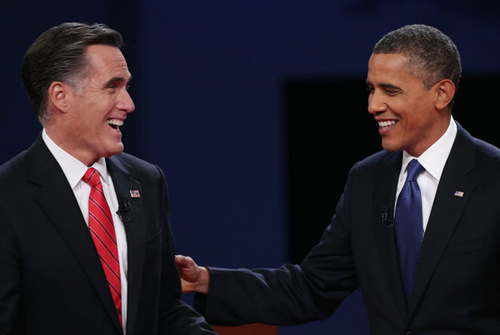
Why are these men laughing?
DB here:
How do we describe political activity? Candidates compete in a race or a contest, they fight for their party’s nomination and attack their rivals, whose positions clash with theirs. The very metaphors suggest stories—a race to a goal, a conflict that yields a winner, a process with a beginning, middle, and end. That is, political discourse is shot through with notions about narrative.
Only relatively recently, though, I think have the press and the public and the pundits and handlers started to use that very term to describe what’s happening. It would take a cultural historian to say why the term has popped up, so I won’t try. What intrigues me as someone who studies narratives (in films, books, plays, comics, etc.) is that by naming what people and institutions do as narrative, writers and readers may have recognized that narratives are artifacts.
More than the other metaphors, it suggests a large-scale construct. A narrative isn’t a momentary skirmish but something shaped by strategy and challenged by accident. A race or fight just happens, but a narrative is built.
“Lugar defeat fits Obama campaign narrative,” says a headline in the Los Angeles Times. It summarizes a story suggesting that Richard Lugar’s primary loss in May is one piece of the Democrats’ broader account of how the Tea Party has taken over the Republican party. This week, of Mitt Romney’s fifteen years at the top of Bain Capital David Stockman writes, “According to the campaign’s narrative, it was then that he became immersed in the toils of business enterprise.”
If we ever thought of a candidate’s personal history or a surrogate’s summary of current events or a news reporter’s account of a day on the campaign trail as a simple chronicle, we may think so no longer. Narratives, our media now seem tacitly to recognize, are made things–assembled selectively, bent to a simplified arc, and shaped for ultimate impact.
That doesn’t make them fiction, but it does invite us to probe them skeptically. Stockman, for instance, goes on to argue that Romney doesn’t fit our standard idea of a businessman because he is someone who buys, packages, and resells “the castoffs of corporate America.” He was not a manager but a “master financial speculator.” A story can be changed or challenged, retold from another point of view, imbued with mysteries and surprises. By making our political life into a vast tangle of narratives, and narratives about narratives, our media have made us more aware that we are nearly always telling each other stories.
Two tales and their tellers
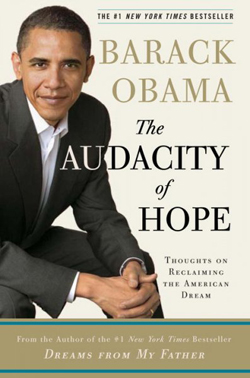
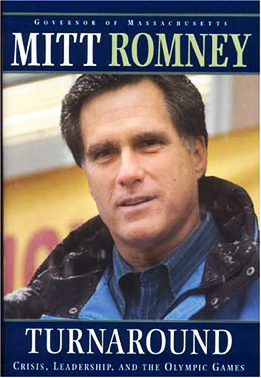
In 2008, I tried bringing some tools of “narratology” (yes, there is such a word) to bear on the US presidential campaigns. For background on my project, you can visit the original post. That drew on three bodies of stories—the development of the campaigns in the press, some self-generated material from the campaigns (especially Obama’s use of everyday citizens’ own narratives), and above all the book-length memoirs by the top candidates: McCain’s Faith of My Fathers and Obama’s Dreams from My Father. Today I’ll focus just on the current candidates’ own tales, as presented in Mitt Romney’s Turnaround: Crisis, Leadership, and the Olympic Games and Barack Obama’s The Audacity of Hope: Thoughts on Reclaiming the American Dream.
Why these? Why not, for instance, Romney’s more recent No Apology: Believe in America? That book is almost wholly a series of statements on policy. Those are accompanied by some narratives tracing Romney’s version of long-term and short-term trends in world history. A few more personal stories are embedded, but on the whole No Apology is less a memoir than a manifesto. By contrast, Turnaround tells the story of Romney’s three-year tenure at the head of the committee preparing the 2002 Winter Olympics. It offers much more in the way of characterization, decision-making, and drama than does No Apology.
The Audacity of Hope has a policy dimension too, certainly more than Dreams from My Father does. But Obama weaves his points about public issues into a personal story about his involvement in state and national politics. As we’ll see, that allows him to present his ideas as ones emerging from his life story and his daily duties as a senator.
There’s another reason for pairing these books. Turnaround was published in 2004 and reprinted in paperback in 2007, when Romney was launching his bid for the 2008 Presidential nomination. Obama’s Audacity of Hope was first published in 2006 and was reprinted in paper in July 2008, almost immediately after Hillary Clinton conceded the primary contests. The books thus align snugly in one time frame, and each had an afterlife as a bid for campaign support.
I’ll simply take authorship as a given. Obama, as is widely recognized, writes his material himself. (No, I haven’t seen good evidence that Bill Ayres is the ghost writer.) Romney explains that he dictated and revised Turnaround, with editorial and research assistance from others. As with Obama, since Romney put his name to the book, I’ll treat him as the author.
Reality is infinitely amorphous, so to make a narrative out of it you must ruthlessly simplify. In what follows, I won’t be tracing what each writer may have strategically omitted. For example, in Turnaround Romney reports noncommittally that Mattel paid $1 million plus a percentage of revenues for a licensing deal for Olympics-related toys (p. 217). He doesn’t mention that Bain Capital was then a major stockholder in Mattel. I haven’t found any piece of journalism that systematically reviews Obama’s and Romney’s work for omissions like this, but I mention them because we need to remember that nonfiction narratives are necessarily selective. I also want to show that even in the absence of such information, we can still measure the impact of the yarns our leaders spin.
From texture to structure
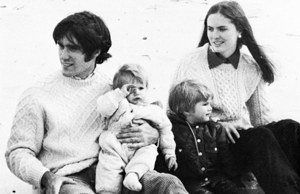

As attentive readers, we might be struck first by the way the books are written—the authors’ styles. For instance, Romney, as you’d expect is brisk and to the point. Why should he take on the Olympics job? He realizes that his wife is right about his abilities.
The more I protested, the less crazy the idea seemed. The more thought I gave it, the more I softened to the idea. Within two weeks, I would make a complete about-face. I would leave friends and family behind and move to Utah. I would walk away from my leadership at Bain Capital at the height of its profitability and take a position without compensation.
I later joked with the press that it was due to an overdeveloped community service gene. And that wasn’t far from the truth (7).
McCain’s Faith of My Fathers, as I tried to suggest back in 2008, has an eloquent bluntness, but Romney’s prose is more generic. It has the virtue of simplicity, with a touch of over-earnestness. I wonder if Romney’s joke really counts as a joke, especially if it’s not far from the truth.
Obama, as in his first book, is more “literary” (odd in a way, since Romney was an undergraduate English major). Instead of short sentences, we get long ones. Instead of simple declarative sentences, we get winding syntax in which appositional phrases pile up concrete details.
For the first time in my career, I began to experience the envy of seeing younger politicians succeed where I had failed, moving into higher offices, getting more things done. The pleasures of politics—the adrenaline of debate, the animal warmth of shaking hands and plunging into a crowd—began to pale against the meaner tasks of the job: the begging for money, the long drives home after the banquet had run two hours longer than scheduled, the bad food and stale air and clipped phone conversations with a wife who had stuck by me so far but was pretty fed up with raising our children alone and was beginning to question our priorities (6).
Obligingly, our authors provide parallel passages for contrast. In each one, a parent savors a moment that won’t last.
Some years ago, my wife, Ann, and I were playing with our children. After a long day of fun and family time, all five of our boys were dressed in their pajamas and slipped upstairs for bed. As the house grew quiet, Ann turned to me and said she wished we could freeze time, to keep them—and us—just as we were then. That’s not possible, of course. As we grow and age, we know that what we leave our children is our most lasting legacy (ix).
Romney turns this recollection into a lesson in patriotism, adding that we must be equally realistic about our country’s future in the face of threat and change across the world. Compare that generic image of a happy home, without many details (even the pajamas are pro forma), with this more customized one.
Later that night, back home in Chicago, I sat at the dinner table, watching Malia and Sasha as they laughed and bickered and resisted their string beans before their mother chased them up the stairs and to their baths. Alone in the kitchen washing the dishes, I imagined my two girls growing up, and I felt the ache that every parent must feel at one time or another, that desire to snatch up each moment of your child’s presence and never let go—to preserve every gesture, to lock in for all eternity the sight of their curls or the feel of their fingers clasped around yours. I thought of Sasha asking me once what happened when we die—“I don’t want to die, Daddy,” she had added matter-of-factly. . . (267).
As elsewhere in this book and in Dreams for My Father, you have to wonder if Obama has a photographic memory or is taking novelistic license to create vivid scenes. The string beans, the curled hair, Dad doing the dishes, and the sudden turn to death (counterweighted by Sasha’s asking about it “matter-of-factly”) give the passage dramatic heft, especially as it’s occasioned by Obama’s recollection of watching his mother die. Instead of Romney’s parable of policy we get a meditation on death. It concludes with Obama’s trust that his mother is somewhere rejoicing in her children. Obama has dramatized the continuity of generations that Romney invokes laconically.
We could spend a long time comparing the men’s prose styles, but for now we can say that they point us to larger, narrative issues. The disparities in texture emerge on the large scale as well. One narrative is built on a simple, direct plan; the other is more indirect and meandering. One is designed like an office building, the other like a scenic highway that sometimes doubles back on itself.
Taking his turn
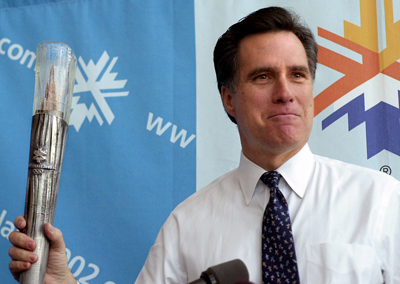
To construct a narrative, you create agents (in fiction we call them characters). You assign them actions. You link those actions by cause and effect. Usually causes that spring from traits or temperaments of the agents, and the effects press them to further action. You invent problems and decision points for your agents, because those things create drama and reveal character. You build in parallels, those echoes of other actions in this tale or others. You invest people, places, and things with symbolic significance. And you bring the whole thing—your plot—to a close that tends to be a resolution of the cascade of actions.
Turnaround’s plot is quite straightforward. After a prologue celebrating the virtues on display in the 2002 Winter Olympics in Salt Lake City, the action begins with a late 1998 telephone call asking Romney to consider taking charge of the mega-event. This is a classic narrative motif that fuses action and characterization. The hero, a man with nothing to prove and no ambitions for glory, is summoned to serve. His modesty is shown by his claims that he’s unsuited for the task. Eventually he’s persuaded, in this case by his wife, and he leaves home to embark on his adventure.
After Romney accepts the task, the plot moves largely in a straight line. Romney’s narration will flash back briefly to fill the reader in on information needed to understand a situation. He suggests that he was drawn to the job by his family tradition of seeking adventure, which leads to an abbreviated history of his ancestors’ flight to Mexico. Another chapter skips back to trace how the SLOC (Salt Lake Organizing Committee) had fractured as a result of a bribery and influence-peddling charges leveled against its top men.
The forward thrust of Romney’s account has a problem/ solution structure. The first and most daunting problem is money, a motif that runs like marbling through the book. The Olympics is under-funded, and its plight is worse than has been reported. Early sections of the book show Romney pursuing sources of cash: sponsors old and new, licensing possibilities, private donors, and the federal government. But the problems keep coming. We learn of marketing failures, the need to rebuild International Olympic Committee support, some unfortunate media coverage, the passivity of the US Olympics Committee, a slide in public opinion, the need to negotiate with Mormon church, and the demands for enhanced security after September 2001. Sometimes an entire chapter is devoted to a cluster of problems.
Romney moves forward on many fronts at once. Occasionally he fails, but he plows on. Despite setbacks, we know that Romney will overcome all these obstacles because the book’s prologue has presented the triumphant beginning and ending ceremonies of the Games. By signaling at the start that the protagonist achieved his goal, all our interest is thrown on the question of how. What will enable Romney to rescue the Olympics? Many factors are invoked, but two are made very salient: Romney’s character suits the task, and he has executive skills that can handle the crisis.
Take character traits first. In the opening pages Turnaround praises qualities of “the human spirit” that are showcased in the Olympics: “determination, persistence, hard work, sacrifice, dedication, faith, passion, teamwork, loyalty, honor, character” (xxii). Without being too obvious about it, these are exactly the traits that the protagonist of Turnaround displays. Romney sacrifices his career by disengaging himself from his stunningly lucrative post at Bain. His family background stresses noblesse oblige, the demand to serve others. He is determined and persistent and full of faith, like his pioneer forefathers but also like the athletes who spend grueling years in competition without any guarantees. He understands that great things require common purpose, whether the team runs a company or plays in a sports event.
Romney usually leaves it to us to infer these virtues in himself, but sometimes he steers us to notice them. He presents himself as passionate, dedicated, honest, and firm.
I pledged fiscal discipline. . . . I vowed to begin reviewing the budget immediately. . . . I was stalwart in my refusal to speculate (35).
The deal was worth about $30 million and . . . I was not about to let it go without giving it my best shot (123).
“I have to level with you,” I said (108).
Steve’s philosophy with the local press was to be entirely forthright and fully accessible. I couldn’t have agreed more. In fact, that’s all I knew (170).
I employed the worst sales strategy known to man: the honest, unvarnished truth (205).
But it’s important that the hero not come across as a chainsaw-wielding Boy Scout. So the Romney of Turnaround isn’t without softer qualities.
I’ve tended to listen to what I feel in my heart about people (57).
It is always the best in humanity that strikes me most deeply (304).
I particularly enjoyed having fun poked at me (85).
Romney also humanizes his protagonist with a few family-centered anecdotes. The height of pathos is reached when the MS-stricken Ann takes part in the running of the torch across the city to the stadium.
After sunset, along a residential street east of Salt Lake City, my family and I waited for the flame to be passed to her. We cheered when she held it aloft; we ran alongside of her on the street and sidewalk as she jogged her 1/5th mile to the next person. . . . There was the love of my life running the Olympic torch down the street. We had wondered if she would be in a wheelchair by that time. Among my children and me there was not a dry eye (347).
Family business
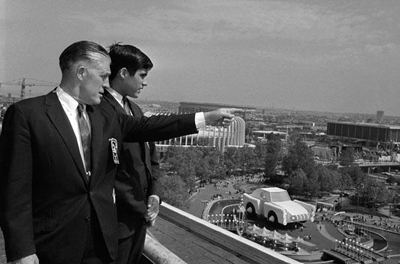
Apart from traits of character, Romney presents himself as prepared to rescue the Olympics because of his experience at Bain Capital. The central symbolic motif of the book is the idea of “turnaround.”
Ann replied, “Just think about it. If there’s any one person ideally suited for this job, it’s you.” She referenced my business experience in turnaround situations. At Bain Capital, we had frequently worked to invigorate underperforming enterprises by utilizing bold and creative maneuvers. I had also been CEO of a consulting firm that had successfully navigated a turnaround (6).
How do you turn a failing company around? Bain has a formula. First, you perform a strategic audit, “a complete review of every aspect of the business.” Then you build a team, selecting choice managers and staff while also motivating them to work together and excel. Then comes “focus, focus, focus”—deciding what few things are critical (54). These steps are followed relentlessly in the book’s overall plot, with chapters devoted to auditing, assembling and deploying staff, and homing in on securing an Olympic-level experience for the athletes and the audience.
Underlying all these steps, and pervading the book’s narrative, is “fiscal discipline.” The problems posed by the Olympics are the classic ones of Waste, Fraud, and Abuse, and Romney sets himself to correct them. There are throughout the book references to what are currently called “takers” in society at large (“patronage jobs, less essential functions, excessive pay contracts,” 111). Contrary to the tenor of current controversies, though, Romney has only scorn for executives and managers who pad their budgets and benefit from freebies. Insofar as Turnaround has villains, they are the previous administrators who let the event be corrupted. They were indicted but not convicted, yet Romney leaves the impression that they were guilty. (“Those who pursued Welch and Johnson were inept,” 23.)
Many big things must be cut. But so must small things, and publicizing those can work to your advantage. Romney notes that the billionaire Bill Marriott (of the hotel chain) once asked for a receipt for a 35-cent toll charge. It’s not just that Bill’s tight with money; he knows that employees and the press will spread the message. This is Romney’s example of “symbolic cuts.” By turning lavish lunches into pizza parties that staff members pay for, Romney shows both insiders and outsiders that his efforts are serious.
The cheeseparing presents a storytelling problem, however. How to keep the hero from looking like a penny-pincher? A few months before the Games open, Romney discovers that the project is in solid financial shape. So he urges that the designer of the big shows plan the fireworks and pageantry as if costs were unlimited. Once the budget has been fixed, the “heart and meaning” of the event can be as spectacular as possible. The book can now end on an upbeat that emblematizes a duality at the heart of Romney’s narrative: Celebrating the triumph of the human spirit is expensive, but ultimately that spirit is more important than money.
After his success, Romney is ready to turn even bigger things around. In the epilogue to the book’s 2004 edition, he explains that he used the Bain formula to run for the Massachusetts governorship. Once he was elected, “The cycle began again: another turnaround” (382).
How did it work out? The prologue added in 2007 claims success. The protagonist managed to get rid of government waste while cooperating with a Democratic legislature. “There are good people on both sides of the aisle” (xi). He turned deficits into surpluses, fought for traditional marriage, supported stem cell research, and took a “truly historic step”:
the passage of a private, market-based health insurance program that would extend coverage to all our citizens. This wasn’t government taking over healthcare and dictating who would get treated for what and by whom. No, it was about personal responsibility replacing government (xi).
Romney emphasizes that this program purged free riders and made everyone, including the working poor, pay something for health insurance.
Having accomplished so much, Romney announces that he feels ready to take the next step. In 2006 he announces his first run for the Presidency.
I know that my love for this country and my experience in bringing change to businesses, to the Olympics, and to Massachusetts would enable me to keep America prosperous and secure (xv).
As in any tale, plot and character coincide: the crisis calls for a leader who has the temperament and the savvy to master it. But the crisis is almost entirely external, leaving no marks on the hero’s psyche. True, Romney harbors some reluctance to take the mission, but that’s a sign of an enduring virtue, his modesty. Once he accepts his mission, he has no doubts and his character doesn’t change. Contrast this with McCain’s conversion narrative in Faith of My Fathers. He starts as a feckless cutup unworthy of his family tradition. Not until his endurance is tested as a tortured POW does he do honor to his father and grandfather. Romney’s character is chiseled in place at the start, and his struggle is a matter of strategy and tactics. The same skill set can be transferred to the problems of a state and to the nation as a whole.
Others don’t receive the same degree of characterization. The members of Romney’s team are quickly sketched, their resumes matched to their place in the hierarchy. Romney’s five sons are barely mentioned, and his wife receives only a little more treatment. Far more important are his mother and father.
References to one’s parents are a basic convention of political autobiography, and Romney sets out both in his characteristically straightforward terms. His mother not only warns him away from caffeine but teaches him the need to serve. His father George Romney becomes an icon of sacrifice (“I grew up idolizing him,” 10), especially for his desire to bring business skills to public service. The measure of the elder Romney’s character is his rescuing his company, American Motors. “He literally risked his net worth on his ability to turn things around” (11). In saving the Olympics, Mitt, like McCain, becomes his father’s son.
The 99 percent
Like Romney’s, Obama’s book starts in the present. He writes as a recent recruit to the US Senate, so again we know how things will end up. Then, like Turnaround, The Audacity of Hope flashes back to earlier moments in Obama’s life. But the time scheme he presents is more complex than Romney’s. And just as the linear pattern of overcoming problems aims to reflect Romney’s speeding-bullet executive style, the braided structure of Audacity suggests the writer’s tendency to circle a problem and study it from several angles.
The Prologue provides a succinct summary of Obama’s career. He leaves his job with a law firm, wins a seat in the Illinois legislature, and in 2000 runs for the US House of Representatives. “I lost badly” (5). He wins a US Senate seat in 2004 and starts serving the following year.
This initial recapitulation of Obama’s career is structurally necessary because the book will be woven out of incidents and ideas from many periods of his life—not just the political career, but his childhood, his days as a community organizer, and the days at a law firm where he courted his wife-to-be. We need a timeline if we’re going to follow all the shifts to come. We aren’t exactly talking Proust here, but Obama does glide freely from the present to different moments scattered through his life, often far out of chronological order.
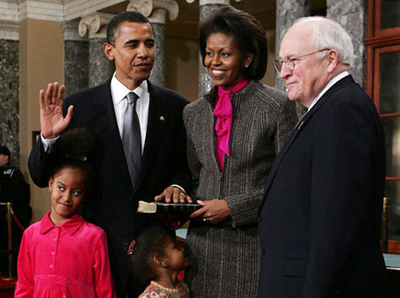
The strongest anchor is given at the start of Chapter One, when Obama is sworn in as Senator. This emblematic moment will reappear in a later chapter and then at the start of the Epilogue. But Chapter One skips from his oath-taking back to his service in the Illinois legislature, then to his “freak win” during the campaign, then to the present and his relations with sitting senators, then back to his childhood and his college days during the Reagan years.
Even more complicated is the zigzag layout of Chapter 6, “Faith.” It starts with abortion debates during Obama’s Senate campaign, skips back to the lack of churchgoing in his childhood, and then traces his acceptance of Christianity as a young man. Next we’re back to the Senate race and a debate with Alan Keyes, followed by Obama’s visit to a black Birmingham church as a serving Senator. Chapter 8, on world problems, starts in Indonesia, one of Obama’s many childhood home countries, before moving to his college days and his un-PC respect for Reagan. Next he’s a Senator going to Iraq in 2005; a citizen stunned by the 9/11 attacks in 2001; a state senator criticizing the Bush invasion of Iraq in 2002. Then he’s back in Iraq, and finally, at the close of the chapter visiting Russia and seeing the threat of nuclear arms in terrorist hands.
What’s the point of all this back-and-forth? Why not a linear account of his campaigns and the obstacles that he overcame? It’s partly because The Audacity of Hope blends the policy statement with the personal memoir. The chapters are presented as topics, like “Values,” “Our Constitution,” and so on. In this respect it’s like Romney’s second book, No Apology. But instead of setting his beliefs out as a finished declaration of principles, Obama tries to show how reflection and encounters with others led him to think about what he should believe. As his style gives dramatic weight to washing the dishes after a family dinner, the book’s overall design tries to present the process of coming to conclusions about policy.
Moreover, by shuttling back and forth across forty-five years of his life, Obama suggests that he brings a variety of experiences to each topic and has learned that life has many sides. For example, the book articulates his recognition that American foreign policy has been a mixture of isolationism and imperial expansion, and he leads us to this through his first-hand experiences of growing up in Indonesia.
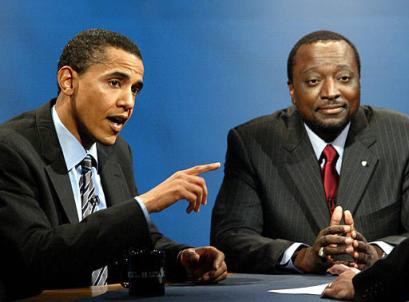
The chapter in which he debates Alan Keyes (above) could easily have been a caricature because, as Obama dryly puts it, Keyes’ self-assurance “disabled in him the instincts for self-censorship that allow most people to naviagate the world without getting into constant fistfights.” Keyes was so unlikely to win the Senate race that “all I had to do was keep my mouth shut and start planning my swearing-in ceremony” (249-250). But Keyes was also a passionate Biblical literalist, and Obama portrays himself as being uncomfortable with the usual liberal responses to Keyes’ militant piety.
He claimed to speak for my religion—and although I might not like what came out of his mouth, I had to admit that some of his views had many adherents in the Christian church (250).
The Keyes debate is a culmination of Obama’s reflection on how he came to Christianity, and he realizes that he has more in common with Keyes than do many liberals who dismiss religion as superficial and ignorant. Incredible as this may seem today, Obama recounts Senate prayer breakfasts in which Rick Santorum and Tom Coburn “share their faith journeys” with “openness, humility, and good humor” (247). He goes on to suggest that liberals must learn to respect and adjust to most Americans’ deep commitment to faith in God.
Shifting the action to and fro across Obama’s life has yet another purpose, one that exemplifies a central concern of the book: the fear of forgetting where you came from. “Stay who you are,” one constituent tells him (122). Obama worries that the poor, the working people, the minority communities, and the struggling middle class will move to the edge of his vision as he embraces compromise and money-driven politics. He even invokes the wealthy one percent.
I know that as a consequence of my fund-raising I became more like the wealthy donors I met, in the very particular sense that I spent more and more of my time above the fray, outside the world of immediate hunger, disappointment, fear, irrationality, and frequent hardship of the other 99 percent of the population—that is, the people I’d entered public life to serve (137).
This worry is given concrete expression in the use of corporate jets. Obama is startled by the amenities he finds on board one of these en route to a meeting with the brains behind Google. But by the end of the chapter (“Opportunity”) he has met union workers, parents of a sick son, and students who go to high school for only half a day because their school district can’t afford to pay full-time teachers. Obama concludes:
These are the stories you miss, I thought to myself, when you fly a private jet (230).
Costs, but what benefits?
Romney gives us very little of the curve of his life: almost nothing about childhood, school, or working at the Bain companies. He comes to us as completely formed and ready for his task. Likewise, he tends to characterize the people around him as finished in their growth. His thumbnail characterizations spell out their gifts for serving in his mission. But Obama meets people who, like him, are still in the process of becoming themselves—children, students, even older people still working out their belief systems.
What little change Romney signals comes from his parents, who taught him civic duty. When given a chance to serve, Romney’s mother asked, “If not me, who?” For Romney, the cardinal virtue of community life is sacrifice. This befits a protagonist who could relax in lifelong comfort but who hears a higher call.
Obama, who scarcely knew the traditional family that Romney celebrates (Turnaround, xiii) and who met his biological father only once, learned from his mother too. When she saw an instance of cruelty or insensitivity, she asked, “How do you think that would make you feel?” (80). The key lesson he learns is empathy. By shifting his story back and forth through time, Obama presents himself as trying to identify emotionally with many people over his life, including those he disagrees with intellectually.
Empathic projection leads the protagonist of The Audacity of Hope to try to see something positive in every opponent, not just Alan Keyes but the judges, lawyers, Congressmen, and professionals who come his way. In his policy reflections, he treats every argument as having some validity. This allows our protagonist to voice self-doubt—an emotion that the Romney of Turnaround never admits to.
For example, Obama opposed Bush’s war in Iraq, but not on grounds of pacifism. He thought it was a war of reckless choice. Still, he supported the ruthless search for Bin Laden and was concerned that Saddam might have weapons of mass destruction. And when Baghdad proved easy to conquer, “I began to suspect that I might have been wrong—and was relieved to see the low number of American casualties involved” (349). Yet after three years of civil war, insurgency, thousands of US deaths, and billions of dollars, Obama came to believe that the invasion had been the mistake he originally suspected it was. Despite all this, when he meets President Bush at his swearing-in ceremony in 2005, he finds him “a likable man, shrewd and disciplined but with the same straightforward manner that had helped him win two elections” (55). They have a friendly conversation. Hate the sin, not the sinner.
Throughout the book, Obama worries. Is he doing right by his wife and children? Family tension is absent from Romney’s memoir, but Obama tells of moments of quarrelling with Michelle, fumbling as a parent and husband (how do you get party bags for a kids’ get-together?) and more seriously wondering—as Romney never does—if the sacrifice of public service is worth the toll it takes on those he loves.
Tentativeness about final judgments and persistent questioning of his own views might lead us to see a Hamlet figure. How does Obama the author solve this problem of characterization? After showing that he scans many sides of a question, he tries to carve out a reasonable middle. In his policy arguments, he tends to start with a core that all sides agree on. Everyone needs to be healthy, all kids need a good education, America needs to remain a model of liberty and civility. He then adduces good points from each side, holding them in balance, as a reasonable way to put core values into practice. It is this strategy, I suppose, that fed the 2008 belief that Obama was “post-partisan.”
In one of the book’s last scenes, he recalls meeting an old lawyer who explained why he couldn’t go into politics. He hated to compromise, he says. For the Obama of The Audacity of Hope, compromise is more than sordid bargaining or betrayal. It rests upon a transcendence of narrow self-interest. It constitutes an ability to see the other person’s ideas and passions as vividly as if they were your own.
Weighing positions in such a way means that confident dogmatism can catch you off-guard. He should have swatted Keyes aside in their debates, but the hyperenergetic windbag got under Obama’s skin. ” In the three debates that were held before the election, I was frequently tongue-tied, irritable, and uncharacteristically tense” (250). The Romney of Turnaround would never feel shaken in this way.
Obama’s storytelling strategies, then, risk making him seem weak. What they could achieve, at least with some readers, is a recognition of frankness, of a man’s realization that he’s prey to human frailties. Romney’s book wants us to admire him, even for his humility, whereas Obama’s tale wants us to empathize—with other citizens, but also with his inner struggles.
From this standpoint, Audacity can offer no fixed finale like Romney’s turnaround successes. For a hero who is perpetually trying to live up to the best he thinks he can be, but plagued by doubts, triumph does not come easily. The book ends on a typically balanced note. He’s happy to have helped people; in an echo of Romney, he recalls Benjamin Franklin saying (to his mother, no less), “I would rather have it said, He lived usefully, than, He died rich.” But then the scale tips toward doubt.
At other times, it seems as if the goal recedes from me, and all the activity I engage in—the hearings and speeches and press conferences and position papers—are an exercise in vanity, useful to no one (426).
He can restore the audacity of hope only by taking a run along the Mall and visiting the Lincoln Memorial–his equivalent of Romney’s Games, a symbol of the virtues he aims to attain.
In their ending is their beginning
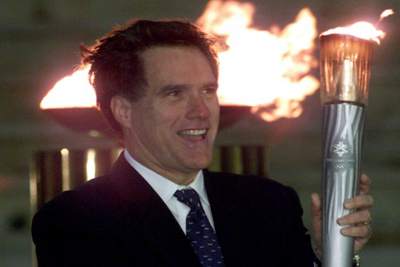
One narrative offers a straightforward struggle to solve a problem; the other, a Bildungsroman tracing the education of a young man in the ways of US politics. Each matches its overall structure to the personality of its hero. And each arises and concludes on an appropriate note.
One way to grasp the dynamics of a narrative is to compare the beginning and the ending. Turnaround starts with Romney contemplating whether to take on the Olympics job.
I held a little contest with my five sons to see who could come up with the best tag line for the Salt Lake Olympics. The winner was “It’s all about sport” (xxi).
In this nexus we find both of the book’s concerns: the Olympic spirit and the need to package and brand it so that it can succeed as a business enterprise. The same duality recurs at the very end:
I could have made a good deal more money over the last five years had I stayed at my investment job. It would mostly have gone to the tax-man or to kids who are better off earning their own. Instead, I have come to know many more people and to help many more people I do not know. It’s a currency of an entirely different denomination: it can’t be taxed, stolen, or depleted. The more I have of it, the richer I feel (384).
Even though the passage denigrates pure money-making, public service is compared to executive compensation, and the satisfaction of helping others is conceived as spiritual wealth.
As you’d expect, Obama’s opening and closing are more spacious and ambivalent. At the book’s start he reviews his political career, the strangeness of his name and his desire to enter politics. He offers a quick invocation of a noble tradition in American politics, one of a commonwealth that gives citizens “a stake in one another” (4). But this sentiment is followed by the doubt I mentioned earlier; did he really believe this easy packaging, all these tag lines?
If you are paying attention, each successive year will make you more intimately acquainted with all of your flaws—the blind spots, the recurring habits of thought that may be genetic or may be environmental, but that will almost certainly worsen with time, as surely as the hitch in your walk turns to pain in your hip (5).
The Audacity of Hope begins under the sign of disenchantment, announcing a restlessness that is perpetually dissatisfied with where one is now and that ignores the “blessings” staring one in the face (5). These worries resurface throughout the book.
By the end, though, the decline that Obama had fretted about at the start turns to a satisfaction in public service akin to Romney’s. If Obama has helped people live with a greater measure of dignity, he can feel worthwhile. At that point, standing in his running shorts at the Lincoln Memorial, he can imagine of all those people, from Lincoln to Martin Luther King, from the colonists and slaves to the citizens of today, who have built America.
It is that process I wish to be a part of.
My heart is filled with love for this country (427).
He doesn’t mention money.
I’ve tried to read each man’s book dispassionately and without benefit of hindsight. I read Obama’s book before the first Presidential debate, Romney’s immediately afterward. It would be easy for me to find that Obama’s prevarication in that initial dust-up reveals his characteristic tentativeness about definitive statements. Likewise, I had to resist seeing in Romney’s aggressive debate performance proof that he was little more than a high-powered salesman. (Although he doesn’t love to sell, he notes in his book, he also notes that selling pervades his executive culture.) Yet I’ve tried to resist such projections. Letting each man have his say, taking each at his word, I’ve tried to study their characteristic narrative strategies—which may reflect the men more accurately than one-off comparisons between their books and their public performances.
In my 2008 narratological analysis of McCain’s and Obama’s books, I didn’t state my own political preferences. I could muffle them now, but I don’t see much point. I am a reluctant Obama voter. I disagree with many of his decisions: the gingerly treatment of Wall Street crooks, the incessant drone strikes, our persisting presence in the Afghanistan war he has too long thought justified, the muddling through the mortgage crisis, the continuing unconstitutional measures mobilized by the war on terror.
I think that Obama has sought to be a statesman without being a politician. Yet he has gotten good things done. There is much to admire in what he’s accomplished in education, health care, fuel efficiency, civil rights, and many other domains. Moreover, he faced unprecedented obstacles to doing anything. I don’t know of any president who has suffered the vileness visited on him and his family by forces of ignorance and cruelty. That Obama can push forward with cheerful poise in the face of such endless, naked hatred shows him to be an extraordinary person.
Despite Obama’s hope that “the fever will break” if he wins, we ought to expect that his more promising proposals will continue to be mocked and blocked by the most shameful elements in American society—selfish wealth, bigotry, self-promotion, fear of science and reason, and lack of compassion. Behind these forces are plutocrats and demagogues prepared to make millions of people suffer while they pursue the one thing they prize: power. Mitt Romney and Paul Ryan are their advance men. For me, the choice is grim but clear: gridlock or cataclysm.
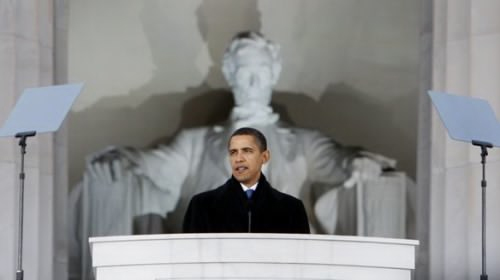
Memories are unmade by this
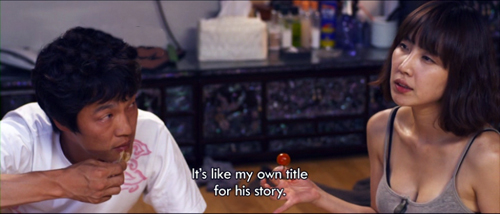
Romance Joe (2011).
DB here:
The Vancouver International Film Festival always provides a host of intriguing experiments with narrative form. This year the Dragons and Tigers series, devoted as usual to new films from Asia, offers such a neat pairing of a veteran director and a newcomer that I can’t resist spending some time on them. Both, it turns out, are interested in memory–not just as a theme, but rather as a process involved in how we watch movies.
Passion for pattern
When we analyze a film, we usually notice patterns—an arc of character development, repeated imagery or musical motifs, recurring framings or lines of dialogue. Filmmakers use these elements of patterning to give elements special significance.
Sometimes the patterns we pick out are noticeable on our first viewing of a movie. Indeed, the film’s effect relies on our seeing later elements as completing a pattern.
Remember “You complete me” from Jerry Maguire? The reason you do, I think, is partly because its first appearance is very salient. It occurs when Jerry and Dorothy are riding in an elevator with a mute couple. Dorothy’s explanation of the couple’s signing highlights it (while characterizing her as a sympathetic person who learned ASL to communicate with a relative). When Jerry restates it in Dorothy’s living room, we recall that it’s a simple declaration of love—a straightforward statement from a man who is habitually slick and evasive. The fact that the phrase stuck in Jerry’s mind from the elevator encounter also offers further proof that he’s not as superficial as he seems. He remembered it, and now we do too.
Sometimes, though, we may find patterns that a viewer may not have noticed on first pass. That’s one of the appeals of doing analysis. As we get to know the film more intimately, we see patterns of coherence that probably many viewers didn’t notice before. In classically made films, for instance, a scene is likely to start with a long shot, proceed to two-shots or over-the-shoulder framings, and then toward tighter close-ups. This stylistic patterning follows the rising drama of the scene’s action. Most viewers probably don’t notice these patterns, but directors, cinematographers, editors, and film students are more likely to catch them. When we analyze a film’s style, we may be surprised to find how often these “hidden” patterns emerge.
Very occasionally a filmmaker gives us something in between obvious patterns and buried ones. A film might repeat something in such a way that (a) you recognize it as a repetition on first pass but (b) you can’t recall exactly what it harks back to. In other words, the filmmaker deliberately organized the movie so that the things that come back are difficult to place in the film as a whole.
The best-known example is perhaps Last Year at Marienbad, where the drifting, dreamlike succession of scenes doesn’t supply standard plot progression. The result is that the images, music, and lines of dialogue are felt as echoes of earlier scenes, but most viewers can’t pinpoint exactly where they first appeared. Another instance would be Buñuel’s Discreet Charm of the Bourgeoisie. Here we get scenes that start more or less realistically, and then devolve into absurdity—at which point one of the people in the scene bolts awake in bed. What we’ve just seen is a dream, but we can’t be sure exactly when the dream started because Buñuel and screenwriter Jean-Claude Carrière didn’t supply a scene that shows the character going to bed. One effect is that the movie seems like a daisy-chain of overlapping dreams, with no sure point at which we can declare that this or that moment is real.
Both Marienbad and Discreet Charm rely on a fact of cinema: It unrolls in time. So do novels, of course, in the act of reading anyhow. But when you’re reading a book you can stop and page back to check where you went off-track. Since the arrival of videotape viewing, we can in principle do the same thing, and we’d want to replay moments if we’re undertaking an analysis. But the normal conditions of viewing, in both theatres and at consumer command, bias us toward forward momentum. Intent on what happens next, we have a surprisingly hazy recall of what preceded the scene we’re watching now. Halfway through a movie, try to come up with an accurate scene-by-scene list of what you’ve just watched.
The diffuse memory we have of the prior action, and the difficulty of going back to check, is one reason that films need some explicit patterning, their marked repetitions, their constant restatement of the story’s premises. Redundancy of information compensates for the time-bound nature of viewing. Films that don’t supply this, as in my recent example of Sueño y silencio, demand a second viewing—and risk frustrating audiences.
In another country, at other times
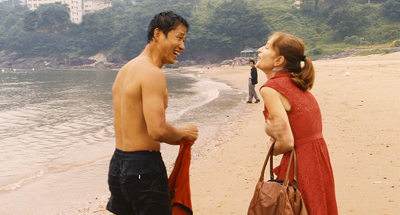
Hong Sang-soo has long been a master of the half-hidden pattern. Each film, usually devoted to the comic deflation of male pretension, is built on a unique armature of repetitions. Most critical commentary simply ignores those, trying to summarize the plots straightforwardly and taking the result as comments on contemporary life—an urban milieu in which intellectuals eat, drink too much, smoke endless cigarettes, and make clumsy attempts at romance and sex. “People tell me that I make films about reality,” Hong remarks. “They’re wrong. I make films based on structures that I have thought up.” It’s the structures, I think, that engage us, and partly by asking us to test our memories of what we saw only an hour or less before.
For instance, The Virgin Stripped Bare by Her Bachelors (2000) at first seems a straightforward he-said/ she-said plot. Initally, scenes showing us a love affair’s progress are organized around one character. Then the affair is replayed, but centering on another character. Many scenes show us each character apart, but when they’re together, that scene gets repeated in the second character’s story. The problem is that some significant details are different in the two versions. We’re asked to wonder whether we’re getting the same story as each character remembers it, or two alternative universes in which the stories differ slightly. Moreover, it’s not easy to recall whether this or that prop or line of dialogue was precisely the same in the first presentation. The strain on our memory is part of the film’s fascination.
Hong has been a regular in the Dragons and Tigers sidebar over the years. He’s reliably prolific: two of his best films, both made in 2010, were in that year’s program. This year brought us another Hong brain-teaser and funnybone-tickler, In Another Country. It’s a measure of Hong’s growing international reputation that Isabelle Huppert is recruited to play three roles in another mazelike plot.
Yonju, staying with her mother in a coastal hotel and beset by family problems, tries writing film scripts. In the first, Anne, a French filmmaker, is vacationing with a South Korean director and his pregnant wife. As Anne gets involved with a hunky, good-natured lifeguard, the director is also making a play for her. Cut back to Yonju, trying another draft. In this one, Anne is a rich housewife from Seoul having an affair with a married man—again a director, but played by a different actor. As she waits for him to join her at the hotel, she meets the same lifeguard and romantic complications ensue. Back to Yonju trying another draft. Now Anne is accompanied by another woman, an older professor. They meet the first director, pregnant wife again in tow, while Anne has become preoccupied with getting life advice from a monk. Once more, needless to say, the lifeguard plays a central role.
As you’d expect with a multiple-draft narrative, the changes are accompanied by some constants—an evening barbeque, the lifeguard emerging from the sea, an encounter between him and Anne in his tent. There are even repeated ellipses, bits that are skipped over in each mini-story. For instance, in all three drafts Yonju, acting as hostess, starts to take Anne on a shopping trip and promises to show her something interesting. But then we cut to Anne alone, wandering through town. Why did the women separate? Is this Anne on a different occasion?
Most to the point of memory tricks, we’ll see something in a late scene that may result from something we saw in an earlier draft. When a bottle of liquor breaks on the beach late in the film, you might remember that a previous scene showed the bottle there already broken—but which scene, in what point, in what story? It’s as if Yonju’s different versions have contaminated one another, with scenes from one draft taken for granted in a different version. In the third draft, what Yonju promised was so interesting seems to be the lighthouse. We may forget that in the earlier versions, we never knew why Anne was searching for the lighthouse. Still, we’re unlikely to forget the parallel framings.
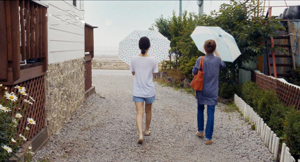
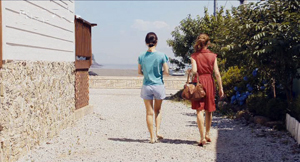
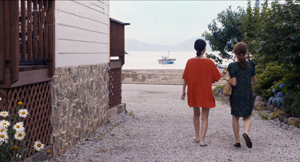
This sort of play with our memory can bring the movie to a satisfying, if enigmatic, conclusion. An umbrella, a casual and forgettable prop in one version, provides a kind of minuscule climax in the last. And the final shot of Anne walking into the distance becomes a variant of the film’s first one.
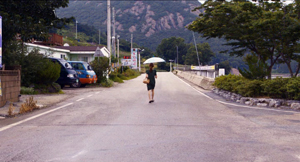

In Another Country provides plenty of social comedy. Hong’s customary satire of Korean males’ awkward sexual aggressiveness is now accompanied by digs at westerners’ search for mystic Asian enlightenment. But the narrative structure is amusing in itself. Hong cajoles us into enjoying the surprising but inevitable recycling of situations, lines, and camera setups. Few filmmakers can make audiences laugh at the mere appearance of a shot and tease us to expect a replay of or departure from what we’ve already seen. Even if we couldn’t say precisely when we saw that image before, we recognize it and participate in a light-hearted game—the game of form.
Wristcutters share their stories
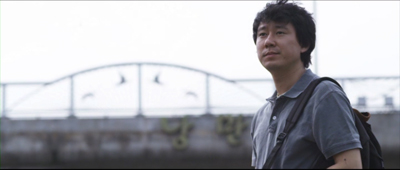
Romance Joe (2011) was made by Lee Kwangkuk, Hong Sangsoo’s assistant director on many projects. No surprise, then, that his debut relies on parallels and variants. Yet it’s much more explicitly about storytelling than In Another Country. Hong uses Yonju’s script drafts as a peg to hang his variations on, but he doesn’t suggest he’s exploring the very nature of narrating. Lee puts fiction-making at the center of his game.
It would be misleading to summarize the plot, since the film aims to put any firm sense of what really happened into question. The core, we might be tempted to say, is the story of a schoolgirl, Cho-hee, who is shunned because she has had sex with an unnamed man. A boy in her class takes pity on her, and when he finds that she has slashed her wrists in a forest glade, he rescues her. They tentatively fall in love and flee to Seoul. On their first night there, he takes fright and returns home. Left alone, she turns to prostitution, and years later, when the boy is now in Seoul in film school, she agrees to participate in a student film he’s crewing. He doesn’t recognize her. More years pass, and the boy is now a film director. He returns to the village, recalls their runaway romance, and in despair attempts suicide. Meanwhile, Cho-hee’s son, whom she has left with her grandparents, comes to the village in search of his mother.
I think it’s fair to say that even this bare-bones anatomy of Romance Joe isn’t fully registered on a first viewing. And in any case, my synopsis is misleading. Why? Because many of these actions are presented as intersecting tales told by two characters who don’t know one another. A Seoul screenwriter recounts the story of the boy’s search for his mother as a purely fictitious one, an idea he has for a script. Alongside that tale, but not precisely inside it, we see Lee, another writer who’s blocked on a story and visits a village to compose a film. There he spends a long night with a tea lady-hooker, Rei-ji, who takes over storytelling duties. Like Scheherazade, she regales him with another story (see our top still). Her tale focuses on the suicidal screenwriter she calls “Romance Joe”–who turns out to be a filmmaker who has gone missing.
So we have one character telling the story of another character who’s hearing a story presented by Rei-ji–a story about yet a third filmmaker, the despairing director, and one that includes his own memories. More confusingly, Rei-ji’s story not only overlaps with the boy’s quest; she becomes a character in the first screenwriter’s imaginary plot. To add to the intricacy, the film employs only partial framing situations, so we might get a scene establishing one tale’s telling, then the embedded tale, and then another situation of telling, as if what we’ve just seen was launched by one storyteller but picked up by another. Instead of a Chinese-box or Russian-doll structure, with one tale neatly enclosed in another, we get something like a cut-and-shuffle mix. And like In Another Country, this film doesn’t wrap things up by a return to the narrating frame; we’re left with something more ambivalent–a question about the very status of the whole assemblage of stories.
It sounds choppy, but it all flows. As one scene slips into another, with abrupt reminders that we’re seeing events told by someone or other, we’re confronted with a cascade like that in Discreet Charm of the Bourgeoisie. We’d be unlikely to recall the precise moment when one story melted into another. Storytelling is linked to rumor and gossip, chiefly by the fact that the trigger for Lee’s initial writer’s block is the suicide of a major actress, supposedly hounded by innuendo. The chief parallel is to Cho-hee, driven to suicide by malicious classmates, but other characters sport the scars of slashed wrists. In this context, the motifs of rumor and suicide tie together the stories conjured up by each of the narrators–again, apparently operating in some predetermined harmony.
Throughout, our uncertainty is increased by some tantalizing misdirections. Might Rei-ji, not Cho-yee, actually be the boy’s mother? Has Lee, after hearing Rei-ji’s story, created the very film we have watched? Finally, the possibility that Rei-ji is no less a fictioneer than the professional writers is broached when she returns to the teahouse and tells the younger hooker that you can make more money through talk than through sex. “Everyone wants a different story. Put some thought into what clients want.” In telling one screenwriter a story about another one, she’s just suiting the service to the customer.
When we study narrative we naturally emphasize the main plot points, the twists and climaxes that claim our attention, the hints that pay off: the gun in the first act that goes off in the last. But films like In Another Country and Romance Joe remind us, as Roland Barthes put it, that “reading is forgetting.” By planting items that will become important later, filmmakers keep us focused on what’s to come and eventually mobilize memory to make all the pieces fit. But filmmakers can also seed their plots with small things that we barely register, then bring them back as half-recalled items. Films like Hong’s and Lee’s are more than puzzle movies; they induce our imaginations to grapple with the limited capacity of our memories. Those limitations in turn affect how we judge characters and the truths of the tales they bear. And in films like theirs, as often in life, our judgments have to remain in tense suspension.
I discuss problems of viewers’ memory in “Cognition and Comprehension: Viewing and Forgetting in Mildred Pierce,” in Poetics of Cinema. I consider Jerry Maguire‘s narrative organization in The Way Hollywood Tells It. For previous VIFF entries that examine complex narration and plot structure, go here and here.
P.S. 5 Oct 2012: Sean Axmaker, with whom we spent many lively hours at VIFF, has posted reviews of several Asian films, including Romance Joe, at Parallax View.
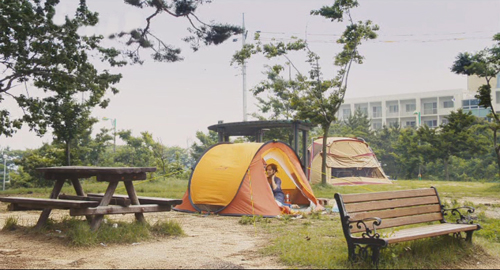
In Another Country (2012).
A Hobbit is chubby, but is he padded?
Kristin here:
On July 14 at this year’s Comic-Con, a thirteen-minute montage of clips from The Hobbit was shown during an appearance by Peter Jackson and cast members of the film. Afterward in press interviews, Jackson unexpectedly hinted that The Hobbit, long announced as being made in two parts to be released in December 2012 and 2013, might be expanded to three parts. This possibility inspired much skepticism among fans and members of the press. And yet only two weeks later, on July 30, it was announced that The Hobbit would indeed be released in three parts, the third to appear in the summer of 2014.
Although some fans of the film of The Lord of the Rings were delighted, there was much speculation in the press that the move was made from sheer greed, milking a third blockbuster from Tolkien’s modest children’s book. There were even some accusations that Jackson had lost his creativity and was seeking to extend his most successful series beyond its logical stopping point.
Yet if one reads the filmmakers’ statements about the decision to make an additional part of The Hobbit, it is clear that they intend to add more plot material rather than stretching the story of the relatively short novel. There is plenty of additional, directly relevant material in Tolkien’s appendices to LOTR. None of it is given in enough detail to make a free-standing film. Still, no doubt the filmmakers and the production studio began to realize that they had the rights to all this material, and that incorporating some of it into The Hobbit was their only chance to use it. Warner Bros. surely was delighted at the prospect of another lucrative blockbuster.
I’m not convinced, however, that Jackson’s team made their decision primarily from considerations of money. For one thing, some of the material from the appendices was created by Tolkien to tie the events of The Hobbit to those of LOTR. The filmmakers could use it for that same purpose. So far, the trailers and images from the forthcoming film seem to me quite promising in terms of how the appendices have been quarried for useful story items.
It happens that for avid fans of Tolkien, this is a special moment. It’s Tolkien Week. Ever since 1978, the week in which September 22 occurs is dedicated to The Professor, as he is respectfully known to devotees. And September 22 is Hobbit Day, because it is the shared birthday of Bilbo Baggins (who turned 111 on the occasion of the Long-Expected Party that opens the book) and his adopted nephew Frodo (who turned 33, the age of adulthood for Hobbits).
Warner Bros. and the filmmakers have shrewdly chosen this week to release the second trailer for The Hobbit (not counting the teaser). It appeared online on September 19, with the best-quality versions on Apple. (A high-quality version of the first trailer can be seen here.) There’s also a site where you can watch the trailer with five alternative endings, all of them humorous. (The Bilbo one is undoubtedly the best, though I enjoyed the Gandalf one as well. The Dwarf ending is actually the same as in the theatrical version.) The first part of The Hobbit is due out on December 14 in the USA and many markets, and on other dates in December elsewhere.
From two parts to three
I have a uniform paperback edition of the two novels where The Hobbit runs 272 pages and The Lord of the Rings, not counting the appendices or Prologue, runs 993 pages. So The Hobbit is less than a third the length of its sequel. The implication would seem to be that in order to be comparable to Jackson’s version of LOTR, its film adaptation should occupy a single part of perhaps three hours.
Of course LOTR, even in its eleven-and-a-half-hour extended DVD versions, left out a great deal of Tolkien’s novel. (Excision was Tolkien’s expressed preference, by the way, for a film adaptation. In a letter disapproving of a 1957 treatment for a proposed film of LOTR, he stated that cutting scenes was far preferable to racing through a complete but compressed version.) Still, given the huge success of the three-part film, it seemed reasonable that Jackson and company would treat The Hobbit more fully, eliminating less and giving fans a more complete version of the earlier book.
But three parts for The Hobbit? Especially when this change was sprung on the public less than six months before the world premiere of the first part (November 28 in Wellington)? The move proved controversial and has been argued and speculated about ever since. Every trailer, every scrap of footage (especially the 13-minutes of clips shown at Comic-Con and still not available to anyone who was not in Hall H on July 14), every photograph has been closely examined for hints of what extra material might be included in an expanded Hobbit.
The reactions have generally been of four types. Keen fans of Jackson’s LOTR are delighted, trusting him and his fellow screenwriters, Fran Walsh and Philippa Boyens, to come up with extra material true, if not to the book, at least to the spirit of the first film. Others are more skeptical, feeling that Jackson’s team is being too ambitious and is trying to stretch the book’s contents too far. After all, it was written as a children’s novel, not an epic romance like LOTR. A third group simply accuses Jackson of opportunism, whether his own or mandated by greedy corporate types at Warner Bros. (parent company of production unit New Line). Finally, a few commentators view the move as evidence of artistic “stagnation” on Jackson’s part
Most prominent among those in the fourth camp is James Russell, who wrote a piece baldly entitled “Peter Jackson’s three Hobbit films suggest he is running on empty,” for The Guardian. He argues that Jackson had never had a commercial success before LOTR, and that his post-LOTR films have been neither as lucrative nor as critically praised. Now, Russell suggests, Jackson has returned to familiar territory, despite having initially hired Guillermo del Toro to do the directing honors:
It’s hard to see how making The Hobbit could be seen as a positive step for Jackson. However, splitting the story into three separate films takes the moribund self-absorption of the project to entirely new levels. It looks as if Jackson is running entirely on empty, pushing this side project to ridiculous extremes because he has nothing else to offer.
(See also IndieWire‘s “An Open Letter to Peter Jackson on Splitting The Hobbit into Three Movies.”)
Jackson inadvertently encouraged such an interpretation back in the early days of pre-production, when del Toro was still the designated director. He said that he had visited Middle-earth once and did not want to compete with himself. Even when del Toro exited the project in late May, 2010, Jackson said he would not step into the job unless no one else could be found and the project was in danger of falling apart. Asked when the production process would move forward, he responded: “I just don’t know now until we get a new director. The key thing is that we don’t intend to shut the project down…We don’t intend to let this affect the progress. Everybody, including the studio, wants to see things carry on as per normal. The idea is to make it as smooth a transition as we can.”
The announcement that Jackson would in fact direct The Hobbit was not made until mid-October, and his statement in the press release was notably bland: “Exploring Tolkien’s Middle-earth goes way beyond a normal film-making experience. It’s an all-immersive journey into a very special place of imagination, beauty and drama. We’re looking forward to re-entering this wondrous world with Gandalf and Bilbo – and our friends at New Line Cinema, Warner Brothers and MGM.” Nevertheless, he has assured the public that once he agreed to direct, his immersion in pre-production re-ignited his enthusiasm for working with Tolkien’s material. Judging by the two trailers, as well as the eight video production diary entries so far posted on Jackson’s FaceBook page, that enthusiasm is genuine. The expansion of the film to three parts is another indicator that he has been inspired by his return to Middle-earth.
Not padding but extension
Major spoilers ahead! Page and chapter numbers from the two novels are from the most definitive versions of the texts: for The Hobbit, Douglas Anderson’s The Annotated Hobbit, second edition, and the 50th anniversary single-volume edition of LOTR, edited by Wayne Hammond and Christina Scull.
The widespread assumption since the announcement of the three-part Hobbit has been that Jackson and his fellow screenwriters would simply stretch out the action of the book. Yet that is clearly not what the trio is up to. In the press release, Jackson sounded much more enthusiastic:
Upon recently viewing a cut of the first film, and a chunk of the second, Fran Walsh, Philippa Boyens and I were very pleased with the way the story was coming together. We recognized that the richness of the story of The Hobbit, as well as some of the related material in the appendices of The Lord of the Rings, gave rise to a simple question: do we tell more of the tale? And the answer from our perspective as filmmakers and fans was an unreserved ‘yes.’ We know the strength of our cast and of the characters they have brought to life. We know creatively how compelling and engaging the story can be and—lastly, and most importantly—we know how much of the tale of Bilbo Baggins, the Dwarves of Erebor, the rise of the Necromancer, and the Battle of Dol Guldur would remain untold if we did not fully realize this complex and wonderful adventure.
There is a great deal of material in the appendices of LOTR relating to the plot of The Hobbit, though in many cases that material involves characters and events barely referred to in the novel. In the book, Gandalf departs from the Dwarves and Bilbo midway through, going off, as he later reveals briefly “to a great council of the white wizards, masters of lore and good magic; and that they had at last driven the Necromancer from his dark hold in the south of Mirkwood” (p. 357). All this was later fleshed out, partly in the body of LOTR and partly in its appendices: the council became The White Council, which included Elves like Galadriel and Elrond; the Necromancer gained a name, Sauron; his “dark hold” became his secondary dark tower, Dol Guldur.
As is quite clear from the trailers and from statements by the filmmakers, action involving the White Council and the attack on Dol Guldur will figure prominently in The Hobbit. Already an image of the White Council, including Saruman and apparently taking place at Rivendell, has surfaced in one of the licensed tie-in books:
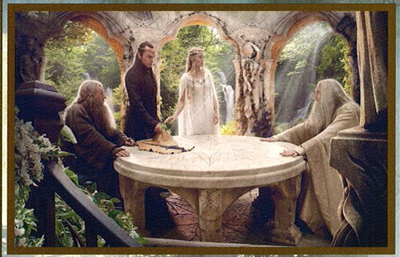
This may not, however, be the White Council meeting that occurs during the action of The Hobbit. It may be a flashback to the one in Third Age 2851, described in the invaluable chronology of Appendix B:
2850 Gandalf again enters Dol Guldur, and discovers that its master is indeed Sauron, who is gathering all the Rings and seeking for news of the One, and of Isildur’s Heir. He finds Thráin and receives the key of Erebor. Thráin dies in Dol Goldur.
2851 The White Council meets. Gandalf urges an attack on Dol Guldur. Saruman overrules him. (p. 1088)
An image of Dol Guldur appears in the second trailer:
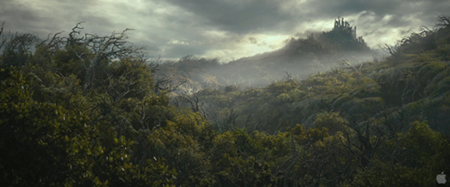
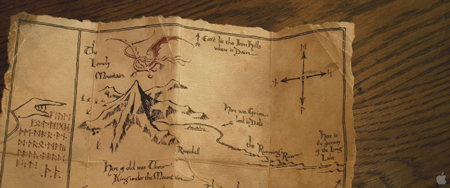
Saruman opposes the attack on Dol Guldur because he has secretly begun to search for the One Ring, desiring it for himself. Thráin gives Gandalf not only the key of Erebor but a map of it. That’s the map Gandalf looks at in Bag End just after his arrival in The Fellowship of the Ring. He will give the map and key to Thorin Oakenshield, son of Thráin and leader of the Dwarven troop in The Hobbit. Both will be crucial in the plot. The map also appears in the second trailer:
Tolkien wrote the appendices in 1954-55, vainly hoping to include them in the third volume of the novel. (They were incorporated into a later edition.) They retrospectively fill in events of the Third Age that led up to the plot of LOTR. He did not go back and extensively revise The Hobbit to incorporate these events, though he did a bit of fiddling with the original version in order to bring it more in line with LOTR. One cannot help but suspect that Tolkien wished he could have dealt with all these events in more than outline form. I for one am intrigued to see these bits of plot, sketched out by Tolkien in such a tantalizing way, fleshed out by the filmmakers.
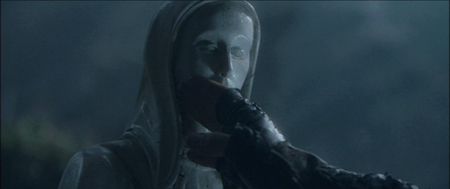
No doubt that, as with LOTR, I will not agree with all the choices the screenwriters make in doing so. Still, we already have evidence that they can be adept in incorporating material from the appendices into the plot. They already did so to a more limited extent in LOTR. The scene in the extended DVD version of The Fellowship of the Ring of Aragorn visiting the grave of his mother, Gilraen, at Rivendell is derived from “Here Follows a Part of the Tale of Aragorn and Arwen,” a section of Appendix A (pp. 1057-1063). Tolkien considered this tale the most important part of the appendices, insisting that if foreign translations had to cut them, they should at least retain the narrative of the Aragorn-Arwen romance. The scene at Gilraen’s grave, brief though it is, adds depth to Aragorn’s character and to his relationship with his foster father, Elrond.
This moving story is also the source of the scene in The Two Towers where Elrond tries to persuade Arwen to leave Middle-earth for the Undying Lands by predicting her life with Aragorn. The dramatization of the prediction is a literal flashforward, for in the book Aragorn’s death eventually leads Arwen to regret her decision to remain with him, and she wanders, embittered and alone, in Lothlórien for a year before her own death (a period depicted by a single shot in the film). This flashforward is a powerful scene, and the film is all the better for its inclusion. We should not leap to the assumption that Jackson, Walsh, and Boyens will falter in their attempts to draw material from the appendices into The Hobbit.
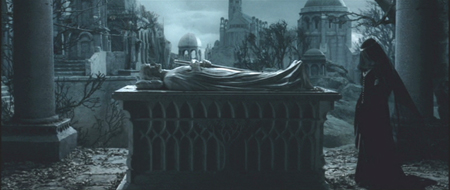
There has been much fan speculation that the longer version of The Hobbit will include flashbacks to more of the Dwarves’ history. A scene might show the dragon Smaug driving the Dwarves from their ancestral home in the Lonely Mountain and assembling the hoard on which he lies when they return to retake the mountain. It might include their move into exile in the Blue Mountains west of the Shire. All of this could also be linked to Moria. Balin, whose tomb the Fellowship members discover in the Mines of Moria in The Fellowship of the Ring, is a character in The Hobbit, the eldest of the Dwarves. Between the action of The Hobbit and that of LOTR, he leads a troop of Dwarves to Moria to try and recapture it from the orcs that had conquered it generations earlier.
Tolkien wrote a brief history of the Dwarves and Khazad-dûm (Moria) in “Durin’s Folk,” another section of Appendix A. This includes an entire scene with dialogue, depicting Thráin’s father Thrór’s suicidal attempt to re-enter Moria; he is killed by the orc Azog. Although not crucial for the Quest of Erebor plot of The Hobbit, a flashback to such a scene would link it to the Moria passage of LOTR. There is a causal connection as well. Before departing for Moria, Thrór gives Thráin the last of the seven Dwarven rings, which leads Sauron to capture and imprison Thráin in Dol Guldur, taking the ring from him; that is why Gandalf later finds him in Sauron’s dungeons.
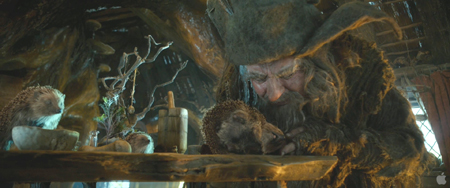
Such scenes might or might not be used, but the filmmakers have definitely decided to include Radagast the Brown, the third wizard, who is only mentioned in The Hobbit. (He appears in one scene in the LOTR novel, but he was eliminated from the film.) Radagast plays a limited role in Tolkien’s Legendarium, having apparently “gone rustic” and become absorbed with the birds and animals of Mirkwood, largely abandoning his part in trying to defeat Sauron. Still, his inclusion in the film seems a positive thing, as some charming shots of him playing with hedgehogs in the second trailer suggests:
The decision to divide The Hobbit into three parts presumably came too late to permit numerous changes in the first part. Nonetheless, the point at which the first film was planned to end has apparently been changed dramatically. The film’s official site posted an interactive wallpaper generator that showed a panoramic scroll summarizing the film’s scenes, from Gandalf scratching a rune on Bilbo’s door to the moment when the Dwarves and Bilbo escape from Thranduil’s dungeons in barrels floating down a river. That scene happens well over halfway through the novel. Once the three-part release was announced, the wallpaper generator was changed to its current version, which ends with the episode of Gandalf, the Dwarves, and Bilbo trapped up burning fir trees by wargs and goblins. Two shots from that episode are the latest events shown in the new trailer and would seem to provide a good cliff-hanger for the ending:
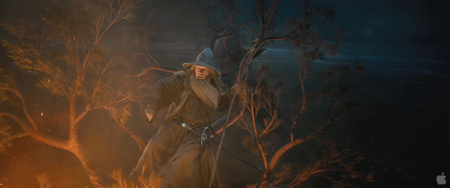
This episode happens in Chapter 6 of the book’s 19 chapters, while the barrels scene is in Chapter 9. This shift suggests that a considerable chunk of action has been added to the first film. That action probably derives from the LOTR appendices rather than some stretching of episodes from The Hobbit.
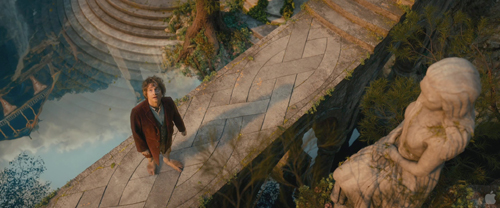
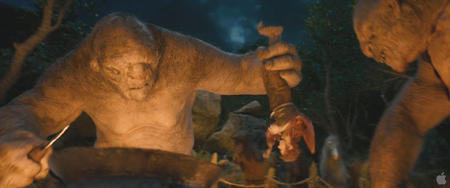
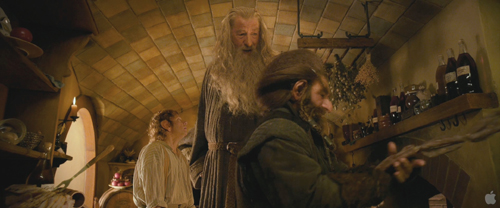
Perhaps to reassure fans, most of the new trailer shows scenes very familiar from the book: the Dwarves arriving unexpectedly at Bag End, the three trolls preparing to cook Bilbo (above), and of course the beginning of the famous riddling contest between Bilbo and Gollum. Two shots of Bilbo’s awestruck reaction to being in Rivendell (at the top) capture the spirit of the book perfectly. After all, Bilbo ended up living in Rivendell during his declining years, and while there he translated the ancient Elvish texts that became The Silmarillion. All this suggests that the bulk of the material derived from the appendices will appear in the second and third parts.
As a long-time Tolkien fan, I would be as disappointed as anyone if the decision to divide The Hobbit into three parts were done merely by stretching out the plot of the novel. All the evidence, however, points to a careful incorporation of bits of Tolkien’s own text to fill out the background of the tale and to link it more firmly to LOTR. Essentially it sounds as though the screenwriters have sought and probably found a way to incorporate the original “bridge” film, announced long ago when The Hobbit adaptation was first revealed in the press, into The Hobbit.
The bridge film was to have been a sequel to The Hobbit, which at that time was planned as a single film. It would fill in the events between the end of The Hobbit and the beginning of LOTR–a gap of sixty years in the novels. It apparently was to have been made up primarily of scraps of plot garnered from the appendices. Whether the writers would have been able to come up with an overall structure to unite those scraps is debatable. Using the strong spine of The Hobbit‘s plot to support them seems a promising solution to the problem.
Perhaps I will be disappointed upon seeing the film, but all the evidence so far indicates that the writers have been inventive and careful in expanding the project. Moreover, the trailers suggest that the technology used to create Gollum and to manipulate the sizes of the actors has improved since LOTR, as the frame below indicates.
Happy Hobbit Day to all!
For Tolkien’s thoughts on cutting versus compression for adaptations of his films, see The Letters of J. R. R. Tolkien, p. 261.
DIAL M FOR MURDER: Hitchcock frets not at his narrow room
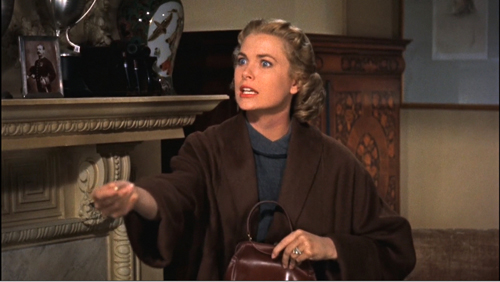
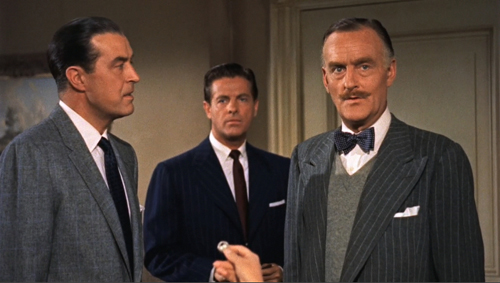
Dial M for Murder (1954).
DB here:
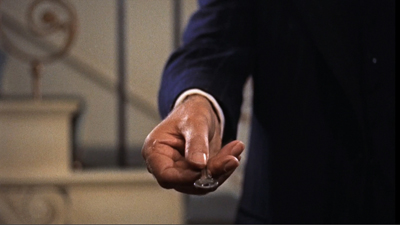
This cut makes you say: Huh? Margo’s hand is shamelessly out of proportion and, judging by the men’s stares, we’re somehow looking through her torso.
Yet does anybody notice it? The cut reminds us that Hitchcock can get away with murder, cinematically speaking. Probably you didn’t need reminding, but even an inveterate Hitchcock watcher (I saw Dial M for Murder when I was about seven years old) can still be shocked by the old guy’s sheer bravado.
In 1979, Dial M was revived, and a restored version began a tour as a re-release, playing in 3D around the US and Europe. It ran in New York’s 8th Street Playhouse in 1981, and Kristin and I caught it in London at about that time. Most relevant to today’s entry, in September of 1981, it screened in a 3D retrospective at what was then called the Festival of Festivals, the earlier incarnation of the Toronto International Film Festival. According to Variety, the late-night show turned away a thousand people.
It’s good to report, then, that about thirty years later it returns to what has become one of the most important festivals in the world. Last night Dial M, muscled up in a digital restoration, screened to a sold-out house at TIFF. Preparing some remarks to introduce it, I found myself captivated once again by this curious project. Overshadowed by Rear Window, which was released later the same year, it now seems quite a daring movie, and not just because of this brazen cut. This newest restoration is very welcome, for it gives us an occasion to see what Sir Alfred can sneak past us.
Naturally, there are spoilers ahead, so if you haven’t seen the film you probably shouldn’t read past the next couple of sections.
3D: Device, demand, decline
During the 3D boom of early 1953, Warner Bros. was an enthusiastic participant. House of Wax, released in April, had proven a huge success; ultimately it would earn $9.5 million and become the top 3D release of the period. Jack Warner halted production from April through early July in order to retool the studio for the new process. Jack announced several pictures going into stereoscopic production, including Lucky Me, Helen of Troy, Them, and A Star Is Born. None of these wound up in the new format, but two others, Hondo and Dial M for Murder, did.
At summer’s end, 3D was starting to flag, largely, it seems, because screening the films posed so many problems. No system had been standardized, and different studios embraced various formats. Late in 1953, some interest perked up, chiefly because of Hondo and MGM’s Kiss Me Kate, but very soon the fad was over. In early 1954 most 3D releases played in their flat forms, and some were released only that way. In April, a month before Dial M opened, Variety ran a story headlined “3-D Looks Dead In United States.”
Dial M had been shot in summer of 1953. According to Bill Krohn, Warners was obliged by contract to wait until the original play had concluded its run, so the release was delayed until May 1954. By then even Jack had lost faith in the format. Dial M was the first Warners 3D picture that the studio permitted to be shown flat in first run, and most exhibitors took that option. 3D, Hitchcock reflected, was a nine-day wonder, “and I came in on the ninth day.” The picture still did reasonably well, earning $3.5 million–but Rear Window returned nearly three times that to Hitchcock’s new home, Paramount.
Wider, deeper, in color
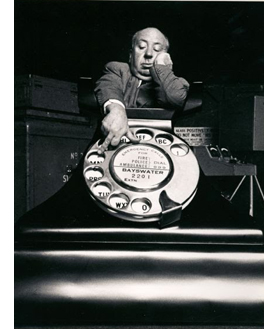 Dial M for Murder confronted Hitchcock with three new technical challenges. Most obviously, the demand that the film be shot in 3D created problems with the bulky camera (“the size of a room,” Grace Kelly remembered, with some exaggeration). It couldn’t focus some shots as closely as Hitchcock would have preferred. The extreme close-up of Tony Wendice dialing, like the shot that starts the opening credits, had to be made with a giant telephone and a big fake finger, a piece of effects work that Hitchcock happily publicized.
Moreover, cinematographers were still figuring out how to judge each shot’s best convergence point (roughly, the way the two lenses defined the location of the screen’s surface) and interocular distance (the distance between the two lenses, mimicking the spacing of our eyes). Misjudging these factors could lead to distortions, such as making actors look closer together or farther apart than intended. Hitchcock worried about the “waste space” around his players in the initial footage the crew shot. In addition, directors had to be careful when the convergence point was set beyond foreground figures. If the figure was cut off by the frameline, a partial torso could be floating out at the audience. (The same threat can arise in today’s 3D films.) Interestingly, there are very few shots in the film’s first half that use a vertical frameline to bisect a character, and almost no over-the-shoulder reverse angles, which were, according to one cinematographer, risky.
Hitchcock’s concern for too much empty space might have been aggravated by the studio’s demand that the film be in widescreen. With the rise of CinemaScope, most studios had decided to release films in wide formats, and Warners was no exception. Dial M was released in 1.85:1.
Finally, although Hitchcock had shot in color before, this was his first outing with Eastman Color, a single-strip emulsion that eliminated the need for three-strip Technicolor. (Indeed, Eastman Color made several new processes, like 3D and CinemaScope, feasible.) But the new stock was somewhat less sensitive to light than Technicolor, and one advantage of shooting single-strip—the fact that you no longer needed the big Technicolor camera—was lost because of the 3D apparatus.
Faced with these obstacles, Dial M can look like a step backward. In Hitchcock’s interview with Truffaut, he agreed, claiming to have been “coasting, playing it safe. . . . I was running for cover again.” He had been planning a more personal project that fell through, and it was Warners that suggested he do Dial M, a property they’d acquired. After seeing the play, he agreed, but even while shooting, Grace Kelly recalled, he was already planning Rear Window.
At first glance, Dial M for Murder seems like the epitome of photographed theatre. Nearly all the action unfolds in the apartment of Tony and Margot Wendice, mainly in their living room. We get brief views of the bedroom, the terrace, and the hallway outside. Only about five minutes, or about 6 %, of the film take place on the street or in Tony’s club.
Both Frederick Knott, author of the play and screenplay, and Hitchcock failed “to take full advantage of the screen’s expansive powers,” opined Brog. of Variety. “As a result, ‘Dial M’ is more of a filmed play than a motion picture.” In talking with Truffaut, Hitchcock seemed to agree. “I just did my job, using cinematic means to narrate a story taken from a stage play.” In another interview he elaborated:
I think that’s the job of any craftsman, setting the camera up and photographing people acting. That’s what I call most films today: photographs of people talking. It’s no effort to me to make a film like Dial M for Murder because there’s nothing there to do.
Actually, I think there was a lot there to do, and Hitch did it.
Acknowledging the source
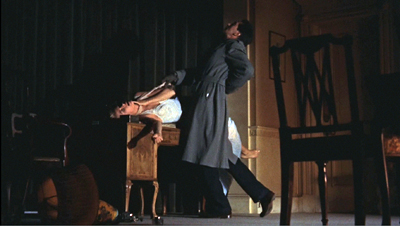
We could counter Hitchcock’s just-a-job-of-work argument easily by citing what he did with the famous attempted strangulation. Swann, alias Lesgate, has slipped out from behind the curtain. After waiting tensely for Margot to lower the phone, he wraps the scarf tightly around her neck and thrusts her onto the desk. She squirms, frantically grabs a pair of scissors, and stabs him in the back. Next, according to Knott’s stage directions:
Lesgate slumps over her and then very slowly rolls over the left side of the desk, landing on his back with a strangled grunt.
No viewer will ever forget the far more hideous death that the would-be killer suffers onscreen. After flopping over Margot, apparently dead, he snaps back to life spasmodically, as if jolted by bursts of electricity. His body yanks itself erect, his arms twisting helplessly as he tries to withdraw the blades, before he turns over and hits the floor . The impact drives the scissor blades further into his back. Hitchcock celebrates the moment with an Eisensteinian overlapping cut to a close-up of the scissors. He had a special pit dug, he proudly told a reporter, to make the lens flush with the floor.
So much for just setting up the camera and photographing the people acting. We could point to other alterations from the play, such as the strained drawing-room courtesies that frame the whole story. “Let me get you another drink,” is the film’s first line, as Margot and Mark pull out of a passionate clinch. At the end, nabbed, Tony offers to pour his wife and her lover a drink, and then asks the detective: “I suppose you’re still on duty, Inspector?” There’s also the peculiar mustache motif. The play text and the film dialogue mock Lesgate/ Swann slightly for growing one, but the film adds the mini-gag of self-satisfied Inspector Hubbard calmly combing his own mustache.
Fine as these isolated moments are, Hitchcock’s treatment is more thoroughgoing. He does, as he tells us, use cinematic means “to narrate a story taken from a stage play.” But those means are unusual and instructive.
Hitchcock had already experimented with plots confined to tight quarters–a lifeboat (Lifeboat, 1944) or a parlor and hallway (Rope, 1948). It’s plausible, as many critics have noted, that he tried the same thing with Dial M. But those earlier films seem more technically radical. You couldn’t ask for a much more cramped space than a lifeboat, unless you wanted a phone booth (which Hitchcock did consider for a film). Similarly, Rope‘s experiment with very long takes (it has only 11 shots) made it extraordinary for its day. From this perspective, Dial M can look like a retreat. It expands its range of action in modest ways, and it doesn’t try for a consistent long-take look. There are nearly seven hundred shots, and the average runs a little under ten seconds, quite normal for the period.
Yet limiting the action largely to the apartment wasn’t exactly taking the line of least resistance. In adapting a play, there’s always a temptation to open things up. Most plays include a great deal of action that takes place before the play’s opening scene, or in other locales offstage. In other words, the plot of the piece is highly selective and concentrated in both space and time, while the broader story—the sum of all the incidents that contribute to the action—is recounted or suggested on stage. Most film adaptations “ventilate” the original by dramatizing these scenes, as Brog. apparently would have preferred.
Hitchcock resisted the temptation to open out the play. Showing scenes that take place before the stage action (perhaps the theft of Margot’s handbag, or Tony’s stalking of the shady Swann/ Lesgate) would have lost the tight focus of the original. Moreover, we can gain an extra layer of interest when action is recounted rather than dramatized: we get both past events and present attitudes toward them. (In other words, sometimes we should tell rather than show.) Most intriguing, though, is Hitchcock’s comment to Truffaut that opening up a play “overlooks the fact that the basic quality of any play is precisely its confinement within the proscenium.” Hitchcock wanted “to emphasize the theatrical aspects.”
Hitchcock wasn’t alone. In the 1940s, several filmmakers were rethinking the problem of filming theatre, and they were exploring ways to bring out the “theatrical aspects” of the material. In a brilliant 1951 essay, André Bazin pointed out that filmmakers were now confident enough in their creative choices to adapt plays while acknowledging the pleasure of purely theatrical conventions. These films, he suggests, engage us by acknowledging the theatricality of theatre.
Bazin pointed to Olivier’s Henry V (1944), which begins in an Elizabethan playhouse and gradually moves its scenes to realistic settings. He mentioned as well Cocteau’s Les Parents terribles (1948), which, somewhat in the manner of Dial M, finds an equivalent for the play’s single-room set by expanding the film’s locale just slightly to take in an entire apartment. Other examples would include Welles’ Macbeth (1948), Melville’s Les Enfants Terribles (1950), and H. C. Potter’s The Time of Your Life (1948). Earlier in the decade, the obviously artificial sets and to-camera addresses of Our Town (1940) and Wyler’s handling of the parlor and staircase in The Little Foxes (1941) suggest a sort of para-theatre, cinema that supplements or amplifies stage conventions rather than trying to escape them.
That Hitchcock should join this trend toward new forms of filmed theatre is surprising. Earlier in his career, as a director nurtured by the silent movies and particularly American and German films, he had been an advocate of “pure cinema.” That meant, above all, editing and pictorial storytelling. Talky scenes were anathema. He wrote in 1937:
If I have to shoot a long scene continuously I always feel I am losing grip on it, from a cinematic point of view. . . . What I like to do always is to photograph just the little bits of a scene that I really need for building up a visual sequence. I want to put my film together on the screen, not simply to photograph something that has been put together already in the form of a long piece of stage acting.
Yet in 1948, he explained that he had yearned to film scenes in long takes.
Until Rope came along, I had been unable to give full rein to my notion that a camera could photograph one complete reel at a time, gobbling up 11 pages of dialogue on each shot, devouring action like a giant steam shovel. As I see it, there’s nothing like a continuous action to sustain the mood of actors, particularly in a suspense story.
He took much the same approach in Under Capricorn (1949).
Why does the montage-oriented director ten years later make two of the showiest long-take films in Hollywood history? I’ve suggested in an essay in Poetics of Cinema that there was something of a long-take contest among American directors in the decade after Citizen Kane. The competition was propelled partly by new equipment that permitted long, flowing camera movements. This “fluid camera” trend, as it was called in American Cinematographer, pushed ambitious directors toward shots that might run several minutes. Welles, Preminger, Minnelli, Cukor, Ophuls, Siodmak, Joseph H. Lewis, and several other directors tried their hands at virtuoso long takes, and in some cases those were applied to stage adaptations. Welles stretched one shot in Macbeth to the length of a whole camera reel.
With Dial M, Hitchcock largely gave up the long take (though a few shots run a minute or so), but he tried something else. He offered a form of filmed theatre that has its roots in silent moviemaking, and he explored ways to transpose it to 3D cinema.
A chamber play
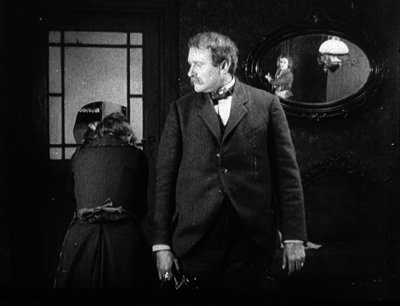
Sylvester (1924).
In fall of 1924 Hitchcock went to Germany, where he toured the magnificent Ufa facility and became acquainted with the work of the industry’s outstanding creators, especially Lang and Murnau. Most writers have emphasized his acquaintance with the Expressionist films of the early 1920s, and he sometimes mentioned his admiration for The Cabinet of Dr. Caligari. But he also praised Lubitsch, who was no Expressionist, and when asked about his major influences, he answered, “The Germans. The Germans.” It’s not farfetched to assume he was aware of another trend in local production, the one known as Kammerspiel.
The Kammerspiel, or “chamber play,” emerged in German theatre, and the film equivalents appeared in the early 1920s. The Kammerspiel film typically confined itself to a few settings and emphasized psychological conflicts among a small cast of characters. Surprisingly, the major instances, such as Shattered (Scherben, 1921), Backstairs (Hintertreppe, 1921), and Sylvester (aka New Year’s Eve, 1924), weren’t adapted from plays but were original scripts by Carl Mayer. The most famous Kammerspiel film, which Hitchcock would likely have seen during his visit, was Der letze mann (aka The Last Laugh, released December 1924), directed by F. W. Murnau. Extensive tracking shots were rare in most silent movies, but Murnau built his film around them. He and Mayer, who had scripted Der letzte Mann, came to America and there made Sunrise (1927), famous for its elaborate camera movements.
Another major director pursued the chamber aesthetic well beyond the silent cinema. Carl Dreyer had made a Kammerspiel film, Michael (released September 1924), and he carried the lesson of the trend back to his native Denmark with The Master of the House (1925), an adaptation of a popular play. Like Dial M, the film concentrates on one locale—a family’s apartment, built out of hundreds of detailed shots of the actors and sets, with almost no camera movements. Later, Dreyer would apply the Kammerspiel aesthetic to other play adaptations, Ordet (1955) and Gertrud (1964), but presented in long, gradually unfolding tracking shots.
With a Kammerspiel aesthetic, you get something fairly distinct from what we think of as filmed theatre. The baseline prototype of filmed theatre is the PBS/ Metropolitan Opera model: a live performance captured by several cameras. The cameras don’t really penetrate the space; they give us different angles and shot scales (usually thanks to different lens lengths), but we don’t have a sense that the camera is in the thick of things. A more flexible form of filmed theatre occasionally inserts the camera among the performers, as with certain shots of Wenders’ Pina. But for Hitchcock, Dreyer, and the chamber-film aesthetic, the space of the “stage” becomes completely permeable. The actors are stuck in the set, but the camera can go anywhere there. The camera can scan the space, jump below or above it, even rotate. The result feels both theatrical and cinematic—a concentrated stage piece heightened by the tools of cinema.
Locked inside these four walls
Films in the Kammerspiel mode find drama in intimacy and routine. Sometimes called “doorknob cinema,” these films draw suspense out of prosaic activities: crossing a room or simply waiting for someone to come through a doorway can become major turning points. Dial M is doorknob cinema par excellence; a latch comes close to being a character. But the director’s problem is to dynamize this enclosed space, to make furniture and entryways and trips back and forth across a parlor engrossing. So it’s a question of how to film it all.
The proscenium tradition of Western theatre pretends that the setting’s fourth wall has been removed. We look through it to the action. PBS-style canned performances preserve this convention, keeping us on the auditorium side. But Kammerspiel-style filming doesn’t adhere to this. Not only does the camera shoot from angles that would be unavailable to a spectator in a playhouse, but it may show all four walls of the set. Dreyer’s Master of the House does this, freely cutting from one side of the action to another, so rigorously that we could sketch a complete floorplan of the rooms.
Dial M does much the same. Consider that bar table against one wall. It’s shown straight on in many shots, but at least once the drinks are shown in the foreground (with striking 3D saliency) and behind Margot and Mark we see the other wall behind them, the one “through which” we’ve seen action before.
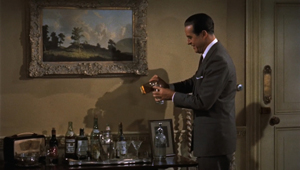
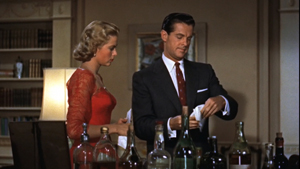
Why go to the trouble of showing the fourth wall? It supplies visual variety while expanding the play in a way that is at once “theatrical” (the space is still enclosed) and “cinematic” (the camera can go anywhere). Allowing a fourth wall also permits more complex staging effects. Characters can now make a circuit around the entire set. This is notable in Dreyer’s late films, when the character’s walk is covered in a single tracking shot, as if the set’s four walls have been ironed out on the screen.
Hitchcock does the same sort of thing through cuts. In one scene, we follow Tony as he finally takes control over Swann, convincing him to kill Margot. Here the showing of the fourth wall can mark off a privileged portion of the scene. To get a sense of how this happens, we can look at a plan of the apartment provided by Steven Jacobs in his stimulating book The Wrong House.
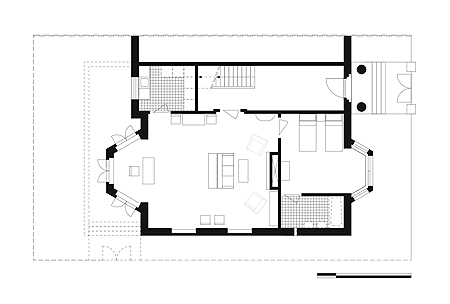
The living room is the biggest space, with the kitchen (never shown) and hallway above it. To the right of the living room are the bathroom (never shown) and the bedroom. The street is at the far right of the diagram, the terrace and garden at the far left.
The living room is the main arena of action. In the left area are the French windows, with Tony’s desk and desk chair in the alcove. The drinks bar, flanked by two chairs, stands along the uppermost wall. Adjacent to the right chair is the crucial main doorway. In the center of the room, facing the fireplace at the right, is the sofa and coffee table, with a narrow table running behind the sofa. Two wingback armchairs are angled alongside the fireplace. On the long bottom wall are bookshelves, hanging pictures, two chairs, and a china cabinet (not pictured).
During most of the film, we are oriented to the apartment from camera positions facing the wall with the drinks bar and the doorway (the top area of the floor plan). At a crucial passage, however, Hitchcock takes us around the entire living room, clockwise.
Tony has been unveiling how much he knows about Swann’s crimes. In this movie, the desk is the place of power, where both the phone and Tony’s account book are. Starting at the desk, Tony builds up the pressure. He moves along the familiar side of the room to confront Swann as he wipes the glasses.
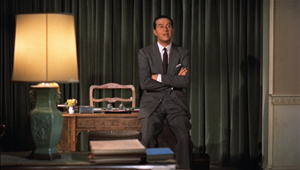
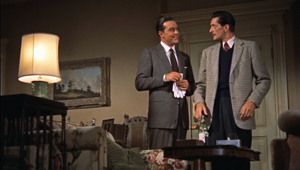
He controls their conversation, even when he pauses to sit down and face a looming Swann.
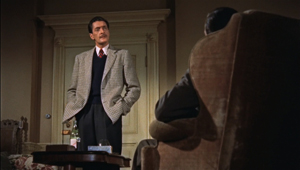
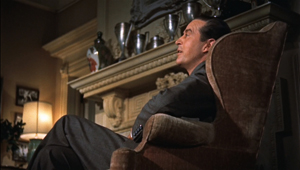
These shots get Tony to a midway resting point. He explains that he’s already framed Swann as the man blackmailing Margot. This pushes Swann into an angry sulk. Hitchcock uses Swann’s static profile as a pivot, in order to switch camera positions 180 degrees. As Tony continues to squeeze Swann, we see a corner of the fourth wall we just more or less occupied.
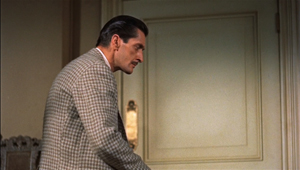
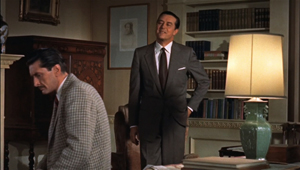
Call this the “stick” part of the sequence. When Tony proposes a carrot—a thousand pounds in exchange for killing Margot—we follow him from the new side we’re on. Swann turns uneasily away, and a slight change of angle accentuates his shift.
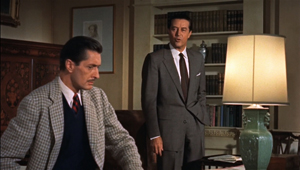
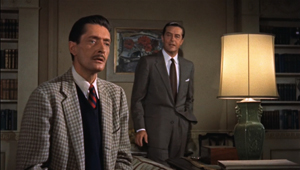
As Swann edges to the fireplace, Tony strolls rightward, passing a bookcase and the china cabinet. When he gets to his desk, he reaches into a drawer.
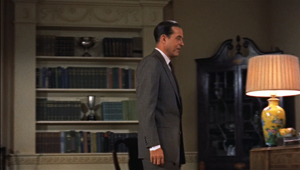
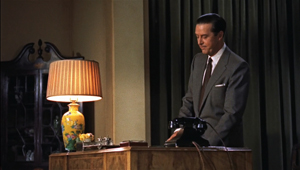
“You can take this hundred pounds on account.” He tosses the money across the room, and the camera pans with it across the fourth wall. The sheaf of bills lands in the wingback chair Tony had relaxed in earlier.
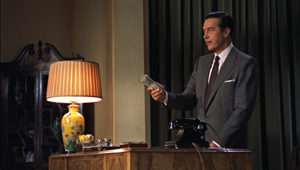
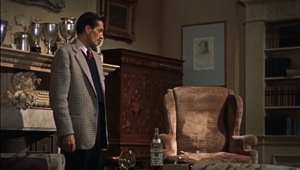
Swann doesn’t touch the money but advances to the desk to check Tony’s claim that the bills can’t be traced. So we make another half-circuit of the room.
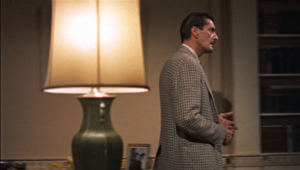
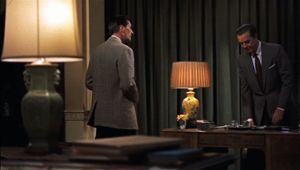
Now we’re back in the zone in which the shot started. When Tony says that the murder will take place “approximately where you’re standing now,” Hitchcock cuts to a low-angle shot of Swann, starting. (This is one of many examples gainsaying the idea that a low angle confers power on an individual.)
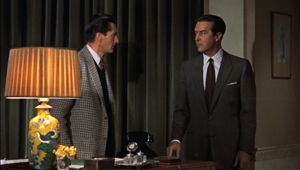
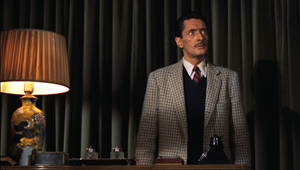
This entire passage, the culmination of Tony’s efforts to recruit Swann to his cause, is rendered in a series of fairly short shots, not long tracking movements. And indeed the “wild wall” with the bookcase would have been much more difficult to manage in a single take. Probably that’s one reason Rope doesn’t show us its fourth wall.
After this patient, quietly bravura passage, Hitchcock starts a new one, this time from a high angle.
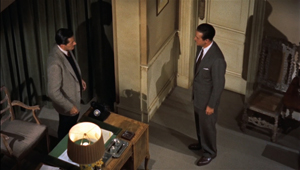
The orientation, one we haven’t seen before in the film, marks a fresh phase of the action: it’s the first of many rehearsals and replays of the killing. This section of the scene gains force by its contrast with earlier low-angle shots and the steady circuit we’ve made of the living room.
Echoing frames
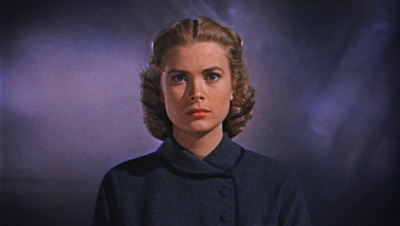
Naturally, Hitchcock dynamizes Knott’s play by means that we’ve seen in other of his films. There are passages of subjective cutting, in which we’re given the optical point-of-view of a character. Early in the film POV shots are assigned to Tony, but as Margot gets drawn into his trap, Hitchcock gives her subjective shots too. The pivot comes when during Hubbard’s questioning. Tony steps out from behind the Inspector and her glance flicks to check his expression. She’s telling the lie he coached her to tell. Our alliance starts to shift to her–and to Hubbard, through whose eyes we’ll see what happens in front of the house at the climax.
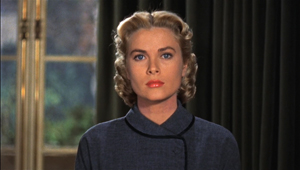
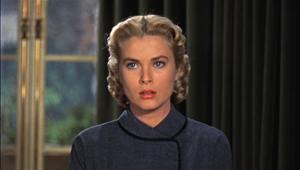
At the climax, when Inspector Hubbard brings Margot out of prison to solve the case, a comparable peekaboo dance takes place through her vision, with Tony replaced by Mark.

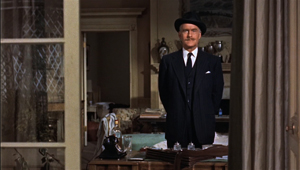
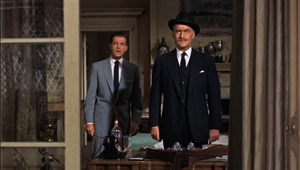
There’s also the remarkable passage of mental subjectivity reminiscent of 1940s montage sequences, in which Margot’s trial and condemnation are compressed into abstract shots showing her as if facing the judge (above). These images again at once open up the play a bit and keep faith with the tightly circumscribed premises of the film. As Hitchcock explained to Truffaut, he handled the court proceedings in such a stylized fashion because shifting the action to another concretely defined space would have destroyed what he’d built up. “People would have started to cough restlessly, thinking, ‘Now they’re starting a second picture.'” The passage also reinforces our emotional attachment to Margo that was initiated during Swann’s attack.
Keeping the action within one set also allows Hitchcock to exploit a tactic that’s common to Hollywood films but that seldom gets such a workout—the repeated setup that carries echoes of earlier actions. I’ve supplied examples in an earlier entry, on Nolan’s The Prestige, but needless to say Hitchcock gives us a master class in reiterated or rhyming setups. The several tours of the apartment activate different props and zones while also highlighting key areas, such as the desk and the door that will come back later. When you have only a few sets, you can layer the audience’s sense of the scene’s progress by calibrating your camera positions to evoke earlier shots of the same bit of space.
For example, when the police are investigating Swann’s death, a high angle ironically echoes Tony’s rehearsal of the murder plot (above). Another straightforward instance is seen in the low angle on Tony in the wingback chair. We first see it when Tony offers his purring explanation of how he’ll frame Swann (above). That shot is recalled quite precisely when, after having adjusted to Swann’s death, he relaxes in the chair after setting up the framing of Margot.
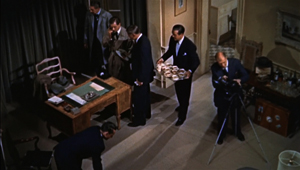
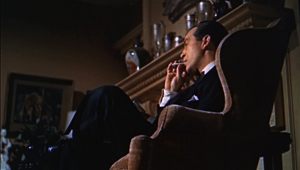
The hallway area receives more prolonged development, with the carpeted stairs becoming more prominent as the film proceeds.
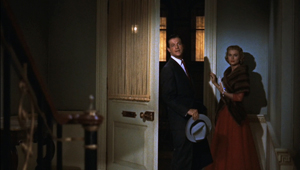
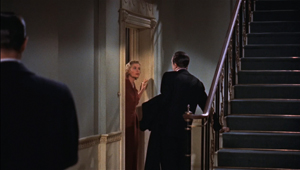
In the second shot above, Hitchcock denies us what any other director would show: a closer view of Tony slipping the key under the carpet as he’s talking casually to Margot. It’s a token of respect for our intelligence, I think. He knows we’re watching Tony’s hand, even in long shot.
Not until Swann arrives do we get the variant of the framing that will be modified at the climax, when Tony comes back from the police station.
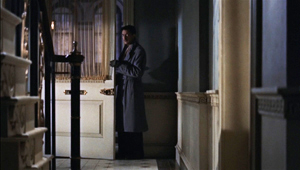
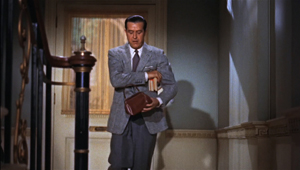
Both of these shots play out as parallels and variants, as each man reaches for the key under the stair carpet.
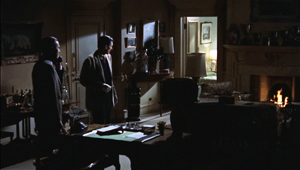
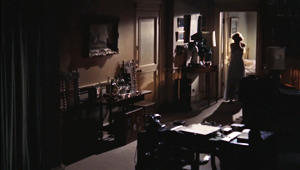
A similar framing presents the grisly aftermath of the murder attempt, contradicting Tony’s confident patter about the plan.
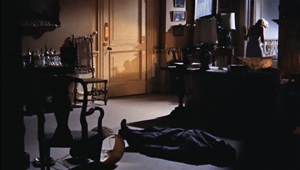
Later, the key framing shows Inspector Hubbard setting the trap for Tony, in a shot recalling the trap Tony set for Margot. When Tony is caught and tries to escape, Hitchcock cuts to the prime orientation to show his path barred.
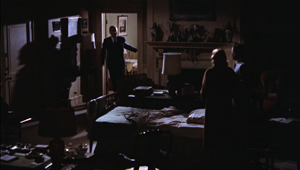

Of course, filming several shots from the same general setups can save time during production, but shrewd directors turn those repetitions to narrative advantage. In this case, they let Hitchcock have his cake and eat it too: he can stay concentrated on a single set, but he can create a web of associations among different phases of the action. The narrow rooms of Knott’s play are transformed by cinema.
Superflat?
The widescreen format forced upon Hitchcock may have been another source of his worry about “waste space.” He used lampshades and other items of furniture to balance the 1.85 compositions. More important, his use of 3D has long seemed rather conservative. Is it?
There are almost no instances of objects popping out from the screen surface; the famous example is Margot’s hand plunged out and toward the scissors on the desk during Swann’s attack. The space is discreetly layered, as when the bottles on the bar table or the bedstead moved to the living room command the foreground of shots. On the whole, Hitchcock follows both advice and custom in using the frame as a window: the depth is on the other side of the screen, tapering toward the distance. This was recommended practice at the time, and still is today.
More important, 3D Westerns like Fort Ti and Hondo and 3D musicals like Kiss Me Kate have settings stretching into the far distance, so you can show an extreme range of depth behind the screen/window. But if you’re shooting an apartment set, you don’t have much distance to play with. The result is a “shallow depth” that is at odds with a central trend of 1940s cinema and many 3D productions of the day.
Like other directors working in the 1940s and early 1950s, Hitchcock sometimes embraced tight depth compositions with big foreground heads or objects. Here are shots from The Paradine Case (1947) and I Confess (1953).
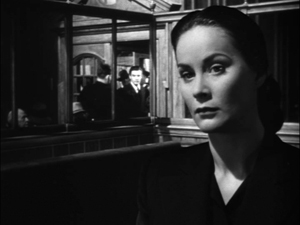
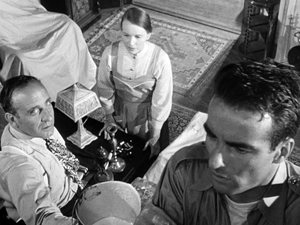
Color filming made shots like these more difficult, as the film speed didn’t allow the lenses to be stopped down so far. Accordingly, for Rope and Under Capricorn, Hitchcock either spread his actors out clothesline-fashion or kept the foreground far enough from the lens so that the depth of field could be managed.
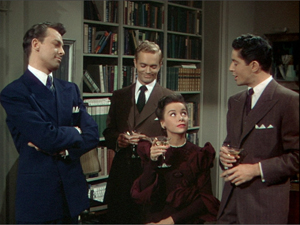
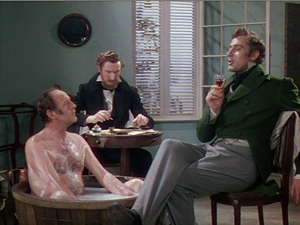
3D added more constraints. Fox cinematographer Charles G. Clarke recommending putting nothing very close to the camera and relying on 50mm lenses for medium shots (rather than the wider 35mm ones common in 2D black-and-white filming). Hitchcock’s cinematographer Robert Burks had shot Hondo and is said to have worked uncredited on House of Wax, so he was aware of the emerging 3D conventions. But the relatively flat spaces of Dial M yielded depth shots that don’t spread its faces across great distances. In many of the shots shown above, you can see that when figures are arrayed in some depth, the foreground is fairly far away from the lens. We have a convenient comparison in the opening of Shadow of a Doubt (1942) and a late scene in Dial M.

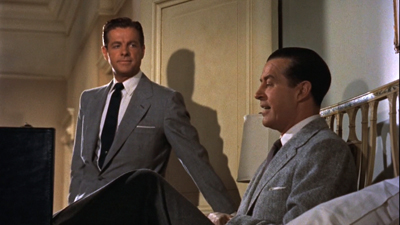
In the later film, Milland in the foreground is further from the lens, and Cummings is closer to him than the landlady is to Joseph Cotten. In most shots in Dial M, the space of the set is shallower, and the characters are typically packed closer together, than in the deep-focus films of the 1940s.
Paradoxically, then, it was harder to get aggressive depth compositions in 3D films than in 2D ones. But Hitchcock seems to have taken advantage of the shallow space of the Wendice apartment to concentrate on his actors, often isolated in single shots rather than the jammed frames of the 1940s. Given the wider frame, his compositions may seem bland, and sometimes they display the waste space he deplored. Still, his approach throws nearly all the emphasis onto the “theatrical” features of line readings, postures, gestures, and facial expressions.
Moreover, seeing the 3D screening at Toronto right after seeing digital 2D copies, I was struck by how many planes are out of focus in the 3D version. Presumably the 2D transfers have always been taken from one or the other of the dual-camera negatives. The result is a harder-edged image than what 3D creates with its staggered overlap of images.
Focus is extremely selective in the 3D version, with often only a face or even a cheek crisp and everything else significantly softer. For example, it’s not easy to discern in the 2D versions that in 3D, Margo’s face is the only plane in focus in the first shot below; both the bouquet and Mark, as well as everything else, is not as sharp. Later, Hitchcock makes the bedside clock salient by letting it be the only item fully in focus, but I don’t think you’d know that from the harder-edged image on display on the DVD and the download version.
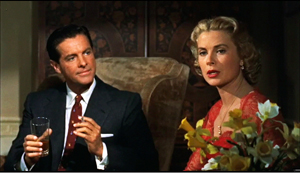
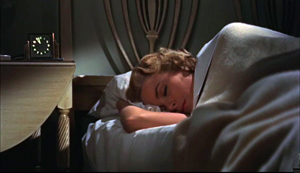
Unlike the 1940s deep-focus style, then, Dial M‘s color 3D puts very few planes in focus, accentuating the shallowness of the space of the scene. The foreground furniture and lamps would be distracting if they were in focus (as, say, they tend to be in The Ipcress File). Like a silent-film director practicing the “soft style” of the 1920s, Hitchcock uses 3D to surround his characters with cushiony, vaguely defined planes.
I’m tempted to see Hitchcock flaunting shallow space in one of the more remarkable moments in Tony’s murder rehearsal. As we’ve seen, high angles trace Tony’s path around the parlor. They also highlight the suitcase that hasn’t been visible in earlier shots, what with all the low angles. But when it’s necessary for Tony to show Swann where he’ll hide the key, we get something quite unlike the rest of the film.
Most directors would either shoot the scene from inside the apartment, framing it in the doorway (as the set is filmed when Hubbard reveals the lost key), or from some vantage point in the hall, probably from rather close to the carpet. Instead we get a cut from the master-shot high angle straight in to another high angle, but taken with a much longer lens.
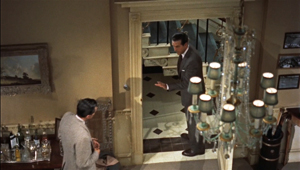

Peering through the chandelier at Tony’s ploy, riveting our attention on the key, this shot emphasizes depth in a way that few other shots in the film do. Yet the long lens has the effect of squeezing the planes together, negating the effect of 3D and relying on monocular depth cues like distance and the out-of-focus chandelier. It might as well be an axial cut out of Kurosawa.
This image, like the two shots I started with, the implausible and underhanded cut showing Margot displaying her key to the three men, reminds us that Hitchcock is always ready to tell stories of the unexpected, in unexpected ways. And these ways celebrate the ability of film to transform whatever it touches.
Years after Dial M, Hitchcock may have soured on the theatre-driven phase of his career. Yet Wordsworth’s sonnet in praise of sonnets celebrates what you can accomplish within a “scanty plot of ground.” By embracing the theatrical trappings of Dial M for Murder, Sir Alfred does more than tell a suspenseful tale. He fastidiously demonstrates that cinema’s power is unpredictable.
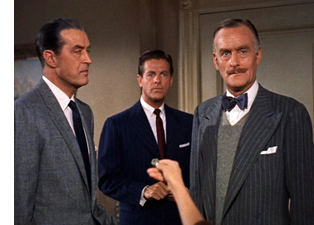
At Toronto, the digital version of Dial M was shown in the original 1.85:1 aspect ratio. The 2004 DVD employs a 4:3 ratio. The version circulating on iTunes HD rental and the 3D Blu-ray disc announced for October, are in 1.77. I’m drawing my frames from the 1.77 version, the closest I can get to the original release.
The 4:3 DVD is not the full-frame film that was recorded in camera. The 1.77 version of Dial M that I worked from includes more material on the sides than can be seen in the DVD release. Correspondingly, a little is trimmed from the top of the 1.77 shots and more is cut from the bottom, and these portions are visible on the DVD. For those who want to study Hitchcock’s visuals, the forthcoming 1.77 Blu-ray is probably to be preferred. But the 1.33 version offers a chance to see how that shot of Margo’s hand was made. Some lady was apparently kneeling underneath the camera.
Speaking of cameras, initial publicity for Warners’ switch to 3D refers to the creation of an “All-Media Camera” that could shoot any aspect ratio and either 2D or 3D. There is evidence that Hondo and subsequent releases were shot on this device; its workings are explained here.
The 1981 Toronto Festival of Festivals’ screening of Dial M is covered in Sid Adilman, “‘Chariots’ Races to Most Popular Film Nod At Toronto Fest,” Variety (22 September 1981), 6. Variety‘s original review of the film is available in the 27 April 1954 issue, p. 3.
Thanks to Steven Jacobs for permission to reproduce his floor plan of the apartment. It originally appeared in his The Wrong House: The Architecture of Alfred Hitchcock (010 Publishers, 2007). Wesley Aelbrecht executed the drawing. Steven analyzes the use of the set on pp. 101-109.
Information on 3D during 1952-1954 comes from three standard sources, Adrian Cornwell-Clyne’s 3-D Kinematography and New Screen Techniques (Hutchinson, 1954); New Screen Techniques, ed. Martin Quigley, Jr. (Quigley, 1953); and R. M. Hayes, 3-D Movies: A History and Filmography of Stereoscopic Cinema (Scarecrow, 1989). See also Thomas M. Pryor, “Warners Reviving Full Film Output,” New York Times (25 June 1953), 23, and “3-D Looks Dead In United States,” Variety (26 May 1954), 1. Some rules for shooting 3D are formulated in Charles G. Clarke, “Practical Filming Techniques for Three-Dimension and Wide-Screen Motion Pictures,” American Cinematographer 34, 3 (March 1953), 107, 128-129, 138.
3-D Film Archive, an invaluable website stuffed with rare images, is run by Bob Furmanek. Particularly helpful entries are here and here. Also check the Home Theatre Forum for posts by Bob.
Hithcock’s remark about 3D creating “waste space” is quoted by Barbara Berch Jamison in “3-D Spells ‘Murder’ for Alfred Hitchcock,” New York Times (11 October 1953), X5. The passage is somewhat opaque, though, and Hitchcock might instead, or also, be referring to the widescreen format. Other quotations come from François Truffaut, Hitchcock (Simon and Schuster, 1967), pp. 156-159 and the 1963 interview “Hitchcock” by Ian Cameron and V. F. Perkins in Alfred Hitchcock Interviews, ed. Sidney Gottlieb (University Press of Mississippi, 2003), p. 51.
Hitch’s comments on editing versus long takes come from two essays, “Direction,” from 1937, and “My Most Exciting Picture,” from 1948, a transcribed interview. Both are available in Hitchcock on Hitchcock: Selected Writings and Interviews, ed. Sidney Gottlieb (University of California Press, 1995), pp. 253-261 and 275-284.
For information on Hitchcock’s career, I’ve drawn on Patrick McGilligan’s Alfred Hitchcock: A Life in Darkness and Light (HarperCollins, 2003) and Donald Spoto’s The Dark Side of Genius: The Life of Alfred Hitchcock (Little, Brown, 1983). See also Bill Krohn, Hitchcock at Work (Phaedon, 2000), p. 130.
Bazin’s essay, “Theater and Cinema,” is available in What Is Cinema? vol. 1, ed. and trans. Hugh Gray (University of California Press, 1967), pp. 76-124. My quotation of the stage directions from Knott’s play come from Frederick Knott, Dial “M” for Murder (Dramatists Play Service, 1954), p. 37. You can read Wordsworth’s “Nuns Fret Not at Their Convent’s Narrow Room” here.
Kristin discusses German Kammerspiel films in our Film History: An Introduction, pp. 95-96. Her remarks on the genre and on Backstairs can be found on Antti Alanen’s blog. I consider Dreyer’s treatment of kammerspiel conventions in The Films of Carl-Theodor Dreyer (University of California Press, 1981). The first essay in my Poetics of Cinema connects Rope with 1940s trends in long-take shooting and the “fluid camera.” See as well Herb A. Lightman, “The Fluid Camera,” American Cinematographer 27, 3 (March 1946), 82, 102-103, and “‘Fluid’ Camera Gives Dramatic Emphasis to Cinematography,” American Cinematographer 34, 2 (February 1953), 63, 76-77. Some of these ideas are discussed in our blog entry, “Bergman, Antonioni, and the Stubborn Stylists.”
I’m grateful to Cameron Bailey, Jesse Wente, Andrew McIntosh, and Brad Deane for enabling me to participate in the screening.
P.S. 12 Sept 2012: Richard Allen of NYU points out to me that John Orr, in his book Hitchcock and Twentieth Century Cinema explores Hitchcock’s Kammerspiel affinities in Dial M and other films. “It is Hitchcock, not Lang,” Orr writes, “who renews the European Kammerspiel tradition in the age of sound and Hollywood colour” (p. 63). I regret that I haven’t read that book, but now I intend to! Excerpts available on Google books suggest that my arguments go in different directions than Orr’s. In any event, Orr is a distinguished film scholar whose work always rewards attention.
P.P.S. 16 Sept 2012: I should also have referenced the special 3-D issue of Film History 16, 3 (2004), which includes articles by William Paul and John Belton, among others. In another essay, Sheldon Hall discusses Dial M, concentrating on manipulations of point-of-view, with other material on the film’s relation to the play. The whole issue is well worth reading, and I regret not recalling it when writing this entry.
P.P.P.S. 11 Oct 2012: At Twitchfilm, Jason Gorber provides thoughts on the digital restoration and an interview with Jesse Wente, who supervised the programming of Dial M for TIFF.
P.P.P.P.S. 11 Oct 2012: At 3Dfilmarchive.com, Bob Furmanek and Greg Kintz provide a dazzling consideration of the new restoration and the Blu-ray release, along with detailed production background and many original documents. Using production documents and photographs, Bob indicates that the Warners All-Media Camera was used on Dial M, and my entry has been revised to reflect the likelihood that this was the case. I’d appreciate further information from interested readers on that gadget, beyond the usually cited passages from John Wayne’s Hondo correspondence. A minority opinion claims that the machine was unworkable and Warners films were shot in the Natural Vision system, but I’ve seen no evidence that would support this. Thanks again to Bob for keeping me in the loop.



