Archive for the 'Film history' Category
Film criticism: Always declining, never quite falling
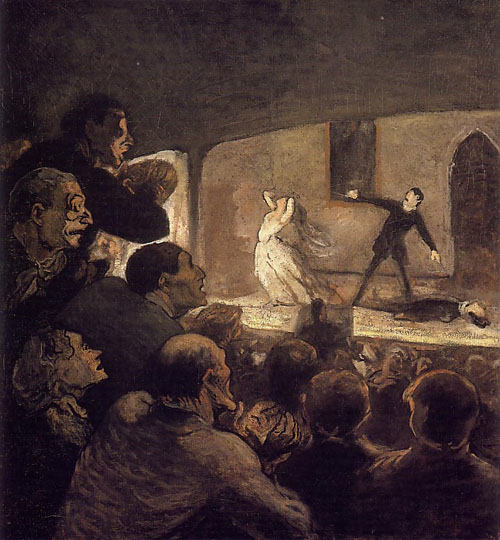
Daumier, Le mélodrame (1860-64)
DB here:
Before the Internets, did people fret as much about movie criticism as they do now? The dialogue has become as predictable as a minuet at Versailles.
Film criticism is dead.
No, it’s not! It’s alive and well on the Web.
Hah! Call that criticism? Nobody can be a movie critic unless they (a) write for print publication; (b) have been doing it for x years; (c) are a member of a critics’ professional society; and/ or (d) get paid for it.
Well, the track record of the official movie critics isn’t that great. Most of their writings are forgotten the minute they’re published.
Infinitely more awful is what you read on the Net. At least print critics kept up standards; there were gatekeepers (also called editors) and a literate public.
The result being….? When has a print critic of recent years equaled the greats of the past—Agee, Farber, Sarris, Kael?
Same thing goes for the Net. Blogs and websites don’t show me anything like that level of achievement. What I see is amateur hour.
Yeah? Well, bloggers and netwriters have passion!
But not a passion for using Spellcheck.
So if print criticism is so valuable, how come all those professional critics are getting fired?
Film criticism is dead.
Repeat as often as you like.
I thought I had watched this rondelay often enough from the wallflower section, but I got dragged onto the dance floor by Tom Doherty. In his piece for the Chronicle of Higher Education, Tom offered another eulogy for serious film criticism. Dead again, as Jim Emerson notes; killed by those wretched netizens.
To watch their backs and retain their 401(k)’s, most print critics have been forced into sleeping with the enemy. As a form of ancillary outreach, blogs, podcasts, and chat-room discussions have become a required part of the job description for print reviewers. Or maybe the print part of the gig is now the ancillary outreach.
Feeling the same heat, academic critics have also plunged into the brash new world. The film-studies panjandrum David Bordwell—think Knowles with chops in postmodern theory—runs one of the most closely watched blogs at David Bordwell’s Website on Cinema (http://davidbordwell.net/blog). The impact of the academic bloggers on Hollywood’s box-office gross is negligible (sorry, David), but the online work of the digital hordes is already making a substantial contribution to film scholarship—in the spirited parry and thrust of the dialogues, in the instant retrieval of past research, and in the factoid jackpots provided by the film databases.
I’m sure Tom means to be complimentary, but just to get mundane: No heat forced Kristin and me to the Web. I set up a bare-bones site in 2000, including a vitae and a statement about what studying film meant to me, because people were sometimes writing me asking for such information. Then, inspired by Philip Steadman’s stylish site extending the arguments in his book Vermeer’s Camera, I used mine to supplement my books, putting in corrections, second thoughts, and pictures. Then I began to write longish essays that build on things in the books.
When I retired in 2006, Kristin and I decided to recast the site as a supplement to our best-known book, Film Art: An Introduction. Our publisher McGraw-Hill funded an upgrade. But our efforts quickly went beyond spinning off the textbook. We treated Observations as our own magazine, with no pesky editors to tell us that a piece was too long or had too many stills. It offered a way to get our ideas out to a new audience, or maybe a bigger one. Just as important, after years spent writing books, I enjoy the recreation of writing shorter pieces. When you’re 62, sprints look better than marathons. Actually, because I’m a compulsive overwriter, some of my blog-sprints are like marathons.
Unhappily, none of this enhanced our 401(k)s.
Some other quibbles: Tom intended “panjandrum” as praise, but as many friends have pointed out, I’m probably the last person you’d associate with PoMo. I’m stuck in pre-post-modernism. Still, Tom is right on one point. My efforts to erode the box-office takings of Babel, The Departed, and The Dark Knight failed utterly. On the other hand, I may have considerably boosted Cloverfield’s first-dollar gross.
Nothing if not critical
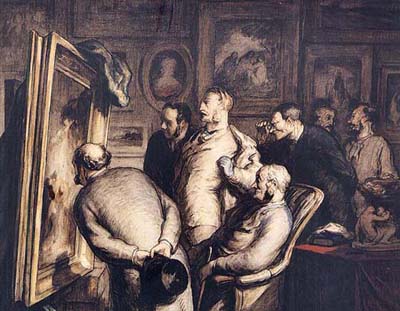
Daumier, Les critiques (1862)
Tom’s piece, its place of publication, the comments on it, and his reply to those comments invite me to revive some points I made around this season in 2008 and 2009. (Is it a rite of spring?)
Film criticism takes many forms. Tom identifies criticism with being paid to review movies that have just come out. This is a form of arts journalism, and like all journalism it is being squeezed by the decline in advertising revenue. So yes, print-based paid reviewing is waning.
But criticism includes more activities than rapid-response reviewing. It includes what we might call haute journalism, as practiced in literary quarterlies, film magazines like Cineaste and Cinema Scope, and even occasionally in the New York Review of Books (which just got around to noticing Sokurov’s 2005 The Sun). There’s also reseach-based criticism, published in specialized venues like Cinema Journal and in semi-specialized journals like Film Quarterly (which seems to be moving toward haute journalism). And of course academics have written whole volumes of film criticism—through-composed books, not collections of published reviews.
Each of these modes of criticism has its own conventions. I try to characterize them here. I think Tom should have made some of these distinctions, because it doesn’t help film culture to encourage readers of the Chronicle to limit their conception of criticism to what they get in The New Yorker or Salon.
Insofar as we think of criticism as evaluation, we need to distinguish between taste (preferences, educated or not) and criteria for excellence. I may like a film a lot, but that doesn’t make it good. For arguments, go here again. Criteria are intersubjective standards that we can discuss; taste is what you feel in your bones. A critical piece that merits serious thinking tends to appeal to criteria that readers can recognize, and dispute if they choose.
Enough with the love, already. My only real quarrel with Gerry Peary’s film For the Love of Movies is that it seems to place “love of cinema” at the center of the critical activity. But everybody loves film. The real question is: What does this love lead to? Gossip? Infighting and insults? A desire to take chances and watch films you might hate? A desire to stretch and nuance one’s viewing? An urge to learn something subtle about cinema more generally?
Opinions need balancing with information and ideas. The best critics wear their knowledge lightly, but it’s there. To be able to compare films delicately, to trace their historical antecedents, to explain the creative craft of cinema to non-specialists: the critical essay is an ideal vehicle for such information. The critic is, in this respect, a teacher.
Which means that the critic traffics in ideas too. A critic of lasting value offers a vision of cinema, of the arts more generally, of society or politics or something beyond the individual movie. For Sarris, the key idea was directorial authorship. For Parker Tyler, it was the idea that popular culture spasmodically threw up surrealistic material. For Farber it was the prospect that the studio system nurtured films, or moments, that hinted at speed, harshness, and darkness. Sontag clung to the hope that cinema could carry on the program of post-World-War-II modernism. For Ebert, what seems central is the belief that cinema can yield humane wisdom that forms a guide for living. Beyond our shores there were Arnheim, Bazin, Eisenstein (yes, he wrote film criticism), the Cahiers and Positif crews, and many more. Their powerful and provocative ideas yielded new ways to think about any movie.
Last year I moderated an Ebertfest panel consisting of a dozen or so critics. A student from the audience said he wanted to be a critic too. Instead of advising him to get into a more financially rewarding form of endeavor, like selling consumer electronics off the back of a truck, the panelists encouraged him. This form of altruism, in which you help people to become your competitor, is alarmingly common in the arts.
A moderator doesn’t get to talk much, so I couldn’t respond. What I wanted to say was: Forget about becoming a film critic. Become an intellectual, a person to whom ideas matter. Read in history, science, politics, and the arts generally. Develop your own ideas, and see what sparks they strike in relation to films.
Writing style is overrated. Many people think that good reviewing amounts to personal opinions whipped up in frothy prose. Perhaps the snazzy styles of Farber and Kael have led people to weight style too much. Granted, the Web has revealed that a lot of people are excellent writers, and without the Web they would probably never have found an audience. Although lively writing is always welcome, it gets heft and endurance through its arguments, and that comes back to ideas and information as much as opinion.
Hollywood, still declining
As often happens, a current controversy sends me backward, and to books. Ezra Goodman’s Fifty-Year Decline and Fall of Hollywood was published in the momentous year 1960, as was Beth Day’s This Was Hollywood. Both wrote finis to the glory days of American studio cinema. But if Day was nostalgic, Goodman was sour, and racy.
He worked as reporter, publicist, and reviewer, most notably for Time. By 1960, he must have felt he never needed an LA job again, so he castigates every specimen of Hollywoodite, from press agents to stars. Buddy Adler, who for a while ran production at Twentieth Century-Fox was no more than “a dutiful office boy.” Humphrey Bogart had “as a result of four marriages, innumerable bouts with the bottle, and a paucity of food and sleep developed what was described as a look of intelligent depravity. . . .”
Goodman includes a long chapter on film reviewers, which launches with a decidedly contemporary ring:
It has been said that there are sometimes more clichés in movie reviews than in the movies they are discussing. Sample review phrases: “sure-fire,” “stunning,” “taut with suspense,” “lavish and exciting,” “sumptuous,” “captures the imagination,” “moving,” “significant drama,” “sheer screen artistry,” “uncommonly good performance,” “dramatic urgency,” “enormous compulsion,” “spectacular finish,” and once in a while, “ineptly directed,” “singularly dull.”
Fifty years later, Goodman would have to add jaw-dropping, adrenalin-charged, mind-bending, hellish/ hellacious, resonance/ resonate, lush, dark, incredible, intensely personal, pitch-perfect, and our two all-purpose adjectives of praise, amazing and terrific. You’d think that we were staggering around astounded all the time.
Yet reading Fifty-Year Decline and Fall confirms my hunch that we have made progress. I would say that the best film writing in all registers–daily/ weekly reviewing, haute journalism, “think pieces,” personal essays, research studies, whether on the web or off– is much better today than it was in Goodman’s era. Then the New York Times had Bosley Crowther; now it has Dargis and Scott. Richard Schickel has hurt his reputation with some insulting remarks he made recently, but read his book on Fairbanks, His Picture in the Papers, or his scathing The Disney Version, and you’ll find a keen eye and a nonconformist intelligence. Riding above the oceanic fizz of infotainment, there are many sharp writers both journalistic and academic. Start clicking our link-list for examples.
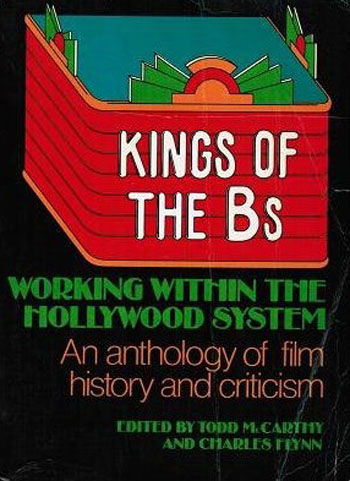
Which makes it all the more lamentable that two of our finest writers have lost their platform. Todd McCarthy’s work for Variety long exemplified the virtues I’ve itemized. He writes a brisk prose that isn’t showoffish. His reviews, often in a few deft words, situate the film historically; he’s one of those guys who has simply seen and read everything. He has as well a guiding idea of cinema—roughly, I think, the premise that straightforward classical storytelling is an inexhaustible resource—but he doesn’t deploy it as a bludgeon. McCarthy’s respect for studio history and the tradition of expressive narrative can be found in his and Charles Flynn’s indispensible collection Kings of the Bs (where you can see what a Republic budget sheet looked like) and in his biography of Howard Hawks. There are also his documentaries on filmmaking (e.g., Visions of Light) and film culture (Man of Cinema: Pierre Rissient), which allow him the leisure to probe subjects in depth.
Or consider Derek Elley. He is one of the most knowledgeable writers on Asian cinema, and his reviews skillfully tie a new film to a trend or earlier work by the same director. Few critics have his ability to supply a translation of a Chinese film’s original title, or to explain a crucial local custom. By dismissing McCarthy and Elley as contract writers, Variety has dealt a blow to informative, thoughtful film writing, whether you call it criticism or not.
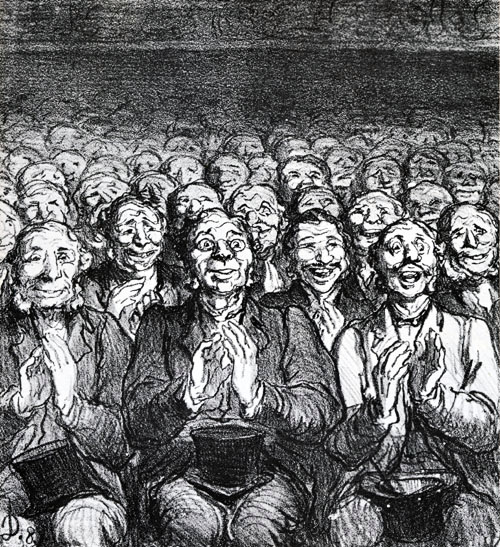
Daumier, One says that the Parisians. . . (1864)
Her design for living
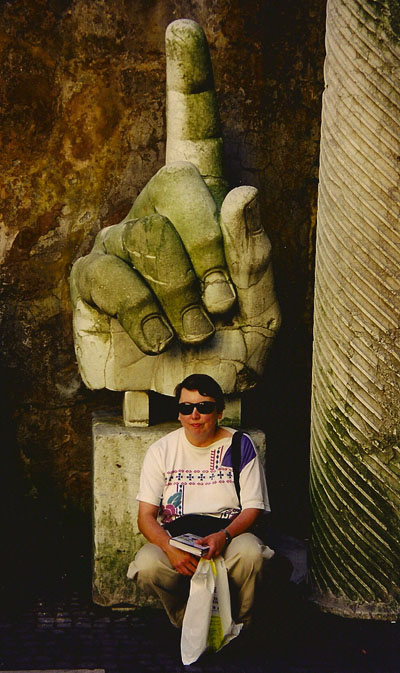
Kristin in Rome, 1997, in front of a “recent” hand from a colossal statue of Constantine. The Amarna statuary fragments she studies are twice as old.
DB here:
Kristin is in the spotlight today, and why not? She’s too modest to boast about all the good things coming her way, but I have no shame.
First, our web tsarina Meg Hamel recently installed, in the column on the left, Kristin’s 1985 book Exporting Entertainment: America in the World Film Market 1907-1934. It was never really available in the US and went out of print fairly quickly. Vito Adriaensens of Antwerp kindly scanned it to pdf and made it available for us. So we make it available to you. More about Exporting Entertainment later.
Second, Kristin is not only a film historian but a scholar of ancient Egyptian art, specifically of the Amarna period. (These are the years of Akhenaten and Nefertiti and their highly unsuccessful experiment in monotheism.) Every year she goes to Egypt to participate in an expedition that maps and excavates the city of Amarna. In recent years she’s focused on statuary, about which she’s given papers and published articles. Now we’ve learned that she has won a Sylvan C. Coleman and Pamela Coleman Memorial Fellowship to work in the Metropolitan Museum of Art’s collection for a month during the next academic year. So at some point then we’ll both be blogging from NYC. Think of the RKO Radio tower sending our signals to a tiny world below.
Third, she is about to turn 60, and in her honor the Communication Arts Department is sponsoring a day-long symposium. On 1 May we’ll be hosting Henry Jenkins, Charlie Keil, Janet Staiger, and Yuri Tsivian to give talks on topics related to her career interests. Kristin’s talk will survey her Egyptological work, with observations on how she has applied analytical methods she developed in her film research. You can get all the information about the event, as well as find places to stay in Madison, here.
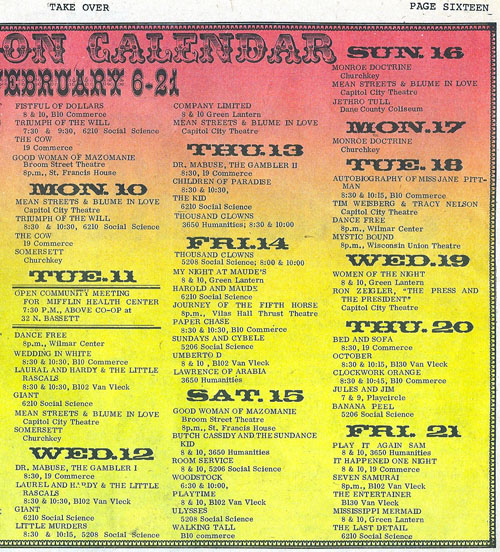
Kristin came to Madison in 1973, a very good moment. Whatever you were interested in, from radical politics to chess to necromancy (there was a witchcraft paraphernalia shop off State Street), you could find plenty of people to obsess with you. Film was one such obsession.
The campus boasted about twenty registered film societies, some screening several shows a week. Fertile Valley, the Green Lantern, Wisconsin Film Society, Hal 2000, and many others came and went, showing 16mm films in big classrooms in those days before home video. Without the internet, publicity was executed through posters stapled to kiosks, and the fight for space could get rough. Posters were torn down or set on fire; a charred kiosk was a common sight. Another trick was to call up distributors and cancel your rivals’ bookings. One film-club macher reported that a competitor had cut his brake-lines.
What could you see? A sample is above. What it doesn’t show is that in an earlier weekend of February of 1975, your menu included Take the Money and Run, The Lovers, Ray’s The Adversary, Page of Madness, Fritz the Cat, The Ruling Class, Dovzhenko’s Shors, Chaney’s Hunchback of Notre Dame, American Graffiti, Wedding in Blood, Pat and Mike, Camille, Yojimbo, Faces, Days and Nights in the Forest, King of Hearts (a perennial), Sahara, The Fox, Day of the Jackal, Dumbo, Investigation of a Citizen above Suspicion, Slaughterhouse-Five, Mean Streets, A Fistful of Dollars, Triumph of the Will, and The Cow. Not counting the films we were showing in our courses.
In addition, there was the Wisconsin Center for Film and Theater Research, recently endowed with thousands of prints of classic Warners, RKO, and Monogram titles. (There were also TV shows, thousands of document files, and nearly two million still photos.) When Kristin got here she immediately signed up to watch all those items she had been dying to see. She suggested that the Center needed flatbed viewers to do justice to the collection, and director Tino Balio promptly bought some. Those Steenbecks are still in use.
 Out of the film societies and the WCFTR collection came The Velvet Light Trap, probably the most famous student film magazine in America. Today it’s an academic journal, though still edited by grad students. Back then it was more off-road, steered by cinephiles only loosely registered at the university. Using the documents and films in the WCFTR collection, they plunged into in-depth research into American studio cinema, and the result was a pioneering string of special-topics issues. When I go into a Parisian bookstore and say I’m from Madison, the owner’s eyes light up: Ah, oui, le Velvet Light Trap.
Above all there were the people. The department had only three film studies profs–Tino, Russell Merritt, and me–though eventually Jeanne Allen and Joe Anderson joined us. Posses of other experts were roaming the streets, running film societies, writing for The Daily Cardinal, authoring books, and editing the Light Trap. Who? Russell Campbell, John Davis, Susan Dalton, Tom Flinn, Tim Onosko, Gerry Perry, Danny Peary, Pat McGilligan, Mark Bergman, Sid Chatterjee, Richard Lippe, Harry Reed, Michael Wilmington, Joe McBride, Karyn Kay, Reid Rosefelt, Dean Kuehn, Samantha Coughlin, and Bill Banning. Most of these were undergraduates, but Maureen Turim and Diane Waldman and Douglas Gomery and Frank Scheide and Peter Lehman and Marilyn Campbell and Roxanne Glasberg and other grad students could be found hanging out with them. A great many of this crew went on to careers as writers, teachers, scholars, programmers, filmmakers, and film entrepreneurs.
Into the mix went film artists like Jim Benning, Bette Gordon, and Michelle Citron. There were film collectors too; one owned a 70mm print of 2001 and didn’t care that he could never screen it. ZAZ, aka the Zucker brothers and Jim Abrahams, were concocting Kentucky Fried Theater. Andrew Bergman had recently published We’re in the Money, and soon Werner Herzog would be in Plainfield waiting for Errol Morris to help him dig up Ed Gein’s grave. Set it all to the musical stylings of R. Cameron Monschein, who once led an orchestra the whole frenzied way through Intolerance. The 70s in Madison were more than disco and the oil embargo. (To catch up on some Mad City movie folk, go here.)
These young bravos worked with the same manic passion as today’s bloggers. The purpose wasn’t profit, but living in sin with the movies. Film society mavens drove to Chicago for 48-hour marathons mounted by distributors. Traditions and cults sprang up: Sam Fuller double features, noir weekends, hours of debates in programming committees. Why couldn’t Curtiz be seen as the equal of Hawks? Why weren’t more Siodmak Universals available for rental? Was Johnny Guitar the best movie ever made, or just one of the three best?
There was local pride as well. Nick Ray had come from Wisconsin, and so had Joseph Losey, not to mention Orson Welles (who claimed, however, that he was conceived in Buenos Aires and thus Latin American). During my job interview, Ray came to visit wearing an eye patch. It shifted from eye to eye as lighting conditions changed. When he showed a student how to set up a shot, he bent over the viewfinder and lifted the patch to peer in. Was he saving one eye just for shooting?
In the big world outside, modern film studies was emerging and incorporating theories coming from Paris and London. Partly in order to teach myself what was going on, I mounted courses centering on semiotics, structuralism, Russian Formalism, and Marxist/ feminist ideological critique.
Back in placid Iowa City, where Kristin got her MA in film studies and I my Ph.D., we grad students had seen our mission clearly. Steeped in theory, we pledged to make film studies something intellectually serious: a genuine research enterprise, not mere cinephilia. Madison was the perfect challenge. Here cinephilia was raised to the level of thermonuclear negotiation, backed with batteries of memos, scripts, and scenes from obscure B-pictures. Confronted with a maniacal film culture and a vast archive, Kristin and I realized that there was so much to know–so many films, so much historical context–that any theory might be killed by the right fact.
Watch a broad range of movies; look as closely as you can at the films and their proximate and pertinent contexts; build your generalizations with an eye on the details. Our aim became a mixture of analysis, historical research, and theories sensitively contoured to both. The noisy irreverence of Mad City, where a former SDS leader had just been elected mayor and city alders could be arrested for setting bonfires on Halloween, wouldn’t let you stay stuffy long.

Kristin’s work in film studies would be instantly recognizable to humanists studying the arts. Essentially, she tries to get to know a film as intimately as possible, in its formal dimensions–its use of plot and story, its manipulations of film technique. I suppose she’s best known for developing a perspective she called Neoformalism, an extension of ideas from the Russian Formalists. Armed with these theories, she has studied principles of narrative in Storytelling in the New Hollywood and Storytelling in Film and Television. She has probed film style in Herr Lubitsch Goes to Hollywood and her sections of The Classical Hollywood Cinema. And she has examined narrative and style together in her book on Eisenstein’s Ivan the Terrible and the essays in Breaking the Glass Armor.
Contrary to what commonsense understanding of “formalism” implies, she has always framed her questions about form and style in a historical context. She situates classic and contemporary Hollywood within changes in the film industry–the development of early storytelling out of theatre and literature, or current trends responding to franchises and tentpole films. For her, Lubitsch’s silent work links the older-style postwar German cinema and the more innovative techniques of Hollywood. She situates Tati, Ozu, Eisenstein, and other directors in the broad context of international developments, while keeping a focus on their unique uses of the film medium.
Perhaps her most ambitious accomplishment in this vein is her contribution to Film History: An Introduction. She wrote most of the book’s first half, and though I’m aware of the faults of my sections, I find hers splendid. After twenty years of research, she produced the most nuanced account we have yet seen of the international development of artistic trends in American and European silent film.
Kristin has also illuminated the history of the international film industry. Everybody knows that Hollywood dominates world film markets. The interesting question is: How did this happen? Exporting Entertainment provides some surprising answers by situating film traffic in the context of international trade and changing business strategies. One twist: the importance of the Latin American market. The book also opened up inquiry into “Film Europe,” a 1920s international trend that tried to block Hollywood’s power. In all, Exporting Entertainment led other researchers to pursue the question of film trade, and I was gratified to see that Sir David Puttnam’s diagnosis of the European film industry, Undeclared War, made use of Kristin’s research.
More recently, Kristin has turned her attention to the contemporary industry, the main result of which has been The Frodo Franchise, a study of how a tentpole trilogy and its ancillaries were made, marketed, and consumed. Her love of Tolkien and her respect for Peter Jackson’s desire to do LotR justice led her to study this massive enterprise as an example of moviemaking in the age of winning the weekend and satisfying fans on the internet. She maintains her Frodo Franchise blog on a wing of this site.
Most readers of this blog know Kristin as a film scholar. They may be surprised to learn that she also wrote a book on P. G. Wodehouse’s Bertie Wooster books. Wooster Proposes, Jeeves Disposes; or, Le Mot Juste is a remarkable piece of literary criticism. Here she shows how Wodehouse developed his own templates for plot structure and style. Again, the analysis is grounded in research–in this case, among Wodehouse’s papers. So assiduously did she plumb Plum that she became the official archivist of the Wodehouse estate. This is also, page for page, the funniest book she has yet written.
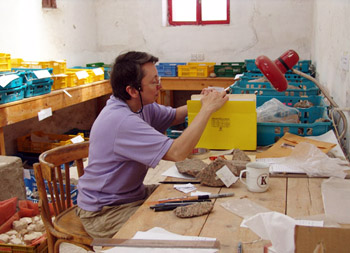
Her Egyptological work is no joke, though, and she has become one of the world’s experts on Amarna statues. She has published articles and given talks at the British Museum and other venues. Soon she’ll trek off for her ninth season at Amarna. There, joined by her collaborator, a curator at the Metropolitan, she’ll study the thousands of fragments that she’s registered in the workroom seen above. It’s preparation for a hefty tome on the statuary in the ancient city.
You can learn more about Kristin’s career here, in her own words. These are mine, and extravagant as they are, they don’t do justice to her searching intelligence, her persistent effort to answer hard questions, and her patience in putting up with my follies and delusions. You’d be welcome to visit her symposium and see her, and people who admire her, in action. While you’re here, you can watch a restored print of Design for Living, by one of her favorite directors, screening at our Cinematheque. In 35mm, of course. We can’t shame our heritage.
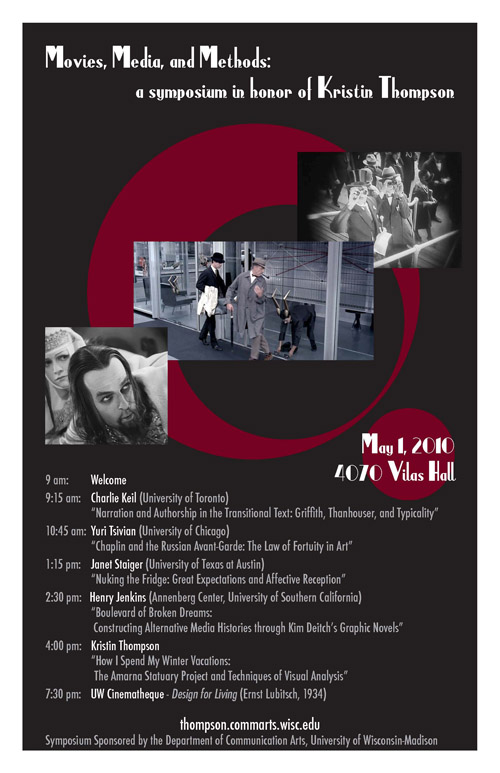
Poster design by Heather Heckman. Check out our Facebook page too.
Sticky splices and hairy palms

Venusville (Fred Worden and Chris Langdon, 1973).
DB here:
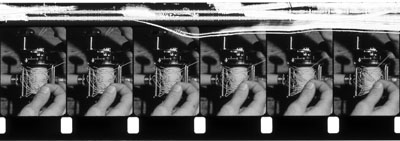
Just as CDs gave us a taste for sterile sound, the DVD has made us prize the clean image. We like sleek, hard-edged frames that look good on computer monitors and home-theatre screens. So who would put up with a shot like the one surmounting today’s entry?
 Mark Toscano, for one. He’s a film preservationist for the Academy of Motion Picture Arts and Sciences Film Archive. Among other tasks, he searches out and preserves experimental and avant-garde cinema, particularly work from West Coast filmmakers. And he savors shots like that hairy palm.
We normally think that someone preserving a film must at the minimum do a cleanup—remove all the specks, hairs, rips, and bad splices—before going on to more serious fixing, like correcting faded color. But what if the filmmaker left in the dirt and glue blobs deliberately? Or what if the filmmaker developed a fondness for the wear and tear that the movie accumulated over years of use? What’s a dutiful archivist to do?
The virtues of degradation
Mark is aware that archivists can have a big impact on film culture. By selecting films to save, they expand the canon and invite researchers to consider work that might otherwise be missed. “A curator’s enthusiasm can fuel new scholarship.” So part of Mark’s mission is to bring the inventiveness of lesser-known avant-garde filmmakers to new prominence.
Surprisingly, sometimes the archivist has to convince a filmmaker that work is worth saving. Robert Nelson had decided that most of his films were of little interest and in 1999 began redoing some and even destroying others. The scrapes you see on The Awful Backlash (above), a film about a tangled fishing reel, are the result of Nelson’s decision to rub out parts of the soundtrack.
Above all, a preservationist can widen the audience by programming collections like the one Mark brought to our Cinematheque last week. His Friday program was a feast of LA experimental film from the 1960s and 1970s. The menu ranged from gorgeous abstractions like Fred Worden’s Throbs (1972) and Pat O’Neill’s 7362 (1967) to exercises in dry wit like Morgan Fisher’s Turning Over (1975), about the momentous instant when a car’s odometer flips from 99,999 miles to 100,000. There was Kathy Rose’s Mirror People (1974), a sinister exercise in fairy-tale animation, headcomix-style, and Diana Wilson’s charming stop-frame still life Rose for Red (1980). One of the program’s implications was that on the Left Coast, avant-garde films were less cerebral than the official classics of the East Coast establishment. Films like David Wilson’s Stasis (1976) and Gary Beydler’s indescribable Pasadena Freeway Stills (1974) show that Structural Film could offer sheer entertainment. Mark’s notes on several of these titles can be found here.
The day before the screening, Mark gave a talk to our departmental colloquium called “Print (de)Generation.” He was paying ironic homage to our colleague J. J. Murphy’s 1974 classic, Print Generation (which Mark is restoring). But his title captures as well the problems of preserving films that don’t aim at pristine imagery.
If you assume that your job is to find the best existing form of the film and conserve that, what do you do with experimental work? Sometimes the films are designed to look messy. Sometimes they acquire a wear and tear that is like the patina on a sculpture or piece of furniture, when the signs of time’s passing become part of the texture of the piece.
Mark gave many examples of the decisions he faces in preserving the deliberate roughness of some work. Ben VanMeter (in spirit and approach, Mark feels, the most classically hippie West Coast filmmaker) corrugated the film strip of Acid Mantra; or, Rebirth of a Nation (1968). The legendary but little-seen Maltese Cross Movement (1967) by Keewatin Dewdney is a dazzling exercise in process structure, and the speckling on the images comes from creative choices. Shots were intercut with black frames—not black film frames, but frames dabbed with opaque paint. Inevitably, flakes of paint migrated across nearby footage.
Brakhage’s films call for special delicacy. Mark showed lovely photos of film strips that Brakhage had painted upon, or welded together with thick splices that look like chain mail, as in the fourth reel of 23rd Psalm Branch (1967).
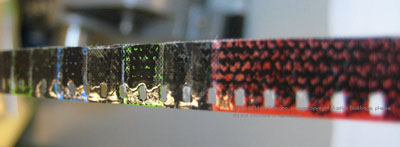
The Garden of Earthly Delights (1981) incorporates bits of grass, ferns, and insect wings.
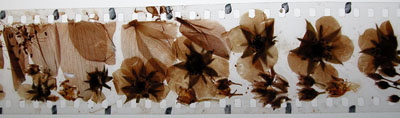
How do you preserve such a thing? Brakhage endlessly revised some of his work, and came to appreciate the flaws that reprinting shooting and editing introduced into a film. When Mark called him about eradicating a hair that had crept into Flight (1974), Brakhage replied: “That hair is the axis around which the entire film revolves.” [Please see PS at bottom of post.]
Feelthy peectures
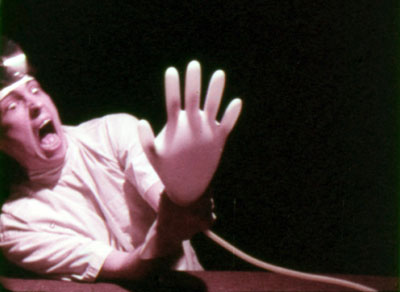
Mark’s talk highlighted Chris Langdon, a little-known Cal Arts filmmaker who worked with John Baldessari, Robert Nelson, and Fred Worden. Worden collaborated on Venusville, (1973), a deadpan satire on Structural Film. Shots of a palm tree tremble in front of us, while we hear puzzled comments from offscreen filmmakers. The image gets grubbier as the film proceeds, as if the viewers were looping it in their search for clues.
Langdon’s work vividly displays the West Coast impulse to hold nothing sacred. You would think that the endlessly self-ironizing Warhol was beyond teasing, but Bondage Boy (1973) makes a good try. We see a fellow wrapped in plastic and chains and struggling half-heartedly while assuming some fairly un-erotic postures. The soundtrack is “These Boots Are Made for Walking.” Langdon made fifteen to twenty films per year in a great many styles, and even created trailers for some of them, including Bondage Boy. She also came up with trailers for unmade films, as in Love Hospital Trailer (1975; above).
Mark’s passion and persistence brought Langdon’s films back to notice very recently, at a Redcat retrospective curated by Mark, Steve Anker, and Bérénice Reynaud. “I guess I was just a little incredulous that anyone would remember those films, and a little wary about it, to be honest,” said Langdon, who now prefers to be known as Inga. “But after a while, I thought it was pretty cool.” Scholars will be lining up to write about her work, with its wild humor and ties to Structural and Punk cinema.
You might not expect the Academy to preserve avant-garde cinema, but it’s a great testament to the institution that it cares so much about all kinds of film. Mark generously praised his colleagues Mike Pogorzelski and Joe Lindner (both Wisconsin alums), who support his efforts. In turn, we’re grateful to people like Mark who devote themselves to recovering films in a way that respects filmmakers and their work—especially when that work seems defaced or distressed. He teaches us that imperfections aren’t always faults. Everything in the world spoils eventually. Why shouldn’t artists acknowledge that? No surprise to learn that Mark owns few CDs but hundreds of LPs. He’s a master in bringing the Vinyl Aesthetic to film.
Mark Toscano keeps a blog titled “Preservation Insanity,” with more images of despoiled imagery, here.
Film preservation and restoration have formed a running thread for Kristin and me, from our trips to Bologna’s Cinema Ritrovato to our reportage on visits from archivists like Grover Crisp.
Currently there’s a blogathon on preservation sweeping the Internets. You can read about it at the Self-Styled Siren and Ferdy on Film, both of whom are keeping running tally on the entries. Please consider contributing to the National Film Preservation Foundation.
You can read more about the West Coast experimental tradition in David E. James, The Most Typical Avant-Garde: History and Geography of Minor Cinemas in Los Angeles (Berkeley: University of California Press, 2005) and Chapter 6 of Paul Arthur’s A Line of Sight: American Avant-Garde Film since 1965 (Minneapolis: University of Minnesota Press, 2005).
PS 19 February: Marilyn Brakhage posted this correction to the Frameworks listserv (ellipses in the original):
I’m glad to see Mark’s work getting some more, deserved attention. However, after reading the blog (which I can’t seem to respond to directly) just thought I’d mention — for the sake of historical accuracy — that the comment from David Bordwell that “Brakhage endlessly revised some of his work . . . ” is simply not true. When a work was done, it was done, and he moved on. He did not re-make/re-edit old work like some filmmakers do. . . . Perhaps Mr. Bordwell was thinking of the inevitable problems in print variation coming through the labs over the years (that the filmmaker, of necessity, had to adjust to), or the “translations” that resulted from blowing up 8 mm to 16 mm versions for distribution purposes. But I wouldn’t call that “revising” his work. (I’m sure he wanted the “translations” to be as true as possible to the original.) . . . And the hair that had “crept into Flight” was there from the beginning — accepted and used by Stan when he began to edit the film. It wasn’t something that happened over time.
I regret my misunderstanding of Mark’s remarks on the subject, and I’m grateful to Marilyn for setting the record straight.

Robert Nelson’s painted and resin-sealed cans of film. Another approach to preservation? Images courtesy Mark Toscano.
DVDs for these long winter evenings
Kristin here:
Coming back from a trip has pleasant and unpleasant consequences. Bills piled up, but so did stacks of packages, books and DVDs we forgot we had ordered or ones sent to us out of the blue.
The intrepid companies that rescue and issue silent films on DVD have been busy. All are past winners of awards in the Cinema Ritrovato festival’s annual ceremony, and obviously they are working hard to keep their standards up. (For a pdf listing all the winners since the awards began in 2004, click here.) Two of my favorite directors are represented.
Much More Méliès!
In 2008, Flicker Alley won “Best Box-Set” for its monumental collection “Georges Méliès: First Wizard of Cinema” (five DVDs with 173 films). Amazingly, 26 more films (or fragments, in one case very short) have been discovered since its issue. These will be released in the U.S. on February 16 on a single disc titled “Georges Méliès Encore.”
One of these, Le Manoir du Diables/The Haunted Castle, from 1896, contains something like 26 cuts, all stop-motion effects. I wouldn’t have thought such an elaborate production would have been possible so early in the history of cinema, but here it is. It’s also interesting for having been shot outdoors, with what looks like a flat gravel “floor.” The lighting changes dramatically at one point, with the sun in a different position after an obvious pause in filming, and for a time the shadow of a tree is visible in the right foreground. The set is also quite elaborate for such an early production. Watch for a moment when the actors bump into the set and cause it to wobble alarmingly.
I had long been intrigued by production photos and sketches from a lost Méliès film, L’omnibus des toqués ou Blances et Noirs/Off to Bloomingdale Asylum. (I have no idea why this English title was chosen, since it has nothing to do with the action. “Toqués” would translate roughly as “crazies.”) The thing that intrigued me was a strange, mechanical-looking horse that draws the omnibus of the title. Finally I got to see it, and it was worth the wait. The horse is good, to be sure. It pulls a small coach with five black-face minstrels sitting atop it.
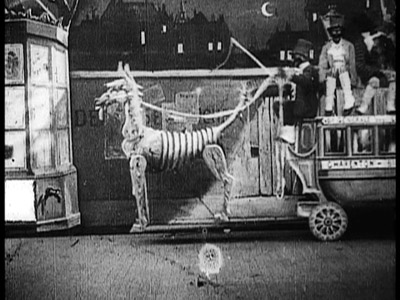
It’s not terribly apparent from the film, but a surviving Méliès sketch makes it obvious that the horse farts, driving the minstrels to jump off. The horse and coach depart, and the four minstrels begin an elaborate game of slapping and kicking each other in rhythm, each blow turning one into a white-clad pierrot figure and then back into a minstrel. It’s another of Méliès’ rapid-fire set of stop-motion substitutions, with the positions of the figures matched with astonishing precision. A tiny masterpiece in one minute and four seconds, counting the title card.
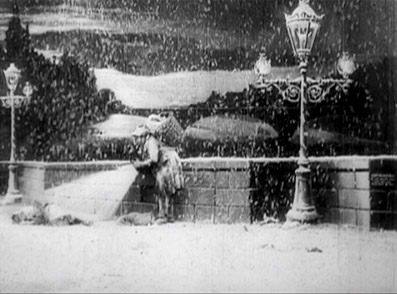
There’s a wide range of genres represented on the disc, including staging of news events, as in Éruption volcanique à la Martinique/ Eruption of Mount Pele (1902); chase films, like Le mariage de Victoire/ How Bridget’s Lover Escaped (1907); and even tear-jerking melodrama, like Détresse et charité/ The Christmas Angel (1904). The latter has an interesting stop-motion effect to add a white-painted stream of light as a rag-picker turns on his lantern to see the little beggar-girl asleep in the snow.
An otherwise surprisingly pedestrian 1905 film, L’ile de Calypso/ The Mysterious Island has one impressive moment, when a giant hand (Polyphemus having been transferred to Calypso’s island) emerges from the dark of a cave to threaten Ulysses (who is a bit hard to see, standing against the rocks at the right of the cave).
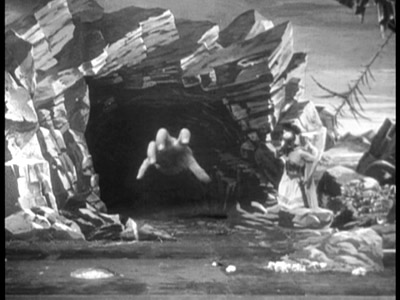
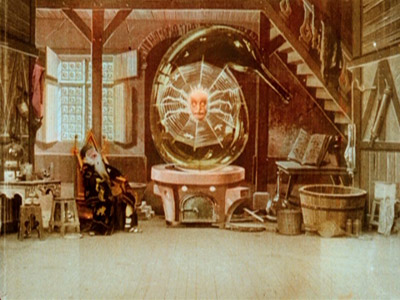
Was Méliès the first filmmaker to realize that leaving a large dark patch in part of set allowed things to be superimposed in that area without looking translucent? The best-known film to use the device is L’Homme à la tête en caoutchouc/ The Man with the Rubber Head (1902), but many other films use it, including some on this disc. A few of the films have hand-coloring, including the early L’hallucination de l’alchimiste/An Hallucinated Alchemist, where the alchemist of the title dreams of a giant spider.
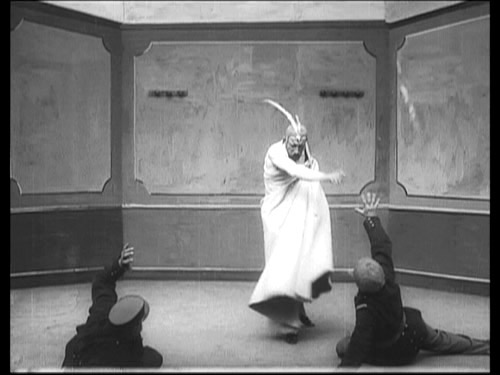
The state of preservation naturally varies enormously. One nearly pristine print is the amusing Satan en prison/Satan in Prison (1907). The title is vital, since the bulk of the action consists of a well-dressed man magically producing a series of items to furnish a bare room, culminating in his summoning up a charming lady to share his meal. Hearing the guards approaching, the man reverses the process, ending with a bare room when the two men enter. Finally he is revealed as one of Méliès’ favorite characters, Satan! (See frame surmounting this entry.)
I suppose we shall never have all of Méliès’ films, but there are now more than twice as many known to survive as when I was in graduate school. I look forward to a second encore.
Lubitsch, Lubitsch, Lubitsch
Another pleasant surprise among the heap of packages was Eureka!’s new boxed set of Ernst Lubitsch films from the years 1918-1921. If that sounds a bit familiar, that’s because this is the third such set to appear in just over three years. I’m not going to make a point-by-point comparison, but I’ll sketch some basic differences.
The German set, confusingly titled in English the “Ernst Lubitsch Collection,” came out in November, 2006 and is PAL, region-2 encoded. It contains five Lubitsch silents: Ich mochte kein Mann sein (1918), Die Austernprinzessin (1919), Sumurun (1920), Anna Boleyn (1921), and Die Bergkatze (1921). Its main bonus is a feature-length documentary, Ernst Lubitsch in Berlin—Von der Schönhauser Allee nach Hollywood. None is subtitled. The set won the Cinema Ritrovato’s prize as Best DVD of 2008.
The set was issued by the Munich company Transit Film, a government-owned 35mm distributor with a library of about 600 titles, drawn from across the history of German cinema. We’ve brought some of their prints to Madison for Cinematheque screenings. The sources of the films are primarily the Friedrich-Wilhelm-Murnau-Foundation and the Bundesarchiv-Filmarchiv. It also produces documentaries like the one on Lubitsch. (The website offers German, English, and French language options.) It has also put out several DVDs under the name “Transit Classics.”
In the U.S., from late 2006 into 2007, Kino Video brought these five titles out as four individual DVDs (pairing Die Austernprinzessin and Ich mochte kein Mann sein on one disc). Apparently, although Transit’s set didn’t include the 1919 comedy Die Puppe, it made it available, and in December 2007, Kino brought it out on a disc with the Ernst Lubitsch in Berlin documentary—and at the same time issued a boxed set of all six features plus the documentary on five DVDs, called “Lubitsch in Berlin.” (All Kino discs are NTSC region 1; given that they were transferred from PAL versions, they probably run about 4% faster than the Transit versions.)
Eureka!’s set is also entitled “Lubitsch in Berlin.” It contains the same set of films, including the documentary, all also licensed from Transit. These are here arranged over six DVDs. Its unique material is relatively slight, consisting mainly of short original sets of liner notes and an original score for Die Puppe. One advantage is that Eureka!, as usual, has retained the German intertitles and added subtitles to them. (The Kino versions, in contrast, replace the original intertitles with English ones, which has been their practice on some, if not all, of their other DVDs.) Some or all of these intertitles may have been replaced, perhaps reconstructed on the basis of censorship records, as is often the case with restorations. Still, many viewers would want access to the German text as well as the English versions. The Eureka! set is PAL, and it doesn’t seem to have region coding.
For those unfamiliar with Lubitsch’s German films, these are a good introduction. The four comedies all hold up well today. The first three are built around Ossi Oswalda, a boisterous blonde comic who seems to have inspired Lubitsch to move away from broad slapstick to a more stylized, eccentric approach. Pola Negri, after acting such roles as Carmen and Madame Dubarry in the director’s costume pictures, revealed her comic talents in Die Bergkatze, his last German comedy.
Overall my favorite of the group is Die Puppe, so I’m very glad it’s been added. Some might prefer Die Austernprinzessin, which is indeed hilarious. But it mainly has the wealthy heroine’s home as its comic milieu. Die Puppe seems denser, with more characters and three comedy-generating settings: the rich uncle’s home, the art-nouveau cartoon doll shop, and the monastery where the hero takes refuge. Plus there’s the famous prologue, where Lubitsch himself sets up the premise that the characters themselves are simply dolls brought to life. (See below.)
I chose Ich möchte kein Mann sein as one of the best films of 1918. See here for a brief description and a frame at the bottom of the entry.
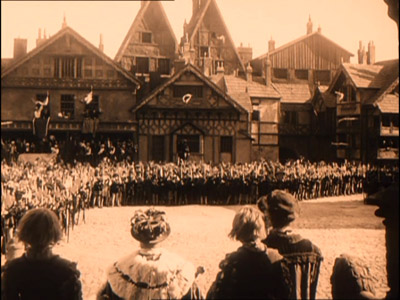
The conspicuous absence from this set is Madame Dubarry, the 1919 historical epic that made Lubitsch famous worldwide. Perhaps it’s not an ingratiating film at first viewing, but I found that it grew on me in repeated screenings. (I talk about some of its best scenes including one impressive long-take scene, in my book Herr Lubitsch Goes to Hollywood.) Anna Boleyn took on British history in an attempt to replicate the success of Madame Dubarry, but I have never been able to warm up to it. That’s probably partly because Henny Porten simply did not bring the vibrancy to the title role that Negri had in Madame Dubarry and perhaps partly because the increased budget let to an overemphasis on huge sets and crowds of extras (above). The characters in Madame Dubarry seem comfortable in their period costumes; the ones in Anna Boleyn don’t.
I chose Die Puppe as one of the best films of 1919. See here for a frame from it, and one that demonstrates why I admire Madame Dubarry. Perhaps restoration work on the latter is going on at this moment, so that another DVD will someday join these on the shelf.
The other film in the collection, Sumurun, is a quasi-Arabian-Nights tale, starring Pola Negri as a seductive member of a traveling troupe of entertainers. Lubitsch plays his last film role as the hunchback clown who dotes hopelessly on her. The performance isn’t all that different from some of his earlier ones, but perhaps seeing his rather exaggerated acting style in the context of a non-comic film led Lubitsch to doubt his own abilities. Given that he was far better as a director than as an actor, his decision to stay behind the camera was a boon to future generations. To me, Sumurun is fascinating because it shows the first real signs of Lubitsch’s awareness of Hollywood continuity editing, a set of techniques he would thoroughly master over the course of his next half-dozen films.
It can’t have been easy to put together a 109-minute documentary on Lubitsch’s life before his move to Hollywood. In working on my book, I discovered how surprisingly few photographs of him at work onset survive. The studios where he worked don’t survive, though there are shots of the giant Ufa Tempelhof sound stages that now stand where those studios were.
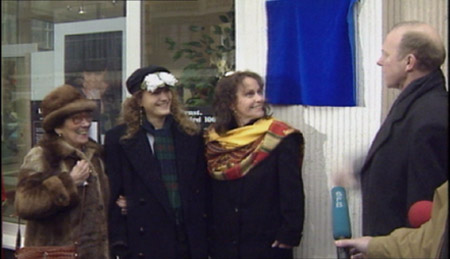
Several prominent historians are interviewed, including archivist Enno Patalas and historian Hans Helmut Prinzler, co-editors of Lubitsch (an extremely useful book, published by the Verlag C. J. Bucher i 1984) and archivist Jan-Christopher Horak (whose master’s thesis was on Lubitsch’s relation to Ufa). Lubitsch’s surviving family members, seen above at the unveiling of a “Lubitsch lived here” plaque, were interviewed: his niece Evy Bettelheim-Bentley (left), granddaughter Amanda Goodpaster (center), and daughter Nicola (right). Lubitsch’s theatrical career is well covered, and generous clips from the pre-1918 era demonstrate his move into comic acting for films. Audio interviews with Henny Porten and Emil Jannings include a charming anecdote she tells about how apologetic Jannings was after the scene in Kohlhiesels Töchter in which his character jerks a bench out from under her–an incident that left her with a bruised rump. In between scenes, directors who have been awarded the Ernst Lubitsch prize, such as Tom Tykwer, discuss the master. Perhaps the most interesting artifact shown is an album Lubitsch’s regular costume designer and friend Ali Hubert made for him, combining drawings with photos of Lubitsch and little poems; below he depicts Lubitsch directing Madame Dubarry. Ultimately Hubert gave it to the director as a gift.
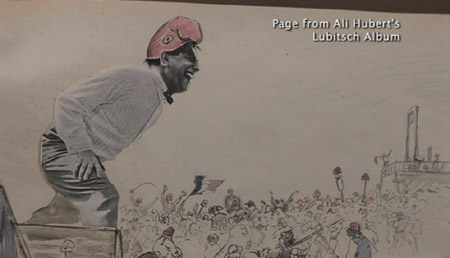
The documentary feels a trifle thin at times, and it makes no real attempt to cover Lubitsch’s Hollywood career, presumably because of the difficulty of getting permission to use clips. But it certainly would be a useful teaching tool for introducing students to Lubitsch’s life before Hollywood.
(Thanks to Ben Brewster for helping determine some of the differences among these three Lubitsch boxes.)
The Man with a Movie Camera before The Man with a Movie Camera
In 2007, the Cinema Ritrovato awarded the “Edition Filmmuseum” series from the Filmmuseum Munchen its DVD award for “Best Series.” We’ve mentioned this series before, in relation to its Walter Ruttmann disc and its DVD of Robert Reinhert’s Nerven.
Now the Filmmuseum has issued a two-disc set offering two of Dziga Vertov’s silent feature documentaries, A Sixth Part of the World (1926) and The Eleventh Year (1928). The former is a poetic look at the various and farflung ethnic groups within the U.S.S.R., the population of which made up one sixth of the world. It was the first of Vertov’s films to be strongly praised, seeming to justify his theory of the Kino-Eye.
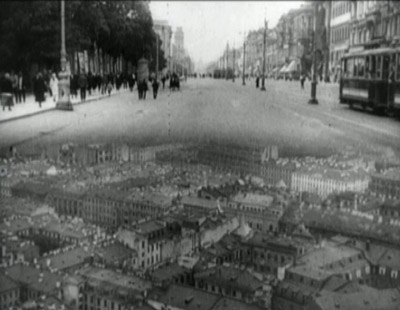
Those expecting anything as experimental as Man with a Movie Camera might be disappointed. There are some of the familiar camera tricks, such as split-screen effects:
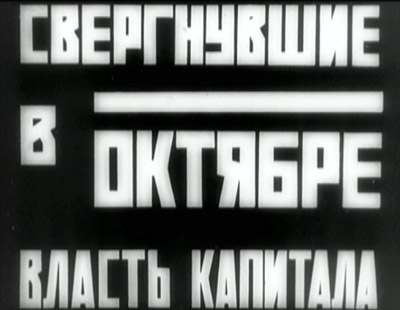
The typography of the intertitles reflects the constructivist style of the 1920s:
The discs have optional English subtitles.
Having seen these films during my research, I haven’t watched the discs in their entirety. The quality looks as good as can be expected. Michael Nyman’s music is certainly not authentic to the period, but what I heard of it sounded strangely appropriate to the images and effective as accompaniment.
The discs also include an interesting bonus, a German propaganda short, Im Schatten der Maschine, by Albrecht Viktor Blum, which used footage from The Eleventh Year to make a film critical of the technical progress which Vertov was praising in his own movie. (Since The Eleventh Year had not yet appeared in Germany, Vertov was actually accused of plagiarizing from Blum rather than the other way round.)
Another bonus is a 14-minute documentary, Vertov in Blum: An Investigation (optional German or English narration). This fascinating short begins by demonstrating that Vertov himself and possibly others almost certainly cannibalized footage from The Eleventh Year for Man with a Movie Camera and other films. It goes on to hypothesize that the final montage in Im Schatten der Maschine may consist of footage that Vertov later removed from The Eleventh Year‘s negative. Side by side comparison of prints using Final Cut Pro revealed matching shots between the two films, highlighted in yellow here:
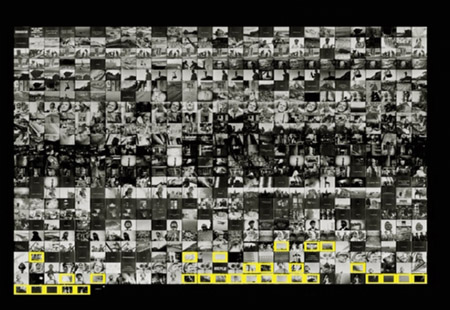
Blum’s film culls shots and even edited passages primarily from late in Vertov’s film, but it continues beyond the end of the surviving version of The Eleventh Year. Some of those shots have been traced to other, later Vertov films, and the archival sleuths are still comparing prints and looking for the rest. They may have found the missing ending from The Eleventh Year; at least, the evidence makes that idea very plausible. Whether they are right or not, though, the short demonstrates the painstaking work often necessary in the restoration of films.
These companies and archives have certainly not been resting on their laurels. It will be exciting to see what the upcoming Cinema Ritrovato’s awards will highlight.