






Archive for the 'Film comments' Category
Do filmmakers deserve the last word?
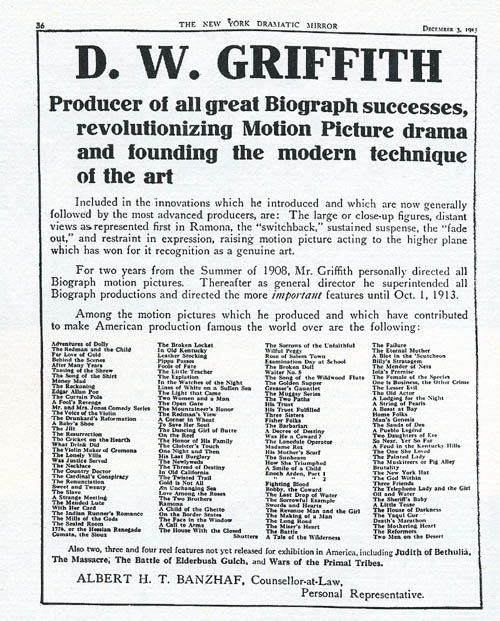
DB here:
On 3 December 1913, the above advertisement appeared in the New York Dramatic Mirror. D. W. Griffith had left the American Biograph company and set out on an independent path that would lead to The Birth of a Nation and beyond. Because Biograph never credited directors, casts, or crews, he wanted to make sure that the professional community was aware of his contributions. Not only did he point out that he had made several of the most noteworthy Biograph films; he also took credit for new techniques. He introduced, he claims, the close-up, sustained suspense, restrained acting, “distant views” (presumably picturesque long-shots of the action), and the “switchback,” his term for crosscutting—that editing tactic that alternates shots of different actions occurring at the same time.
Griffith’s bid for credit was a shrewd move for his career, and it had repercussions after the stunning success of The Birth of a Nation two years later. Many historians took Griffith at his word and credited him with the breakthroughs he listed. He became known as the father of “film grammar” or “film language.” The idea hung on for decades. Here’s the normally perceptive Dwight Macdonald, criticizing Dreyer’s Gertrud for being anachronistic:
He just sets up his camera and photographs people talking to each other, usually sitting down, just the way it used to be done before Griffith made a few technical innovations. (1)
Filmmakers believed the Griffith story too. Orson Welles wrote of the “founding father” in 1960:
Every filmmaker who has followed him has done just that: followed him. He made the first close-up and moved the first camera. (2)
In the late 1970s a new generation of early-cinema scholars gave us a more nuanced account of Griffith’s place in history. They pointed out that most of the innovations he claimed either predated his Biograph work, (3) or appeared simultaneously and independently in Europe and in other American films. Some Griffith partisans had already conceded this, but they maintained that he was the great synthesizer of these devices, and that he used them with a vigor and vividness that surpassed the sources.
That judgment seems right in part, but Eileen Bowser, Tom Gunning, Barry Salt, Kristin Thompson, Joyce Jesniowski, and other early-cinema researchers have drawn a more complicated picture. (4) Griffith did speed up cutting and devote an unusual number of shots to characters entering and leaving locales. But these innovations weren’t usually recognized as original by previous historians. More interestingly, much of what Griffith did was not taken up by his successors. His technique was idiosyncratic in many respects. By 1915 younger directors like Walsh, Dwan, and DeMille were forging a smoother style that would be more characteristic of mainstream storytelling cinema than Griffith’s somewhat eccentric scene breakdowns. Instead of creating film language, he spoke a forceful but often unique dialect.
The New York Dramatic Mirror ad coaxes me to reflect on how filmmakers have shaped critics’ and historians’ responses to their work. Hawks and Hitchcock developed a repertory of ideas, opinions, and anecdotes to be trotted out on any occasion. Today, directors write books, give interviews, appear on infotainment shows, and provide DVD commentary. We know that many of the talking points are planned as part of the film’s publicity campaign, and journalists dutifully follow the lead. (In Chapter 4 of The Frodo Franchise, Kristin discusses how this happened with Lord of the Rings.) For many decades, in short, filmmakers have been steering critics and viewers toward certain ways of understanding their films. How much should we be bound by the way the filmmaker positions the film?
Deep focus and deep analysis
Citizen Kane (1941).
Determining intentions is tricky, of course. Still, I think that in many cases we can reconstruct a plausible sense of an artist’s purposes on the basis of the artwork, the historical context, surviving evidence, and other information. (5) This may or may not correspond to what the artist says on a particular occasion. For now, I want simply to point to one instance in which filmmakers have shaped critical uptake, with results that are both illuminating and limiting.
In the late 1940s and early 1950s, André Bazin, one of the great theorists and critics of cinema, argued that Orson Welles and William Wyler created a sort of revolution in filmmaking. They staged a shot’s action in several planes, some quite close to the camera, and maintained more or less sharp focus in all of them. Bazin claimed that Welles’ Citizen Kane and The Magnificent Ambersons and Wyler’s The Little Foxes and The Best Years of Our Lives constituted “a dialectical step forward in film language.”
Their “deep-focus” style, he claimed, produced a more profound realism than had been seen before because they respected the integrity of physical space and time. According to Bazin, traditional cutting breaks the world into bits, a series of close-ups and long shots. But Welles and Wyler give us the world as a seamless whole. The scene unfolds in all its actual duration and depth. Moreover, their style captured the way we see the world; given deep compositions, we must choose what to look at, foreground or background, just as we must choose in reality. Bazin wrote of Wyler:
Thanks to depth of field, at times augmented by action taking place simultaneously on several plane, the viewer is at least given the opportunity in the end to edit the scene himself, to select the aspects of it to which he will attend. (6)
While granting differences between the directors, Bazin said much the same about Welles, whose depth of field “forces the spectator to participate in the meaning of the film by distinguishing the implicit relations” and creates “a psychological realism which brings the spectator back to the real conditions of perception” (7).
In addition, Bazin pointed out, this sort of composition was artistically efficient. The deep shot could supply both a close-up and a long-shot in the same framing—a synthesis of what traditional editing had given in separate shots. Bazin wove all these ideas into a larger theory that cinema was inherently a realistic medium, bound to photographic recording, and Welles and Wyler had discovered one path to artistic expression without violating the medium’s biases.
There are many objections to Bazin’s argument, some of which I’ve rehearsed in On the History of Film Style. My point here is that Bazin was presenting analytical points that stemmed from publicity put out by Welles, Wyler, and especially their talented cinematographer Gregg Toland.
In a 1941 article in American Cinematographer, Toland talked freely about how he sought “realism” in Citizen Kane. The audience must feel it is “looking at reality, rather than merely a movie.” Key to this was avoiding cuts by means of long takes and great depth of field, combining “what would conventionally be made as two separate shots—a close-up and an insert—into a single, non-dollying shot.”(8) Toland defended his sometimes extreme stylistic experimentation on grounds of realism and production efficiency, criteria that carried some weight in his professional community of cinematographers and technicians. (9)
Toland’s campaign for his style addressed the general public too. For Popular Photography he wrote an article (10) explaining again that his “pan-focus” technique captured the conditions of real-life vision, in which everything appears in sharp focus. A still broader audience encountered a Life feature in the same year (11), explaining Toland’s approach with specially-made illustrations. Two samples show selective focus, one focused on the background, the other on the foreground.
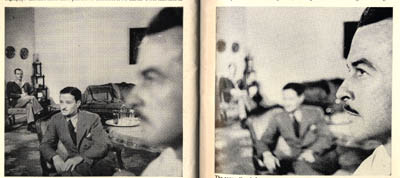
An accompanying photo shows pan-focus at work, with Toland in frame center, an actor in the background, and Toland’s camera assistant in the foreground.
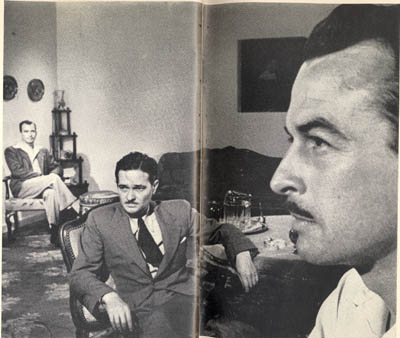
In sum, Toland’s publicity prepared viewers, both professional and nonprofessional, for an odd-looking movie.
Throughout the 1940s, Welles and Wyler wrote and gave more interviews, often insisting that their films invited greater participation on the part of spectators. In a crucial 1947 statement, Wyler noted:
Gregg Toland’s remarkable facility for handling background and foreground action has enabled me over a period of six pictures he has photographed to develop a better technique for staging my scenes. For example, I can have action and reaction in the same shot, without having to cut back and forth from individual cuts of the characters. This makes for smooth continuity, an almost effortless flow of the scene, for much more interesting composition in each shot, and lets the spectator look from one to the other character at his own will, do his own cutting. (12)
Some of this publicity material made its way into French translation after the liberation of Paris, just as Kane, The Little Foxes, and other films were arriving too. Bazin and his contemporaries picked up the claims that these films broke the rules. Deep-focus cinematography became, in the hands of critics, a revolutionary new technique. They presented it as their discovery, not something laid out in the films’ publicity.
But the case involved, as Huck Finn might say, some stretchers. Watching the baroque and expressionist Kane, it’s hard to square it with normal notions of realism, and we may suspect Toland of special pleading. Some of Toland’s purported innovations, such as low-angle shots showing ceilings, had been seen before. Even the signature Toland look, with cramped, deep compositions shot from below, can be found across the history of cinema before Kane. Here is a shot from the 1939 Russian film, The Great Citizen, Part 2 by Friedrich Ermler.
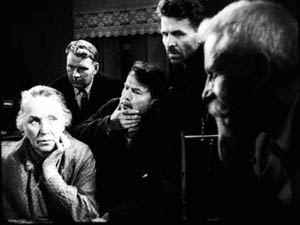
More seriously, some of Toland’s accounts of Kane swerve close to deception. For decades people presupposed that dazzling shots like these were made with wide-angle lenses.
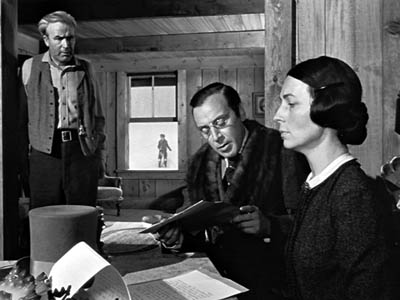
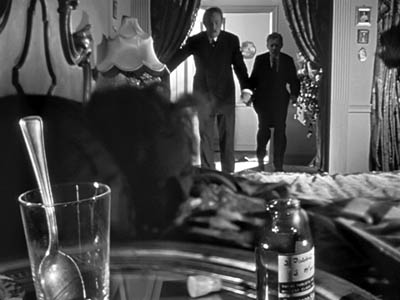
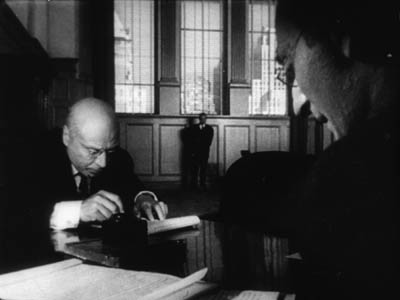
Yet the deep focus in the first image was accomplished by means of a back-projected film showing the boy Kane in the window, while the second image is a multiple exposure. The glass and medicine bottle were shot separately against a black background, then the film was wound back and the action in the middle ground and background were shot. (And even the middle-ground material, Susan in bed, is notably out of focus.) I suspect that the flashy deep-focus illustration in Life, shot with a still camera, is a multiple exposure too. In any event, much of the depth of field on display in Kane couldn’t have been achieved by straight photography. (13)
RKO’s special-effects department had years of experience with back projection and optical printing, notably in the handling of the leopard in Bringing Up Baby, so many of Kane‘s boldest depth shots were assigned to them. But here is all that Toland has to say on the subject:
RKO special-effects expert Vernon Walker, ASC, and his staff handled their part of the production—a by no means inconsiderable assignment—with ability and fine understanding. (14)
Kane’s reliance on rephotography deals a blow to Bazin’s commitment to film as a medium committed to recording an event in front the camera. Instead, the film becomes an ancestor of the sort of extreme artificiality we now associate with computer-generated imagery.
Despite these difficulties, Toland’s ideas sensitized filmmakers and critics to deep space as an expressive cinematic device. Modified forms of the deep-focus style became a major creative tradition in black-and-white cinema, lasting well into the 1960s. Bazin’s analysis certainly developed Toland’s ideas in original directions, and he creatively assimilated what Toland and his directors said into an illuminating general account of the history of film style. None of these creators and critics were probably aware of the remarkable depth apparent in pre-1920 cinema, or in Japanese and Soviet film of the 1930s. Their claims taught us to notice depth, even though we could then go on to discover examples that undercut Toland’s claims to originality.
Some little things to grasp at
I assume that Toland and his directors were sincerely trying to experiment, however much they may have packaged their efforts to appeal to viewers’ and critics’ tastes. But sometimes artists aren’t so sincere. By the 1950s, we have directors who started out as film critics, and they realized that they could guide the agenda. Here is Claude Chabrol:
I need a degree of critical support for my films to succeed: without that they can fall flat on their faces. So, what do you have to do? You have to help the critics over their notices, right? So, I give them a hand. “Try with Eliot and see if you find me there.” Or “How do you fancy Racine?” I give them some little things to grasp at. In Le Boucher I stuck Balzac there in the middle, and they threw themselves on it like poverty upon the world. It’s not good to leave them staring at a blank sheet of paper, no knowing how to begin. . . . “This film is definitely Balzacian,” and there you are; after that they can go on to say whatever they want. (15)
Chabrol is unusually cynical, but surely some filmmakers are strategic in this way. I’d guess that a good number of independent directors pick up on currents in the culture and more or less self-consciously link those to their film.
Today, in press junkets directors can feed the same talking points to reporters over and over again. An example I discuss in the forthcoming Poetics of Cinema is the way that Chaos theory has been invoked to give weight to films centering on networks and fortuitous connections. As I read interview after interview, I thought I’d scream if I encountered one more reference to a butterfly flapping its wings.
More recently, Paul Greengrass gave critics some help when he suggested that the jumpy cutting and spasmodic handheld camera of The Bourne Ultimatum suggested the protagonist’s subjective point of view–presumably, Jason’s psychological disorientation and frantic scanning of his surroundings. I expressed skepticism about this on an earlier blog entry, Anne Thompson replied on her blog, and I returned to the subject again. Any director’s statement of purpose is interesting in itself, but it should be assessed in relation to the evidence we detect onscreen.
Another recent instance: the new Taschen book on Michael Mann. The luscious pictures, mainly from Mann’s archive, are the volume’s raison d’etre, but the filmmaker seems to have placed unusual demands on the text. F. X. Feeney writes:
An earlier version of this book completed by another writer attempted (in a spirit of sincere praise) to treat Mann’s films as reactions against film traditions, as subversions of genre. This fetched a rebuke from Mann: “It’s irrelevant and neither accurate nor authentic to compare my films to other films because they don’t proceed from genre conventions and then deviate from those conventions. They proceed from life. For better or worse, what I’ve seen and heard and learned on my own is the origin of this material. Maybe the film medium by nature spawns conventions, because we all built on what’s gone before, but the content and themes of my films are not facile and derivative. They are drawn from life experience.” (16)
We have to wonder if Mann’s objection played a role in eliminating the earlier writer’s version. If that happened, it’s an unusually strong instance of a director’s holding sway over critical commentary. (17)
In the text we have, Feeney provides a chronological account of Mann’s career: plot synopses, thematic commentary, production background. There’s no discussion of broader historical trends, such as the migration of TV directors into film, the creative options available in 1980s-1990s Hollywood, the development of self-conscious pictorialism in modern film, the possibility of genre films becoming art-films or prestige pictures, or the changes in media culture or American society. All of these lines of inquiry would require comparing Mann with other filmmakers. It remains for other writers, perhaps without the director’s cooperation, to put Mann’s achievement into such contexts.
It’s always vital to listen to filmmakers, but we shouldn’t limit our analysis to what they highlight. We can detect things that they didn’t deliberately put into their films, and we can sometimes find traces of things they don’t know they know. For example, virtually no director has explained in detail his or her preferred mechanics for staging a scene, indicating choices about blocking, entrances and exits, actors’ business, and the like. Such craft skills are presumably so intuitive that they aren’t easy to spell out. Often we must reconstruct the director’s intuitive purposes from the regularities of what we find onscreen. (For examples, see this site here, here, and here.) And it doesn’t hurt, especially in this age of hype, to be a little skeptical and pursue what we think is interesting, whether or not a director has flagged it as worth noticing.
(1) Macdonald, “Gertrud,” Esquire (December 1965), 86.
(2) Quoted in Orson Welles and Peter Bogdanovich, ed. Jonathan Rosenbaum, This is Orson Welles (New York: HarperCollins, 1992), 21).
(3) Such would seem to be the case of the close-up, which of course is found very early in film history. But Griffith’s idea of a close-up may not correspond to ours. More on this in a later blog, perhaps.
(4) I give an overview of this rich body of research in Chapter 5 of On the History of Film Style. See also various entries in the Encyclopedia of Early Cinema, ed. Richard Abel (New York: Routledge, 2005).
(5) The most detailed argument for this view I know is Paisley Livingston’s book Art and Intention: A Philosophical Study.
(6) “William Wyler, or the Jansenist of Directing,” in Bazin at Work: Major Essays and Reviews from the Forties and Fifties, ed. Bert Cardullo (New York: Routledge, 1997), 8.
(7) Orson Welles: A Critical View, trans. Jonathan Rosenbaum (New York: Harper and Row, 1978) 80).
(8) Toland, “Realism for Citizen Kane,” American Cinematographer 22, 2 (February 1941), 54, 80.
(9) See the discussion in Bordwell, Janet Staiger, and Kristin Thompson, The Classical Hollywood Cinema: Film Style and Mode of Production to 1960 (New York: Columbia University Press, 1985), 345-349.
(10) Toland, “How I Broke the Rules in Citizen Kane,” Popular Photography (June 1941), 55, 90-91.
(11) “Orson Welles: Once a Child Prodigy, He Has Never Quite Grown Up,” Life (May 26, 1941), 110-111.
(12) Wyler, “No Magic Wand,” The Screen Writer (February 1947), 10.
(13) Peter Bogdanovich was to my knowledge the first person to publish some of this information; see “The Kane Mutiny,” Esquire 77, 4 (October 1972), 99-105, 180-90.
(14) Toland, “Realism,” 80.
(15) “Chabrol Talks to Rui Noguera and Nicoletta Zalaffi,” Sight and Sound 40, 1 (Winter 1970-1971), 6.
(16) F. X. Feeney, Michael Mann (Cologne: Taschen, 2006), 21.
(17) Mann’s reasoning puzzles me. He insists that his films can’t be compared to others along any dimensions, especially thematic ones. Yet in saying that his films are lifelike, he suggests that other films aren’t as realistic as his. Moreover, what about comparisons on grounds of technique, surely one of the most striking and admired features of Mann’s work? For reasons that are obscure, the director discourages any critical consideration of style; Feeney tells us that Mann hates the very word (p. 20).
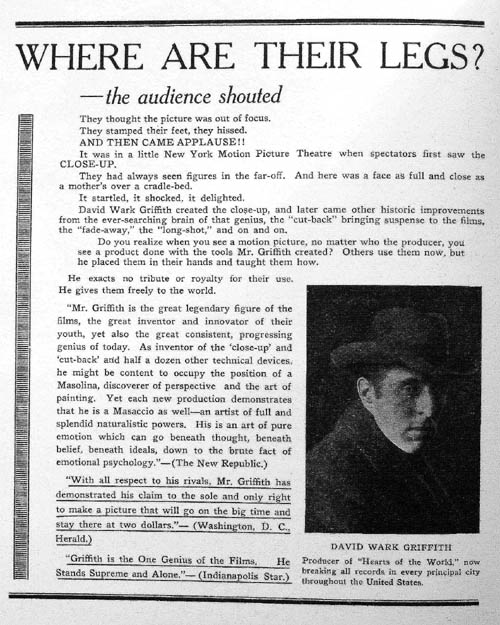
Ad in Wid’s Year Book 1918.
PS: 15 October: I’ve received a clarification from Paul Duncan, editor of F. X. Feeney’s Michael Mann book for Taschen. He expresses general agreement with my suggestions about how directors shape the uptake of their work, but he explains that the Mann book isn’t an instance of it. Here are the comments bearing on my blog entry.
In reply to my suggestion of other avenues to explore about Mann’s career:
In fairness to F.X. Feeney, he only had 25,000 words to cover Mann’s career, and all the subjects you write about are really outside the scope of the book. It sounds as though these are subjects that you would like to explore, and I can’t wait to read them in a future book or blog.
As for whether Mann exercised some control over the book’s final form, which I float as one possible explanation for its compass:
First, you speculate whether Mann caused the first version of the book to be scrapped, i.e. He exerted editorial control/censorship over the book. This is not the case, and if it was, do you think that he would have allowed F.X. to write that in the published version of the book?
In Note 17 appended to Feeney’s quote, you write: “Yet in saying that his films are lifelike, he suggests that other films aren’t as realistic as his.” If you had continued Mann’s quote, you would have reported the following: “I don’t look at the excellent French director Jean-Pierre Melville to decide how to tell the story in Thief. I meet thieves. And I guarantee you the reason Melville’s Le Samourai 1967) has authenticity, the reason Raoul Walsh’s White Heat (1949) has authenticity, is because those film-makers knew thieves, too.” I do not see any evidence here that Mann suggests that his films are more lifelike than other directors’. Only that his films stem from life like other films stem from life.
Also, in Note 17, you write: “For reasons that are obscure, the director discourages any critical consideration of style; Feeney tells us that Mann hates the very word (p. 20).” The reason Mann hates the word “style”—and I apologize for not making this clear in the book—is because after producing the Miami Vice TV show, he was forever referred to as a stylist, and the “style” of the show was all anybody ever talked about. The implication was that Mann is a director of style without substance. Subsequently, Mann has been very wary of the word, and discussion of it, because it puts undue weight on one aspect of his work.
Finally, I would like to explain a little of the working method with Mann on the book. The book was researched and written during rehearsal, filming and editing of Collateral. F.X. wrote the text and was given full access to everything that Mann had said in interviews. Mann then read and annotated the text, and this was discussed face-to-face with F.X. Most of these annotations were of a factual nature, correcting dates, being precise about the sequence of events, and to correct misinterpretations of his comments in previous interviews. However, they would also bring up new comments from Mann about his work. F.X. then rewrote some texts to include Mann’s comments, and then F.X. wrote his replies. In this way, the book became more of a dialogue between Mann and F.X. and is stronger for it I feel. So, in this case, the filmmaker did not get the last word.
I thank Paul for his clarifications, which should be of interest to all the book’s readers. On only two matters do we disagree.
First, Feeney’s book achieves what it set out to achieve, and it deserves credit for giving us valuable information about Mann in a clear, pungent style. And no one expects a Taschen book to be an in-depth monograph covering all aspects of a director’s career. But I still think that length limits don’t prevent an author from raising the contextual issues I mention. Many articles manage to address matters that go beyond the sort of career survey that Feeney provides, so there are ways to sketch such issues in an abbreviated way. I inferred, erroneously, that the choice not to tackle them could have been related to Mann’s own views on the comparative dimension that such issues tend to rely on.
Secondly, a minor matter: The fact that Mann can invoke Melville and Walsh on films about thieves suggests that a comparative perspective is valuable; he’s including himself in the company of directors who know their subjects from life, in explicit contrast to those who don’t. I didn’t include the extra sentences because I thought that they simply provided further signs of the contradiction I found in Mann’s own position—that his films can’t be compared to other directors’ works.
More light from the East

Useless (Jia Zhang-ke, China, 2007).
DB’s last communiqué from the 2007 Vancouver International Film Festival:
I’m so taken with José Luis Guerin’s En la ciudad de Sylvia (Spain/ France) that I’ll be devoting a separate blog entry to it soon. At Vancouver it was projected with his Unas fotos en la ciudad del Sylvia, a remarkable sketchpad for and rumination on the feature. Rubbed together, the two films throw off sparks. En la ciudad is in color and very tightly constructed, Unas fotos consists of hundreds of black-and-white stills linked by associations and intertitles, with no sound accompaniment. Guerin, an admirer of Murnau, says that as a young man he watched old films in “a sacred silence” and he wanted to try something similar.
Unas fotos may not be factual—call it a lyrical documentary—but it illuminates En la ciudad in striking ways and is intriguing in its own right. Structured as a quest for a woman the narrator met 22 years ago, the film moves across several cities and invokes as its patrons Dante and Petrarch, each of whom yearned for an unattainable woman. But this isn’t exactly a photo-film à la Marker’s La jetée; it uses dissolves, superimpositions, and staggered phases of action to suggest movement. The subjects? Dozens of women photographed in streets and trams. Some will find a creepy edge to the movie, but it didn’t strike me as the obsessions of a stalker. Guerin becomes sort of a paparazzo for non-celebs, capturing the many looks of ordinary women.
Watch this space for more on the many looks of Sylvia. For now, more Asian highlights from Vancouver.
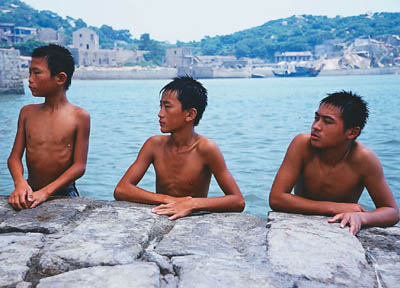
Fujian Blue.
Johnnie To and Wai Ka-fai have reunited for The Mad Detective (Hong Kong), which is as off-balance as you’d expect from its premise. Evidently spun off those TV series that feature telepathic profilers, the film stars Lau Ching-wan as a detective who solves cases by intuiting crooks’ “inner personalities.” We’re introduced to him crawling into a suitcase and asking his partner to throw it downstairs. After a few bumpy descents, he flops out and names the man who packed up a girl’s body the same way. Soon Lau is mentally reenacting a convenience-store robbery, and To/Wai cut together various versions of it as he plays with the possibilities.
Years after Lau leaves the force, his partner brings him back as a consultant to another case. By now, though, our mentalist has gone mental. The filmmakers get comic mileage, and some genuine poignancy, out of intercutting his hallucinations with what’s really happening. Lau envisions multiple personalities within the man they’re hunting, and as he traces out clues each personality flares up. To and Wai carry their dotty premise to a vigorous climax that multiplies the mirror confusions of both Lady from Shanghai and The Longest Nite. The brilliant sound designer Martin Chappell is back on the Milkyway team, making the effects and music magnify Lau’s heroic disintegration.
 Lee Chang-dong, of Peppermint Candy and Oasis, has won his widest acclaim yet with Secret Sunshine (Korea). As your basic domestic crime-thriller Born-Again-Christian female-trauma melodrama, it’s undeniably gripping.
Secret Sunshine earns its 130-minute length, because Lee needs time to do several things. He traces the assimilation of a widow and her little boy into a rural town. Then he must follow the remorseless playing out of a harrowing crime. He makes plausible her succumbing to fundamentalist Christianity and her growing conviction that she needs to forgive the criminal. And there are more changes to come.
For me the most unforgettable moment was the heroine’s appalled confrontation, in a prison visiting room, with the man who wronged her. His unexpected reaction dramatizes how religious faith can cultivate both emotional security and an almost invincible smugness. Jeon Do-yeon won the Best Actress award at Venice for her nuanced performance, and Song Kang-ho, best known for The Host and Memories of Murder, lightens the somber affair playing a man of indomitable cheerfulness and compassion.
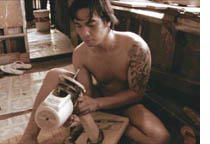 I found Brillante Mendoza’s Slingshot (Philippines) quite absorbing. Hopping among various lives lived in the Mandaluyong slums, it’s shot run-and-gun style, but here the loose look seems justified by both production circumstances and aesthetic impact. It was filmed on actual locations across only 11 days, and though it feels improvised, Mendoza claims that it was fully scripted and the actors were rehearsed and their movements blocked. Most of the actors were professionals, intermixed with non-actors—a strategy that has paid off for decades, in Soviet montage films and Italian Neorealism. Slingshot reminded me of Los Olvidados, both in its unsentimental treatment of the poor and its political critique, the latter here carried by the ever-present campaign posters and vans threading through the scenes. I suspect that the final shot, showing an anonymous petty crime accompanied by a crowd singing “How Great Is Our God,” would have had Buñuel smiling.
Off to China for Fujian Blue by Robin Weng (Weng Shouming). The setting is the southeastern coast, a jumping-off point for illegal immigration. The plotline has two lightly connected strands. In one, a boys’ gang tries to blackmail straying wives by photographing them with boyfriends, going so far as to sneak in homes and catch the couples sleeping together. The other plot strand presents Dragon, a boy who’s trying to sneak out of China and make money overseas. The whole affair is reminiscent of Hou Hsiao-hsien’s Boys from Fengkuei, and in Dragon’s story we can spot overtones of Hou’s distant, dedramatized imagery. Yet Weng adds original touches as well, including an almost subliminal ghost of London across the blue skies of the China straits.
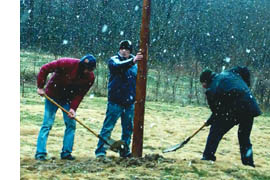 Fujian Blue shared the festival’s Dragons and Tigers Award with Mid-Afternoon Barks (China) by Zhang Yuedong. The two films are very different; if Weng echoes Hou, Zhang channels Tati and Iosseliani. (When I asked him if he knew the directors, he didn’t recognize the names.) Mid-Afternoon Barks is broken into three chapters. In the first, a shepherd abandons his flock and wanders into a village. An unknown man shoots pool. Dogs bark offscreen. The shepherd shares a room with another visitor, but midway through the night, the innkeeper orders them to put up a telegraph pole. When he awakes, the man is gone, and so is the pole. He wanders on.
In the second episode . . . But why give away any more? In this relaxed, peculiar little film Beckett meets the Buñuel of The Milky Way and The Discreet Charm of the Bourgeoisie. As the enigmatic men without pasts or even psychologies wound their way through the long shots, Zheng’s quietly comic incongruities won me over long before the last dog had barked and the last ball had bounced.
Jia Zhang-ke is known principally for fiction films like Platform, The World, and Still Life, but from the start of his career he has shown himself a gifted documentarist as well. His In Public (2001) is a subtle experiment in social observation, and Dong (2006) made an enlightening companion piece to Still Life. Useless is more conceptual and loosely structured than Dong. Omitting voice-overs, Useless offers a free fantasia on the theme of China as apparel-house to the world.
The first section of the film presents images of workers in Guangdong factories as they cut, sew, and package garments. Jia’s camera refuses the bumpiness of handheld coverage; it opts for glissando tracking shots along and around endless rows of people bent over machines. (Now that fiction films try to look more like documentaries, one way to innovate in documentaries may involve making them look as polished as fiction films.) Jia also gives us glimpses of workers breaking for lunch and visiting the infirmary for treatment.
In a second section, Useless follows the success of a fashion house called Exception, run by Ma Ke. Her new clothing line Inutile (Useless) consist of handmade coats and pants that are stiff and heavy, almost armor-like, and that flaunt their ties to work and nature. (Some outfits are buried for a while to season.) Ending this part with Ma’s Paris show, in which the models’ faces are daubed with blackface, Jia moves back to China and the industrial wasteland of Fenyang Shaoxi. There he concentrates on home-based spinning and sewing. Neighborhood tailors patch up people’s garments while the locals descend into the coalmines. A former tailor tells us that he gave up his work because large-scale clothes production rendered him useless.
Jia’s juxtaposition of three layers of the Chinese clothes business evokes major aspects of the country’s industry: mass production, efforts toward upmarket branding, and more traditional artisanal work. Without being didactic, he uses associational form to suggest critical contrasts. The miners’ sooty faces recall the Parisian models’ makeup, and their stiff workclothes hanging on a washline evoke the artificially distressed Inutile look. What, the film asks, is useless? Jia shows industrial China’s effort to move ahead on many fronts, while also forcefully reminding us of what is left behind.
Thanks to Alan Franey, PoChu AuYeung, Mark Peranson, and all their colleagues for a wonderful festival. They’re so relaxed and amiable, they make it look easy to mount 16 days crammed with movies. Be sure to check on CinemaScope, the vigorous and unpredictable magazine that makes its home in Vancouver. It gives you many gems online, but it’s well worth subscribing to.


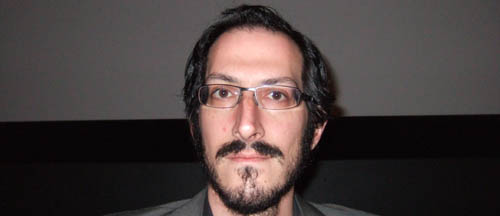
Alan Franey, Director of the Vancouver International Film Festival; PoChu AuYeung, Program Manager; and Mark Peranson, Program Associate and Editor of Cinema Scope.
Asian media empires, and the greatest of all filmmakers
DB here:
I owe you a final report on my viewings in Vancouver, but while I’m preparing that, I want to signal three publications, two printed books and one online book.
America seems to have cornered the market in branded entertainment. Movies and comics have given us Mickey Mouse, Shrek, Barney the dinosaur, Batman, Jughead, and all those other lovable characters you can’t escape. Once in a while another country gets into the game, as with Tintin (Belgium), the Smurfs (Belgium), and the Teletubbies (Britain). But for sheer numbers, the US’s only real rival, it seems, is Japan.
The cliché is that the Japanese make the hardware and we make the software. But Astro Boy (originally Mighty Atom), Speed Racer, Mighty Morphin Power Rangers, Sailor Moon, Pokémon, Cutie Honey, and Super Mario Brothers beg to differ. And if Zatoichi and Godzilla add their weight to the argument, you’ll back off fast. The Japanese have given the world an unending spate of sagas and characters, often of marked peculiarity. Ranma ½ changes from a boy to a girl and back again, and Mothra, even just being himself, is fairly creepy.
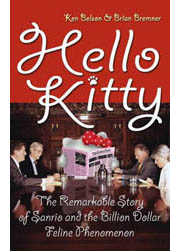 All of which makes Ken Belson and Brian Bremner’s Hello Kitty: The Remarkable Story of Sanrio and the Billion Dollar Feline Phenomenon (Wiley) an informative study and a breezy read. The pudgy cat with no mouth generates about $500 million in annual sales, half of Sanrio’s total, and she adorns over 20,000 products, including vibrators.
Belson and Bremner trace Ms. Kitty’s rise from humble beginnings in 1974 to her current status as a media superstar. Just as important, they put her in several intriguing contexts. They trace the rise of the kawaii (cuteness) sensibility throughout Asia, where Peanuts‘ Snoopy became the model. They show that Miss Kitty is emblematic of Japan’s shift from “hard” manufacturing industries to “soft” culture-based ones like comics and videogames. Some consumers, though, choke on all this sugar, and the authors haven’t omitted mention of those media jammers who want to turn our heroine into a hellcat.
The book is especially good at characterizing the distinctive Japanese belief that a product must arouse an emotional attachment in the consumer. Sony does it through sleek design, Tamagotchi the digital pet did it through guilt-tripping. Ms. Kitty might seem the epitome of blandness, her awww quotient and neoteny-driven features rendering her vacuous. Yet the lady has a touch of mystery. You’ve seen a smile without a cat, but here is a cat without a smile. Snoopy shamelessly exposes his fantasy life, but who knows what she’s feeling? Lust? Caution? Is she quietly judging us? Fill in the blank.
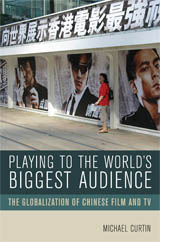 For a more comprehensive analysis of how Asian media empires work, go to Michael Curtin’s brand-new Playing to the World’s Biggest Audience: The Globalization of Chinese Film and TV (University of California Press). Michael is a close friend and colleague, so in principle I’m biased; but I’d think this a terrific book if he were a stranger. Among many other things, it shows that media globalization isn’t a one-way flow, from Hollywood to ROTW (Rest of the World). Asian media are globalizing too, and the process is both fascinating and far-reaching.
The book provides both history and contemporary analysis. Michael shows that Shaw Bros. pioneered the concept of an entertainment conglomerate in Asia, and he traces their policies across several decades. The story starts in Hong Kong, with its curiously transnational film industry, but the tale sweeps across media (TV, telephony, internets) and territories: Taiwan, Singapore, and mainland China. Michael has interviewed many major players, so if you want to know what’s really behind Golden Harvest, Media Asia, China Star, Star TV, Celestial, and other companies, this is the place to go. In the area I know a little, Michael offers the shrewdest and strongest analysis of the rise and precipitous fall of the Hong Kong film industry I’ve seen.
Playing to the World’s Biggest Audience will attract scholars and business people wanting to understand the dynamics of Asian media. I think as well that fans of Asian film, music, and TV can get a lot out of it. If you’re put off by the first chapter’s theoretical layout, skip to chapter two and jump into the compelling story of how entrepreneurs from southern China assembled a media juggernaut that now enthralls over a billion spectators.
 Finally, about a year ago on this blog I wrote an entry about the online arrival of my Ozu and the Poetics of Cinema, thanks to the publishing initiative of the Center for Japanese Studies at the University of Michigan. Now an improved online edition of this scarce out-of-print book has just gone online. You can download the whole shebang if you want.
In the first version, posted a year ago, the pictures were hard to see, so we made digital versions of all the original stills. The monochrome ones look very nice, and the color ones (not an option for the print edition) look fine. In addition, if you click on a still in the sidebar, you can enlarge it and even download it. Thanks to web tsarina Meg Hamel, we have a permanent link in the list of books on the left.
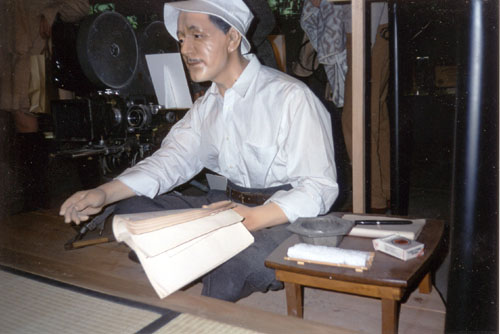
There’s also a new introduction, in which I explain a bit about the background of the book, talk about the approach it takes, position it within trends of film studies, and suggest what Ozu means to me. My introduction also shows some rare pictures, including snaps from a strange exhibition about Ozu’s life. The exhibition has vanished now, but maybe that’s an appropriate tribute to an artist who made mutability everlastingly vivid.
A toast to Markus Nornes, Bruce Willoughby, Kristi Gehring, Terry Geitgey, and all the other people who took pains to make this improved online Ozu possible.
Vancouver visions

Drizzle every day can’t dampen audiences’ enthusiasm.
DB again:
More dispatches from the Vancouver International Film Festival.
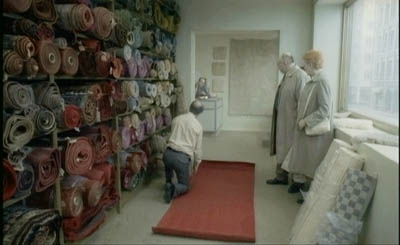
“Be pleased, then, you living one, in your delightfully warmed bed, before Lethe’s ice-cold wave will lick your escaping foot.” As a tram destination, Lethe makes a brief appearance in the Swedish film You, the Living, Roy Andersson’s latest comedy of trivial miseries. The line from Goethe is apt. After ninety minutes of drab apartments and Balthus-like figures, all bathed in sickly greenish light, you’re ready to stay in bed forever.
As in Songs from the Second Floor, Andersson gives us a loose network narrative, with barely characterized figures threading their way through urban locales. Long-shot, single-take scenes turn clinics and dining rooms into monumentally desolate spaces. Humans, either bulbous or emaciated, trudge through torrential rain and peer out from distant windows. The bodies may be distorted and careworn, but the spaces are even more so. We get a sort of dystopian Tati, in which gags, near-gags, and anti-gags are swallowed up in the cavities we call home and workplace. A carpet store stretches off into the distance, and a cloakroom seems like a basketball court.
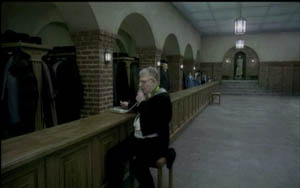
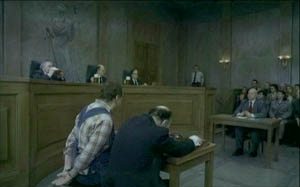
In You, the Living, Andersson’s characters recount their dreams, and these open onto areas only a step beyond our world in their lumpish crowds and eerie vacancy. Judges at a trial are served beer as they condemn the accused. Spectators at an electrocution snack on popcorn from supersized buckets. How can I not like a filmmaker so committed to moving his actors around diagonal spaces, even if the frame is either sparse or uniformly packed, and though he does treat his people like sacks of coal? Don’t look for hope here, only a sardonic eye attracted by banality and pointlessness, images made all the bleaker by an occasional song.
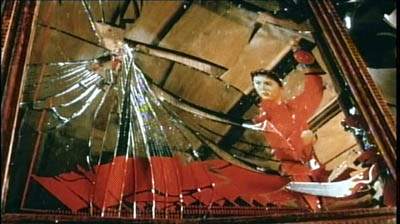
I’m drawn to directors who create a powerful visual and auditory world more or less out of phase with reality as we usually see it (in life and in movies). Andersson is one such director; Jiang Wen is another, whose audacious The Sun Also Rises is one of my favorites of the festival so far. Not doing so well with Mainland Chinese audiences, according to the International Herald Tribune, it hasn’t warmed up a lot of Western critics either. Amazingly, it was declined for competition at Cannes.
It seems impossible to discuss The Sun Also Rises without using the word “magic,” as in magic realism, but I saw it as more of a fairy tale or fable. Set in the Cultural Revolution, it tells two stories in the first two sections. A young boy’s mother goes a little mad on a labor farm; in another village, a teacher is compromised by the passionate love of a nurse and an accusation of sexual misconduct. The two stories intersect in a third section, which leads to a jubilant, if disconcerting, final stretch.
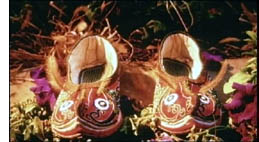 At the center of each plot stands a vivacious, passionate woman who unleashes a cascade of unhappy events. Yet the tone of the film is cheerful, almost giddy, thanks not only to Joe Hisaishi’s buoyant score (he may now be the Nino Rota of Asian cinema) but to Jiang’s fresh, assured technique. The movie starts with tight close-ups—the fish-design shoes the mother wants, her feet and hands, her son’s hands at the abacus—edited at a cracking pace. Staccato movements in and out of the frame give the whole passage a visual snap that launches the movie. Characters lunge through the shots, running this way and that without catching breath, and Jiang’s camera follows them without pausing for the sort of stately scene-setting that audiences may expect. Likewise, the second story opens with hands at play and work, the teacher stroking his guitar strings and a bevy of woman kneading bread dough.
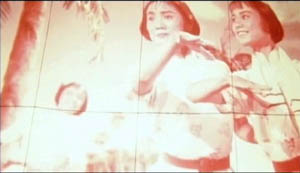
The exuberance of the characters and the style contrasts with the usual presentation of this cruel era of PRC history. Jiang finds real pleasure in Cultural Revolution kitsch, and he links a snapshot of the missing father to an iconic image from The Red Detachment of Women. It’s another knot joining the two plot strands; in the second section, villagers watch a screening of that film. Jiang makes the event a real festivity, with couples courting, the teacher humming along with the tunes, and an old lady feeding fish in a pond. Jiang dares to suggest that the force-fed popular culture of Maoism, so scoffed at now, gave genuine enjoyment
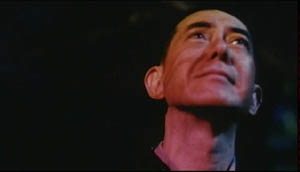
The fairy-tale atmosphere is conjured up by little mysteries, such as a talking bird and the possibility of taking dictation on an abacus, and bigger ones about fatherhood, a stone hut in the forest, and a shadowy figure named Alyosha, whose identity is more or less revealed in the film’s final long sequence. Variety‘s Derek Elley found The Sun Also Rises both rushed and dawdling, but you could say that about 8 ½ too. Like Fellini’s film, Jiang’s shows a filmmaker at the top of his powers inviting us to savor the exhilarating attractions of imagination.
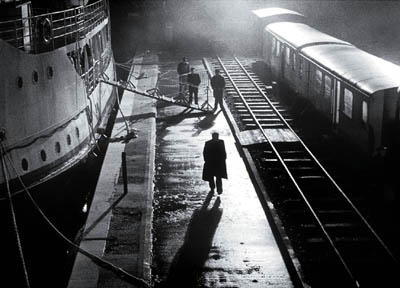
Another world, another vision. The camera frames a rope descending into black water and tilts slowly, really slowly, up to reveal the ship’s prow and the deck, swathed in darkness. Two silhouettes are visible, and one says, “Don’t follow me too soon.” Soon we’re following the transfer of a small suitcase, the disembarking of passengers making their way to a train. This nearly thirteen-minute shot (!) gives way to another long take, in which we see, in the distance, a murder on the quay.
Béla Tarr has called The Man from London a film noir, and he explained that to me by saying, “Not an American film noir. They were done by bad directors. More like the original French film noirs.” Indeed, the opening shot, with its mists and murky waterfront, suggests Quai des brumes. But here the plot action is slight, presented at a distance, and opaque in its motives; 10 % story, we might say, but 90 % atmosphere. The camera coasts across the waterfront town with the same grave deliberation we see in Damnation, Sátántangó, and Werckmeister Harmonies, swallowing up the Simenon situation in Tarr’s fluid way of seeing, a scanning of ever-shifting surfaces and vistas.
With fewer than thirty shots across about 133 minutes, The Man from London is another exercise in long-take virtuosity, but I thought I noticed some fresh departures. For one thing, there are few characters and relatively few locales, and situations are brought out with unusual explicitness (for Tarr). Instead, it seemed to me that Tarr was exploring new possibilities in one of his pet techniques, the over-the-shoulder long shot I mentioned in an earlier entry.
The opening shot, at first an apparently objective survey of the moored ship, turns out to be a view from the tower manned by Maloin. In shooting the wharf, the camera is forever oscillating, within a single shot, between what we can see outside, at a distance, from a high angle, and glimpses of Maloin at his post, his head or shoulder sliding into the foreground. Imagine Rear Window without the reverse shots of Jimmy Stewart watching.
In earlier films, Tarr tended to be quite clear when his foreground character was noticing something in the distance; his chief interest lay in suppressing the character’s reaction. What we get here can be seen as a refinement of the opening shot of Damnation, with its awesome landscape gradually reframed by Karrer looking out his window, or of passages of the doctor at his window in Sótántangó. Several of the tower scenes in The Man from London, are elaborations of that image scheme, but with more ambiguity. The camera, slipping from long-shot background and close-up foreground, coasts along without telling us whether Maloin has seen exactly what we’ve seen. The result is a suspenseful uncertainty not only about what’s happening in the noir plot but also about what Maloin knows.
There are many other points of interest in the new film, and after one viewing I can’t claim to have a grip on them. But I do think critics have overlooked its sheer visual beauty and Tarr’s efforts to turn his style toward a fluid pictorial suspense.
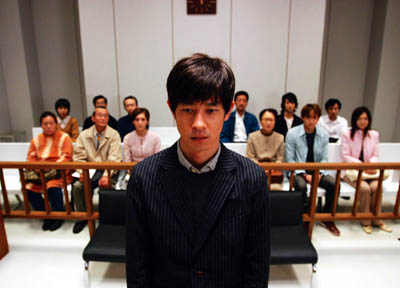
Altogether less flamboyant than any of these was Suo Masayuki’s I Just Didn’t Do It (Japan), which I’d been looking forward to since my February entry. It’s definitely a change of pace for a director known for comedies that satirize youth culture and middle-aged boredom. A young man is accused of groping a schoolgirl on a crowded traincar. The police advise him to confess and pay a fine, but he insists on his innocence. This decision drops him into a judicial mill that grinds slow and altogether too fine.
The script carpentry seems to me excellent. The presentation of each phase of the boy’s case could have been dry, but Suo makes each step hinge on a detail of fact or inference, so small questions keep popping up—including questions about whether the boy really might have done it. The finale, which recalls Kurosawa’s Ikiru in its methodical summing up of everything we have seen, becomes grueling, but in a salutary way. In Japan, the film is a trailblazing critique of the criminal justice system, where most people arrested confess in order to avoid the almost inevitable guilty verdict in a trial. Eliminating a jury, barring defense counsel’s discovery of prosecution evidence, and capriciously replacing one judge by another midway through a case, the system encourages cynical submission.
Suo avoids stylistic pyrotechnics. He plays down his signature mugshot framings (the publicity still above is an exception) and has recourse to handheld camerawork simply to distinguish the train scenes from the rest of the film. Still, his shooting displays a quiet agility. The high point is probably the testimony of the schoolgirl, her identity protected by screens set up around her. Suo finds a remarkable variety of camera setups here, each well-judged to impart a particular piece of information. (In its resourceful changes of viewpoint, the sequence reminded me of Mizoguchi’s courtroom scenes in Taki no Shiraito and Victory of Women.) The title suggests a strident social-problem film, but Suo’s calm plainness of handling yields a quality rare in the genre: tact.
Many more films to report on, including Johnnie To’s latest, but I must rush off to—what else?—another movie. I’ll try for a wrapup on Thursday, while I’m on that highway in the sky.
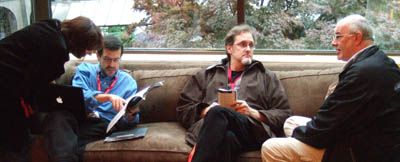
The critics line up: Bérénice Reynaud, Shelly Kraicer, Chuck Stephens, and Tony Rayns.