



Archive for the 'Books' Category
Great Danes in the morning
This morning I received my author’s copies of a superb book published by the Danish Film Institute, 100 Years of Nordisk Film. Nordisk was one of the world’s top producing and distributing companies in the 1900s and 1910s, and it continues today. This volume, edited by Lispeth Richter Larsen and Dan Nissen, is now the fullest account in English of this extraordinary firm.
There are essays by top scholars like Isak Thorsen, Marguerite Engberg, Stephan Michael Schroder, Niels Jorgen Dinnesen, Edvin Kau, Thomas Christensen, Casper Tybjerg, Ib Bondebjerg, and Peter Schelpern, and the illustrations are eye-popping. I contribute an essay on the aesthetics of Nordisk’s 1910s films, and my stills came out beautifully.
Many of the silent films discussed are available on DVD from the Institute, and they are extraordinary. If you want a sample, try the Asta Nielsen or Benjamin Christensen collection. These are amazing movies, and the Christensens offer remarkably inventive uses of cutting, lighting, and camera movement–very unusual for their day.
I don’t yet find a source for ordering the book online, but it will probably be available soon from the Institute’s bookstore. Danish cinema is one of the most exciting national cinemas in Europe right now; for coverage, have a look at their new homepage.
Addendum to an earlier post: Industry sage and entertaining skeptic David Poland of The Hot Button calls foul on Gladwell’s New Yorker piece on the Epagogix software–you know, the one purporting to predict hit movies. Thanks to Sean Weitner of Flak Magazine (itself highly recommended).
In the kitchen with Benton, Hill, Kasdan, et al.
DB here:
I’ve never understood why many people in film studies ignore what practicing filmmakers tell us about their work. If we want to know about technique, form, and the creative process, we should understand filmmakers’ craft knowledge, the tricks of their trade. Filmmakers know an awful lot, and we benefit from listening to them.
So books of interviews can be quite valuable. They take us into the kitchen and let us watch chefs at work. Sometimes they follow recipes but just as often they throw things together with inspired, or disastrous, results.
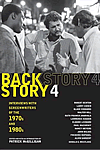
Among the best of the interview books is Pat McGilligan’s Backstory series, about screenwriters and their craft. Backstory 4, just out from the University of California Press, is an addictive read, and I recommend it. McGilligan has done a wonderful job assembling these interviews, most of which he also conducted. You can’t fail to learn about filmmaking, and along with that, the wit of people who use language for their living just cheers you up. A few samples out of many:
Walter Hill: “Shoot me as the Antichrist, but I never much liked the Beatles.”
Paul Mazursky: “Voice-overs are like a good drug.”
Donald Westlake: “People shouldn’t be handed a camera until they reach the age of reason.”
Alvin Sargent: “I hardly ever finish books. You know, Paper Moon is adapted from a book, and I truly didn’t read the last part of it. I just couldn’t read that book any more. I got bored.”
John Milius: “Our whole world, our whole culture, is like a giant high-school dance.”
Westlake again: “David Hockney is the only thing that’s ever been improved by being moved to Los Angeles.”
I’m especially glad that McGilligan included two of my favorite novelists. Elmore Leonard comes off as good-humoredly disillusioned with the screenwriting process. Just as important, there’s an enlightening interview with the prolific but still too little celebrated Donald E. Westlake. Westlake is known for his comic crime novels, but even better, methinks, is his hard-boiled fiction signed by Richard Stark. The Stark novels center on the professional thief Parker, and they’re unsentimental, stripped to the bone, and formally quite adventurous. One thing we learn from Backstory 4 is that one of the best Parker novels, The Jugger, was the putative source for Godard’s Made in USA. Westlake: “such a rotten movie.”