




Archive for the 'Books' Category
From books to blogs to books
Kristin here:
This is a follow-up to David’s latest entry on the supposed death of film criticism.
 As academics rather than reviewers, we’ve tried to take advantage of the benefits offered by the Internet. In our pre-blogging days, David used his website to post articles. They came out faster than they would if submitted to a print journal, and they would reach a larger audience, at least in the short run. When we added a blog to the site, it became, as David wrote, “our own magazine.”
For a while putting a lot of entries no place but on the blog seemed fine. Our stat-counter tells us that a lot of the older entries get read. Either a teacher assigns them or someone finds an old link or discovers the blog for the first time through a new entry and then clicks around on a lot of the older pages. So it’s not as though the pieces disappear a few weeks or so after they’re written. The blog has become a large resource by now.
But what about the really long run? I tend to want to see my prose in print. It’s unlikely that the blog will completely crash, but what if it did happen? And what becomes of all the material on the blog in the distant (I hope) future when we’re not around to keep an eye on it?
Ironically, the internet has proved to be a good way of extending the life of our print books. David’s Ozu and the Poetics of Cinema went out of print, and now it’s online, improved with better pictures, many in color. My Exporting Entertainment was in print for such a short time that few knew I had written it; now it has found a home on the website. Now Planet Hong Kong is out of print as well. David plans to update it and post the new version on the website as well.
Ironically, just as we were contemplating the migration of our books from print to pixels, Rodney Powell, of the University of Chicago Press, inquired as to whether we would be interested in turning a selection of our blog entries into a book. It wouldn’t be necessary to take down the original entries, he assured us. We couldn’t have done that anyway, since our textbook Film Art has just added a feature that alerts teachers and students to relevant essays via URLs in the margins. But we agreed to such a collection, and we’ve just sent in the manuscript for copy-editing. The result, called Minding Movies, should be out next spring.
There hasn’t exactly been a stampede to collect blog entries as books, but some presses, including Chicago, are trying out this new genre. Profile Books has just published classicist Mary Beard’s It’s a Don’s Life, based on her blog of the same name. (I highly recommend her book, The Fires of Vesuvius.) Economists Gary S. Becker and Richard A. Posner’s Uncommon Sense (also the University of Chicago Press) culls items from The Becker-Posner Blog.
Apart from blog-based books, the University of Chicago Press has some more traditional books of film criticism in press. One is a collection of Dave Kehr’s reviews from his days with the Chicago Reader (1974-1986). In September it will also publish a book gathering writings by Jonathan Rosenbaum (some of which have also been posted on his website) called Goodbye Cinema, Hello Cinephilia: Film Culture in Transition. Chicago has announced a third volume of Roger Ebert’s Great Movies for October of this year. Although some of these pieces have been posted on the authors’ websites after their initial print publication, Minding Movies is unusual in that its entire contents, like those of the Becker-Posner book, were written designedly for the Internet.
Will people want books of blog material that’s available for free online? From our standpoint it seems odd. True, some people just don’t like reading anything longer than a few paragraphs on a computer screen. But choosing the entries to put into the book made us realize how big the blog has become over three and a half years. It’s not easy to just browse through.
This entry marks post number 320 on Observations on Film Art. We were able to include 31 of that total in the book, which will be around 96,000 words. The inescapable conclusion is that we have posted ten volumes’ worth of stuff on the blog. Whew!
Not that we would want to put everything on Observations on Film Art into print. There are a lot of relatively topical items like festival coverage and reports on lectures and conferences and DVD supplements. My piece on the “I Drink Your Milkshake” phenomenon brought us our single busiest day ever (over 20,000 page loads), but it dealt with a fad and certainly doesn’t deserve to go between the covers of a book. Still, quite a few of the entries do reflect research and analysis of the sort that we would ordinarily put into our articles.
Even before it ever occurred to us that we could put together a blog collection, colleagues had said, “Your stuff deserves to be published as a book.” Maybe that’s a sign of the lingering sense that print publication is still more serious than blogging. Another implication seems to be that, while pieces written to be posted online may be excellent and worthy of publication in any format, they also need to be rescued from the vastness that is the Internet. Yes, Google can help people find David’s entry on staging in There Will Be Blood in a flash. But if the reader doesn’t have any particular film or other specific topic in mind and just wants to see our best pieces, it’s not that easy.
Incidentally, “Hands (and faces) across the Table,” the There Will Be Blood piece, won’t be in the book. It contains too many pictures, which becomes more of a concern in print. There will be a few of the heavily illustrated entries in the book, but we had to balance those with others that don’t depend on images.
Whether books based on film and other media-related blogs will become a lasting genre has yet to be seen. Perhaps after a period of adjustment to the Internet as a venue for film criticism, we will return to the practice of the 1960s and 1970s, when Andrew Sarris, Pauline Kael, and other critics routinely saw their material collected as books. We might end up concluding that the Internet has not harmed books in the way that it has some newspapers and magazines.
If blog-based books do catch on, they will provide further counter-evidence to the notion that film criticism is dying out. If they don’t, the failure won’t prove that film criticism is dead, only that now it probably flourishes best online.
[March 22: Coincidentally, TV historian and critic Jason Mittell posted a related entry on his blog today. It’s entitled “Why a Book?” and ponders the pros and cons of publishing a scholarly book or putting the same material online. The piece doesn’t deal with the idea of a book collecting blog entries, but it touches on factors like long-range availability.]
Her design for living
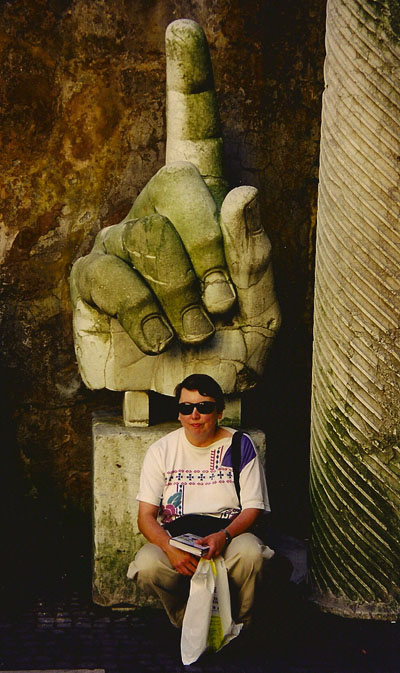
Kristin in Rome, 1997, in front of a “recent” hand from a colossal statue of Constantine. The Amarna statuary fragments she studies are twice as old.
DB here:
Kristin is in the spotlight today, and why not? She’s too modest to boast about all the good things coming her way, but I have no shame.
First, our web tsarina Meg Hamel recently installed, in the column on the left, Kristin’s 1985 book Exporting Entertainment: America in the World Film Market 1907-1934. It was never really available in the US and went out of print fairly quickly. Vito Adriaensens of Antwerp kindly scanned it to pdf and made it available for us. So we make it available to you. More about Exporting Entertainment later.
Second, Kristin is not only a film historian but a scholar of ancient Egyptian art, specifically of the Amarna period. (These are the years of Akhenaten and Nefertiti and their highly unsuccessful experiment in monotheism.) Every year she goes to Egypt to participate in an expedition that maps and excavates the city of Amarna. In recent years she’s focused on statuary, about which she’s given papers and published articles. Now we’ve learned that she has won a Sylvan C. Coleman and Pamela Coleman Memorial Fellowship to work in the Metropolitan Museum of Art’s collection for a month during the next academic year. So at some point then we’ll both be blogging from NYC. Think of the RKO Radio tower sending our signals to a tiny world below.
Third, she is about to turn 60, and in her honor the Communication Arts Department is sponsoring a day-long symposium. On 1 May we’ll be hosting Henry Jenkins, Charlie Keil, Janet Staiger, and Yuri Tsivian to give talks on topics related to her career interests. Kristin’s talk will survey her Egyptological work, with observations on how she has applied analytical methods she developed in her film research. You can get all the information about the event, as well as find places to stay in Madison, here.
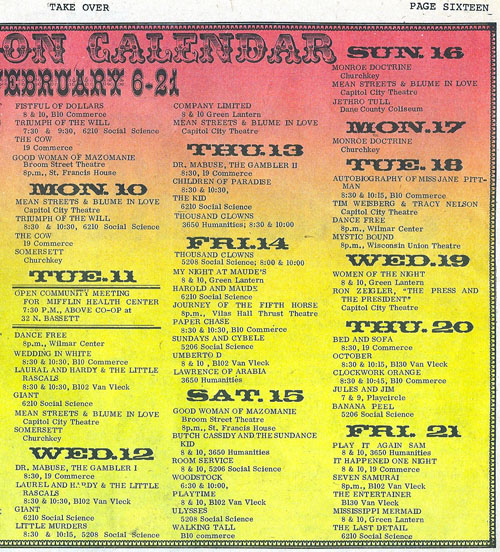
Kristin came to Madison in 1973, a very good moment. Whatever you were interested in, from radical politics to chess to necromancy (there was a witchcraft paraphernalia shop off State Street), you could find plenty of people to obsess with you. Film was one such obsession.
The campus boasted about twenty registered film societies, some screening several shows a week. Fertile Valley, the Green Lantern, Wisconsin Film Society, Hal 2000, and many others came and went, showing 16mm films in big classrooms in those days before home video. Without the internet, publicity was executed through posters stapled to kiosks, and the fight for space could get rough. Posters were torn down or set on fire; a charred kiosk was a common sight. Another trick was to call up distributors and cancel your rivals’ bookings. One film-club macher reported that a competitor had cut his brake-lines.
What could you see? A sample is above. What it doesn’t show is that in an earlier weekend of February of 1975, your menu included Take the Money and Run, The Lovers, Ray’s The Adversary, Page of Madness, Fritz the Cat, The Ruling Class, Dovzhenko’s Shors, Chaney’s Hunchback of Notre Dame, American Graffiti, Wedding in Blood, Pat and Mike, Camille, Yojimbo, Faces, Days and Nights in the Forest, King of Hearts (a perennial), Sahara, The Fox, Day of the Jackal, Dumbo, Investigation of a Citizen above Suspicion, Slaughterhouse-Five, Mean Streets, A Fistful of Dollars, Triumph of the Will, and The Cow. Not counting the films we were showing in our courses.
In addition, there was the Wisconsin Center for Film and Theater Research, recently endowed with thousands of prints of classic Warners, RKO, and Monogram titles. (There were also TV shows, thousands of document files, and nearly two million still photos.) When Kristin got here she immediately signed up to watch all those items she had been dying to see. She suggested that the Center needed flatbed viewers to do justice to the collection, and director Tino Balio promptly bought some. Those Steenbecks are still in use.
 Out of the film societies and the WCFTR collection came The Velvet Light Trap, probably the most famous student film magazine in America. Today it’s an academic journal, though still edited by grad students. Back then it was more off-road, steered by cinephiles only loosely registered at the university. Using the documents and films in the WCFTR collection, they plunged into in-depth research into American studio cinema, and the result was a pioneering string of special-topics issues. When I go into a Parisian bookstore and say I’m from Madison, the owner’s eyes light up: Ah, oui, le Velvet Light Trap.
Above all there were the people. The department had only three film studies profs–Tino, Russell Merritt, and me–though eventually Jeanne Allen and Joe Anderson joined us. Posses of other experts were roaming the streets, running film societies, writing for The Daily Cardinal, authoring books, and editing the Light Trap. Who? Russell Campbell, John Davis, Susan Dalton, Tom Flinn, Tim Onosko, Gerry Perry, Danny Peary, Pat McGilligan, Mark Bergman, Sid Chatterjee, Richard Lippe, Harry Reed, Michael Wilmington, Joe McBride, Karyn Kay, Reid Rosefelt, Dean Kuehn, Samantha Coughlin, and Bill Banning. Most of these were undergraduates, but Maureen Turim and Diane Waldman and Douglas Gomery and Frank Scheide and Peter Lehman and Marilyn Campbell and Roxanne Glasberg and other grad students could be found hanging out with them. A great many of this crew went on to careers as writers, teachers, scholars, programmers, filmmakers, and film entrepreneurs.
Into the mix went film artists like Jim Benning, Bette Gordon, and Michelle Citron. There were film collectors too; one owned a 70mm print of 2001 and didn’t care that he could never screen it. ZAZ, aka the Zucker brothers and Jim Abrahams, were concocting Kentucky Fried Theater. Andrew Bergman had recently published We’re in the Money, and soon Werner Herzog would be in Plainfield waiting for Errol Morris to help him dig up Ed Gein’s grave. Set it all to the musical stylings of R. Cameron Monschein, who once led an orchestra the whole frenzied way through Intolerance. The 70s in Madison were more than disco and the oil embargo. (To catch up on some Mad City movie folk, go here.)
These young bravos worked with the same manic passion as today’s bloggers. The purpose wasn’t profit, but living in sin with the movies. Film society mavens drove to Chicago for 48-hour marathons mounted by distributors. Traditions and cults sprang up: Sam Fuller double features, noir weekends, hours of debates in programming committees. Why couldn’t Curtiz be seen as the equal of Hawks? Why weren’t more Siodmak Universals available for rental? Was Johnny Guitar the best movie ever made, or just one of the three best?
There was local pride as well. Nick Ray had come from Wisconsin, and so had Joseph Losey, not to mention Orson Welles (who claimed, however, that he was conceived in Buenos Aires and thus Latin American). During my job interview, Ray came to visit wearing an eye patch. It shifted from eye to eye as lighting conditions changed. When he showed a student how to set up a shot, he bent over the viewfinder and lifted the patch to peer in. Was he saving one eye just for shooting?
In the big world outside, modern film studies was emerging and incorporating theories coming from Paris and London. Partly in order to teach myself what was going on, I mounted courses centering on semiotics, structuralism, Russian Formalism, and Marxist/ feminist ideological critique.
Back in placid Iowa City, where Kristin got her MA in film studies and I my Ph.D., we grad students had seen our mission clearly. Steeped in theory, we pledged to make film studies something intellectually serious: a genuine research enterprise, not mere cinephilia. Madison was the perfect challenge. Here cinephilia was raised to the level of thermonuclear negotiation, backed with batteries of memos, scripts, and scenes from obscure B-pictures. Confronted with a maniacal film culture and a vast archive, Kristin and I realized that there was so much to know–so many films, so much historical context–that any theory might be killed by the right fact.
Watch a broad range of movies; look as closely as you can at the films and their proximate and pertinent contexts; build your generalizations with an eye on the details. Our aim became a mixture of analysis, historical research, and theories sensitively contoured to both. The noisy irreverence of Mad City, where a former SDS leader had just been elected mayor and city alders could be arrested for setting bonfires on Halloween, wouldn’t let you stay stuffy long.

Kristin’s work in film studies would be instantly recognizable to humanists studying the arts. Essentially, she tries to get to know a film as intimately as possible, in its formal dimensions–its use of plot and story, its manipulations of film technique. I suppose she’s best known for developing a perspective she called Neoformalism, an extension of ideas from the Russian Formalists. Armed with these theories, she has studied principles of narrative in Storytelling in the New Hollywood and Storytelling in Film and Television. She has probed film style in Herr Lubitsch Goes to Hollywood and her sections of The Classical Hollywood Cinema. And she has examined narrative and style together in her book on Eisenstein’s Ivan the Terrible and the essays in Breaking the Glass Armor.
Contrary to what commonsense understanding of “formalism” implies, she has always framed her questions about form and style in a historical context. She situates classic and contemporary Hollywood within changes in the film industry–the development of early storytelling out of theatre and literature, or current trends responding to franchises and tentpole films. For her, Lubitsch’s silent work links the older-style postwar German cinema and the more innovative techniques of Hollywood. She situates Tati, Ozu, Eisenstein, and other directors in the broad context of international developments, while keeping a focus on their unique uses of the film medium.
Perhaps her most ambitious accomplishment in this vein is her contribution to Film History: An Introduction. She wrote most of the book’s first half, and though I’m aware of the faults of my sections, I find hers splendid. After twenty years of research, she produced the most nuanced account we have yet seen of the international development of artistic trends in American and European silent film.
Kristin has also illuminated the history of the international film industry. Everybody knows that Hollywood dominates world film markets. The interesting question is: How did this happen? Exporting Entertainment provides some surprising answers by situating film traffic in the context of international trade and changing business strategies. One twist: the importance of the Latin American market. The book also opened up inquiry into “Film Europe,” a 1920s international trend that tried to block Hollywood’s power. In all, Exporting Entertainment led other researchers to pursue the question of film trade, and I was gratified to see that Sir David Puttnam’s diagnosis of the European film industry, Undeclared War, made use of Kristin’s research.
More recently, Kristin has turned her attention to the contemporary industry, the main result of which has been The Frodo Franchise, a study of how a tentpole trilogy and its ancillaries were made, marketed, and consumed. Her love of Tolkien and her respect for Peter Jackson’s desire to do LotR justice led her to study this massive enterprise as an example of moviemaking in the age of winning the weekend and satisfying fans on the internet. She maintains her Frodo Franchise blog on a wing of this site.
Most readers of this blog know Kristin as a film scholar. They may be surprised to learn that she also wrote a book on P. G. Wodehouse’s Bertie Wooster books. Wooster Proposes, Jeeves Disposes; or, Le Mot Juste is a remarkable piece of literary criticism. Here she shows how Wodehouse developed his own templates for plot structure and style. Again, the analysis is grounded in research–in this case, among Wodehouse’s papers. So assiduously did she plumb Plum that she became the official archivist of the Wodehouse estate. This is also, page for page, the funniest book she has yet written.
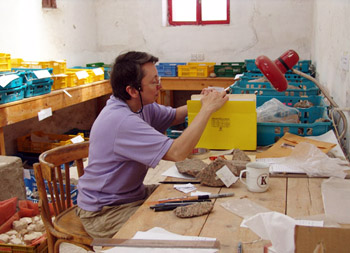
Her Egyptological work is no joke, though, and she has become one of the world’s experts on Amarna statues. She has published articles and given talks at the British Museum and other venues. Soon she’ll trek off for her ninth season at Amarna. There, joined by her collaborator, a curator at the Metropolitan, she’ll study the thousands of fragments that she’s registered in the workroom seen above. It’s preparation for a hefty tome on the statuary in the ancient city.
You can learn more about Kristin’s career here, in her own words. These are mine, and extravagant as they are, they don’t do justice to her searching intelligence, her persistent effort to answer hard questions, and her patience in putting up with my follies and delusions. You’d be welcome to visit her symposium and see her, and people who admire her, in action. While you’re here, you can watch a restored print of Design for Living, by one of her favorite directors, screening at our Cinematheque. In 35mm, of course. We can’t shame our heritage.
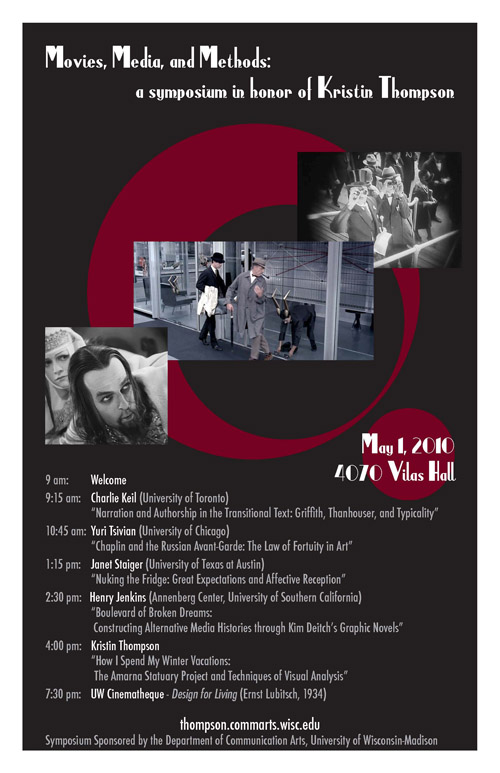
Poster design by Heather Heckman. Check out our Facebook page too.
Propinquities
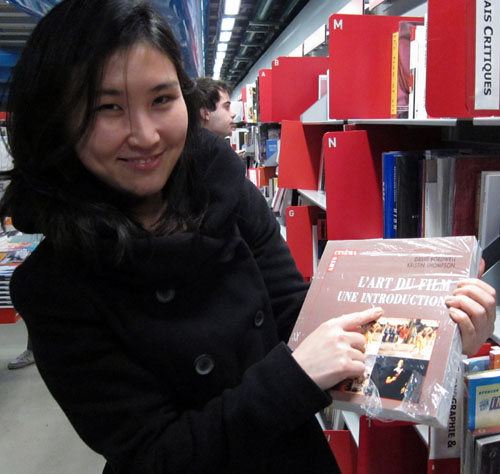
Jinhee Choi, Centre Pompidou, January 2010.
Propinquity: Nearness, closeness, proximity: a. in space: Neighborhood 1460. b. in blood or relationship: Near or close kinship, late ME. c. in nature, belief, etc.: Similarity, affinity 1586. In time: Near approach, nearness 1646. —Oxford Universal Dictionary
DB here:
In any art, tools and tasks matter. From the first edition of Film Art (1979) to the present, our introduction to film aesthetics starts with an overview of film production. How is production organized within the commercial industry, or within a more artisanal mode? What freedom and constraints are afforded within the institutions of filmmaking? How does current technology support or limit what the filmmaker can do? And how do filmmakers explain what they’re doing—not just as personal proclivities but as rhetorical “framings” that lead us to think of their work in a particular way?
Some would call this approach “formalism,” but that label doesn’t capture it. Traditionally formalism refers to studying an artwork intrinsically, as a self-sufficient object. In this sense, our perspective is anti-formalist: We look outside the movie to the proximate conditions that shape its form, style, subjects, and themes.
More literary-minded film scholars have sometimes been impatient with this perspective. Yet in the history of painting and music, it has yielded real advances in our knowledge. It continues to do so in film studies too, as I learned when we came back from Yurrrp to find some books awaiting us. (Kristin has already remarked on the stacks of DVDs that had accumulated.) Among these were books that illustrate the continuing value of situating film artistry in its most immediate context: the creative circumstances, the norms and preferred practices operating within traditions, the rationales that artists offer for their choices. Even better, the books were written by friends, so we have both intellectual and personal propinquity. I have always wanted to use the word propinquity in a piece of writing.
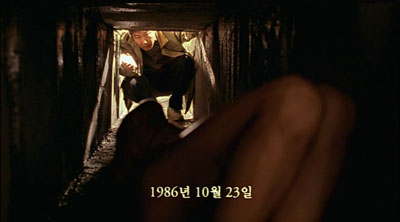
Memories of Murder (Bong Joon-ho).
Jinhee Choi’s The South Korean Film Renaissance: Local Hitmakers, Gobal Provocateurs is a wide-ranging survey of what some have called the “next Hong Kong”–a popular cinema of brash impact and technical polish, on display in JSA, Beat, Dirty Carnival, My Sassy Girl, and the like. But unlike Hong Kong, South Korea has a strong arthouse presence too, typified by Hong Sang-soo’s exercises in parallel narratives and thirtysomething social awkwardness. Between these poles stands what local critics called the “well-made” commercial film, as exemplified by Bong Joon-ho’s Memories of Murder.
Choi, a professor at the University of Kent, mixes analysis of cultural and industrial trends with consideration of crucial genres (notably the “high school film”) and major auteurs. She is the first scholar I know to explain changes in the Korean film industry as emerging from a dynamic among critics, filmmakers, private funding, and government sponsorship. A must, I would say, for anyone interested in current Asian film.
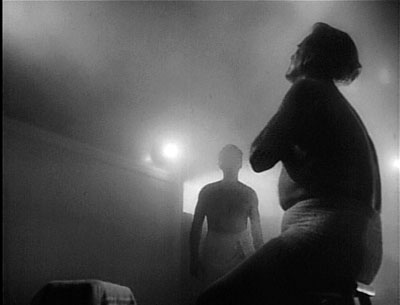
T-Men (Anthony Mann, cinematographer John Alton).
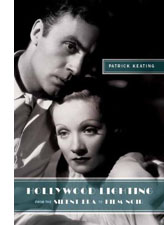 The South Korean Film Renaissance is matched by a work of equal subtlety, Patrick Keating’s Hollywood Lighting: From the Silent Era to Film Noir. Keating has an MFA in cinematography from USC, and his Ph. D. work concentrated on classical American cinema. His book captures the craft of the great studio cameramen, following not only what they said they were doing (in interviews and in the trade papers) but also what they actually did. He homes in on the contradictory demands facing artists who, they claimed over and over, had to serve the story. How do you claim artistry if your contribution is unnoticeable? This problem becomes acute with film noir, where the style is expected to come forward to a significant degree.
Keating scrutinizes the films with unprecedented care, tracing not only cameramen’s distinctive styles but showing that originality was always in tension with the conventional lighting demands of various genres and situtations. Many big names are here—John Seitz, Gregg Toland, John Alton—but the book also examines innovations coming from solid craftsmen like Arthur Lundin, who lit Girl Shy and other Harold Lloyd films. You won’t look at a studio movie the same way after you’ve digested Keating’s richly illustrated analyses.
Both Jinhee and Patrick were students here, and I directed the dissertations that eventually became these books. So of course I’m biased. But I think that any outside observer would agree that these monographs show the value of studying how film artistry and the film industry intertwine.
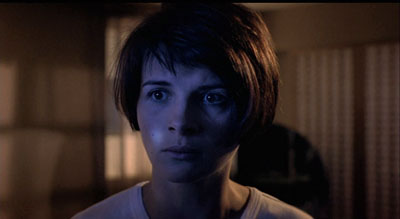
Blue (Krzysztof Kieslowski).
No less sensitive to the interplay of art and business is Patrick McGilligan’s Backstory 5: Interviews with Screenwriters of the 1990s. The collection is as illuminating as earlier installments have been. How could it not be, with career ruminations from Nora Ephron, John Hughes, David Koepp, Barry Levinson, John Sayles, et al.?
I’ve long found Pat’s Backstory volumes a treasury of information about Hollywood’s craft practices. Every conversation yields ideas about structure, style, and working methods. In this volume, for instance, Richard Lagravanese points out that scenes have become very short; with slower pacing in the studio days, scenes had time to breathe. And after claiming over and over that cinematic narration comes down to patterning story information, I was happy to read Tom Stoppard:
The whole art of movies and in plays is in the control of the flow of information to the audience. . . . how much information, when, how fast it comes. Certain things maybe have to be there three times.
In the studio days this last condition was called the Rule of Three: Say it once for the smart people, once for the average people, and once more for Slow Joe in the Back Row. Some things don’t change.
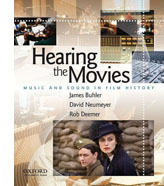 Pat McGilligan is also a Wisconsin alumnus, so to keep these notes from getting too incestuous, I’ll just mention that I know the distinguished musicologist David Neumeyer chiefly from his writing (though I have to confess I first met him when he visited . . . Madison). Along with coauthors James Buhler and Rob Deemer, David has published an excellent introduction to film sound. Hearing the Movies: Music and Sound in Film History is designed as a textbook, but it’s so well written that every movie lover would find it a pleasure to read.
The examples run from the silent era (including Lady Windermere’s Fan, a favorite of this site) to Shadowlands, and while music is at the center of concern, speech and effects aren’t neglected. There’s a powerful analysis of the noises during one sequence of The Birds, and the authors pick a vivid example from Kieslowski’s Blue (above), in which Julie is shown listening to a man running through her apartment building; we never see the action that triggers her apprehension.
The authors provide a compact history of sound film technology, including many seldom-discussed topics. For instance, 1950s stereophonic film demanded bigger orchestras and more swelling scores, while separation among channels permitted scoring to be heavier, without muffling dialogue. Throughout, Neumayer and his coauthors balance concerns of form and style with business initiatives, such as the growth of the market for soundtrack albums and CDs (a topic first explored by another Wisconsite, Jeff Smith, in his dissertation book). Once more we can arrive at fine-grained explanations of why films look and sound as they do by examining the craft practices and industrial trends that bring movies into being.
Watching back episodes of the American version of The Office recently, I’ve been struck by the premise it takes over from the UK original. This comedy of humors in Cubicle World is supposedly recorded in its entirety by an unseen film crew. I enjoy the clever way in which the show bends documentary techniques to the benefit of traditional fictional storytelling. The slightly rough handheld framings suggest authenticity, and the to-camera interviews permit maximal exposition by giving backstory or developing character or filling in missing action. The premise that an A and a B camera are capturing the doings at the Dunder Mifflin paper company permits classic shot/ reverse-shot cutting and matches on action.
The camera is uncannily prescient, always catching every gag and reaction shot; even private moments, like employees having sex, are glimpsed by these agile filmmakers. Above all, the camera coverage is more comprehensive than we can usually find in fly-on-the-wall filming. For instance, Dwight is preparing Michael for childbirth by mimicking a pregnant woman and Andy, behind him, tries to compete. Here are four successive shots, each one pretty funny.
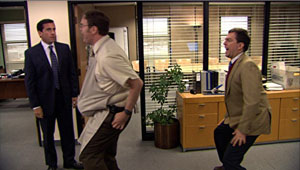
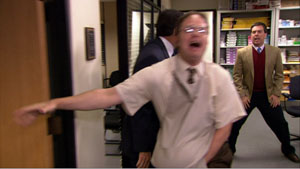
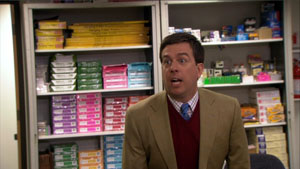
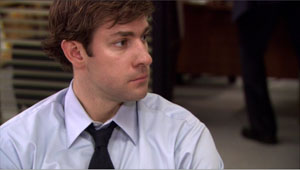
Somehow the cameramen manage to supply a smooth cut-in to Andy, and that’s followed by a reaction shot, from a fresh angle, showing Jim watching. The range of viewpoints, implausible in a real filming situations, is often smoothed over by sound that overlaps the cuts, as in both documentary and fictional moviemaking. (See our essay on High School here to see how a genuine documentary uses these techniques.)
Of course I’m not faulting the makers of The Office for not rigidly imitating documentary conditions. Any such blend of fictional and nonfictional techniques will involve judgments about how far to go, as I indicate in an earlier post on Cloverfield. It’s just to acknowledge that TV visuals have their own conventions, and these can be creatively shaped for particular effects. We ought to expect that those conventions would encourage close analysis as easily as film traditions do. Jeremy Butler’s new book Television Style offers the best case I know for the claim that there is a distinct, and valuable, aesthetic of television.
Following his own study Television: Critical Methods and Applications (third edition, 2007) and paying homage to John Caldwell’s pioneering Televisuality, Butler gets down to the details of how various TV genres use sound and image. Butler’s conception of genres is admirably broad, considering dramas, sitcoms, soap operas, and commercials, each with its own range of audiovisual conventions and production practices. His discussion of types of television lighting complements Keating’s analysis; put these together and you have some real advances in our understanding of key differences and overlaps between film and video.
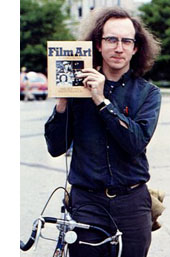 Kristin has met Jeremy, but I haven’t yet. In any case, Television Style shows that he’s a kindred spirit who’s made original contributions to this research tradition. Like Jinhee, Patrick, Pat, and David, he demonstrates that we can better grasp how media work if we study, patiently and in detail, the creative options open to film artists at specific points in history. He began thinking about these matters in 1979, as the photo attests.
None of this is to say that artistic norms or industrial processes are cut off from the wider culture. Rather, as becomes very clear in all of these books, cultural developments are often filtered through just those norms and institutions.
For example, everybody knows that in classical studio cinema, women were usually lit differently from men. But Keating notices that often women’s lighting varies across a movie, depending on story situations. He goes on to make a subtler point: there was a greater range in lighting men’s faces. Men could be lit in more varied ways according to the changing mood of the action, while lighting on women was a compromise between two craft norms: let the lighting suit the story’s mood, and endow women with a glamorous look. The fluctuations in the imagery stem from adjusting cultural stereotypes to the demands of Hollywood’s stylistic conventions.
Careful studies like these, alert to fine-grained qualities in the films and the conditions that create them, can advance our understanding of how movies work. Pursuing these matters takes us beyond both the movie in isolation and generalizations about the broader culture; we’re led to examine the filmmaker’s tasks and tools.
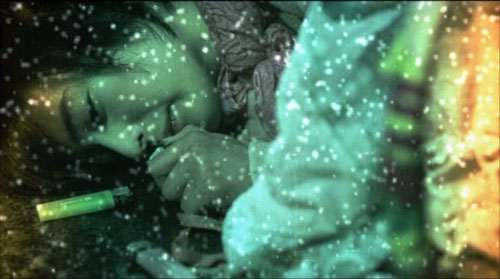
Resurrection of the Little Match Girl (Jang Sun-woo, 2002).
Things we like of late
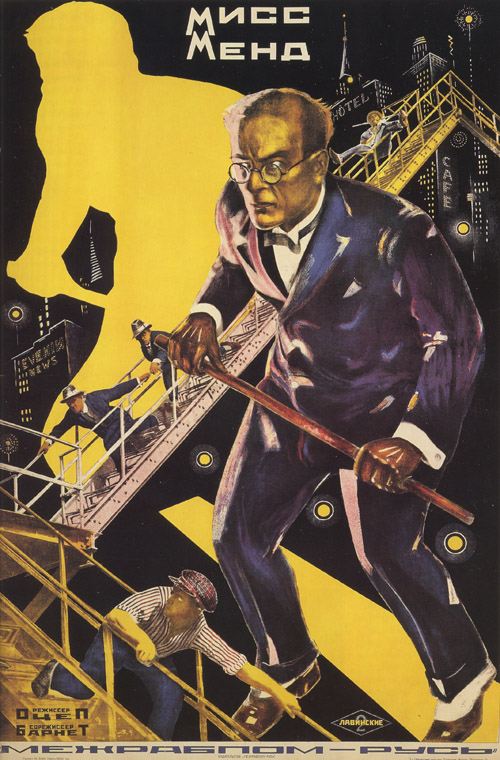
One of several posters the Stenberg brothers designed for Miss Mend.
We’ve been quite busy in the tail end of October. David sweated over a Bresson essay, started on his online version of Planet Hong Kong, and continued to help out in Lea Jacobs’ seminar on film stylistics. Kristin has started organizing a book about the statuary from the site in Egypt where she works for three weeks each year. And both of us have been steering the ninth edition of Film Art: An Introduction through the final phase of production. So instead of a blog essay this week, we offer some items from recent months that we think deserve wider notice and in some cases a pat on the back.
In our second report from the Vancouver film festival, Kristin wrote about a Chilean film, The Maid. She suggested that it was entertaining enough to be remade in English as a vehicle for an actress willing to play middle-aged and curmudgeonly. On October 16, the film was released theatrically. Starting in one theater, then going to six, and now 13 in its third week, it’s doing pretty well judging by per-theater averages. It’s not likely to get beyond big-city arthouses, but at least a release means that it should come out on DVD.
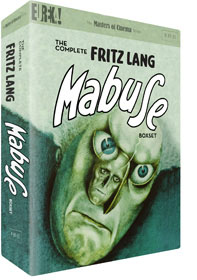 Speaking of DVDs, German silent cinema continues to be well-served with two new releases from British firm Eureka! F. W. Murnau’s 1922 film Phantom was already available in the US on the 2006 disc from Flicker Alley. The new Eureka! set includes both Phantom and Die Finanzen des Grossherzogs (1924). We saw the latter years ago at the National Film Theatre in London. It’s a comedy, and it struck us that Murnau was a bit ill at ease in that genre. Still, any Murnau film is worth a look. The set contains commentary on Die Finanzen by David Kalat, and there’s an essay on both films by Janet Bergstrom.
One of the best arguments that sequels and series, even those about super-villains out to rule the world, aren’t necessarily bad is Fritz Lang’s Dr. Mabuse films. They span almost the length of his directorial career, from the two-part serial Dr. Mabuse der Spieler in 1922 through Das Testament des Dr. Mabuse in 1933, up to his last but definitely not least film, Die 1000 Augen des Dr. Mabuse (1960), which David included in his Belgian summer course. For those who can’t get enough of this arch-fiend and his followers, Eureka! has packaged all three in a new boxed set. There are numerous extras, which you can read about here. For those who have only seen The 1000 Eyes of Dr. Mabuse dubbed in English, this set gives the option of German with subtitles or dubbed. (The films are not available from Eureka! separately.)
The films of Lev Kuleshov pupil Boris Barnet are only gradually being discovered outside Russia. One of the hits of this year’s “Il Giornate del Cinema Muto” was his 1928 comedy, The House on Trubnaya. Yes, there were Soviet Montage comedies, and this is one of the funniest. Let’s hope an enterprising company brings it out on DVD.* In the meantime, Flicker Alley is doing its bit to make Barnett known by releasing his 1926 three-part serial, Miss Mend. We saw it years ago without subtitles, so we look forward to finally finding out exactly what this fast-paced thriller is about. Something anti-capitalist involving the “Rocfeller and Co.” factory.
Soviet film was much on our minds this semester because our Cinematheque was running a series of films by Grigori Alexandrov. Probably best known for collaborating on Eisenstein’s silent films, Alexandrov came into his own in the 1930s with a series of lumpy but ingratiating musicals. They run the gamut from slapstick to mild satire (of familiar targets like bureaucrats). He likes silly gags, direct address to the audience, and a sort of relentless jollity that seems designed to prove Stalin’s claim in those years of privation that “Life has become gayer, comrades, life has become more joyous.”
Jolly Fellows (aka Jazz Comedy, 1934) is a somewhat labored effort in Marx Brothers absurdity, while Bright Path (1940) gives us a Stakhanovite Cinderella. It’s full of special-effects trickery used for comic effect, as when a poster coyly comes to life.
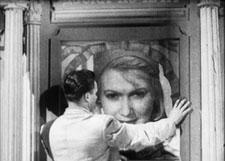
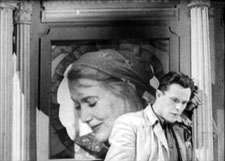
Although Alexandrov helped bring Hollywood production values to Soviet cinema, his 1936 Circus is a pointed critique of American racial bigotry.
Alexandrov’s best known film is Volga Volga (1938), reportedly Stalin’s favorite movie. It’s a meandering tale enacting the battle of highbrow music and popular tastes, including a clever scene (perhaps derived from the “Isn’t It Romantic?” number of Love Me Tonight) in which the movie’s principal tune jumps from boat to boat down the river, until it has become an unofficial national anthem. The films star Alexandrov’s wife, Lyubov Orlova, whose bullheaded energy swamps all resistance. The series is from a touring program, Red Hollywood, and you can read the background here.
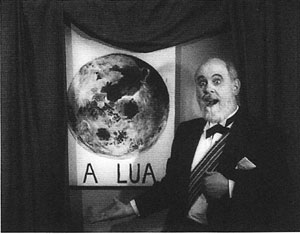
Wisconsin Bioscope silent films went south in August–specifically, to São Paulo’s third Brazilian Days of the Silent Cinema. Here at the University of Wisconsin–Madison, Dan Fuller, a photographer and historian of photography, teaches students to use classic cameras and devise their own 1910s movies. Of the two Bioscope films chosen for the São Paolo festival, A Expedição brasieira de 1916 (2006) depicts the first earthlings’ arrival on the moon. It features a stirring performance by a novice actor (above) whose film career was tragically cut short when he decided to become a professor.
Cinema in yet another land is the subject of Research Guide to Japanese Film Studies by Abé Mark Nornes and Aaron Gerow. At its center is a robust bibliography, including journals as well as books, but there’s much more: a survey of archival collections of films and documents, a list of film distributors, a gathering of online resources, and even a list of bookstores specializing in Japanese cinema. Donald Richie calls it “a reference work which both illuminates and defines this field, clearing a formerly obscured terrain for future scholarship.” Markus and Aaron are strong participants in a tide of younger scholars, both Asian and Western, who are rethinking this very important national cinema.
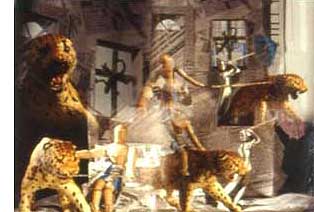 Images, not moving, come at you in another package. Remember Viewmasters? Vladimir, a projectionist at the Northwest Film Center in Portland, makes handsome viewmaster-style discs presenting strange tales culled from Kafka, Calvino, and less-known sources. The images are still-lifes incorporating toys and props, and it’s up to you to figure out the narrative. Concept sometimes outruns execution, but the shots suggest a childhood world turned sinister. You can even get your own viewer–called, naturally, a Vladmaster.
At Parallax View, Sean Axmaker is building an online archive of the complete run of the legendary magazine Movietone News. Richard T. Jameson and Kathleen Murphy are leading voices in American film criticism, but I suspect that the younger generation isn’t as aware of them as it should be. In Movietone News and elsewhere they provide a body of criticism that nicely balances judgment, information, and ideas. Hats off to Jim Emerson for using Halloween as an occasion to point up Richard’s astute observations on modern shot design.
 On Sunday night we went along with Jeff Smith to a campus lecture by Steven Pinker. The talk was a condensation of Pinker’s book The Stuff of Thought, a fascinating effort to show how various dimensions of language, chiefly semantics and pragmatics, reflect basic concepts of space, time, causality, and social relations. Language, Pinker says, furnishes a window into human nature. In a virtuoso turn, the book wraps up two trilogies at once: it caps a pair on cognitive and evolutionary theory (How the Mind Works and The Blank Slate) and a pair on grammar and semantics (The Language Instinct and Words and Rules).
David first heard Pinker speak at an at extraordinary conference in Santa Barbara in August 1999. Coordinated by Leda Cosmides and John Tooby, “Imagination and the Adapted Mind” was an effort to explore how the arts could be illuminated by contemporary psychology, particularly one informed by an evolutionary perspective. This event–featuring not only Pinker but also Mark Turner, Eleanor Rosch, Ellen Dissayanake, Don Browne, and other luminaries–was a major moment in bringing “evolutionary aesthetics” to the table, although it’s taken about a decade for most humanists to catch up. (Several of the papers are available in a double issue of SubStance.) It was at that event that Pinker made his notorious suggestion that art was a byproduct of the brain’s evolution, a sort of “mental cheesecake” designed as a compact “superstimulus” appealing to our senses, mind, and emotions.
David had read The Stuff of Thought when it came out and had viewed the talk online. Sunday’s lecture remained a compelling performance, packing a remarkable number of ideas, data, and vivid examples into an entertaining seventy-five minutes. Pinker has been called the Dawkins of linguistics and cognitive psychology, but his sense of humor is rowdier. His straightfaced analysis of swearing is lively enough on the page, but it’s uproarious live.
Finally: Ever notice how many classic kung-fu movies are in widescreen? David has posted a new online essay tracing how Shaw Brothers popularized the anamorphic format in Hong Kong. The essay also considers how the widescreen format led Hong Kong filmmakers toward a distinctive approach to composition, cinematography, and dynamic movement. . . . of which the image below is a fair instance.
*[Nov 5: Thanks to James Steffen for alerting us to the fact that Edition Filmmuseum is bringing out The House on Trubnaya, along with Barnett’s other silent comedy of the same period, The Girl with the Hat Box, soon. There’s an impressive list of films in preparation, including the rare Expressionist classic Von morgens bis Mitternacht (1920), by Karl Heinz Martin. Comedy lovers should key an eye open for the release of a collection of Max Davidson’s hilarious silent comic shorts, including, we presume, the immortal Pass the Gravy.
Variety also has announced that Sundance is going national. On January 28, 2010, eight filmmakers will present their films and hold Q&As in eight theaters across the U.S.A. Madison, with one of only two Sundance multiplexes in the country, will be one of the host cities.]
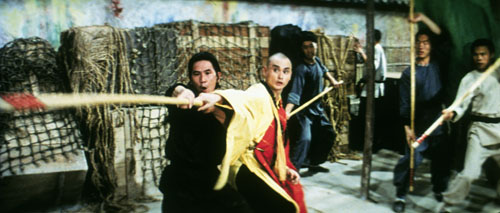
Return to the 36th Chamber.