



Archive for 2007
A scoop from Auckland
It’s still Friday for many of you, but here in Auckland it’s Saturday, and the “Weekend Review” section of the New Zealand Herald has run a story about our visit to the university. It’s by Peter Calder, who has reviewed films for the Herald since 1984. We had a pleasant chat with him in preparation for the article. With all his film experience, Peter is one of those rare reporters who puts the quotations in their proper context and gets his facts right. You can read the article, “Figuring out the Frodo Franchise,” and its sidebar, “Technical tricks of the trade,” in the Herald‘s online version.
Dispatch from the Land of the Long White Cloud
Kristin here—
David and I are currently in New Zealand. The University of Auckland offered us both Hood Fellowships, and we will be in residence here for the month of May.
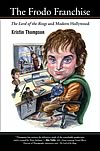
After settling into a hotel room with a splendid view of part of the Auckland harbor and downtown, we were shown around the campus by our host, Brian Boyd, Nabokov scholar extraordinaire. We’ll be giving lectures in classes and to the public over the next week and a half. I’ll also be doing some media interviews relating to The Frodo Franchise, which is due to be published here by Penguin New Zealand, probably in early September. Today, in fact, I met my editors and publicity person at Penguin.
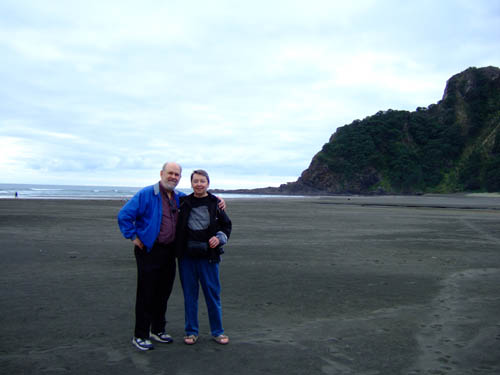
Yesterday Brian and his wife Bronwen Nicholson drove us out to the Waitakere Ranges Regional Park, a large area on the coast west of Auckland. The park is spectacularly beautiful in itself, but our goal was Karekare Beach, one of several black-sand beaches within the park. It was the location where the beach scenes of Jane Campion’s The Piano were shot and even now remains a popular tourist destination. There we are (above), more or less at the spot where Holly Hunter’s character brought her piano ashore in her new home.
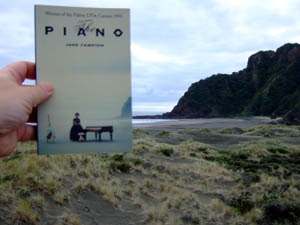
Naturally we have also done some book and DVD shopping. When I first came to New Zealand to work on The Frodo Franchise, back in September and October of 2003, there were almost no Kiwi films on DVD: Once Were Warriors, of course, and Whale Rider, the two most popular New Zealand features, and a few others.
As I discuss in the book (Chapter 10), The Lord of the Rings had a beneficial impact on New Zealand cinema. In large part because of the trilogy, filmmakers gained new skills, new production infrastructure was created, local directors and other talent returned from jobs abroad, and government funding increased. Kiwi films became more popular within their own country. When I talked to Dr. Ruth Harley, CEO of the New Zealand Film Commission, in late 2005, she declared that the national cinema was perhaps having its best year ever, and the momentum does not seem to have slowed.
One sign of success is that one can now find some of the older classics on DVD. There’s actually a “Roger Donaldson Collection” series. (That’s the same Roger Donaldson who is more famous in U.S. for The Bounty, Dante’s Peak, and Cocktail.) We picked up his Sleeping Dogs (1977), notable as the first New Zealand film to play in American theaters, and Smash Palace (1981), the movie that led to his career abroad. A DVD set from this series containing both films is available in the U.S.
I saw Donaldson’s latest, The World’s Fastest Indian (2005) at the American Film Market in 2005—the same occasion upon which I interviewed Dr. Harley for the second time for my book. I opined to her that the film might well be a considerable success in the US. It’s an engaging and entertaining film with Anthony Hopkins giving a marvelous performance in the true story of an eccentric Kiwi who tinkered with an old motorcycle (the “Indian” of the title) and set a world speed record with it.
Unfortunately The World’s Fastest Indian was released without much publicity and didn’t do much business in the US. It’s well worth seeking out on DVD.
There are other signs of increased interest in local films. Geoff Murphy’s hit film Goodbye Pork Pie (1981), previously available on a PAL DVD without region coding, has come out in a “Special Collector’s Edition” with a new transfer, a stereo soundtrack not included on the original release prints, and a second disc of extras. Three years ago I would not have predicted that an older Kiwi film would get such treatment. Murphy is better known in the art-cinema world for his later Utu (1983) and The Quiet Earth (1985).
Similarly, May 6 saw the inauguration of a series of eight older Kiwi films to be shown weekly on Sunday nights until June 24 on Māori Television, one of the national channels in New Zealand. Most of these are not specifically oriented toward Māori subject matter—perhaps further indication that a curiosity about Kiwi cinema in general has spread through the national culture. The opening film, The Last Tattoo (1994), was an engrossing political thriller set in 1943. I look forward to seeing as many of the others in the series as time permits.
Recent DVDs have also allowed me to catch up with two 2006 New Zealand films that I had not had a chance to see yet. Both received favorable reviews from Variety when they played at North American film festivals.
Sione’s Wedding is set among the Samoan community of Auckland. It follows four irresponsible young men as they try to fulfill a condition that will allow them to attend the wedding: they must all find “real” dates to bring along. No. 2 deals with an extended family struggling to organize a traditional Fijian feast on short notice when the matriarch declares that she will name her successor at the event.
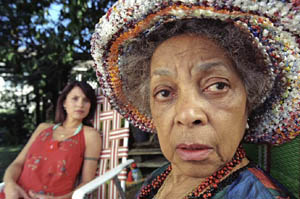
Both are made with the sorts of technical resources that one would expect of an American indie film. New Zealand films still work with small budgets, but funding is distinctly larger than in the pre-Lord of the Rings era. Strikingly, both of these films deal with the familiar situation of a big family event where irresponsible men must be led to maturity by their women. Both are also highly enjoyable, especially No. 2, with its skillful blend of humor and sentiment and its powerful performance by Ruby Dee as the matriarch.
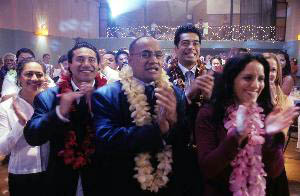
Sione’s Wedding, retitled Samoan Wedding for the North American release, received an enthusiastic review from Variety after its premiere at the Montreal World Film Festival late last summer. Magnolia released it on November 10, 2006, with a run of 14 weeks. It started in two theaters, with a respectable $7,852 average on its opening weekend. Eventually it played in only three theaters, made $72,244, and disappeared. It did, however, come out on DVD.
No. 2, also well-reviewed by Variety, is apparently to be released in the U.S. under the title Naming Number Two. For those living in or near New York, it will be shown on May 10 as part of the Pacifika Showcase series.
By a happy coincidence, next Saturday on TV2 at 5:30 pm, I’ll be able to watch the premiere of the children’s animated series Jane and the Dragon. Back in October 2003, when I interviewed Richard Taylor, head of Weta Workshop, he mentioned that he was trying to diversify the company’s projects so as to be able to offer steady work to his employees. One project was this series, for which he was then seeking financing.
Just over a year later, in early December 2004, I interviewed Richard again. By another coincidence, that was the day when Weta was beginning to test its new motion-capture studio that had been created to help in the production of Jane and the Dragon and other projects. Now at last the series is finished.
It’s already playing on Canadian TV, and the YTV.com site offers an entire episode for viewing here. The official website, aimed specifically at children, is here.
I hope to report back on it and other media-related experiences here in New Zealand, or Aoteroa, which means “The Land of the Long White Cloud.” It’s a well-deserved name. Anyone who thinks the mountains and other unspoiled landscapes shown in The Lord of the Rings and The Lion, the Witch and the Wardrobe were created by CGI are mistaken. Much of New Zealand actually looks like that. I’m hoping to visit a few of the film locations that I haven’t seen on previous visits.
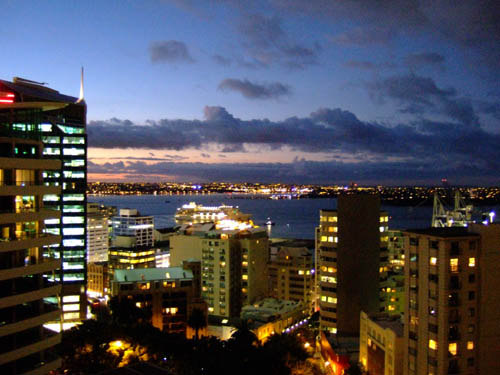
The view from our hotel balcony.
Funny framings
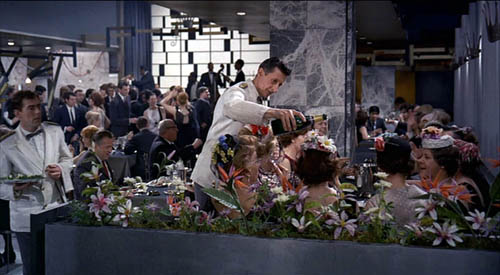
DB asks: Can a film shot be amusing in itself?
Of course a shot can show us a gag that’s funny. If Jerry Lewis or Adam Sandler is going to fall off a ladder into a Dumpster, we want to see everything clearly. Here the framing can be modestly functional. But can the very choice of lens, angle, scale, or composition play a stronger role? Can camerawork itself provide the gag?
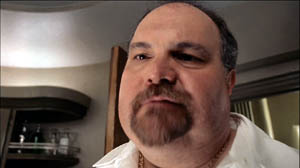
Barry Sonnenfeld, cinematographer for the Coens and now a prominent director, thinks so. He’s remarked that an extreme wide-angle lens is inherently funny. In the commentary for the DVD of RV, he explains, “You just put a big 21mm lens really close to [Will Arnett’s] face and you get comedy without him having to do anything.” I don’t have an RV frame handy, but here’s an example from Big Trouble, with both the wide lens and the low-angle creating the sort of grotesque disproportions that Sonnenfeld finds funny.
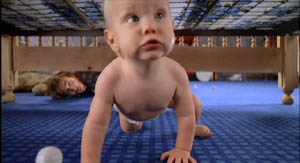
Sonnenfeld got this idea, he claims, by working on the Coens’ early films, which used wide-angle shots for cartoonish exaggeration. In Raising Arizona, the angle and lens length make the wandering baby loom; we’re not used to seeing an infant rampant.
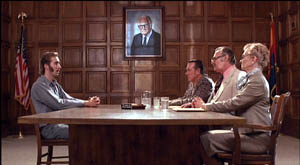
But the Coens had a broader approach to funny framings than Sonnenfeld acknowledges. For instance, they created humor by means of geometrical tableaus. In H. I.’s parole hearing in Raising Arizona, an absurd solemnity is set up by the symmetrical layout of actors. At the apex of the triangle, a portrait of Senator Barry Goldwater blesses the occasion.
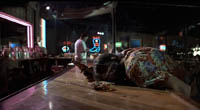
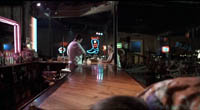
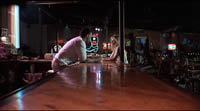
Even more memorable is the forward tracking shot down the bar top in Blood Simple. The camera, encountering a drunk sprawled in its path, simply crawls over him.
The silent comedians knew how to use camera position to build up their gags. Long ago Rudolf Arnheim praised the opening scene of Chaplin’s The Immigrant. As a ship rocks treacherously, we see Charlie from the rear heaving and kicking on the railing. As Arnheim puts it, “Everyone thinks the poor devil is paying his toll to the sea.” (1)
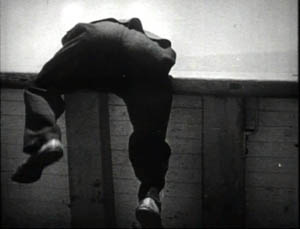
But then Charlie turns toward the camera to reveal he’s been struggling to reel in a fish.
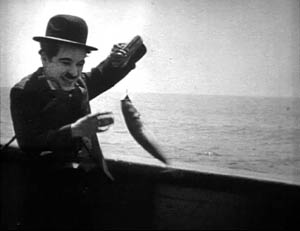
Here the framing creates the gag by what it doesn’t show. “The element of surprise,” Arnheim notes, “exists only when the scene is watched from one particular position.” The camera setup also makes an expressive analogy; we probably never noticed the similarity between vomiting and wrestling a fish.
One of my favorite comic framings occurs in The General. Buster’s train is hurtling along, and a cannon on one car is suddenly trained on him. The first shot gives us the situation with maximum clarity, in a profiled shot. But then Keaton cuts to another angle, showing the cannon in the foreground and Buster trying to escape it.
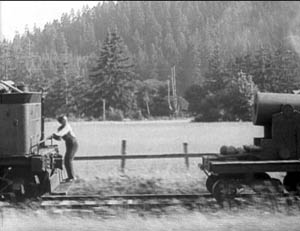
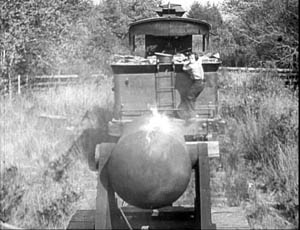
Nothing much has changed in the scene’s action, just the camera setup. But now we get to watch the cannon draw a bead on Buster. Audiences invariably laugh at this shooting-gallery image.
Jacques Tati is in many ways the modern heir of Keaton, and humor in his sequences often stems simply from a juxtaposition of elements in a single frame. An older man ogling a pretty woman on the beach is funny in a standard way, but in M. Hulot’s Holiday, we get more.
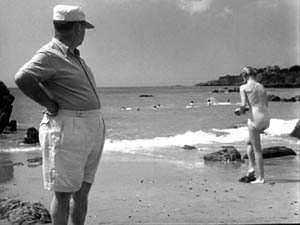
No words are spoken, but Tati’s staging and framing juxtapose the very different bodies in telling ways. We’re invited to note the difference between age and youth, paunchiness and health, passing yearning and its likelihood of fulfillment.
Play Time, Tati’s masterpiece and one of the greatest films ever made, offers an abundance of subtly comic framings. The shot below promotes the film’s theme that modern architecture has homogenized the world. The posters present the same building in different locales, with only stereotyped add-ons to distinguish the US, Hawaii, Mexico, and Stockholm. As one of the ladies on Barbara’s tour says, “I feel at home everywhere I go.”
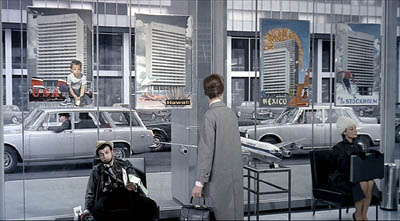
Again, though, a juxtaposition adds to the humor. Throughout Play Time, Tati suggests the disparity between the joy of travel as promoted by our culture and the stress of hustling from place to place. The promise of the posters is undercut by the dazed traveler who’s flopped underneath them, clutching maps and flightplans. And he in turn contrasts with the no-nonsense businesswoman on the far right.
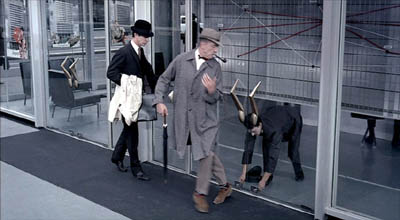
Tati can create comedy by the exact placement of the camera; a foot to the left or right and the gag would vanish. In the image at the start of this entry, the waiter is pouring champagne, but he seems to be watering the ladies’ flowery hats, which mask their champagne glasses. The same sort of exactitude of placement occurs in a shot we use as an illustration in Film Art (p. 195). M. Hulot is leaving an office building when it’s closing. As a guard locks down a doorway, his cap falls off and Hulot is startled: the guard seems to have grown horns.
Can we find funny framings in current films? Yes! I was prompted to write this blog while rewatching Shaun of the Dead. Zombies have overrun London, and two groups of human survivors meet. Shaun is leading one, Yvonne is leading the other. Instead of being presented as a mingling of the two groups, the scene plays out along two lines of people. Have a look.
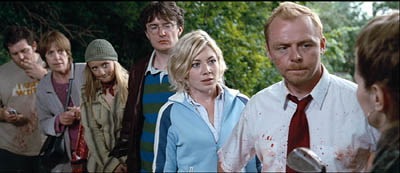
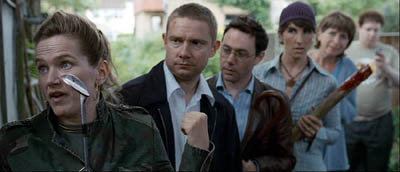
The gag’s premise is that each survivor has a counterpart in the other line. There are two posers in brown leather jackets, two can-do girls, two matrons, and two distracted videogame geeks. I wonder how many first-time viewers catch this? (Kristin did, I didn’t.)
These mirror-image depth shots set up the real gag, which pays off in another clever composition. When the two groups set off on separate paths, each member passes and smiles awkwardly at her/his lookalike, while the framing underscores their likenesses.
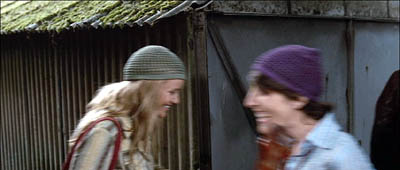
As they walk through the frames, the similarities increase.
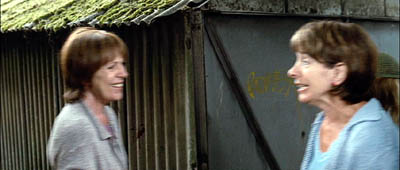
The framing makes a clever point about conformity and social stereotypes. Ending the procession with the two gamers, oblivious to the danger and to one another, tops the topper, as gag writers would say.
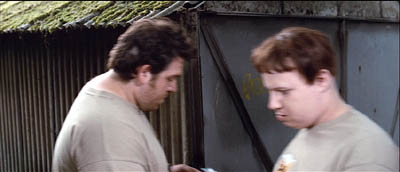
Tati would have loved these shots.
Of course I’ve simplified things for the sake of making my point. It’s not that the camera is somehow capturing a free-standing event by selecting the most amusing view. In all these examples, the staging is calculated to match the camera position. Staging, like camerawork and other film techniques, creates filmic narration. I’m only suggesting that in these scenes, the staging wouldn’t work on its own to create humor, nor would a simply functional framing. Choices of lens, camera position, and the like seem to be critical in making the gags work.
Finally, a borderline case that intrigues me. In last year’s Crank, our hero is in overdrive thanks to a constant intake of drugs. Stepping into an elevator, he faces a man who starts speaking Japanese. Naturally, his line is subtitled.
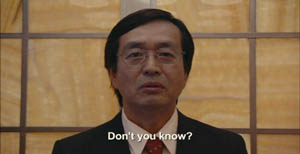
But then we get this:
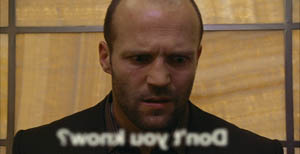
The idea of the head-on reverse angle is carried to comic extremes by reversing the subtitle as well (and blurring it to reaffirm the hero’s muzzy mental state).
I think that aspiring filmmakers can learn a lot from this tradition. Our films need more pictorial creativity, which often doesn’t require fancy CGI. Stylistic handling can add fresh layers to a basic story situation, and astute filmmakers can be alert to the possibilities of comic compositions and funny framings.
(1) Rudolf Arnheim, Film as Art (Berkeley: University of California Press, 1957), p. 36.
PS 4 May: Owen Williams writes to point out that the gag in Crank depends not just on a reverse framing but a play on the idea of lens focus. “The subtitle is fuzzy because it’s supposed to exist in real space (at least in this character’s head), with the letters hanging in mid-air in front of the Japanese man. Therefore in the reverse angle they appear out of focus (fuzzy) because they are closer to the camera. It’s a great gag.” Thanks, Owen.
PPS 8 May: I’ve gotten a lot of correspondence about this blog entry. Here are some nifty supplements:
Kent Jones was reminded of the shot in High Anxiety in which the camera moves to a picture window, with people dining behind it, and then crashes through the glass.
Sam Adams recalled a shot in Killer of Sheep that had something of the same effect, showing men trying to load a car engine onto the bed of a pickup truck. But the context isn’t itself comic. Sam reflects: “Based on the examples you choose, it seems that ‘comic framing’ invariably involves a level of self-consciousness, a feeling that the audience is being deliberately toyed with by the figure behind the camera. We get a sense that the scene has been staged for our amusement, rather than feeling that we must identify emotionally with whatever the characters are going through (which even in comedies is often quite sad).”
Stew Fyfe found a host of in-jokes in the Shaun of the Dead shots:
“Viewers of British television might notice an extra parallel between the shots. The actors playing each of the group leaders, Simon Pegg (Shaun) and Jessica Stevenson (Yvonne), were the leads in the sitcom Spaced (also directed by Edgar Wright, the TV predecessor to Shaun). Also split between the two groups are Lucy Davis (Shaun’s Group, hat) and Tim Freeman (Yvonne’s group, second in line), from original The Office and Dylan Moran (Shaun’s group, glasses) and Tamsin Greig (Yvonne’s group, hat), the leads of the sitcom Black Book. Yvonne’s mum (second matron) is played by Julie Deakin, who played the drunk and desperately lonely/horny landlady in Spaced.”
Thanks also to Bryan Wolf for a note on the same subject.
Finally, this from Jeremy Butler:
“I like your example from The General, but my favorite example of comic framing from Keaton’s work (and one I use in class to illustrate how he was more “cinematic” than Chaplin) is in Sherlock, Jr. Buster runs along the top of a freight train, and is then flushed to the tracks by a spout from a water tank. What makes it funny, I’d suggest, is the choice to frame it from the side, at a right angle to the tracks (much like the first General frame in your example). It minimizes the size of Buster’s body and contrasts him with the size of the train cars. Plus, it emphasizes the movements in opposite directions of his body and the train.
All these elements make it visually funny in a way that would not be apparent if it were filmed from an oblique angle or from behind the train.
But then, maybe I just like to show it because it’s the scene in which Buster literally broke his neck–which he didn’t realize until decades later when being x-rayed for something completely different!”
Thanks to everyone who wrote in with comments and who linked to this entry.
1525 big thumbs up
Kristin here—
 David and I just got back from Roger Ebert’s Overlooked Film Festival. It’s been held under the auspices of the University of Illinois, Roger’s alma mater, in late April for nine years now. This year the event was front-page news because our irrepressible host attended the event while recovering from surgery for salivary-gland cancer and complications last summer.
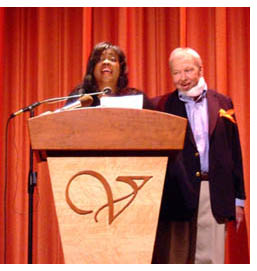
Roger’s features have changed somewhat and he faces further surgery and rehabilitation. Yet the man’s enthusiasm for movies and movie people has not waned. Most of the audience for Ebertfest (as it will officially be called starting next year) are regulars, and the standing ovations that greeted Roger and his wife Chaz show that the enthusiasm and affection are mutual. For more coverage, go here and here. For the official photoblog, with lots of neat pictures, go here.
If anything, Ebertfest audiences seemed even more cheerful and energetic than usual, happy that Roger has been so determined to avoid canceling this year’s event.
David and I have fond memories of Roger’s last visit to the Wisconsin Film Festival in 2006. There he introduced a restored print of Laura, held a signing at a local bookstore, and appeared at other screenings. People passing him on the street called out, “Hi, Roger,” as if he were an old friend. He graciously allowed me to interview him on the subject of press junkets for my chapter on marketing in The Frodo Franchise. There’s no way just to look up the history of junkets. No one has written one. But Roger is a primary document, having been attending them on and off since the 1960s. I learned a lot from our talk.
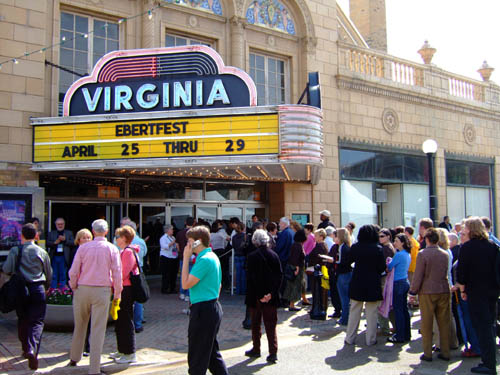
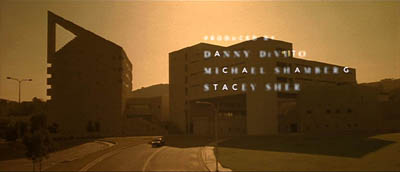
We drove down from Madison to Urbana-Champaign on Wednesday, David attending for the fourth year and I for the third. The opening film that evening was Gattaca (1997). With tepid reviews and box-office on its original release, Gattaca definitely counts as an overlooked film. Shown in an excellent print on the giant screen of the vintage Virginia movie palace, the cinematography was stunning and the story absorbing. Not an utter masterpiece, perhaps, but a very good film that deserved revival. As usual, people came from all over America to pack into the restored 1525-seat venue.
Now we’re back…and doing a summary blog. We had little time at the festival, and during our last day the web service at our lodgings conked out, so this stands as a fill-in.
Gattaca.
David’s two bits:
I saw ten films across three days and four nights.
The Virginia theatre did special justice to Gattaca. Writer-director Andrew Niccol used the anamorphic format imaginatively, a bit in the chilly manner of THX-1138, and the framings appeared to full effect on the 56-by-23-foot screen. This time I noticed how much the credit sequence, with only the G-A-T-C letters appearing first, owes to Godard. Like Alphaville, Gattaca uses not artificial sets but actual buildings to evoke the near future.
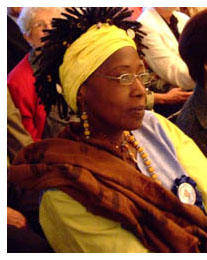 I thought that Moolade held up well on my second viewing, and the post-film discussion with the main performer Fatoumata Coulibaly (right) and Professor Samba Gadjigo was informative. The film’s call for an end to female genital mutilation is typical of Osmane Sembene’s use of controversial material; Professor Gadjigo recalled that Sembene calls his cinema a “night school” for Africa. Ms. Coulibaly said that in production “Papa Sembene” wouldn’t make eye contact with her, but before filming a painful sex scene he told her that she was “doing the scene for future generations.”
Sadie Thompson was still fine, I thought, with Walsh’s skill in cutting and staging exemplifying what Hollywood could do so easily in 1928. Swanson of course is tremendous in the role, using her whole body to tell the story of a woman who’s not as hard-edged as she makes out. The score by Joseph Turrin, conducted by Steve Larsen, was discreet and compelling.
La Dolce Vita seemed to me not to wear so well. I hadn’t seen it in at least twenty years, and its pacing and dramatic point-making appearing at once heavy and unfocused. Still, the film has that patented Fellini verve, and its daring fresco-like structure makes it a remarkable experiment in panoramic storytelling. It’s historically an enormously important film, and Jackie Reich illuminated it in our onstage discussion afterward. She has just published a book on Mastroianni’s career, Beyond the Latin Lover.
Of the items that were new to me:
The Weather Man took me by surprise, not only for its glum tone and antiheroic protagonist but also for its refusal of a tidy happy ending. Of Steve Conrad’s screenplay, Gil Bellows remarked that “one of the things that he can do is make you cringe for a character.” To his credit, Gore Verbinski, of Pirates of the Caribbean fame, found this uneasy domestic drama/ comedy a congenial project.
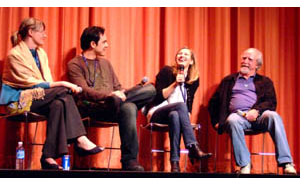 Come Early Morning by Joey Lauren Adams was a clear-eyed character study of an intelligent, flawed woman. Lacking villains and almost lacking heroes, it captures the rhythms of life in a small Arkansas town. Our protagonist, quietly efficient in her job, is caught in family and romance problems as she moves from man to man in a beery stupor. It was tactfully directed by Adams and graced by the underappreciated Ashley Judd. The Weather Man concludes with our hero facing us in close-up, but Come Early Morning ends with the protagonist turned away; in each case, the image feels right. On the left, Lisa Rosman, Eric Byler (Charlotte Sometimes), Joey Lauren Adams, and Scott Wilson (who plays the protagonist’s father).
I must be the last person in North America to see Holes. Its tight plot, clever humor, and easygoing handling of racial matters endeared it to me. As in old Disney fare, familiar actors (Jon Voigt, Sigourney Weaver, Robin Wright Penn, Tim Blake Nelson) are willing to ham it up for the kids, with enjoyable results. And I was startled by the intricate flashback structure on offer; are kids now being trained to follow movies like 21 Grams? Given the interracial love story at the movie’s center, I had a new angle on what Walden Media might be contributing to modern Hollywood, something valuable that escapes cliches about “family-friendly” and “faith-based” entertainment.
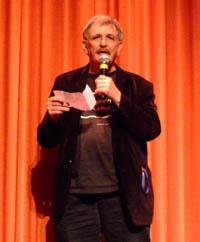
Man of Flowers was a crowd-pleaser. I admired Paul Cox’s visuals, though the grainy print probably didn’t do justice to the range of dark tones in the original. An exercise in portraying a wealthy man’s obsessions and their sources in childhood, it moved toward Buñuel’s Archibaldo del Cruz, but it wasn’t prepared to be as lurid or delirious. A bit too dry and tasteful, perhaps. Still, I admire patient, unshowy long takes, and Man of Flowers is full of them. The photo above shows Paul reading a heartfelt tribute to Roger.
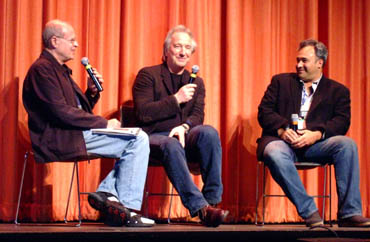
Perfume: The Story of a Murderer was much liked by the audience, and the presence of Alan Rickman made it all the more pungent. I wanted to like it more than I did. Despite my admiration for Tom Tykwer’s other films, particularly Winter Sleepers, The Princess and the Warrior, and Heaven, this one struck me as an overproduced Euro effort at a Big Movie. I thought it overdid the camera tricks (slow-mo, ramping) and the insistence on stuffing every shot with details (e.g., fish, cobwebbed glassware, glistening golden liquids). Above, you see the great actor with Festival Director Nate Kohn and entertainment analyst David Poland.
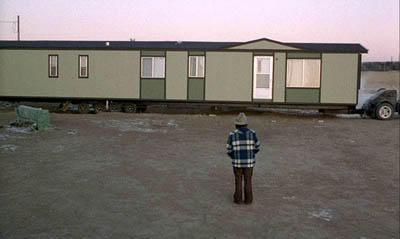
The simple and modest Stroszek was, for me, better at evoking smells—for instance, the stale smoke of the Himmel bar that our hero frequents. The print was faded and weatherbeaten, but the mysterious simplicity of this modern classic came through. The Wisconsin scenes, shot in Plainfield thirty years ago, wouldn’t need much changing today. As usual, I enjoyed the porous, unpredictable plot and Herzog’s willingness to dwell on unfathomable moments like a premature baby with powerful fingers (sleeping, he looks like a wrinkled alien) and the warped imagery of people passing a prison, seen through a hanging water bottle. The dancing chicken became one of the top screen icons of the 1970s.
Now for some quotes I like.
*Gattaca producer Michael Shamberg: “In the pilot scenes of Top Gun, Tom Cruise doesn’t wear his oxygen mask.” Ebertfest blogger Lisa Rosman: “It’s Scientology.”
*“None of the people I write about have friends.” Steven Conrad, screenwriter.
*“The US and Europe are my market. Africa is my public.” Osmane Sembene, quoted by Samba Gadjigo.
*Werner Herzog gave Roger Ebert an early alert about the importance of Anna Nicole Smith in American culture: “The poet must not avert his eyes.”
*“When I pray, I pray to Jesus.” Joey Lauren Adams.
*“Ambiguity in everyday life isn’t exactly celebrated in most movies. . . . It’s great when a big movie celebrates unnameable things.” Alan Rickman on Perfume.
*“Alan, be more subtle—do more.” Ang Lee to Alan Rickman, directing Sense and Sensibility.
*Why did Michael Wiese move to Penzance? “I was in a Witness Protec—oops.”
*“I’ve learned more about directing by working with bad directors than with good ones. And I’ve worked with a lot of bad directors.” Joey Lauren Adams.
*“Sometimes I think I’d like to join another species. . . . They seem to live a more sensible life.” Paul Cox.
*“Our technological civilization is not sustainable on this planet. Nature is going to regulate us very quickly. . . .We’ll be the next ones [to go extinct]. But that’s okay. Let’s enjoy movies and friendship and beer.” Werner Herzog.
*“I saw perhaps three or four films last year. I love cinema, but I’m not a cinephile.” Werner Herzog.
And some portraits of Ebertfest regulars:
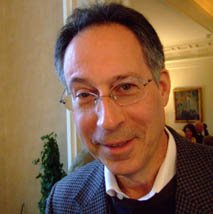
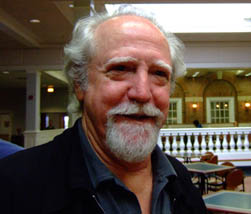
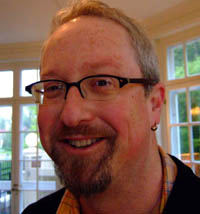
First: Michael Wiese, filmmaker (Hardware Wars, The Sacred Sites of the Dalai Lamas) and publisher of outstanding books on the art and craft of film. Next, actor Scott Wilson (In Cold Blood, Junebug, The Host, and many more). Finally, Jim Emerson, who runs Roger’s website and writes fine film criticism at Scanners.
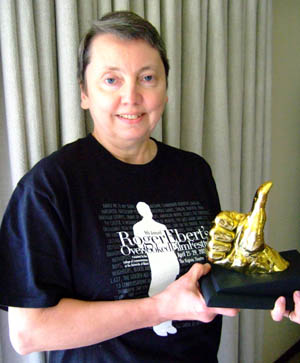
Each year, several guests receive an Ebert Thumb. This year, Kristin was one of the lucky ones.
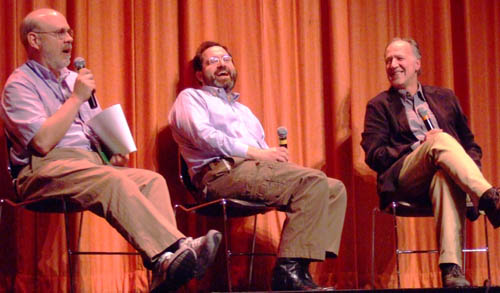
Finally, here I am with Michael Barker, co-president of Sony Pictures Classics, and Werner Herzog. All I said was that I was from Wisconsin….
I plan to blog again soon about Roger and his contributions to filmmaking and film culture. For now, let me just echo Kristin’s opening point that his passion for film is exceeded only by his enjoyment of other people. This weekend’s gathering of top-rank filmmakers, young and old, and the enthusiastic audiences showed that he is probably the most deeply loved film critic whom we have ever had.