
Archive for 2007
Two Chinese men of the cinema
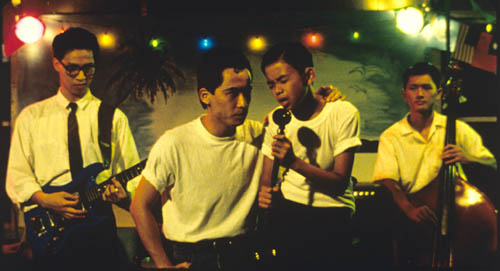
A Brighter Summer Day.
DB here:
This summer two major figures in Chinese filmmaking died. One was Edward Yang (Yang Dechang), one of Taiwan’s finest directors, who died on 29 June. But before I pay tribute to him, I want to acknowledge another figure who had a great impact on Asian cinema.
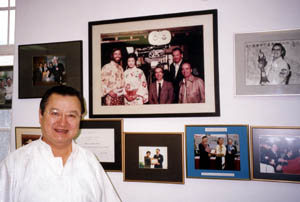
Charles Wang died on 6 July. Along with his brother Fred, Dr. Wang ran Salon Films, the major supplier of film equipment for Hong Kong and a principal one for East Asia and the Pacific Rim. Charles graduated with a degree in chemistry before inheriting the business from his father. As Hong Kong filmmaking grew in sophistication, Salon grew along with it. Most Hong Kong films bear the firm’s brand in their end credits.
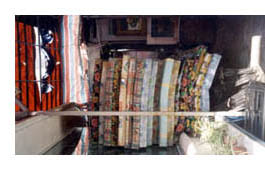 Since 1969 Salon has provided top-flight cameras, lenses, lighting gear and other technical support for both local and visiting productions, such as Mission: Impossible III‘s Shanghai shoot. An early triumph was winning the Panavision franchise for the region. The company even supplies trampolines and landing cushions for martial acrobatics, as this glimpse inside a Salon van shows.
When I interviewed Dr. Wang in 2003 he kindly gave me information about the company and the development of film technology in Hong Kong. He showed me his many awards and talked enthusiastically about Salon’s new efforts to assist mainland moviemaking. In recent years, Salon was investing in films such as Zhang Yimou’s Hero. Like most Hong Kong film people, he was very accessible and generous; he even gave me a lift back to my hotel. Charles Wang was a major force in the Hong Kong industry and will certainly be missed.
Laconic cuts and long takes
I met Edward Yang twice. First, at a Hong Kong Film Festival reception, we chatted about his film Mahjong (1996), which had screened. I got to know him a little better in fall of 1997, when we were both invited to the Kyoto Film Festival. We ate and watched films together, and we shared baby-boomer nostalgia; it turns out that he and I (and Hou Hsiao-hsien) were all born in the same year.
I found him friendly, thoughtful, and open to appreciating all film traditions. He spoke of enjoying Japanese swordplay movies in his youth, and he admired American films for their gripping stories. Still, his preference for ellipsis and understatement came through. When we met Kitano Takeshi for dinner, Edward praised a crisp transition in Sonatine: to show the gang going from Tokyo to Okinawa, Kitano simply gives us a quick pan of the sky accompanied by the sound of a jet plane.
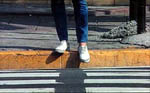
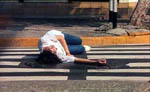
Yang was an accomplished cartoonist, and I thought that this background partly explained his early style, on display in the short film Desires (1982) and in the features That Day, on the Beach (1983), Taipei Story (1985), and The Terrorizers (1986). In these films Yang often breaks his scenes into simple but striking fragments. After the police shootout in The Terrorizers—one of the most enigmatic and elliptical opening sequences in modern cinema—the Eurasian girl staggers out to the street. Yang gives us her collapse in quite abstract, percussive images. Her foot hits the pavement. Cut. She takes a step and falls out of frame; the camera holds on the empty frame. Cut. She’s lying on the crosswalk. I imagine these as forceful, laconic comic-book panels.
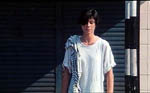
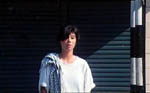
With A Brighter Summer Day (1991), my favorite of his works, Yang tells another gap-filled story but treats the scenes in long, distant, often decentered takes reminiscent of Hou. Now his frames are more dense with figures and furniture, and layers of action extend quite far back. In Figures Traced in Light, I devote a little—too little—analysis to one admirably staged passage. Another of my favorite scenes in A Brighter Summer Day shows the hero Xiao S’ir developing a romantic attachment to Ming, the girlfriend of the absent gang leader Honey. They sit in a brightly decorated café.
Suddenly Ming darts out of the shot, leaving Xiao S’ir and the other boys staring. From their point of view we see that Honey, dressed in a sailor suit, has returned and Ming has gone to meet him.
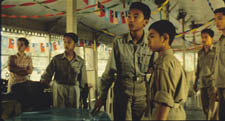
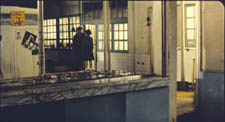
Yang cuts back to the boys as Honey’s gang starts to threaten Xiao S’ir. Abruptly, Ming runs into the shot, past the boys, down the long central aisle, and out of the café. (In a 35mm print you can see her pausing and lingering outdoors.)
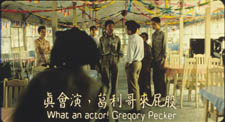
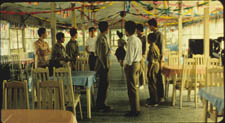
The group closes around Xiao S’ir; only Honey’s entry breaks the tension. He leads the boy into the depth of the shot, the camera following them.
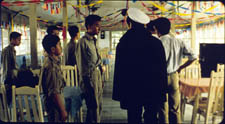
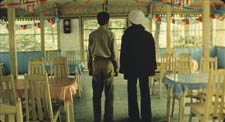
Honey warns Xiao S’ir off, and our hero goes outside, mimicking the path Ming had followed.
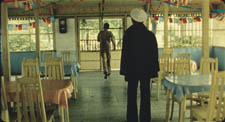
As Honey turns his attention to his gang and an upcoming skirmish with their rivals, he moves back down the aisle, the camera backing up. Once his business is done, Honey drifts back to the rear door.
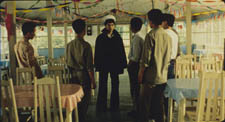
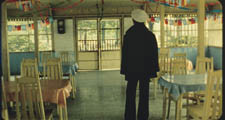
Honey pauses far from us, at the window. Yang cuts to show what he sees: Xiao S’ir, in flagrant violation of the warning, talking to Ming outside.
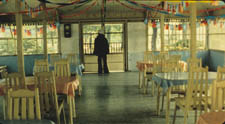
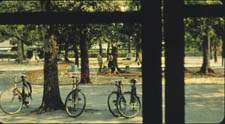
First we got Xiao S’ir’s point of view on Honey and Ming; now, in a reversal, we get Honey’s point of view on Ming and Xiao S’ir. In scenes like this, Yang merges his developing skills in long-take staging with cuts that develop not only the action but story parallels. Very distant framings, characters moving to the rear of the shot and turning their backs: Yang “dedramatizes” the scene. Further, by shifting point of view, he leaves us guessing about story information: What led to Ming’s running away from Honey? What are Xiao S’ir and Ming talking about now? Yang created a laconic visual approach that, I’d argue, invests fairly standard dramatic situations with a tantalizing uncertainty.
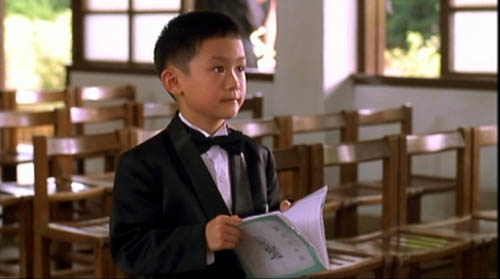
Yang’s best-known film is, of course, Yi Yi (2000), and it won him the wide appreciation that he had long deserved. It’s a warm and gentle work, less innovative than his earlier efforts but utterly typical of his vision of lives pervaded by melancholy routine and abrupt disappointment. People often remarked that the adolescent hero of A Brighter Summer Day resembled Edward himself. Perhaps too in Yi Yi Yang’s enigmatic pictorialism is echoed in the idea of a little boy who makes photographs of people’s heads seen from the rear. Like the director, the boy (named Yang-yang) displays a reticence that respects the mysteries of people’s private lives.
We already have a very useful guide to Yang’s work in one chapter of Emilie Yueh-Yu Yeh and Darrell William Davis’ book, Taiwan Film Directors. And Criterion’s Curtis Tsui has done a wonderful edition of Yi Yi, as Brian Hu shows here. We must hope that Criterion, Eureka, or another gilt-edged DVD publisher will soon bring us Yang’s other works in the pristine editions they deserve.
A Brighter Summer Day (1991)
In 1998, when we screened A Brighter Summer Day at our Cinémathèque, I wrote a program note. I reproduce it, lightly revised, as a quick pointer to one of the great films of the 1990s.
With Taipei Story (1985) and The Terrorizers (1986) Edward Yang established himself as one of the two leaders of the Taiwanese New Wave generation. At first it seemed that he and Hou Hsiao-hsien had agreed to a division of labor in their subjects and styles. Hou tended to concentrate on life in the countryside, or on rural characters transplanted, bewilderingly, to the modern city. Hou was also deeply interested in the history of Taiwan; his most acclaimed film, City of Sadness (1989), is a panoramic survey of Taiwanese society immediately after World War II. Hou’s tranquil style favored a contemplative mood and muted emotion.
Yang, by contrast, tended to focus on the lives of well-to-do urbanites in a contemporary setting, Taiwanese yuppies plagued by anomie and the desperation of love and work. His elliptical editing technique, reminiscent of Resnais, fractured time and space, while his compositions had a painterly starkness. The Terrorizers shuttles kaleidoscopically among characters at its beginning; their relations only gradually settle into intelligible patterns. Whereas Hou tended toward nuance and quiet drama, Yang was unafraid of shocking, inexplicable bursts of bloodshed.
Now it seems evident that this impression of a division of labor was somewhat schematic. Hou’s range of interests has widened, with new emphasis on the violent world of urban crime (Goodbye South Goodbye, 1996), and he has come to rely on quite disorienting transitions between past and present (Good Men, Good Women, 1995). Likewise, with A Brighter Summer Day Yang turned to history and cultivated a more sober style of filming, with lengthier shots and a fixed or barely moving camera. This approach throws down a challenge to the razzle-dazzle of contemporary popular cinema—from Hollywood, Hong Kong, and even the American “independents”—and invites us to scrutinize, moment by moment, the details of action unfolding on the screen.
Three years in the making, A Brighter Summer Day was a triumph of independent production. At a period when the Taiwanese film industry was virtually dead, Yang found money (mostly Japanese) to mount a project of remarkable ambition. Over half the cast and crew had never worked on a film before. At first released in a three-hour version, the film was re-released in a four-hour director’s cut, and this has become the standard version.
The historical event examined in A Brighter Summer Day took place in Taipei in the 1960s, when an adolescent boy about Yang’s age stabbed a young woman. At epic length Yang creates a web of circumstances around the event. He shows the interplay of traditional culture—filial duty, education as an ideal of social advancement—with popular culture, especially the rock n’ roll songs that recur throughout. Yang has said that Americans might not realize the shattering force of rock in other cultures: “These songs made us think of freedom.”
The film has over eighty speaking parts, most filled by nonactors, and it intertwines several characters’ destinies. On first viewing, the film can be somewhat bewildering to a non-Taiwanese audience, so a plot sketch may help. (Skip to the next paragraph if you don’t want to know the action in advance.) At the center is fourteen-year-old Xiao Si’r. He tries to be a dutiful student, but with his friends Cat and Airplane, he lives on the fringes of the Little Park gang of teenage thugs. When Xiao Si’r reports seeing a gang member with another boy’s girlfriend, he triggers a power struggle in the gang. As his friends fall by the wayside and rival gangs fight for control of local turf, Xiao S’ir becomes involved with Ming, a girl who’s attached to Honey, exiled leader of the Little Park gang. A major climax occurs during a gang rumble at a rock n’ roll concert. Interwoven with the juvenile intrigues are political matters; the police pursue and question Xiao S’ir’s father about his Communist friends. Xiao S’ir becomes friendly with Ma, a general’s son, before they start to compete for Ming’s favor. The rivalries build to a tense schoolroom confrontation and a tragic finale in the park. In the final scene and over the credits, a radio transmission broadcasts the names of the students who have passed their school entrance exams.
The plot is even more intricate than my bare-bones summary can indicate; I haven’t discussed the boys’ adventures in a film studio or Cat’s singing career or the slender line of action involving Xiao S’ir’s sister. The breadth of action is extraordinary, and a sense of the contradictory pulls of daily life emerges steadily. No less demanding is Yang’s style—scenes played in darkness, few close-ups, with medium-shots and long-shots keeping us at a distance from the characters. But the result is a dispassionate look at teenaged passions, a deromanticized treatment of young people growing up in a repressive milieu. A Brighter Summer Day (the English title comes from Elvis Presley’s “Are You Lonesome Tonight?”) is an elegy to the ideals and mistakes of youth, an analysis of the vanities of the male ego, and a view of a generation painfully facing the limitations of tradition, the constraints of political oppression, and the demands of the modern world.
Yi Yi.
Len Lye, Renaissance Kiwi
Kristin here–
David and I have many pleasant memories from our May visit to New Zealand, where as Hood Fellows we were resident at Auckland University for a month. Among these memories is meeting Roger and Shirley Horrocks. Roger has been a major figure in the development of film studies and culture in New Zealand. He founded the Department of Film, Television and Media Studies at Auckland University and was its head until his retirement in 2004. He co-founded the Auckland International Film Festival and has written on television and film in New Zealand.
Shirley is a producer and director of documentary films, many of them about Kiwi art and culture, made primarily for TVNZ and NZ On Air. In 1984 she founded her own production company, Point of View Films.
Retrieving Len Lye
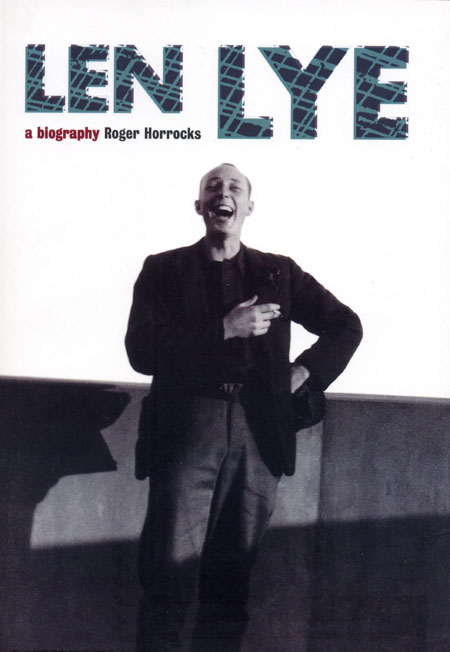
Among the Horrocks’ accomplishments has been to aid in the preservation of the work of filmmaker/ sculptor/ painter/ poet/ theorist Len Lye (1901-1980) and to disseminate information about this undeservedly overlooked figure. Roger generously gave us a copy of his impressive book, Len Lye: A Biography, and Shirley presented us with a DVD of her documentary on Lye, Flip & Two Twisters, named for one of the artist’s sculptures.
I remember seeing a few Len Lye films long ago and thinking they were delightful and innovative. In working on our textbooks, I had the privilege of sitting in one of the British Film Institute’s refrigerated viewing rooms and seeing a gorgeous nitrate copy of his 1936 film Rainbow Dance. Color frames from it appear in Film Art (8th edition, p. 164) and Film History (2nd edition, p. 321). I had also seen Lye’s strange and evocative first film, Tusalava (1929), an animated film with abstract shapes much influenced by Maori and Australian Aboriginal art (illustrated on p. 176 of Film History).
Lye was born and grew up in New Zealand, lived for stretches in Samoa and Sydney, moved to London as a young man, and moved permanently to New York in 1944. He was extraordinarily attuned to sensory perception and rhythm and was drawn to the indigenous art of the southwest Pacific area. From an early age he studied modern art and especially abstraction.
Lye belonged to a generation of innovative animators who began working in the 1920s and 1930s: Oskar Fischinger in Germany and later the U.S., and Alexandre Alexeïeff and Claire Parker in France and later Canada. Although their styles differed considerably, all sought to find alternatives to Hollywood cel animation and to explore the relationship between music and cinema.
Roger and Shirley’s gifts inspired me to renew my acquaintance with Lye’s work and take a closer look at his career. “I’ll just order a DVD of Lye’s films,” I thought to myself. Back in the late 1980s Pioneer had issued a marvelous though brief series called “Visual Pioneers.” David and I had bought “The World of Oskar Fischinger” and “The World of Alexandre Alexeïeff.” I figured that these had probably been re-issued on DVD, along with the rest of this short-lived series. It turns out, no. Lucky we held onto those laserdiscs!
Unfortunately, there was never a “Visual Pioneers” disc devoted to Lye.
The age of DVDs has not served these filmmakers well, either. One has to be doggedly determined in finding and acquiring their work. The bountiful “Unseen Cinema” set from Image contains Oskar Fischinger’s An Optical Poem (1938), an abstract short film made for MGM (!) after the filmmaker moved from Germany to the U.S. It’s on the disc titled “Viva la Dance: The Beginnings of Ciné-Dance.” Although the set claims to deal with the American avant-garde up to 1941, Alexeïeff and Parker’s 1934 masterpiece Une nuit sur le Mont Chauve (Night on Bald Mountain) is included. I suppose the logic there is that Parker was an American, though she and Alexeïeff (born in Russia) made the film in Paris and worked thereafter in Europe and Canada. (A few other émigré directors’ European works are in the set, though I can’t see why Anémic cinéma by Marcel Duchamp [aka Rrose Sélavy] should be there.)
There is a French region 2 DVD of the pair’s work available. I found it for sale online at fnac and Cinedoc. A DVD of ten Fischinger films is available from the Center for Visual Music’s shop; it actually sells the disc through Amazon, which might make it relatively easy for some to acquire.
The Center’s shop carries a variety of experimental cinema, and there I found a collection of Lye’s films—on VHS. “Rhythms” contains twelve of Lye’s major works, including A Colour Box (1935) and Rainbow Dance. It was brought out by Re: Voir, a major distributor of avant-garde cinema. One can buy it from that company, though in the U.S. the Center is a convenient source. My copy from the latter came quite quickly.
The cassette does not include Tusalava. The only place that seems to be available is on YouTube, and I hesitate to recommend it, given the fuzziness of the image. (Poor copies of some other Lye films are there as well, but since the tape contains far better versions there is no good reason to link to them.) Tusalava survives in beautiful condition, and I hope it eventually could be added to an expanded Lye collection on DVD.
Don’t be misled by the collection “The Experimental Avant-garde Series Number 19–The Serious, the Silly, and the Absurd.” There the short Lambeth Walk Nazi Style is wrongly attributed to Lye–a fairly common mistake. Lye’s short, Swinging the Lambeth Walk (1939), is an abstract film using the same pop song as a soundtrack; it’s on the “Rhythms” tape.
The Filmmaker
Perhaps one reason why Lye’s films command less attention today than they should is simply because they are so short. All twelve films on the “Rhythms” tape add up to a mere 47 minutes, and even the seven-minute Tusalava would fail to bring the total to one hour.
This paucity of footage results in part from the painstaking labor involved in making them. Some of Lye’s films depended on elaborate painting and scratching directly on 35mm film stock. This kind of animation was Lye’s innovation and not, as is widely assumed, that of Norman McLaren. A Colour Box looks remarkably like a McLaren film. The resemblance is not coincidental. One of the few periods during which Lye had institutional support was when he worked for the GPO Film Unit in London. McLaren was freshly out of art school and working at the same unit. He freely acknowledges his amazement at seeing and hearing A Colour Box and its influence on him: “Apart from the sheer exhilaration of the film, which intrigued me was that it was a kinetic abstraction of the spirit of the music, and that it was painted directly onto the film. On both these counts it was for me like a dream come true.” (pages 144-45 of Len Lye: A Biography.)
An equally revolutionary technique Lye used was no less time-consuming. The new color film stocks of the 1930s fascinated him, especially the three-strip processes. These recorded each of the three primary colors on a separate strip of black-and-white film, with the color of the final film being achieved by adding color dyes to the matrices and combining them. Technicolor is the most famous of these systems, though Lye drew upon European processes, including Gasparcolor. Lye seems to have been alone in his realization that one could use the three-strip technique on film shot originally in black-and-white.
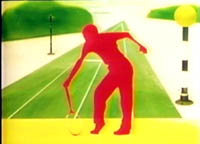
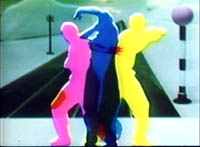
Rainbow Dance was made by shooting, in black-and-white, a human figure leaping, playing tennis, and executing other actions against a white screen and then using the result as a silhouette filled with vivid, saturated colors. Abstract and semi-abstract shapes surrounding the figure, constantly moving and changing, create a dazzling effect. The film ends abruptly with the message, “The Post Office Savings Bank puts a pot of gold at the end of the rainbow.” As advertisements, some of Lye’s films of the 1930s played in theaters, though viewers often perceived them as experimental shorts.
Another reason for the lack of attention paid to Lye is that he was always very much an eccentric loner, working on the periphery of Surrealism, Abstract Expressionism, and kinetic art. Works by him were included in exhibitions devoted to these trends, but Lye always refused the prominence that allegiance with fashionable movements might have given him. He was also highly impractical about money and not adept at explaining his projects to potential grant-bestowing foundations.
The Legacy
Roger Horrocks met Lye late in the artist’s life and worked as his assistant in his final months. Roger and Shirley were involved in setting up the Len Lye Foudation, housed at the Govett-Brewster Art Gallery in New Plymouth, New Zealand. (Its website is the best online source of information on Lye.) The foundation’s collection include extensive unpublished writings by Lye, to which Roger had complete access. He also interviewed a wide range of people who had known Lye in various capacities. The result is not only thorough, but it also gives a lively sense of a profoundly eccentric artist.
As part of Lye’s fascination with the senses, he deliberately cultivated a sort of stream-of-consciousness language, both for speech and writing. The result often suggests someone communicating in poetry rather than prose, and the quotations are not always easy to understand. One note scribbled after Lye had seen a film reads, “The knobbly cast of the star Elliott Gould, bemused, his mouth full of marbles, finally flapping his foot-flippers enrout insouciantly to some horizon or other” (p. 294). Roger, however, has waded through a large, difficult set of notes and journals. As he puts it, “It took my years to find my way round this chaotic collection of fragments and drafts, but ultimately it proved a goldmine.” One early reader of the biography remarked that “the book felt at times more like an autobiography than a biography” (p. 3). This is an astute observation, for Roger has woven many quotations into his own prose and thus given a structure to the chaos. By the end one feels that one understands not just the facts of Lye’s life but also his personality.
(Unfortunately the biography, published by Auckland University Press in 2001, is already out of print. With luck there’s a copy in your local library.)
The Sculptor
For film fans and scholars with at least a passing knowledge of Lye’s shorts, the real news here will be his versatility as an artist. Before he started making films, he was already an accomplished painter. Because painting was a relatively inexpensive activity, Lye often did not promote his own work and simply gave the paintings to friends. He sought buyers and patrons for his kinetic sculpture, though, because he needed funding to build these ambitious projects.
A few museums, like the Museum of Modern Art and the Whitney, own Lye pieces, but on the whole his kinetic sculptures, many of which are large and difficult to maintain in working order, are not widely or continuously displayed. Indeed, much of Lye’s later life was devoted to designing huge pieces, only some of which have been realized even now. The Len Lye Foundation is committed to realizing posthumously the plans he left behind, though no doubt some of his more grandiose schemes will remain too impractical to render.
Shirley’s documentary Flip and Two Twisters (1995) helps fill in that side of the artist’s career for those who cannot travel to New Plymouth. Although she sketches Lye’s career and shows clips from some of the films, the real revelation is footage of Lye at work on some of the main pieces, like “Blade” (1954) and “Flip and Two Twisters” (1965). The dates, by the way, are a little misleading, as Lye continued to modify his sculptures after their initial versions were finished—usually making them larger.
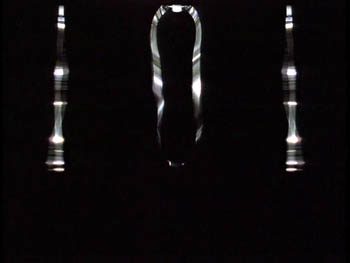
“Flip and Two Twisters” is a casual name for a formidable piece, though Lye eventually took to calling it “Trilogy.” The sculpture consists of a large looped ribbon of flexible steel suspended from the ceiling, flanked by two vertical strips of similar steel. Once set in motion, the thrashing and twisting movements of these three elements gradually become quite loud and violent. Onlookers declare that it is frightening to be in the same room with the sculpture, as even just watching it on video makes plausible.
This documentary would be a terrific teaching supplement for a course on avant-garde cinema. Copies are available direct from Point of View Films.
Shirley gave us three of her other documentaries. Kiwiana (1996), as its name suggests, explores some of the icons of New Zealand’s popular culture. Kiwis were beginning to appreciate these neglected everyday objects, which were becoming collectibles in the 1990s: the buzzy-bee, the gumboot, and, yes, the kiwi fruit. Peter Jackson even makes a brief appearance as a talking head. Marti: The passionate eye (2004) chronicles the extraordinary life of Marti Friedlander, who was raised in a Jewish orphanage during the 1930s and 1940s in London. She was trained as a photography laboratory technician but also became a photographer. Emigrating to New Zealand, she worked on a series of Maori portraits and documented such moments of political ferment as the Women’s Movement. Finally, The New Oceania (2005) is a portrait of the Samoan-born writer Albert Wendt and his fostering of a new Pacific culture based on local traditions but embracing modernism. All of these films are available from Point of View.
We are grateful to Roger and Shirley for being among the many who made us feel so welcome in Auckland. I’m particularly grateful for being led to revisit and explore a director who deserves to be far better known.
Summer camp for cinephiles
Bruges, Belgium is a tourist haven. This reconstructed medieval city boasts museums, canals, cafes, an impressive town square, and other attractions guaranteed to keep credit cards flowing through. It’s a wonderful place to stroll in the sunshine, shop, or watch windmills slowly spin.
In alternating summers, though, Bruges plays host to people who prefer to sit in the dark. This strange cult includes professors, students, and cinephiles from all walks of life. For a small fee Belgians and Netherlanders can plunge into eight intensive days of viewing, lectures, and discussions. While tourists shuttle by unsuspecting, the devout are gathered to watch such items as Rebel without a Cause, the entire Niebelungen, and Destroy All Monsters.
It’s the Zomerfilmcollege, funded by the Flemish side of the Belgian government and run by the Flemish Service for Film Culture in partnership with the Royal Film Archive. In English we’d call it Film Summer Camp. There are no papers or grades. It’s a college in the original sense, a gathering of minds for purposes of deepening knowledge and expanding ideas.
It’s held in the Lumière cinema, a central three-screen moviehouse specializing in arthouse fare (and, for part of our stay, The Simpsons Movie). On the ground floor is a cozy bar, which also serves the lunches and dinners for the collegians. The whole building, like the atmosphere of the event, is unpretentious and welcoming.
Typically there are two principal courses and a sidebar. This year, one course was on Fritz Lang, the other was on widescreen film, and the sidebar was devoted to the French cinematographer Henri Alékan (La Belle et la Bête, Wings of Desire). The schedule is fairly full. At 9:00 AM there’s a lecture, followed by a film screening, then lunch. After lunch, another lecture and another screening. Dinner follows at about 6:30, and evening events follow, with a film or special presentation at 8:00 and then at least one more film afterward. All films are in 35mm prints.
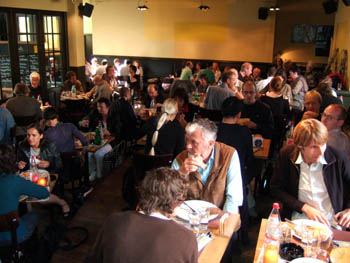
A real workout
Kristin and I had been lecturers here several times, but this year I came alone. The Lang cycle was to have been handled by Tom Paulus, who gave us Hawks last time, but illness kept him away. He was replaced by several other fine Flemish scholars: Hilde D’haeyere, Steven Jacobs, and Roel Vande Winkel. They supplied lectures on Lang and architecture, on his relationship to the German “street film,” on his relation to the Nazi regime, and on his American work. The retrospective gave a good sampling, running from the Dr. Mabuse films (1922) to Moonfleet (1955; very nice print). For Alékan, there was the filmmaker/ archivist/ novelist Eric DeKuyper, for whom Alékan shot A Strange Love Affair (1984), and the Belgian professor Muriel Andrin, who incisively introduced us to visual influences on Alékan’s aesthetic.
Most lectures are in Dutch, but fortunately for me some are conducted in English. In previous years I’ve lectured on modern Asian film, Hollywood in the 1970s, and the history of film staging. This year my topic was anamorphic widescreen. The talks grew out of my research for an essay to appear this fall in my collection Poetics of Cinema.
The week is now about three-quarters done, and I’ve had a great time. Using clips and slides, I started with a block tracing CinemaScope in the US, with my main examples being Rebel, River of No Return, Moonfleet (intersecting with Lang), The Girl Can’t Help It, and Compulsion. Tonight we’ll get our example of modern usage of the widescreen with a showing of Three Kings.
The next three sessions concentrate on non-US usage of the anamorphic format. Le mépris screened today and will be discussed tomorrow. Oshima’s The Catch will represent a Japanese approach. On Sunday, we end with Johnnie To Kei-fun’s The Mission as illustrating one Hong Kong approach. By nice synergy, To’s Election and Election 2 are playing on other Lumière screens, so collegians can sneak off for some extracurricular viewing.
I enjoy visiting the college, and not just because I like to lecture. A schedule of screenings negotiated by what’s available in a good print from the archive or a distributor forces me to confront films I haven’t studied before. Even for those I know pretty well, seeing them big and beautiful can stimulate new musings. And as any teacher will tell you, even going back over familiar material shows you something fresh.
No lack of scope
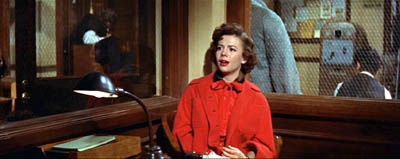
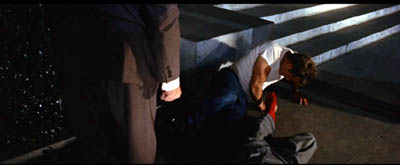
For example, I had always loved the way Nicholas Ray used deep space to link his young protagonists in the police station at the start of Rebel. But this time I noticed how Dean’s performance was fitted to the wide frame: He begins the movie prone and pretty much ends there.
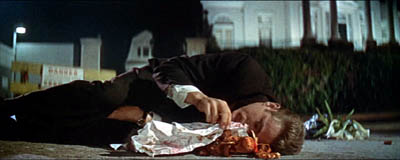
I also noticed how Jim’s gesture of covering the toy monkey at the start is echoed by his and Judy’s protective covering of Plato, and by the climax when Jim’s father covers him.
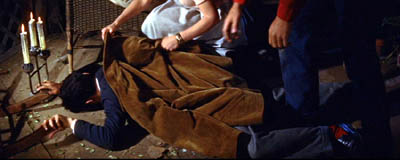
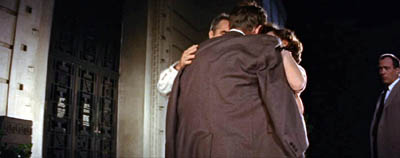
Viewers more familiar with Rebel than me have probably noticed these rhyming gestures and attitudes, but finding them on my own, innocently if you like, fueled my interest in teaching a film I had never studied closely.
Likewise, I wasn’t aware that the glasses motif in Compulsion is linked to imagery of blinding light, a kind of supernatural authority that not only points to the guilty party but also leads the monstrous, pathetic Judd to mercy. The dynamic is given diagrammatically in the closing and opening credits.
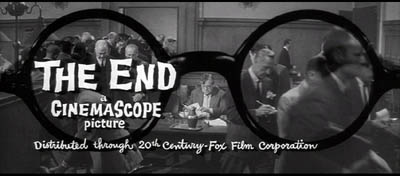
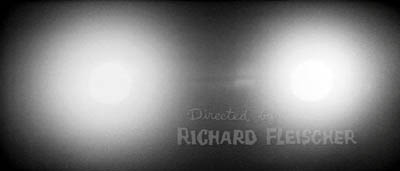
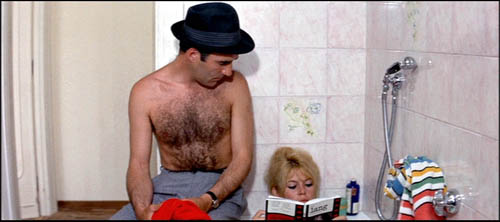
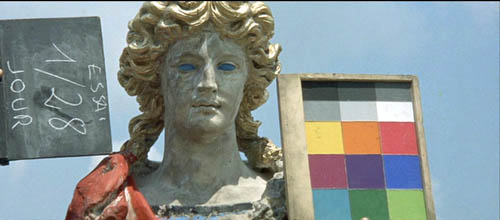
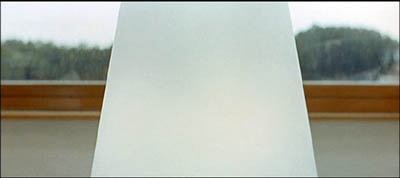
My previous post was about watching movies small and super-slow; now I’m reaping the advantage of watching films big and normally. Today, watching Godard’s Contempt on the screen I was able to enjoy those motifs of color, light, and composition that move almost musically through every Godard film (See top of entry.) I was able to identify some more citations (the novel adorning BB’s fanny is John Godey’s noir Frapper sans entrer) and feel the full force of the bold geometry of the framings. I hadn’t noticed before that the first image of the table lamp in the apartment sequence prepares, inversely, for the villa steps in Capri.
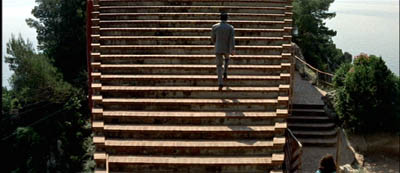
And I’d never noticed before how the last time Paul sees Camille, at the rocky outcropping that overlooks the seascape, she becomes that nymph seen in Lang’s rushes and identified as Penelope of the Odyssey.
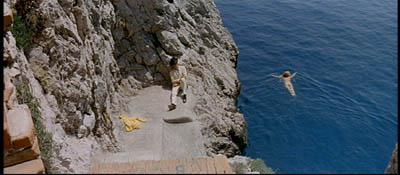
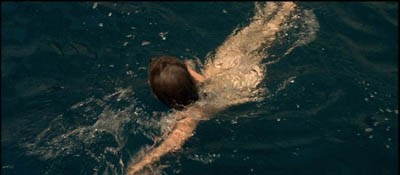
Perhaps Camille is Penelope for Paul, but not necessarily for us. One task of the film is surely to make us suspicious of neat parallels between contemporary and classical culture; what Godard gives us graphically he often qualifies or negates elsewhere in the film. (1)
I expect to have some further fun with The Catch and The Mission, both of which will look splendid on the Lumière screen.
I turned sixty on the day I showed Rebel. Being here, though, I don’t feel so old. I have to keep up with the collegians and the dedicated archive team–Stef, Tim, Vico, Esther, and Joost. Their energy turns a medieval city into an exuberant adventure in cinema.
(1) After preparing my lecture, I discovered a wonderful website on citations in Godard, with special focus on Le mépris.
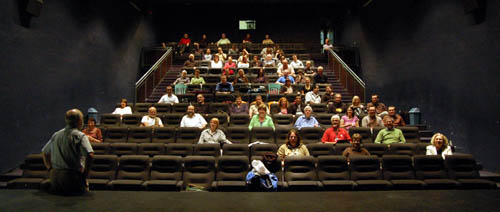
The Zommerfilmcollege gang, in 2.35 Scope. Photo by Esther Dijkstra.
Watching movies very, very slowly
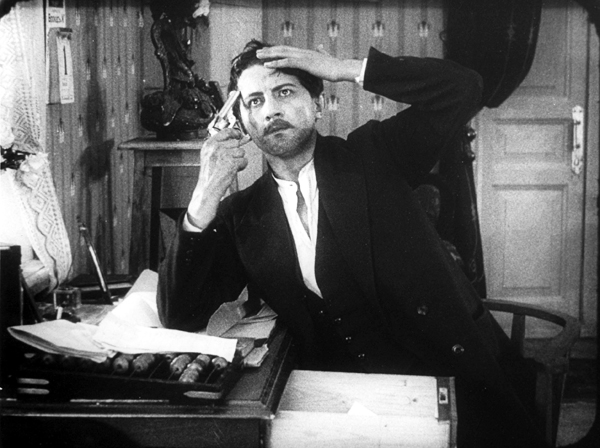
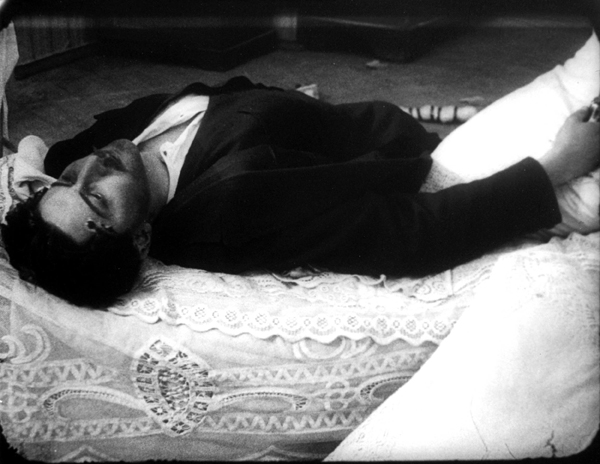
Children of the Age (1915).
DB here:
Before DVD and consumer videotape, how could you study films closely? If you had money, you could buy 8mm or 16mm prints of the few titles available in those formats. If you belonged to a library or ran a film club, you could book 16mm prints and screen them over and over. Or you could ask to view the films at a film archive.
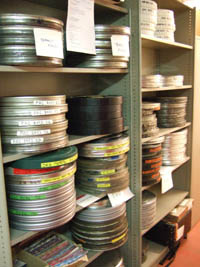 I started going to film archives in the late 1960s, when they were generally more concerned with preserving and showing films than with letting researchers have access. Over the 1970s and 1980s this situation changed, partly because several archivists grew hospitable to the growing field of academic film studies.
At first archives found it easier to screen films for researchers in projection rooms, but eventually many let visitors watch the films on stand-alone viewers. That way the researcher could stop, go forward and back, and take notes. In researching my dissertation in the summer of 1973, I watched films at George Eastman House in 16mm projection, but a few weeks later in Paris, Henri Langlois of the Cinémathèque Francaise allowed me time on Marie Epstein’s visionneuse (a term I’ve admired ever since).
Over the years Kristin and I have visited archives in various countries. We’ve become particularly close to the Royal Film Archive of Brussels, partly because back in the 1980s the head, Jacques Ledoux, believed that Kristin’s research was worthwhile and allowed us to visit regularly. Without the cooperation of Ledoux and his successor Gabrielle Claes, we couldn’t have done a great deal of our research. No wonder it helped us so much: the Belgian Cinémathèque is arguably the most diverse archive in the world.
Case in point: My current visit. I came with two goals. First, I had to prepare for my lectures in Bruges later in the month. These consist of eight talks on anamorphic widescreen. So I planned to watch four early CinemaScope films, plus Oshima’s The Catch (1961) and the SuperScope version of While the City Sleeps.
I also wanted to fill in a big gap in my knowledge about a major silent filmmaker. More on him shortly.
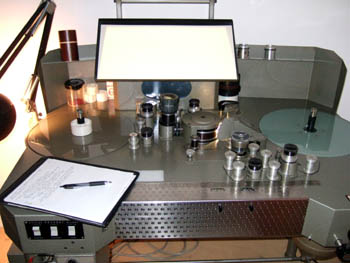
Viewing on a visionneuse
If you’ve never watched a film on a viewer, let me explain. The classic viewer is a flatbed, or viewing table. It’s the size of an executive desk. Two platters or spindles hold a feed reel and a take-up reel. Motors drive the film through a series of sprocketed gates, past a projection device (usually a prism) and across a sound head. The film appears on a smallish screen. There’s usually a little surface space to set a notepad, along with a lamp on an articulated arm.
Before digital editing came along, such machines offered the only way filmmakers could cut sound and picture. (Now most phases of editing are done on computer, with physical editing reserved for late stages of postproduction.) Eventually flatbeds were offered in simpler versions for playback rather than editing.
The most common American-made viewer was the Moviola, which was initially not a flatbed but an upright machine. Eventually the German Steenbeck and KEM became the high-end standards for editing picture and sound. The Brussels archive relies on the Prévost, an Italian machine that is very easy to maintain. The Prévost, seen above, beams the image from the prism onto a mirror hanging over the machine, which bounces the picture onto the screen.
35mm films are mounted on 1000- or 2000-foot reels, the latter yielding about twenty minutes of film at sound speed. A feature film will consist of four or more 2000-foot reels. Even if you watch a film straight through, without stopping to make notes, it takes time to change the reels, so a two-hour movie will probably consume nearly three hours on a 35mm flatbed. And of course researchers stop a lot to take notes and move to and fro across a scene. If I’m studying a film intensively, I probably consume about an hour per 2000-foot reel. Across my life, I wouldn’t dare calculate how many months I’ve spent in visionneuse viewing.
Viewing on an individual viewer has both costs and benefits. Sometimes details you’d notice on the big screen are hard to spot on a flatbed. But with your nose fairly close to the film, you can make discoveries you might miss in projection. (Ideally, you would see the film you’re studying on both the big screen and the small one.) In addition, of course, you can stop, go back, and replay stretches. Above all, you get to touch the film. This is a wonderful experience, handling 35mm film. Hold it up to the light and you see the pictures. You can’t do that with videotape or DVD.
The scary part of any flatbed viewing, at least for me, is watching the film whiz along under your nose at ninety feet per minute. If you haven’t threaded the thing properly, or if the print has a weak splice or torn sprocket hole, you can rip the film. For this reason, archives typically don’t allow a researcher to handle films they hold in only one copy.
The average film you watch on a flatbed has an optical soundtrack, that squiggly line that is read by an optical valve. But early CinemaScope films had magnetic tracks so that they could provide stereophonic sound. In the picture below you can see that strips of magnetic tape, like those in tape cassette players, run along both edges of the film strip. For my Scope films, I was obliged to use a Prévost that could handle mag sound–and of course one that could be fitted with an anamorphic lens to unsqueeze the image to the proper proportions.
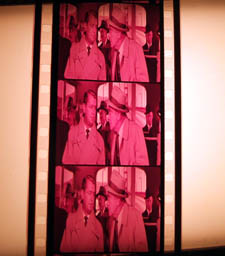
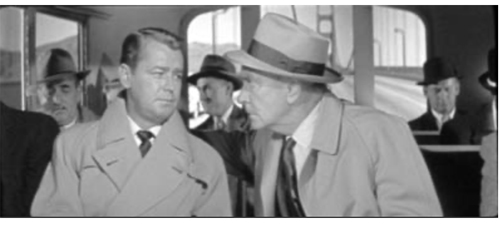
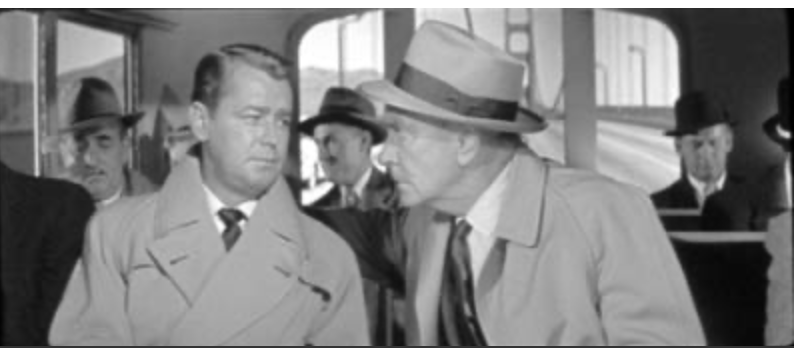
Hell on Frisco Bay (1954) was a color movie, but this print, like many from the period, has faded to bright pink. The Eastman color stock of the period was unstable, and many prints were processed carelessly. (In unsqueezing the frame, I’ve eliminated the color cast for better clarity.) Restoring color to films of this period is one of the major tasks facing film archivists. Cinema is a fragile art form.
Hours and hours of Bauers and Bauers
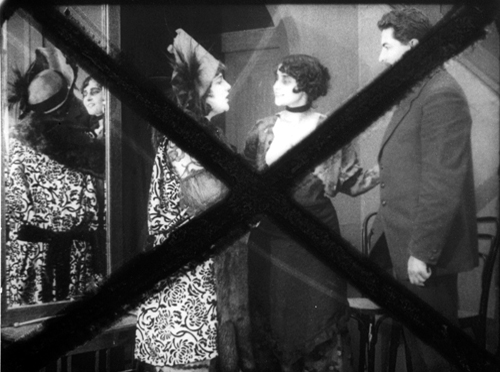
At the Giornate del Cinema Muto in Pordenone in 1989, Yuri Tsivian’s retrospective on Russian Tsarist cinema convinced a lot of us that good filmmaking in that country didn’t start with the Bolshevik revolution. Along with that retrospective came a wonderful book, Silent Witnesses, edited by Yuri and Paolo Cherchi Usai. Unfortunately hard to find now, it’s filled with information about pre-Soviet filmmaking.
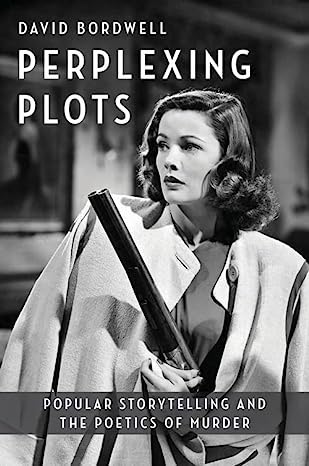
Although I enjoyed the Tsarist films, I didn’t know exactly what to watch for. It took me some years to appreciate their artistry, and some of my ideas about them showed up in On the History of Film Style (1997) and Figures Traced in Light (2005). In those places I studied 1910s “tableau” staging and used some examples from Yevgenii Bauer, by common consent the most pictorially ambitious Russian director of the period. Kristin and I also used Bauer as an example of tightly choreographed mise-en-scene in Film Art (p. 143). I thought it was time I examined his work more systematically, and I knew that the Royal Film Archive held some Bauer prints, which they acquired from Gosfilmofond of Moscow.
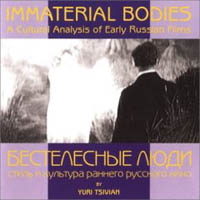 Bauer had a brief but prolific career. He started directing in 1912 and completed eighty-two films before his death in 1917. Unhappily, only twenty-six of his works survive. Just as bad, most of those lack their original intertitles, so we don’t have the expository and dialogue titles we expect in silent films. The placement of the titles is sometimes signaled by two Xs marked on two successive frames. Without titles, the storylines can get obscure. Yuri, Ben Brewster, and other scholars have sought to reconstruct something approximating the original titles by studying the plays and novels that Bauer adapted. Three of the reconstructed films are available on a DVD called Mad Love, and Yuri has also created an innovative CD-ROM (right) that takes us through works of Bauer and his contemporaries.
Although he made comedies, Bauer is most famous for his somber psychological melodramas, often centering on class exploitation. A woman becomes a rich man’s mistress; when she abandons her husband and takes their baby, he commits suicide (Children of the Age). A serving maid is seduced by her master and callously tossed aside when he marries a flirt (Silent Witnesses). Things can get pretty dark. This is the director who made films entitled After Death (1915) and Happiness of Eternal Night (1915). In Daydreams (1915), a widower sees a woman who strikingly resembles his dead wife. Like Scottie in Vertigo, he follows her and becomes increasingly obsessed. Did I mention that he keeps a ropy braid of his dead wife’s hair in a glass box?
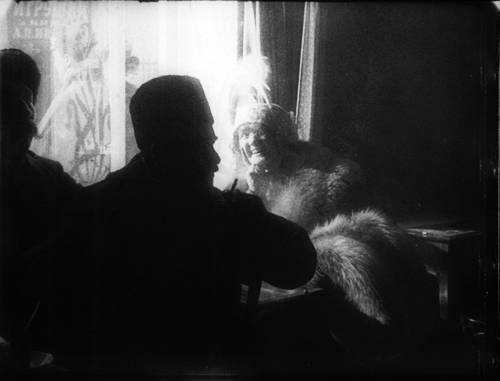
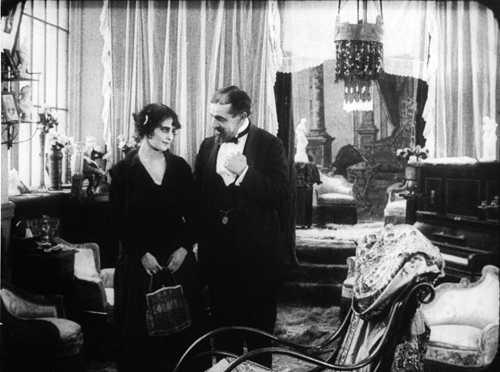
Seeing several films again confirmed my view that Bauer knew better than most directors how to organize a shot. His contemporary Louis Feuillade favored a quiet, sober virtuosity, but Bauer developed a flashy visual style. He’s most known for his ambitious use of light (Frigid Souls, below) and big, textured sets packed with columns, trellises, drapes, brocades, embroidered pillowcases, and other elements that add abstract patterns to a scene (Children of the Age, below).
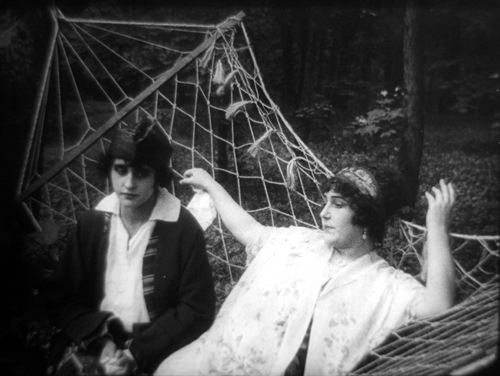
Even a hammock can be stretched and framed to create a swooping web around the innocent heroine of Children of the Age, ensnared by the demimondaine.
In particular, I admire Bauer’s constant inventiveness in moving his actors around the set in smooth ways that always direct our attention to what’s happening at the right moment. European directors of this period seldom cut up a scene into several shots of individual actors; the frame typically shows us the entire playing space. Directors were obliged to shift their actors across the frame and arrange them in depth, like chesspieces.
This master-shot, single setup approach might seem hoplelessly restrictive. Today we expect films to have lots of cutting and camera movement. How does the filmmaker sculpt the action, moment by moment within a static frame?
Blocking, as in blocking the view
I trace some principles of this approach in the books I already mentioned. I’ll mention two strategies here, and if you want to know more you can follow up in On the History of Film Style and Figures Traced in Light.
Filmmakers of the 1910s created intricate choreography by moving actors left or right, up to or away from the camera. Often they set up unbalanced compositions and then rebalanced them, creating a kind of spatial tension that parallels the drama. In the course of the action, actors close to the camera might conceal those that are farther away. The blocking of the actors, in other words, also sometimes blocks our view.
In Leon Drey (1915), Bauer tells the story of a cynical womanizer. In one scene, he’s dallying with his latest conquest when another of his lovers bursts into his apartment. The first phase of the shot is very unbalanced; most directors would have put the mistress at the door on one side of the frame and Leon and the woman in his arms at the opposite side. Immediately, though, the woman flees to the bed in the back of the shot and activates the right area of the frame.
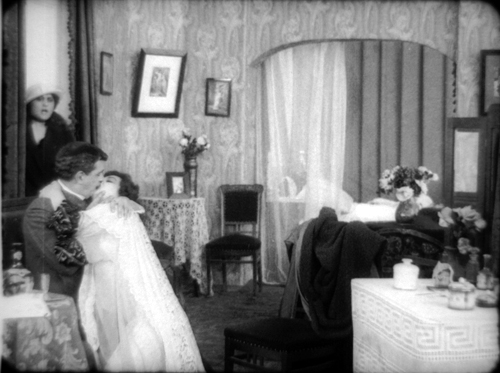
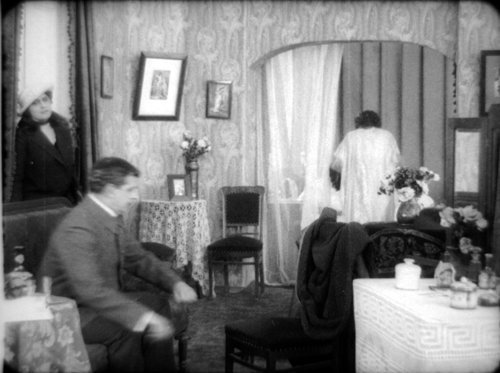
As the mistress rushes to the woman in the rear, Leon strides to the foreground and his burly body blots out the drama between the two women. We’re forced to concentrate on his cold indifference to both of his lovers. Eventually his mistress comes to the foreground to remonstrate with him. Now, at the high point of the scene, we have a balanced frame. Note that Leon continues to conceal the first woman; the scene’s not yet about her.
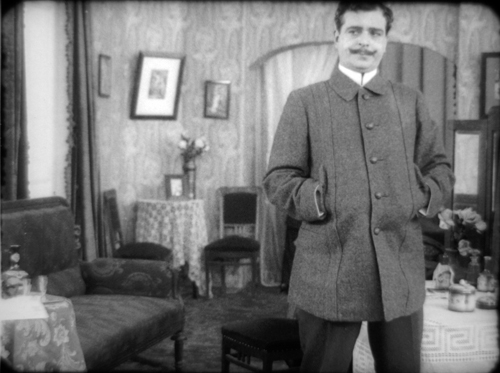
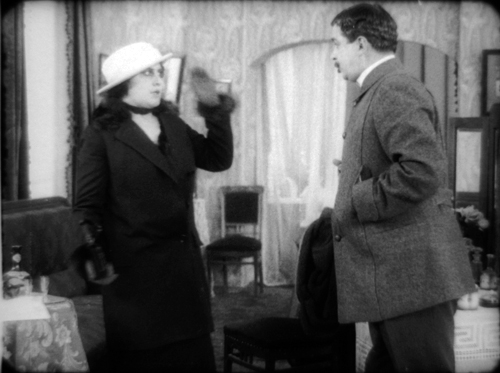
The mistress leaves, angry and desperate, and Leon placidly pays her no mind. As the door closes, he hurries to lock it and summons the first woman, now visible, back from his bed. He will have little trouble convincing her to return to his arms.
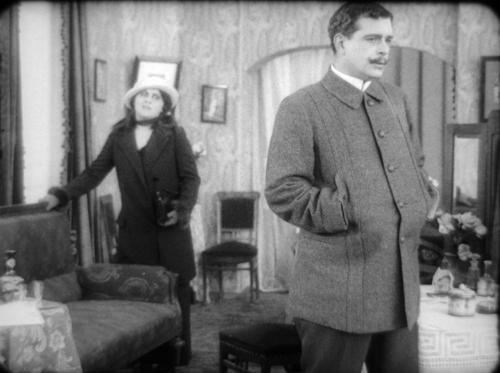
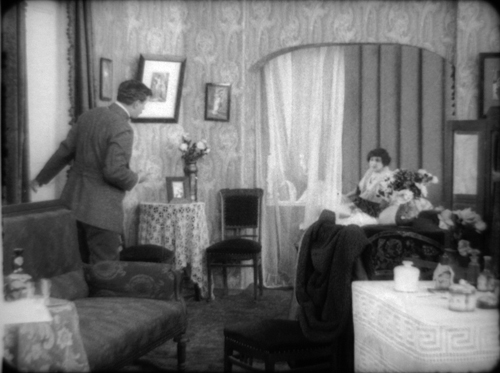
The dramatic curve of the scene has been expressed in compositional asymmetry and symmetry, concealing space and then opening it up.
Most directors of the period used principles like these to turn dramatic conflict into vivid choreography. Bauer also tried more unusual tactics. He was especially good at shifting actors’ heads very slightly to open or close off channels of action behind them. Here’s an instance from Her Heroic Feat (1914).
The butler informs Lina and her mother that the scandalous ballerina Klorinda is calling on them. At first Lina’s head is solidly blocking the doorway in the rear. As the butler goes to the rear door, Lina pivots a little to clear our view of that doorway.
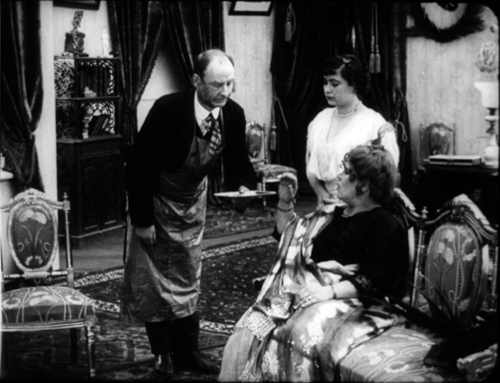
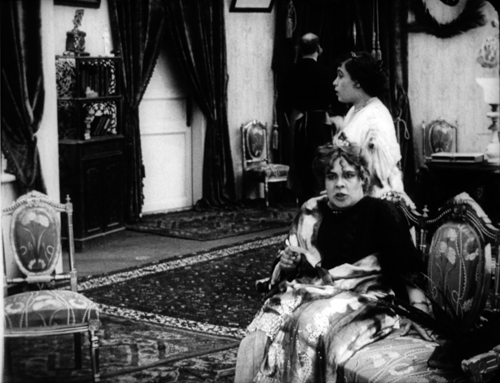
Klorinda sashays in, and who could miss it? She’s wearing a bright dress, she’s centrally positioned, and she’s moving toward us. The other women refuse to look at her, but their immobility assures that we keep our eye on Klorinda. When she stops to greet them, then they move, pivoting away; Lina’s head goes back to blocking the doorway. Imagine how things would have gone if her head had been there when Klorinda appeared in the background.
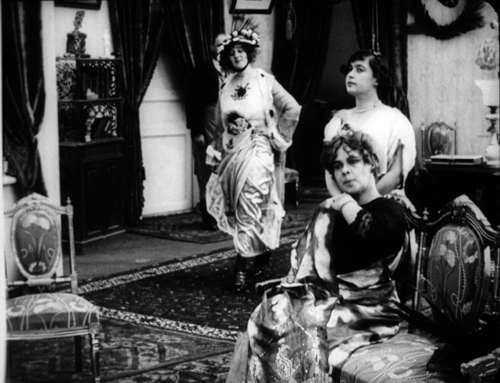
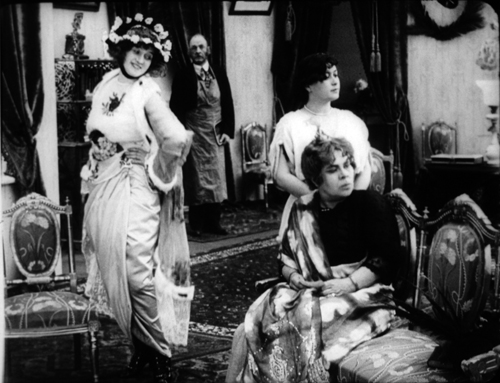
Of course, we should also study the performance techniques of Bauer’s actors–a subject examined in a fine book by Ben Brewster and Lea Jacobs, Theatre to Cinema. The compositional tactics employed here work to draw our attention to the actors’ expressions and body language.
Still, not everything in 1910s ensemble staging owes a debt to the theatre. The changes in Lina’s head position, or Leon Brey’s calculated blockage of the women behind him, wouldn’t work on the stage; most of the audience wouldn’t see the exact alignment we get onscreen. Live theatre depends on varying sightlines, but in cinema, we all see the action from one position, that of the camera. Bauer, Feuillade, and their contemporaries realized that they could organize the action, down to the smallest detail, around what the camera could and could not take in.
The fluent choreography developed by 1910s directors is almost unnoticeable when you’re watching in real time. You’re supposed to register the what–the point of interest in the frame–rather than the how, the slight shifting of actors that highlights this face, then that gesture. By the time you realize that something has happened, the first stages of the process have slipped away, inaccessible to memory.
So there’s a need for slow viewing. Filmmakers have thousands of secrets, many that they don’t know they know. Sometimes we have to stop the movie, go back, and trace precisely how directors achieve their effects. Really slow viewing can help us discover how deep film artistry can be. All hail the visionneuse and the archives that allow scholars to use her.
For background on Bauer, see William M. Drew’s excellent career survey. I discuss Bauer’s relation to narrative painting in another blog entry.
In production and distribution of the period, the titles and inserts (close-ups of newspapers or messages) were sometimes stored on separate reels. In many cases, only the image reels have survived.
Several other Bauer films are available on Milestone’s invaluable DVD set Early Russian Cinema.