 [1]
[1]
Kristin here:
David’s passing was well over two years ago, and not surprisingly various tributes continue to appear. Film series, collections of essays by his colleagues and friends, many of whom he never met but whose lives were touched by him, and even the naming of institutions for him and me. (One such event will take place in September, and I shall blog about it then.) Scholars around the world have helped to explain the facets of his complex career and its impact on the field.
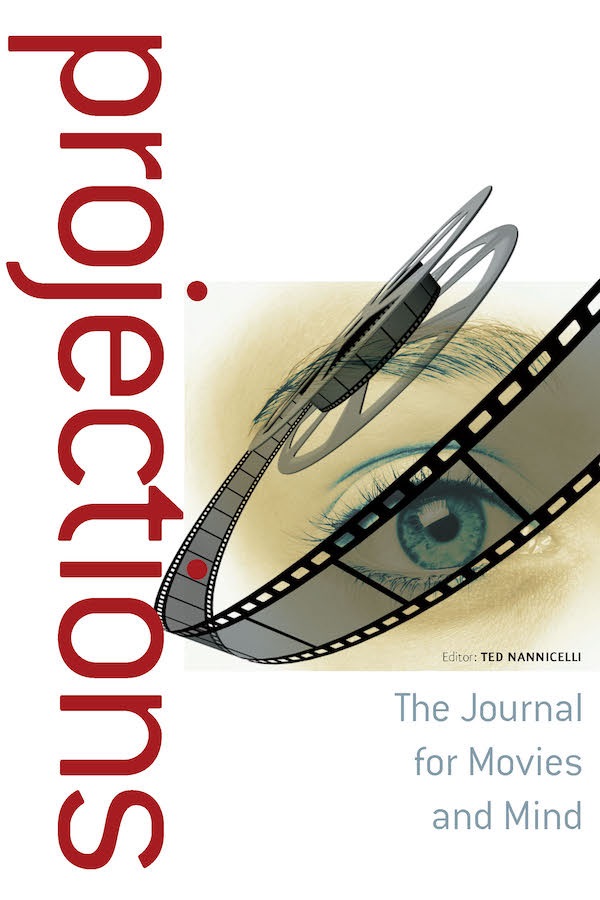
One major recent tribute is the latest issue of Projections, the journal of the Society for the Cognitive Study of the Moving Image [2]. David helped found this organization, which is still thriving. He attended the annual conferences as long as he was able to. The March, 2026 issue explores the various aspects of David’s devotion to this particular approach to cinema studies.
He has contributed to this blog before, sharing his expertise concerning the James Bond franchise [4]. Now he has kindly written a review-article on the Projections essay.
His duty was to the question.
—Guillermo del Toro, in Leonardo Da Vinci (Burns, Burns, and McMahon, 2024)
 [5]
[5]
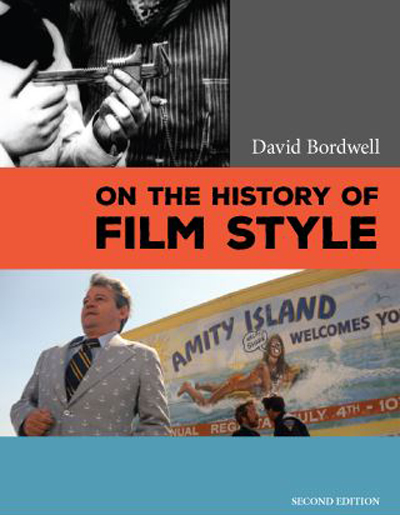
David Bordwell’s On the History of Film Style [6] (1997, revised 2018) opens with a floating string of tantalizing examples from film history, lavishly illustrated with frame enlargements and loosely linked via the themes of cinematic staging and editing. The examples at last touch down with an oomph:
Can we pick out plausible patterns of change running from our earliest image to our most recent one? Are there overall principles governing these differences? Disclosing such patterns and principles only sharpens our appetite. How and why did these changes take place? […] How, that is, can we explain the change we discern? We are asking the cinematic counterpart of the question that opens E. H. Gombrich’s Art and Illusion: Why does art have a history? (pp. 2-3, emphasis in original)
It’s no small query. It’s weighty and difficult to answer. And that’s the point. Research should be a carefully calibrated, flexible, and ambitious form of investigation.
Like many artists and scholars we might admire—I, too, would mention Gombrich, of whom Partha Mitter wrote, in the volume Art and the Mind—Ernst H. Gombrich [7] (2018), “his questioning methodology will be his enduring legacy”(p. 329)—Bordwell’s duty truly was to the question. I mean this in both literal and robust senses, senses I should explain before reviewing the recent issue of Projections: The Journal of Movies and Mind devoted to Bordwell’s contributions to the study of film. [8]
Bordwell had many radical ideas. He argued that movies matter to the humanities, and that movie history matters, too [9]. More than this, he argued that cinema’s development as an art, technology, and institution is best seen through the lens of historical poetics [10] and that our everyday understanding of movies is best explained by the findings of cognitive psychology, not psychoanalysis.
Yet more radical, and less understood, was his belief that the true test of a humanist’s work is whether it poses a question—and proposes answers that improve upon our previous knowledge. By question Bordwell didn’t mean simple coverage of a theme or topic. Many of us write passionately and intelligently about things that interest us or our fields. But even passionate and intelligent writing can be redundant. It repeats what we already know or even ignores what we’ve discovered through painstaking effort. A questioning methodology is more ambitious and more exciting. It’s driven by truly open-ended inquiry that sets about filling important gaps in understanding. The researcher does not know the answer to the question from the get-go—because no one has yet to chart the terrain.
Perhaps some of this will sound rather A-B-C, but in my experience, commitment to genuine discovery is rare in the humanities. It requires a strategic form of self-discipline that isn’t often taught. Focused, question-based research means controlling for one’s preferences—in a specific way. If even one prefers an idea, method, or example—for its cultural importance, internal brilliance, laudable worldview, or timeliness—it may not fill important gaps.
Controlling for preference, and thereby fine-tuning our awareness of such gaps, can act as fundamental assumptions in a research program. Here things are theoretically loaded. “Film studies is an empirical discipline,” Bordwell provocatively writes in the 2018 Afterword of On the History of Film Style (p. 272). His research embraced the values of investigatory science broadly conceived, in particular the notions that a researcher’s level of certainty about a phenomenon should scale with the evidence adduced, and that the results of research shouldn’t be steered, conditioned, or tampered with to reflect a pet theory or worldview. Likewise, methods or examples shouldn’t be selected selectively to avoid unwanted or unanticipated counter evidence.
 [11]
[11]
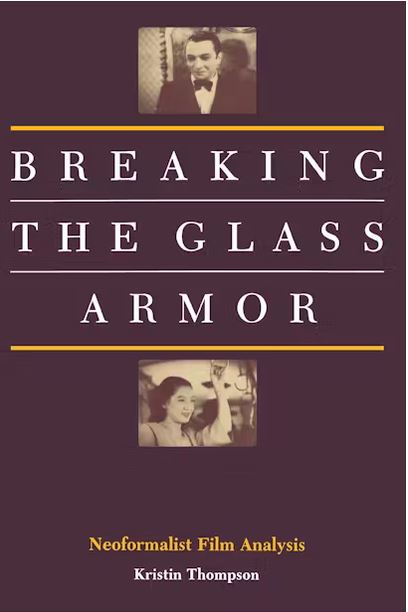
Other assumptions we on-board should promote a genuine need for further investigation. As Kristin Thompson puts it in Breaking the Glass Armor (1988), poetics includes assumptions “about traits shared by different artworks, about procedures spectators go through in understanding artworks, and about ways in which artworks relate to society” (p. 3). These kinds of assumptions make us inquisitive. The adventure of fine-tuning assumptions is the adventure of heightening our curiosity for the unknown—of “sharpening our appetite,” as Bordwell put it.
* * *
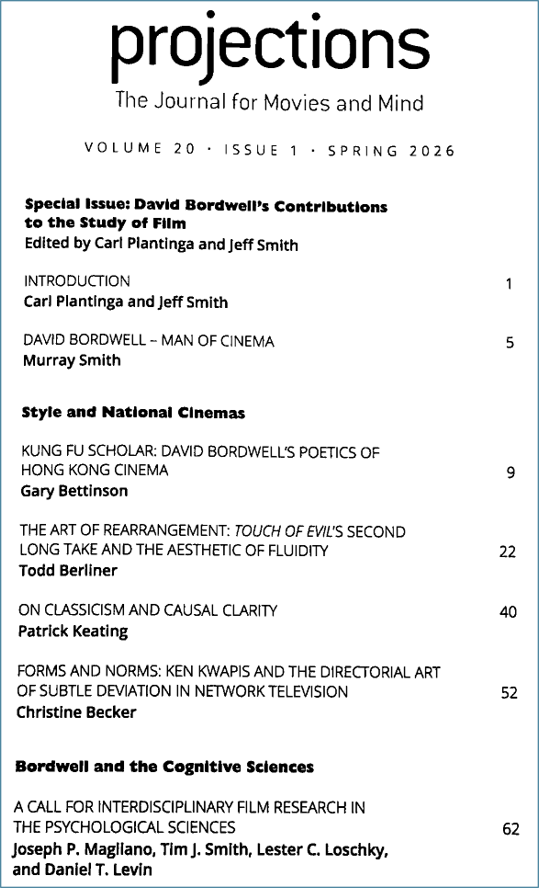
Bear this in mind when reading the issue of Projections dedicated to Bordwell’s contributions to film study. My takeaway from these impressive essays, written by members of the Society for the Cognitive Study of Moving Images (SCSMI) [2], is this. Each addresses fundamental assumptions and questions underpinning Bordwell’s research. In doing so, the authors get at something more. They implicitly highlight two sides of Bordwell’s questioning approach, his pluralism—the more questions we pursue, the richer the field—and his heurism—our methods matter to the extent that they promote and answer questions. Admittedly the second aspect isn’t as widely appreciated as the first.
 [12]
[12]
 [13]
[13]
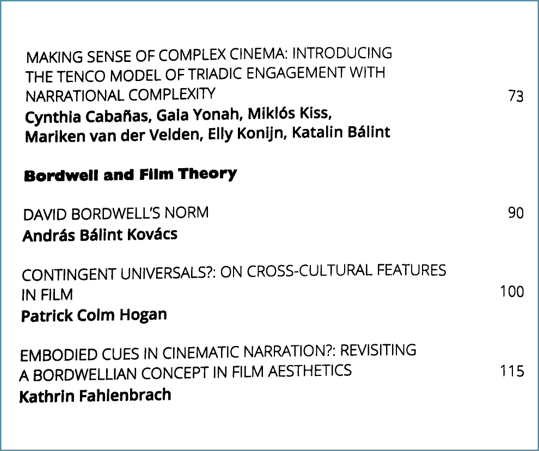
The issue’s introduction, [14] by Carl Plantinga and Jeff Smith, and Murray Smith’s short commemorative essay, “David Bordwell—A Man of Cinema,” [15] set up these themes nicely. “He favored research that posed specific questions for which evidence and observation could establish concrete answers,” Plantinga and Smith write: “Bordwell also hoped that his work could assist studies of those topics he did not much address. And it has” (p. 1). Murray Smith amplifies the point. Bordwell, he explains, created “the space for the more rigorous, but also more pluralistic and more imaginative, intellectual community to which Projections, and its sponsoring academic society SCSMI, bears witness” (p. 5).
The issue carves up Bordwell’s contributions into three categories, “Style and National Cinemas,” “Cognitive Sciences,” and “Film Theory.” In each case, Bordwell cleared new ground, at times in the teeth of opposition from those who in practice restricted the range of questions the field could pose.
 [16]
[16]
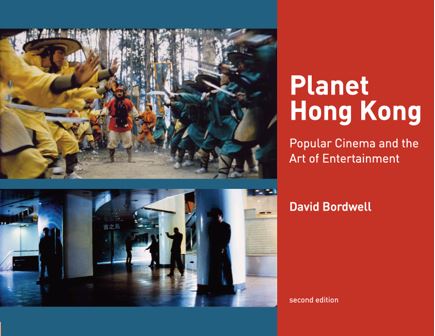
This opposition is addressed most directly in Gary Bettinson’s “Kung Fu Scholar.” [17] Bettinson picks apart criticisms of Bordwell’s research on East Asian cinemas, especially Planet Hong Kong: Popular Cinema and the Art of Entertainment [18] (2000, revised 2011). For some critics, the book “commits a form of cultural imperialism, subjecting an alien film industry to the Western gaze” (p. 12). Bordwell has likewise been accused of “universalism” (p. 12). Critics, as I read them, assumed that because Bordwell relied on a poetics of cinema which he developed in studying Hollywood and other Western cinemas, the results of his research on Hong Kong were determined entirely by the approach. Thus the research is biased.
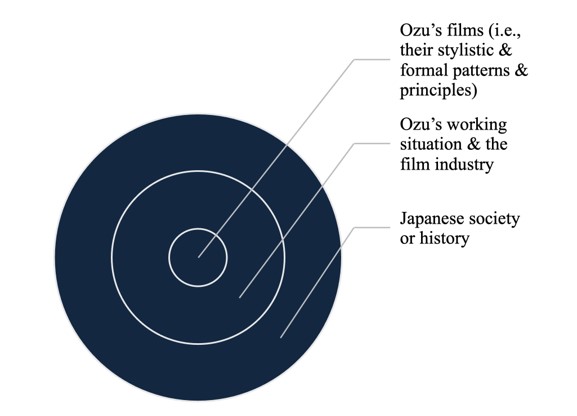
As Bettinson points out, these criticisms are threadbare. Critics simply asserted them with little evidence. The basic tactic, I’d add, is one of ignoring Bordwell’s research questions. Take his 1988 book Ozu and the Poetics of Cinema [19]. The guiding query is something like, if we take the filmmaker’s creative choices as the bullseye of our study, what can we reveal about relationship between films and their social contexts? The question crystallizes as a model, one of concentric circles (p. 17).
 [20]
[20]
The model isn’t a theory in the sense that some might assume. Its function is not to present a set of systematic, abstract principles which in themselves explain culture or cinema (or even this culture or this cinema). To criticize it as such is to miss the point. Its function is heuristic. It’s a rule of thumb to research by. The first test of such a rule is its relevancy and efficacy in achieving a task. Does it produce insights about a specific corpus of films (i.e., Ozu’s) and their formal and stylistic features?
Now, heuristics that generate knowledge could nonetheless be hampered by bias. What do we do in such cases?
If like Bordwell our duty remains to the question, then the burden isn’t simply to label the approach Western or universalist and move on. It’s to present a case for rephrasing the question—to eliminate the bias while retaining some of the inquiry’s thrust—or to develop approaches or models attuned to the bias that are better suited to answering the question.
In short, in the realm of historical inquiry, criticism shouldn’t just come from the sidelines. Critics need to step onto the field of play if they want to improve the game. Let’s assume for the sake of argument that Planet Hong Kong does have some research biases. To step onto the field, other researchers would need to answer its question more effectively than does Bordwell (perhaps by using new information from archives or rediscovered films, or by accessing cultural knowledge that unlocks a distinct set of explanations, etc.). Or they would need to apply a different set of assumptions to a similar question and see it through to an answer, thereby rendering Bordwell’s findings about the same area of culture or aspect of cinematic form or style incomplete, insufficient, or obsolete.
This is the kind of critical process that expands knowledge. But it hasn’t always happened, and Bordwell could seem slightly disquieted about that. As he points out somewhat wearily in the preface to Planet Hong Kong’s second edition, recent (viz., pre-2011) Hong Kong film scholars “have not asked quite the same sorts of questions that preoccupy me” (p. vii). Indeed, they didn’t seem to be posing open-ended questions at all. Following a hermeneutic rather than an investigatory protocol, these scholars “concentrated on assigning implicit or symptomatic meanings to the movies” (p. vii).
* * *
Because many humanists appear unaccustomed to questioning investigation, Bordwell has rarely received criticisms of a question-related sort. Critics like to remain on the sidelines, poking holes in the rules of play and ignoring how these same rules can unleash generative and athletic performance on the field. (Generative and athletic—great terms for describing the research practices of our most useful poeticians.)
 [21]
[21]
As the Projections issue makes clear, the question-focused inquiry Bordwell had in mind has had a positive effect on numerous subfields. In the study of style, it has encouraged many to reexamine what we think we know about familiar films and film traditions and to open fresh avenues of inquiry in media yet to be understood on formal and stylistic grounds.
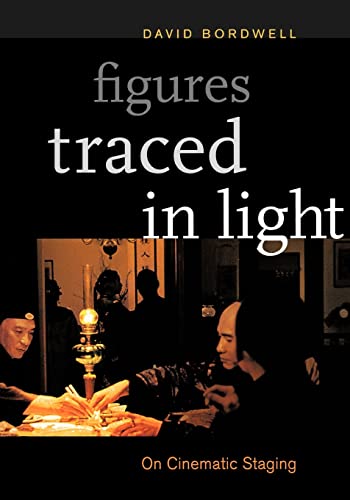
In his “The Art of Rearrangement [22],” Todd Berliner revisits the seemingly perennial question of long takes and their effects in A Touch of Evil (1958). In particular, he tackles the second “inconspicuous” long take to make some fresh insights about the role shot duration can plays in the viewing experience. Berliner adopts Bordwell’s concept of the function of style (as discussed in 2005’s Figures Traced in Light: On Cinematic Staging [23], pp. 33-34) and, just as one ought to do with heuristics, stretches it a little to adjust to the question at hand.
Berliner discusses the aesthetic function, that is, the broad experiential effect a stylistic choice can have on the viewer, like engagement, immersion, or disruption (p. 24). In the end, inconspicuous long takes alert us to a faulty assumption in the critical literature. Long takes don’t always rise in the viewer’s consciousness as impressive displays of stylistic virtuosity. They can gently ease the viewer through low-key patterns of organic change—almost imperceptible transitions in camera positions, slightly rearrangements of figures, and the like. Berliner calls these captivating but subtle effect “murmurations” (p. 37). (For a study of similar “transparent” uses of longer takes and staging, see Bordwell’s blog on patterns of balancing, unbalancing, and rebalancing [24] in the cinema of Louis Feuillade.)
Patrick Keating’s “On Classicism and Causal Clarity [25]” outlines how Bordwell himself tended to ease his heuristics in new directions. The contours of a concept, in this case that of a classical style in Hollywood, always depended on its role in answering questions. As Keating reveals, in earlier work like Narration in the Fiction Film (1985) Bordwell attempted to isolate the fundamentals of film comprehension. The back cover reads, “How do motion pictures tease us into building what we call stories?” The very question led to a search for the baseline. “Classical narration,” especially in Hollywood, used the medium—including visual and sound style—to channel our attention in clear and simple ways to the causal chain of events that comprised the plot. Once that question was answered, Keating shows, Bordwell added more meat to the bone, reframing this narrational form as a richer classical style capable of much more, including innovation.
 [26]
[26]
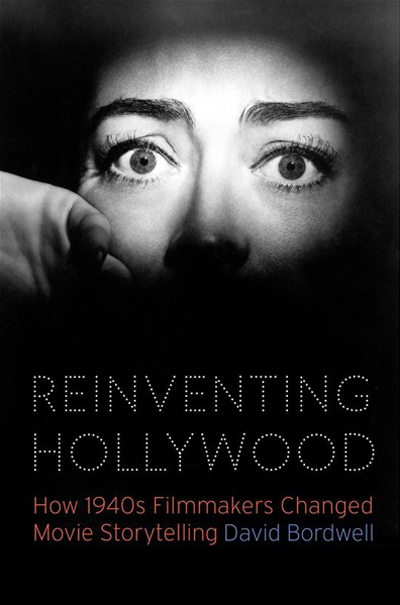
In books like The Way Hollywood Tells It: Style and Story in Modern Hollywood [27] (2006) and Reinventing Hollywood: How 1940s Filmmakers Changed Movie Storytelling [28] (2017), Bordwell studied classicism as a range of “narrative dynamics,” “a system of manipulating expectations and emotions” (p. 41). Crucially, the widening of the heuristic encouraged greater investigatory nimbleness. Keating writes that Reinventing Hollywood, for instance, has inspired him, in his own work [29], to explore “how the classical Hollywood style could be lavish, odd, and expressive” (p. 48). Heurism entails enlarging the scope of an original rule of thumb to accommodate new lines of inquiry.
Styles are worth studying even if they aren’t experimental, lavish, and odd—or indeed held in high esteem. As Henry Jenkins puts it in a 1995 essay entitled “Historical Poetics” (published here [30]), the approach aims to “denaturalize established cultural hierarchies” (p. 108)—to get us beyond the study of masterworks and cherished prototypes and explore the art of everyday production. In her Projections essay “Forms and Norms: Ken Kwapis and the Directorial Art of Subtle Deviation in Network Television [31],” Christine Becker does just that as she sets out to explain how television directors like Ken Kwapsis, in shows like Freaks and Geeks (1999-2000), “can achieve artistic distinction, if not from radical innovation, then through subtle augmentation of established forms” (p. 53). In surveying archival records, interviews, published writings, industry practices, visual style, and storytelling form, Becker’s essay is perhaps the fullest example of historical poetics in the Projections issue, illustrating among other things the paradigm’s largely untapped transdisciplinary potential for the study of other media and the forms they share (a point which I’ve made here [32]).
Surveying various aspects of culture, industry, and craft is precisely the point of Bordwell’s research paradigm, as András Bálint Kovács demonstrates in his Projections contribution, “David Bordwell’s Norm [33].” In the 2018 Afterword to On the History of Film Style, Bordwell describes norms as
those principles of acceptable filmmaking operating in particular times and places. Tacit norms define the salient problems and the favored solutions, the standard schemas and the permissible revisions and the out-of-bounds rejections. I think that reconstructing the norms governing filmmaking practice is of paramount importance in understanding style. (p. 286)
Bordwell, in fact, fits norms into a cluster of heuristics for constructing a history of style and form. Standard ways of doing things in an industry (schemas) feed artistic problems (“forced options” within the “logic of the situation” of filmmaking) (p. 284). The schemas and solutions in turn make visible the underlying norms at work at any given moment. More pithily, “schemas help solve problems. Both solutions and schemas help instantiate norms” (p. 286).
Kovács situates Bordwell’s norms within an even larger configuration of poetics research in which style and form “are measured in the dimensions of (1) a given norm, (2) available technical apparatus, (3) a work’s idiosyncratic stylistic system, (4) cultural traditions, and (5) viewer psychology understood as a combination of biological givens and general social experience” (p. 98). Kovács sees Bordwell’s sophisticated film historiography as belonging to a long line of art historiography, exemplified by the work of E. H. Gombrich. This alternative rejected previous art-historical paradigms in which “the active agent becomes ‘history,’ the ‘zeitgeist,’ ‘kunstwollen,’ ‘the essence of the medium,’ rather than the artist” (p. 99).
Kovács’s account brings to mind an excellent series of articles by Radomír Kokeš tracing the origins of Bordwell’s concept of norms (the articles are available here [34] and here [35]). In the first article, Kokeš uncovers the emergence of norms as an explanatory tool in Czech literary structuralism and Bordwell’s almost immediate transformation of Jan Mukařovský “norms” into an “an empirical research tool” that drained the concept of its theoretical underpinnings so it could function as a flexible heuristic subject to a series of “rhetorical refinements” (pp. 49-52).
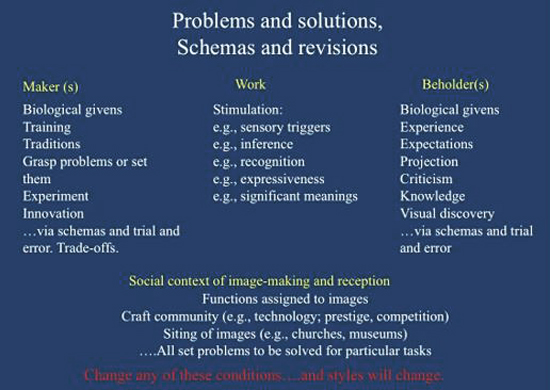
The Kovács essay also reminds me of a lecture Bordwell gave at my university in 2018, where he discussed Gombrich’s concept of artistic change—which, as I understand it, Bordwell had considered writing up as a short book. Evidently Gombrich became for Bordwell a means for working through some fairly intricate ideas about why art has a history. Yes, individuals are the agents. But social conditions shape developments as well. Here’s a slide from Bordwell’s 2018 presentation, which has never been published:
 [36]
[36]
The difficult-to-see sentence at the bottom, in red, is the payoff. It reads, “Change any of these conditions… and styles will change.”
* * *
Bordwell liked to point out [37] that film style and form can change through a principle of schema and revision. Film techniques follow patterns of adoption and alteration. The same applies to knowledge itself. We see this in the sections of Projections on “Cognitive Sciences” and “Film Theory.” Cognitivist researchers have taken up Bordwell’s research schemas and tweaked them to open more lanes on the highway of film inquiry.
More explicitly than any other essay, “A Call for Interdisciplinary Research in the Psychological Sciences [38],” by Joseph P. Magliano, Tim J. Smith, Lester C. Loschky, and Daniel T. Levin, urges a partnership among disciplines. The authors have noticed a trend. Films are now being used as surrogates for everyday experience in psychological studies. Researchers show subjects a short film and test for response—not to the film as a film but to film as “a proxy for real-world scenes” (p. 63).
The essay’s intervention is clear. To urge psychological scientists to learn, from both film studies more broadly and fascinating developments in cognitive film studies more specifically. Learn what, exactly? A single idea, one that’s easily expressed but challenging to study. Films are not the world. They are “constructed artifacts; the stylistic practices used in creative fiction film have non-trivial effects on visual processes (attention and perception), neurological responses, and comprehension” (p. 63).
Magliano, Smith, Loschky, and Levin deftly sketch how cognitive film researchers have read Narration in the Fiction Film—and its emphasis on constructivist psychology (p. 30-31)—as seeds for further experimental investigation. Bordwell’s findings have become hypotheses subjected to testing, in other words. This is the case not because his modes of inquiry are humanistic and thus limited, but because his answers suggest new questions, even new forms of inquiry.
 [39]
[39]
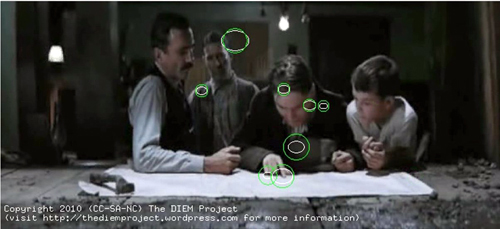
For instance, Tim Smith wondered whether Bordwell’s conclusions about how film directors encourage viewers to scan the space of a shot [40] could be experimentally tracked. But he didn’t stop there. Smith wanted to know whether tracking could yield different answers. The resulting study of viewer eye movements during a sequence from P. T. Anderson’s There Will Be Blood (2007) [41] refines both our language for describing the psychology of viewing and our appreciation of Anderson’s strategies for directing attention in a shot. A research schema—directors use technique to guide attention—is picked up and revised to incrementally add to our understanding.
 [42]
[42]
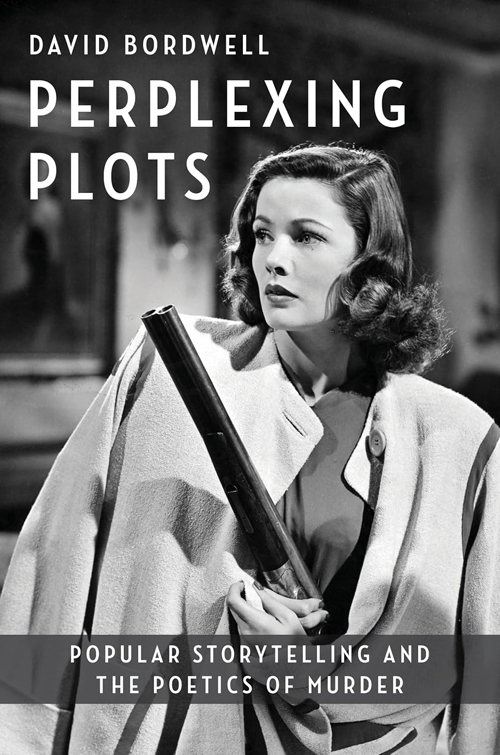
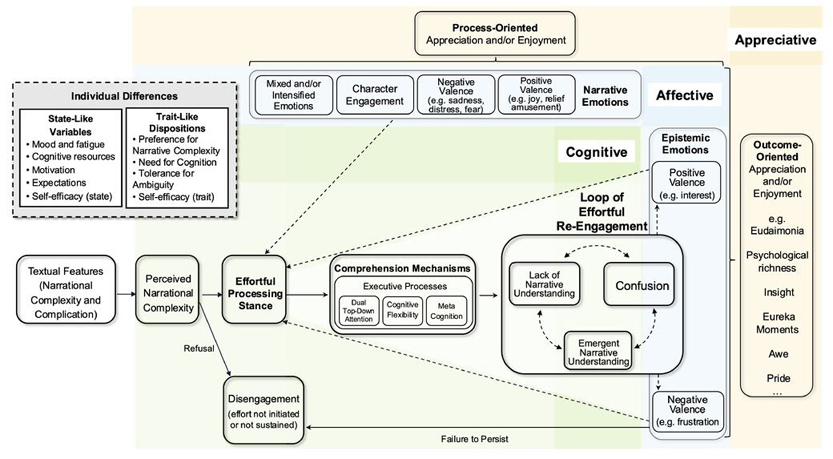
Similarly, in their Projections piece “Making Sense of Complex Cinema [43],” Cynthia Cabañas, Gaia Yonah, Miklós Kiss, Mariken van der Velden, Elly Konijn, and Katalin Bálint take Bordwell’s ideas about narrative form and its complexity in books like Perplexing Plots: Popular Storytelling and the Poetics of Murder [44] (2023) as the grounds for experimental study into the actual experience of complexity. They challenge Bordwell’s claim that contemporary forms of popular film complexity still essentially feel the same as classical Hollywood. Recent innovations in narrative complexity, for Bordwell, still rely on “tactics of accessibility” in their storytelling (cited in Cabañas, Yonah, Kiss, van der Velden, Konijn, and Bálint, p. 74).
If I have one criticism for the authors, it’s that they assume that Bordwell was interested in the study of actual viewers—i.e., in reception. This is a common enough mistake. But he wasn’t a psychologist. He was a poetician. The authors write, “Rather than viewing narrational complexity as a mere extension of classical norms, we propose that the experience it elicits is qualitatively different, requiring a theoretical model that accounts for this uniqueness, as well as how and why viewers engage with complex storytelling” (p. 74, emphasis in source). This is a worthy pursuit, but poeticians tend to look for something substantively different. Their primary focus is on a hypothetical viewing practice constructed in large part by the film (see Narration in the Fiction Film, p. 39, and Breaking the Glass Armor, p. 29). One posits such a heuristic to gain insight into how movies work by design. What real viewers feel may or may not be pertinent to the question.
Still, Cabañas, Yonah, Kiss, van der Velden, Konijn, and Bálint are onto something really exciting. It’s one of the master questions in film studies: what is the experience of cinema like? Can we describe it, even while factoring in the neuronal weather patterns (my term) that comprise the minds of individual viewers?
With Narration in the Fiction Film, Bordwell focused on one layer of cinematic experience, viewer comprehension. Keating’s Projections essay reveals that Bordwell eventually considered broader dynamics of the experience, like emotion. The authors here propose something more ambitious still, a model called the TENCo (Triadic Engagement with Narrational Complexity). It characterizes the full, rounded experience of complex movies—what they actually feel like.
 [45]
[45]
The authors conclude that “TENCo clarifies distinctions between perceived complexity (viewer experience), narrational complexity (formal disruptions), and narrational complication (informational density)” (p. 84). One wonders whether these insights can be brought back onto the poetics field of play. If for example we applied TENCo to a study of formal and stylistic choices in large corpus of films over time, it may assist with some very fine distinctions between film techniques that complexify (or disrupt) and film techniques that complicate (or densify) the viewing experience—and the various creative problems and solutions filmmakers have devised for both throughout film history.
I found the Projections contribution by Kathrin Fahlenbrach, entitled “Embodied Cues in Cinematic Narration? Revisiting a Bordwellian Concept in Film Aesthetics [46],” among the issue’s most rewarding. Like Keating’s piece, it charts the development of one of Bordwell’s heuristics. And like Cabañas, Yonah, Kiss, van der Velden, Konijn, and Bálint, Fahlenbrach addresses how research has shifted to questions about a complete psychological picture of film viewing. Yet here, findings are tied directly to the questions of film poetics.
Poetics’ concern for hypothetical viewing comes more fully to light here: “A prominent misunderstanding of his critics has always been that this argument implies a generalization about spectators’ actual understanding” (p. 116). Fahlenbrach then maps how, in the wake of Narration in the Fiction Film, cognitive researchers have turned to emotion psychology and “more biologically anchored affective aspects of moving images” (p. 117). Bordwell’s criticisms of some of this work, as Fahlenbrach correctly states, was from a poetics perspective. Bordwell continued “searching for cinematic patterns in filmic styles and the way they were informing our comprehension of movies” (p. 118).
 [47]
[47]
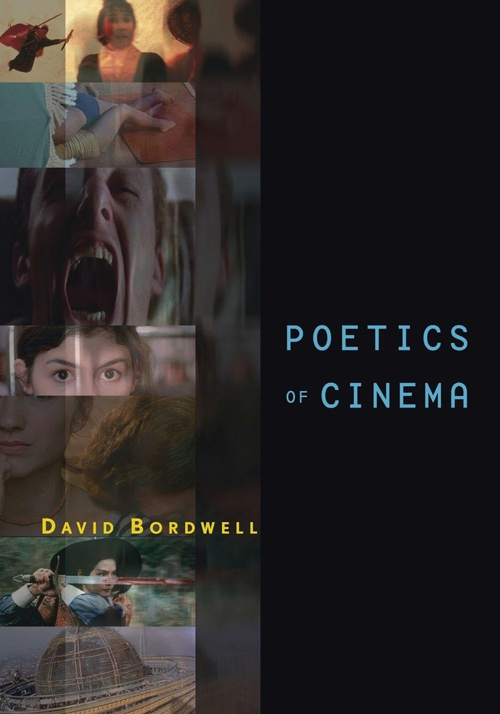
Yet as Bordwell’s questions about comprehension evolved, so too did his accompanying heuristic, the concept of the cue. This is especially the case in Poetics of Cinema (2008). In 1985’s Narration in the Fiction Film, Fahlenbrach argues, cues consisted of “sensorial data” which were not only “insufficient for comprehending more complex meanings; they are even insufficient for building perceptual meanings on the bottom-up-level” (p. 118). The question of Narration in the Fiction Film after all emphasizes—in Bordwell’s words now—
…how the spectator thinks. To make sense of a narrative film, however, the viewer must do more than perceive movement, construe images and sounds as presenting a three-dimensional world, and understand oral or written language. They must take as a central cognitive goal the construction of a more or less intelligible story. But what makes something a story? And what make a story intelligible? (p. 33, emphasis in source)
The state of the question at that point was about viewers making sense of stories—i.e., the process of narration. It wasn’t primarily focused on film style (i.e., techniques that shape sensory perceptions). Once Bordwell enlarged the scope of his inquiry to include a broader range of styles—in Poetics of Cinema, for instance—his heuristic understanding of cues and the questions the concept can shape enlarged as well: “Instead of just triggering cognitive inferences as incomplete data, he now argues that the online perception of cinematic cues actively feeds into cognitive comprehension and even into the (cultural) appropriation of moving images: ‘Sensory input drives perceptual processing; perceptual processing feeds into comprehension and appropriation, in the bottom-up direction’” (p. 120). Again, Bordwell adapts his tools to the needs of the question.
Fahlenbrach astutely reveals how the stylistic concept of cues—which broadens the original narrational concept of cues—might lead to some fine-grained research into culture: “Stylistic cues, then, can be so powerful in channeling our full experience and understanding of movies, because they trigger both sensorial reflexes and (film-)culturally appropriated associations and meanings” (p. 122). Her work, available in a volume she edited [48], has shown that visual and sound cues directly on-board fundamental cultural metaphors, some of which are so widespread that they might be classified as contingent universals, an idea to which I now turn as I wrap up this review.
* * *
Bordwell described his heuristic tools as instances of mid-range thinking—not too close to one’s objects of study as to avoid generalization, but not so distant from them either as to lose a sense of their fine-grained qualities. “We should forge mid-range concepts that are flexible and delicate tools for describing, analyzing, and explaining things about cinema,” he writes in the 2018 Afterword to On the History of Film Style:
These concepts aren’t typically general, deductively secured theories about such matters. We need concepts that are provisional, flexible tools that allow one to pose research questions and examine evidence that can answer them. The concepts are open to correction and rejection after encounters with bodies of evidence. A pretty theory can be killed by a counterexample. Many are. What’s empirical is what’s corrigible in the light of further information. (p. 272)
One of his most discussed mid-range concepts—contingent universals (also examined here [49])—is taken up in Projections by Patrick Colm Hogan. Hogan’s essay, “Contingent Universals? On Cross-Cultural Features in Film [50],” is conceptually rich, endeavoring to thicken Bordwell’s heuristic into a full-blow theory in need of scrutiny for its direct explanatory potential.
Hogan, to my eyes, indulges in a thought-experiment. What if we scrutinize Bordwell’s concepts as high-end rather than mid-range? Hogan strategically recasts Bordwell’s contingent universals through the lens of linguistics.
In simple terms, a contingent universal in historical poetics isn’t really, truly universal, i.e., something to be found in every film, in the experience of every viewer, or in every corner of global film culture for all time. It’s simply widespread across film industries and cultures—so conspicuously widespread that it needs a special kind of explanation that straddles nature and nurture, benefiting from a combination of historical and biological insight.
Bordwell presents contingent universals as an aspect of the cultural history of cinema [51]. Hogan posits a higher-end concept that’s ultimately biological and thus more clearly delineated, even fully explanatory:
In linguistics, universals are properties or relations—or, more generally, principles—that are instantiated in a significantly greater number of languages than would be predicted by random processes alone, with “significance” having its usual, statistical sense. A universal that occurs in all languages is an “absolute” universal, whereas a universal that occurs in fewer is a “statistical” universal. […] The presumption of calling these non-absolute principles “universals” is that they will ultimately be explained by absolute universals. (pp. 100-101)
When would poeticians need such a powerful tool? Hogan confesses that Bordwell’s research never really establishes such a need. He doesn’t describe “any properties that satisfy the standard [viz., linguistic] criteria for universality” (p. 104).
For Hogan, the strongest candidate for a cinematic universal in the linguistic sense is hierarchy constituent structure (p. 105). When we speak a language, listen to a piece of music, and endeavor to comprehend a narrative, including in film, our brains click in “neurocognitive mechanisms to build structure,” in the words of Neil Cohn, Ray Jackendoff, Phillip Holcomb, and Gina Kuperberg [52]. Why is this aspect of cinema universal? Because it stems from the very way the brain works, not just with respect to cinema but in a range of shared and culturally specific (and isolated) circumstances. The challenge with cinematic universals, Hogan reveals, is that, by virtue of cinema’s spread via “European colonialism,” researchers will never be able to isolate developments in film, film culture, or film viewership that avoid influence from a “common origin”—a crucial test of true universality (p. 105, 113).
* * *
In this post, I’ve proposed one way—I think an especially important way—to read and critique Bordwell’s work. It’s erotetic. It pursues questions. To really appreciate his achievements, we must keep his questioning methodology in mind. He posed queries, proposed heuristics for answering them, revised these heuristics to shift the terms of his research or produce different results, and passed these tools on to others—others who have since revised them and fashioned new queries. His dogma, to the extent that he had one, was one of relentless questioning. The process of discovery itself needed to be preserved—preserved in an explicitly investigatory posture.
 [53]
[53]
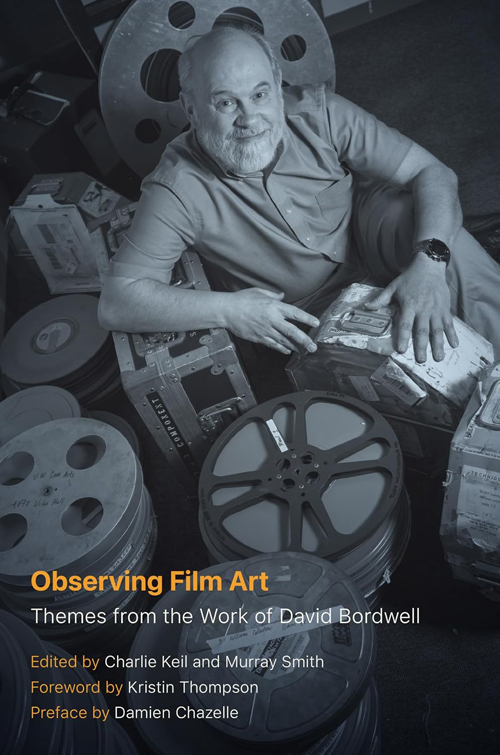
In an upcoming post, I hope to review another major publication on Bordwell’s work, Observing Film Art: Themes from the Work of David Bordwell [54], edited by Charlie Keil and Murray Smith and due out from Rutgers University Press in December 2026. There, I will explore not just Bordwell’s questions but his many answers. What did Bordwell add to our understanding of film and film history?