





Archive for the 'Actors: Hart' Category
What next? A video lecture, I suppose. Well, actually, yeah….
DB here:
We’ve said several times that this website is an ongoing experiment. We started just by posting my CV and essays supplementing my books. Then came blogs. We quickly added illustrations to our entries, mostly frame enlargements and grabs. Eventually, video crept in. In 2011 we ran Tim Smith’s dissection of eye-scanning in There Will Be Blood. Last year, in coordination with our new edition of Film Art: An Introduction, we added online clips-plus-commentary (an example is on Criterion’s YouTube channel), and near the end of the year Erik Gunneson and I mounted a video essay on techniques of constructive editing.
Today something new has been added. I’ve decided to retire some of the lectures I take on the road, and I’ll put them up as video lectures. They’re sort of Net substitutes for my show-and-tells about aspects of film that interest me. The first is called “How Motion Pictures Became the Movies,” and it’s devoted to what is for me the crucial period 1908-1920. It quickly surveys what was going on in cinema over those years before zeroing in on the key stylistic developments we’ve often written about here: the emergence of continuity editing and the brief but brilliant exploration of tableau staging.
The lecture isn’t a record of me pacing around talking. Rather, it’s a PowerPoint presentation that runs as a video, with my scratchy voice-over. I didn’t write a text, but rather talked it through as if I were presenting it live. It nakedly exposes my mannerisms and bad habits, but I hope they don’t get in the way of your enjoyment.
“How Motion Pictures Became the Movies” is designed for general audiences. I’ve built in comments for specialists too, in particular, some indications of different research approaches to understanding this period of change.
The talk runs just under 70 minutes, and it’s suitable for use in classes if people are inclined. I think it might be helpful in surveys of film history, courses on silent cinema, and courses on film analysis. If a teacher wants to break it into two parts, there’s a natural stopping point around the 35-minute mark.
Some slides have several images laid out comic-strip fashion, so the presentation plays best on a midsize display, like a desktop or biggish laptop. A couple of tests suggest that it looks okay projected for a group, but the instructor planning to screen it for a class should experiment first.
I plan to put up other lectures in a similar format, with HD capabilities. Next up is probably a talk about the aesthetics of early CinemaScope. I’d then like to spin off this current one and offer three 30-minute ones that go into more depth on developments in the 1910s.
The video is available at the bottom of this entry, but it’s also available on this page. There I provide a bibliography of the sources I mention in the course of the talk, as well as links to relevant blogs and essays elsewhere on the site.
If you find this interesting or worthwhile, please let your friends know about it. I don’t do Twitter or Facebook, but Kristin participates in the latter, and we can monitor tweets. Thanks to Erik for his dedication to this most recent task, and to all our readers for their support over the years.
Looking different today?
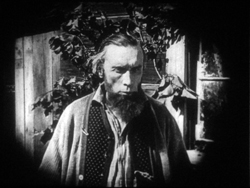
Johan (1921).
DB here:
Earlier this month Manohla Dargis wrote a New York Times article on how we watch, or should watch, films that some audiences consider slow and boring. She suggested that appreciating such films requires us to cultivate fresh ways of seeing. Her article and my interests coincide on this matter, so I wrote an entry developing some ideas about viewing strategies and skills. This piece also, happily, brought new readers to Tim Smith’s experiment in tracking viewers’ scanning of a scene in There Will Be Blood.
Today I explore another angle on the problem of how to watch movies that aren’t the normal fare. But this time what’s abnormal for us was once normal for everybody. I look at the pictorial possibilities that emerged in the 1910s. Those possibilities are of interest if we want to fully understand film history, but they offer some mysteries as well. If viewing movies involves skills, did people a century ago have the ones we have? Or did they employ different viewing habits, ones that we have to learn?
Editing, your imaginary friend
I write from my annual research trip to the Royal Film Archive of Belgium, now known as the Cinematek. For some years, I’ve been looking into feature filmmaking of the 1910s. On every visit I’ve found rich material, movies off the beaten path that give me a sense of the immense creativity of that early period. (See the bottom of this post for links.) The official classics of these years, by Chaplin and Griffith and Fairbanks and Bauer and Gance and Sjõström and Feuillade, remain remarkable, and Kristin’s latest entry makes a case that Alberto Capellani belongs among this heroic company. But you can also find extraordinary moments in ordinary movies. Even the most banal film has something to teach me about what choices faced the era’s filmmakers.
One of those teachable elements involves the ways in which directors guide our attention. We know that editing serves to shift our attention from one part of a scene to another, but so does judicious staging. This is one of the great lessons of the cinema of the 1910s. Watching films from that period convinced me that the craftsmanship of Anderson in There Will Be Blood, and of other directors reliant on long-take ensemble staging, has deep roots in filmmaking tradition. But the golden age of cinematic staging was relatively brief, and it was eclipsed by an approach based largely on editing. That approach is, essentially, still with us.
Let’s start by appreciating the technique that became most prominent. By the late 1910s, Hollywood filmmakers had more or less perfected what we’ve come to call the classic continuity editing system. The camera could penetrate the most intimate exchange, breaking it up into intelligible bits. Here, in a minor Metro film called False Evidence (1919), Madelon tries to persuade her father that she, not her boyfriend, is responsible for a crime.
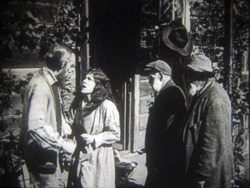
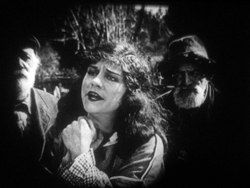
After giving us father and daughter close together in profile, the camera has somehow squirmed in between them, showing each one in a tight 3/4 view. Or rather, the cutting has forced the staging to pull the characters a bit apart so that each one can have a frame to him- or herself. Spatial plausibility gives way to dramatic urgency; what we care about are clear views of their emotional responses. As long as the spatial relations remain clear, they can be just approximately consistent.
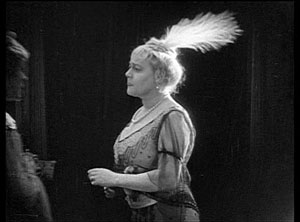
For a little more finesse, we can look–as usual–to Rio Jim. William S. Hart’s films are among the most visually elegant and ambitious of this period, and even his less-known items seldom disappoint. John Petticoats (1919) gives us “Hardwood” John Haynes, a rough-edged logger who finds he has inherited a New Orleans dressmaking shop. His comic introduction to the place, in the company of a new friend he’s made, uses editing to tease us. The two gents come in, with John bewildered by a feminine world he’s never known. They pause before a model sashaying on the stage, and when she pauses, she’s blocked by the Judge’s body.
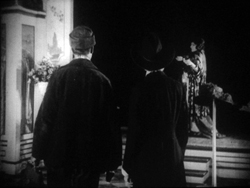
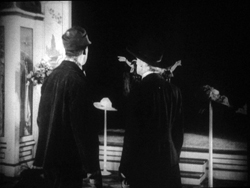
We’re left without the revelation of her appearance, but when her dresser comes forward to peel off her wrap, we cut, in effect, “through” the Judge to get a clear view of the disrobing. The blocked shot teased us, but the cut pays us off.
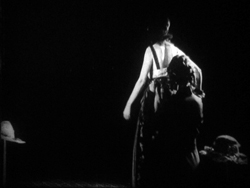
Now that the model bares a lot more than before, the biggest tease begins. How will John react? The answer is given in the next shot, a nearly 180-degree shift from the earlier framing of the men that incorporates a mirror in the background to keep the model onscreen.
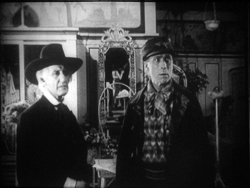
Thanks to a cut, action and reaction are given in the same shot–in fact in the same zone of the frame, the center.
A pass, a pat, a squeeze
Fabiola (1918).
Many European directors were moving in the same direction as Lambert Hillyer in John Petticoats. Although they might not use as many shots or as many different angles as their American counterparts, they were confidently breaking their scenes up into closer views, often through axial cuts that take us straight into or out of the action, along the lens axis.
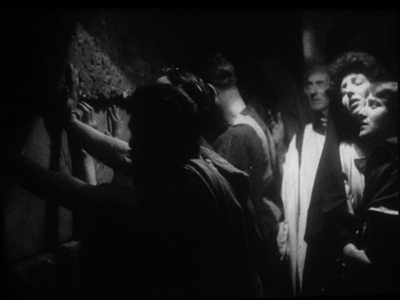
Take Enrico Guazzoni’s Fabiola (1918), henceforth known to me as Fabulosa. Normally I consider the Roman oppression of Christianity one of the least fertile topics for a good movie, but Fabiola proves me wrong. For one thing, the title names a rather unpleasant woman who barely figures in the action until the climax. For another, Guazzoni proves an adept filmmaker. I was struck by those immense sets that distinguish the Italian costume drama, the dazzling lighting (see above), and the skilful editing.
Our introduction to Fabiola comes as she sits disdainfully in her household, attended by servants. After a long shot showing off the set, an axial cut takes us closer to her.
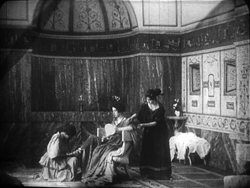
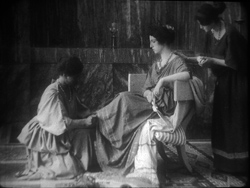
She turns as her tardy servant Sira comes in. Having stretched her elegant neck, Fabiola tips her head forward slightly, in a bob of disdain.
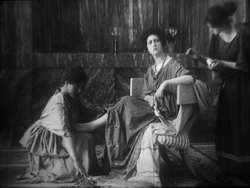
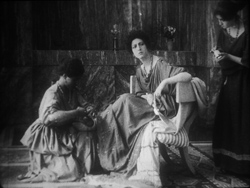
Another axial cut takes us still closer to her. And in a few frames her gesture, at once haughty and angry, is repeated. (The streak across the first image below is the splice, so this is the very first frame of the next shot.)
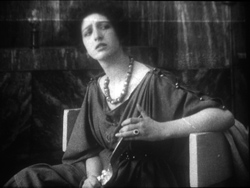
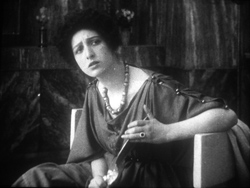
This, I think, is no mistake. The matches on action elsewhere in the film are quite precise, and indeed earlier Italian films have shown that directors used this device skilfully. Guazzoni wanted to stress Fabiola’s head movement, and he used the same tactic, the overlapped action match, that some Americans would use and that many Soviet directors drew on later. This slight accentuation of Fabiola’s gesture is a vivid way to introduce the character, caught in a characteristically scowling moment. Very soon, in a fit of pique she’ll jab Sira with a hatpin.
On the whole, keeping the setups close to the camera axis is the default value in Fabiola. For the Americans, though, cutting made the camera almost ubiquitous. A year after John Petticoats, O’Malley of the Mounted (1920), lets Lambert Hillyer again resort to intelligible shifts of setups. O’Malley, played by Hart, has gone undercover to track a killer. Posing as a robber, he has joined an outlaw gang, but they’ve discovered he’s betrayed them and plan to hang him at sunup. He’s lashed to a tree and guarded by his enemy, the brutal Big Judson. But Rose Lanier, who has drifted along with the gang, is going to help O’Malley escape. The cutting will show us exactly how she does it, and why.
Rose interposes herself between Big and O’Malley, chatting up the thug. A cut of about 180 degrees takes us to the opposite side of the tree and shows her slipping a knife toward O’Malley’s hand. We’re so familiar with this sort of insert that we’re likely to forget that once it was fresh.
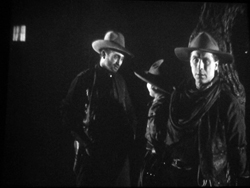
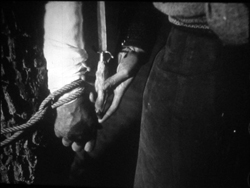
O’Malley starts, then shifts his gaze toward Big.
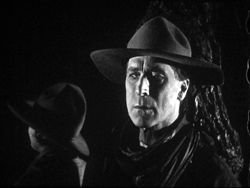
Then comes a simple, remarkable shot. Rose slips the knife to O’Malley. Then she pats his hand. Then she gives it a squeeze.
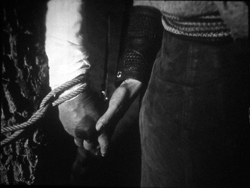
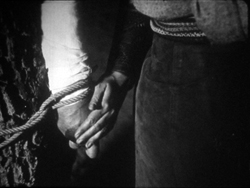
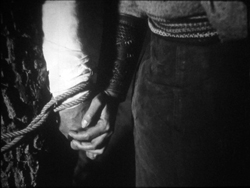
Mystery and charm of the American cinema, as Godard would say: a single cut-in of hands can give us a lot. First there’s the narrative information (I’m passing you the knife), then Rose’s expression of support (Good luck!), capped by a burst of affection (I love you). The whole thing takes less time than I’ve used to tell it. Surely this ability to invest plot-driven detail shots with heartfelt emotion helped American cinema conquer the world. I’m tempted to say that we could sum up of the power of Hollywood, in its laconic prime, with that formula: the pass, the pat, the squeeze.
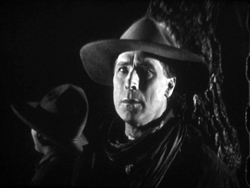
This shot is as compact in its expression as the previous one. It’s impossible to capture here all the emotions that flit across O’Malley’s face: hope of eluding death, realization that Rose loves him, anxiety that surviving will make him choose between love and duty. Rose’s brother is the killer he’s been tracking, and in a perversely honorable way O’Malley had looked forward to being hanged. That would have spared him arresting the boy. Now he must live, enforce the law, and lose the woman who has saved him.
I saw some European films that absorbed such continuity tactics quite deeply. Above all, Mauritz Stiller’s Song of the Scarlet Flower (Sangen om den Eldroda Blomman, 1919) and Johan (1921) relied heavily on analytical editing in the American fashion, including angled shot/ reverse shot. As in Fabiola, some of the discontinuous cuts have their own logic. I wish I had time to explore those Stiller films in more detail–particularly their use of turbulent rivers as dynamic plot elements, not mere landscapes. Maybe in some future entry….
Four-quadrant style
Before they adopted the analytical editing characteristic of American cinema, directors were still able to guide our attention. The so-called “tableau” style, about which I’ve waxed enthusiastic on this site before, became a rich tradition in the 1910s. Editing within the scene is minimized. (Apparently most European directors didn’t consider it a creative option in its own right until later in the decade.) The drama is carried by performance and ensemble staging. Relying on movement, acting, and composition, the director controls where we look and when we look at it
To take a straightforward example, consider the rather ordinary melodrama Le Calvaire de Mignon (Mignon’s Calvary, 1917). The scheming and dissolute Dénis de Kerouan wants to wreak misery on his brother Robert. While Robert is out of the country, Dénis hires a forger to fabricate a letter indicating that Robert has a mistress. Dénis leaves the letter on the desk for Robert’s wife to find.
Dénis has exited through the central entryway, and into the empty study comes Robert’s wife. She discovers the letter.
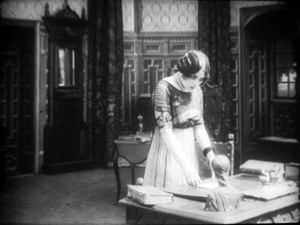
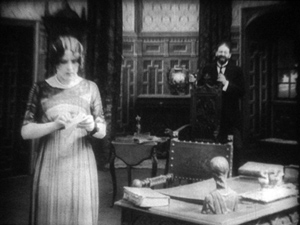
She moves to the left foreground and starts examining it. At this point Dénis’ face peeps out from behind the central curtain. The director makes it easy for us to notice him because nothing else is happening in the set, and Denis’ face is rather close to the wife’s. It’s almost as if he’s looking over her shoulder.
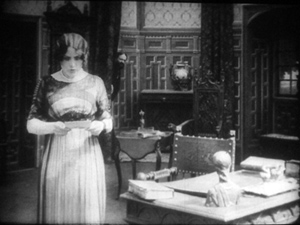
Once we register Dénis’ presence, the director can proceed to balance the shot. All that empty real estate on the right of the frame asks to be filled, and that’s what happens.
When the wife reads the damning letter, she collapses rightward into the chair, just as Dénis rushes forward to take charge of the situation.
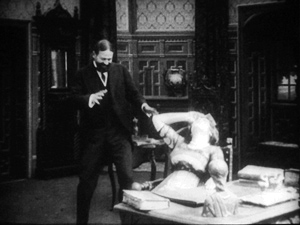
This move exemplifies the staging technique known as the Cross, which motivates the switching of characters’ positions in the frame.
Simple as it is, this portion of the prologue of Le Calvaire de Mignon shows how, without cutting, a director can steer us to one or another zone of the shot through such cues as faces, centering, proximity to points of emphasis, and movement. Something similar happens in one, more striking moment of another fairly unexceptional movie from the period.
Nobody will claim Der Stoltz der Firma (The Boss of the Firm, 1914) is a masterpiece, or its director Carl Wilhelm is a master. It’s one of the many comedies in which Ernst Lubitsch starred before becoming a director. Here he’s Siegismund, a bumbling young provincial with more aspirations than abilities, who simply lucks into marrying the boss’s daughter. On the way to the happy ending, he wins the patronage of a fashion designer, Lilly, whose husband finds her flirtation with the young parvenu none too innocent.
Wilhelm’s use of the tableau approach isn’t especially dynamic in most of the film, but there’s one flashy scene. Wilhelm gets us to watch a very small, tight area of the frame and then gently swings our attention to a wider swath of action. As usual, everything depends on a sort of task-commitment on our part: Watch what’s likely to forward or enrich the ongoing narrative.
Lilly lures Siegismund into a changing room, with the composition showing him reflected in a mirror behind her. This sets up an item of setting that will be central to the scene.
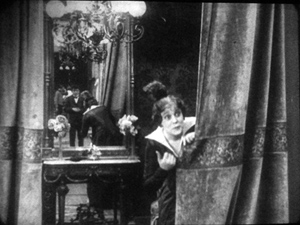
Once inside, he coyly presents her with a flower and they draw close together. Since we tend to concentrate on faces, the small area encompassing their two profiles is likely to draw our attention. Nonetheless, the shot is notably unbalanced, as if anticipating something coming in from the right side.
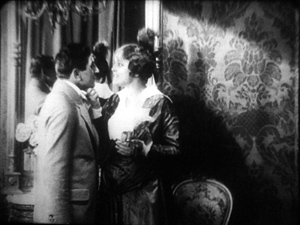
Abruptly Siegismund and Lilly draw apart, and the space between them, in the mirror, is filled by the face of Lilly’s husband, coming through the curtain.
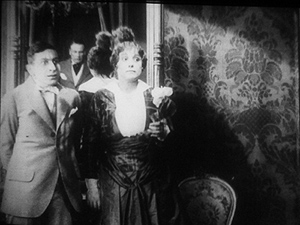
I’d bet that a Tim Smith experiment would find that nearly every spectator is already watching this small zone in the upper left quadrant of the shot. Faces, especially frontally positioned ones, command our notice, and thanks to the mirror we here have three of them. Moreover, movement is an attention-getter too, and all three faces are in motion. Mr. Maas’s face, in fact, gets notably bigger and clearer. His wrathful expression is another reason to watch him.
The husband’s body enters to fill the frame, then presses into the center of the shot, blotting out Lilly as he faces down Siegismund.
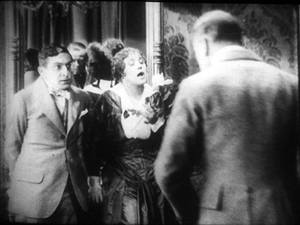
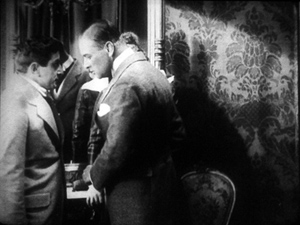
Now the director controls the speed of our gaze quite precisely. Maas slowly rotates, forcing Siegismund to swing from left to right, as if he were attached to the bigger man by a rod. This yields, again, that nice sense of refreshing the frame that we always get from a Cross.
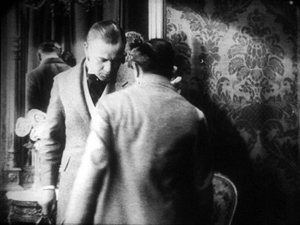
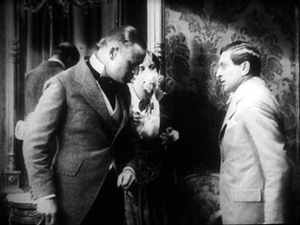
Siegismund collapses into the lower right of the frame, flinching from the fight that’s about to start. Lilly soon shoves aside her husband’s chastisement and melodramatically tells him to leave. “We’re divorcing!” the following intertitle says.
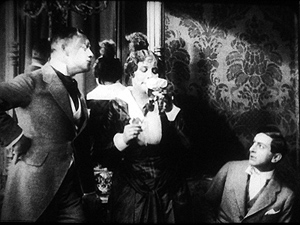
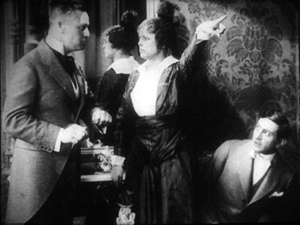
Mr. Maas takes it in stride, shrugging and spreading his arms. He leaves, and thanks to the helpful mirror we can see him chortling as he glances back and passes through the curtain.
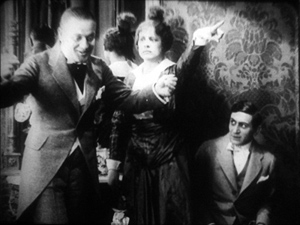
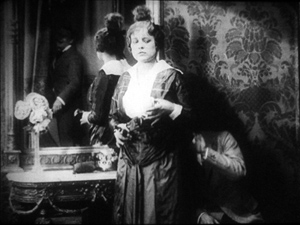
If we hadn’t already noticed Siegismund cowering behind Lilly in the lower right quadrant, we will now. Lilly angrily flounces to our left (the Cross again). Siegismund rises to explain he hadn’t meant to cause a rift in the marriage.
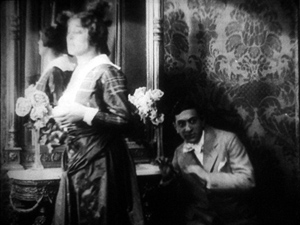
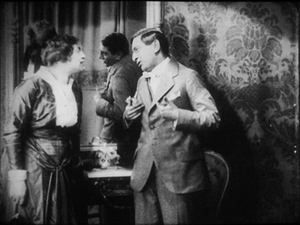
We’re back to something like the initial setup, but now with Siegismund centered, the couple further apart, and a less unbalanced frame. The drama, which now consists of Lilly inviting him to tea tomorrow, can proceed from here.
A different way of seeing?
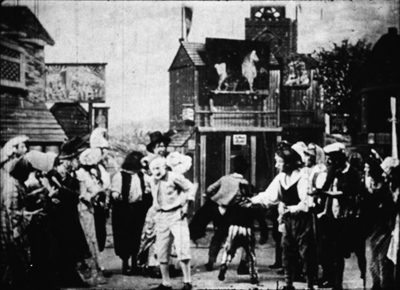
Tom Tom the Piper’s Son (1905).
We’ve become used to editing-driven storytelling, and I’m convinced that we can learn to notice the staging niceties of the tableau alternative. But what if early filmmakers explored some other ways of looking that are far more unfamiliar to us today?
Noël Burch, in his 1990 book Life to Those Shadows, argued that in the first dozen years or so of cinema, movies solicited viewing skills that we lack today. He suggested that early filmmakers often refused to center figures and crammed their frames with so much activity that to our eyes the shots look confused and disorganized. In Tom, Tom, the Piper’s Son (1905), Burch notes, the bustle of the fair, the reliance on an extreme long shot, and the absence of any cutting make the central event, Tom’s swiping of the pig, difficult to catch. In the frame surmounting this section, Tom is making off with the pig in an area just right of center, but the antics of the clown and the response of the crowd may well distract us from the main action.
The result, says Burch, is a mode of filmmaking that demanded
a topographical reading by the spectator, a reading that could gather signs from all corners of the screen in their quasi-simultaneity, often without very clear or distinctive indices immediately appearing to hierarchise them, to bring to the fore “what counts,” to relegate to the background “what doesn’t count” (p. 154).
Later developments linearized this field of competing attractions, creating a smooth narrative flow “harnessing the spectator’s eye.” Among these developments were the presence of a lecturer at many screenings (telling people what to watch) and, of course, the growth of the continuity editing system. But Burch suggests that the “primitive mode” hung on until about 1914.
A famous example is a shot from Griffith’s Musketeers of Pig Alley (1912). The gangster has lured the Little Lady (Lillian Gish) into a back room and distracts her with a photograph while he tries to dope her drink, in a precursor of date-rape drugging. But the Snapper Kid, another gangster, has been keeping an eye on her and follows. As the gangster starts to pour the drug out, the Kid’s entry is presaged by a whiff of cigarette smoke.
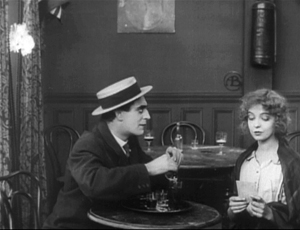
At the crucial moment, we have three things to notice: the Little Lady’s obliviousness, the gangster’s pouring the drug, and the full entrance of the Snapper Kid.
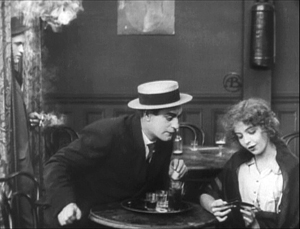
Today’s director would likely resort to editing that shows the doping, then the Kid arriving, then the doping again, and leaving us to infer a vague sense that they’re happening at the same time. Griffith’s choice gives us genuine simultaneity, but at a cost. Two cues compete for our attention: central composition for the drink, major motion on the edge for the Kid’s entry. In my experience, viewers tend to notice the appearance of the Kid, but to miss the business with the drink. (Another passage for Tim Smith to test!) By today’s standards, Griffith has failed as a director, but Burch’s view suggests that 1912 viewers, more sensitive to “all-over” composition, could have registered both actions, perhaps by rapidly scanning back and forth.
During my trip I found a fascinating example of this issue, as well as an apt counterexample. Both involve daggers.
In Maman Poupée (1919), a remarkable Italian film directed by Carmine Gallone, a devoted, somewhat infantile wife learns of her husband’s affair with a society woman. Susetta confronts the mistress and begs her to break off the affair. The woman laughs in her face. What happens next is given in several shots, mostly through axial cuts.
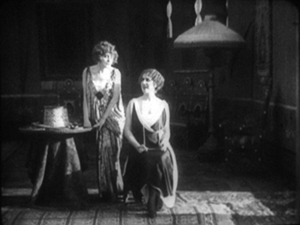
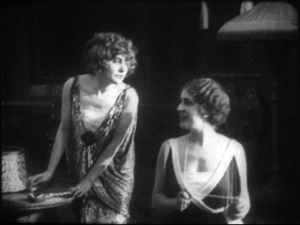
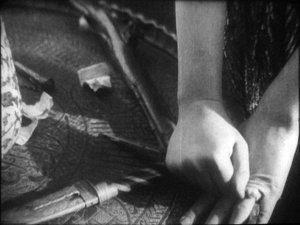
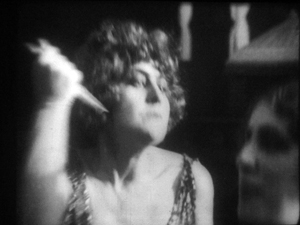
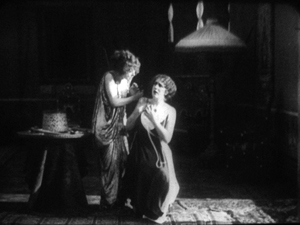
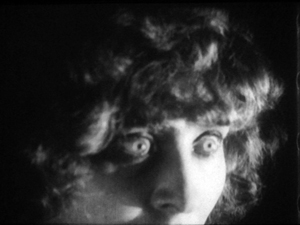
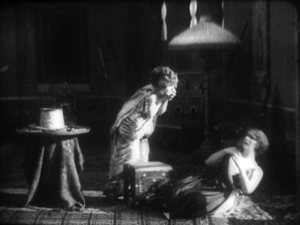
The linear editing, as Burch indicates, lays everything out for us step by step. The close-ups accentuate what is important at each moment: Susetta seizing the dagger, stabbing her rival, and–in a remarkably modern-looking extreme close-up–registering her horror at what she has done.
Two years before, Marcel Simon, the (Belgian!) director of Calvaire de Mignon, handled a similar situation rather differently. The diabolical Dénis, whom we met earlier, has succeeded in destroying his brother’s life. It remains only for him to force Robert’s niece Mignon to marry the Algerian Emir Kalid. Kalid is at first humble, beseeching Mignon to become his bride, but then he gets rough. We might note already that Mignon, while fairly near the camera, hovers close to the left frame edge.
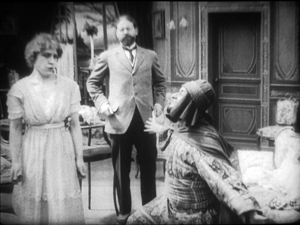
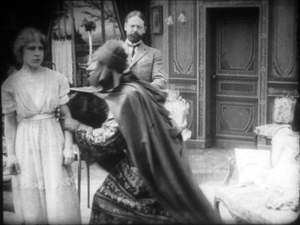
In their tussle, Mignon snatches something from Kalid’s waistband and flings him far away to the right.
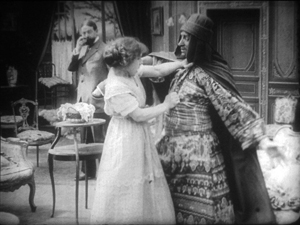
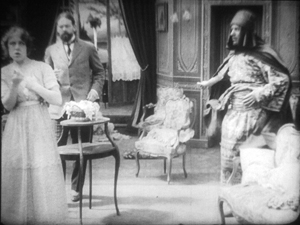
What’s up? Mignon has grabbed the Emir’s dagger and stands poised with it pressed to her heart. But we haven’t been able to see that dagger very clearly (no cut-in close-up here, as in Maman Poupée) and she’s returned to her position far off-center. It’s likely that a viewer today wouldn’t understand that she’s holding the men at bay by threatening suicide. Would a 1917 viewer be as uncertain? Would the situation, plus her posture and the men’s hesitation, be enough to get the point across?
Moreover, this moment goes by very quickly. Scarcely has Mignon struck her pose when her true love, René, bursts in behind her–frontal, fairly centered, and moving fast. Meanwhile, Dénis is sneaking up on her, hugging the left frame. Mignon makes a break for René, dropping the still almost indiscernible dagger.
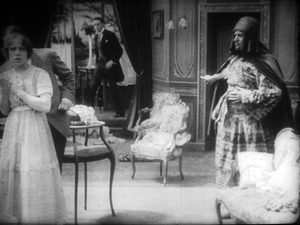
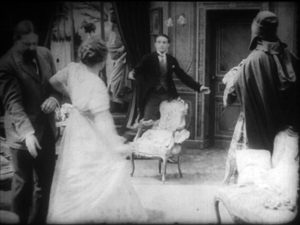
While Mignon and Rene embrace in the right rear doorway, blocked from our view by Kalid, Dénis stoops over. It’s a timely adjustment, giving us full view of the benevolent Le Maire sweeping into the room.
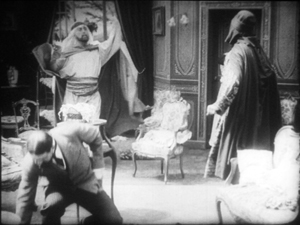
As the two men confront one another–the climax of the scene–director Simon has the effrontery to let Dénis steal the show. He picks up the dagger, which now can be seen more or less plainly, weighs it in his hand, and looks out for a brief, pondering moment.
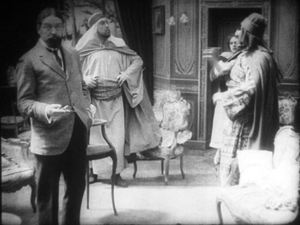
We seem to have a late example of the Snapper Kid Effect, in which important actions compete for our attention. Is it clumsy direction to perch Mignon on the frame edge as René rushes in, and to let Dénis recover the dagger while we’re supposed to concentrate on the face-off between the two powerful men? Or would audiences have tracked all the strands of action and enjoyed their simultaneity?
On this site and elsewhere, I’ve assumed that directors in the 1910s structured their compositions for what Charles Barr calls “gradation of emphasis,” a fluid pattern of primary and secondary points of attention. I’ve argued as well that Burch exaggerates the decentered, nonlinear compositions of even the earliest years. Many of the films staged by Lumière cameramen are designed cogently, and so are many films from the 1900s. (Tom, Tom might be the exception rather than the norm.) Yet every so often, you get a later case, like Musketeers of Pig Alley or Le Calvaire de Mignon, that suggests that some viewers might have been more adept at tracking simultaneous events than we are.
A still broader question remains. Let’s assume that people were able to follow and enjoy films in the tableau style, even when that style pushed toward illegibility. What enabled people to adapt, and so quickly, to continuity-based movies? Some scholars and filmmakers argue that continuity editing achieved its power and worldwide acceptance because it mimics our natural mode of perception. At any moment, we’re concentrating on just a small portion of our surroundings, and this is like what editing does for us in a scene. On the other side, Burch and others would argue that continuity filmmaking is only one style among others, with no special purchase on our normal proclivities. On this view, classical continuity’s apparent naturalness hides all the artifice that goes into it, and this concealment makes its work somewhat insidious. I’ve offered some thoughts on this problem elsewhere, but I bet I tackle it again on this site some time.
In any case, we need to study films that seem odd or difficult, whether they’re recent or from the distant past. We’re guaranteed to find some striking and unpredictable things that provoke us into thinking. That’s one of the pleasures of exploring the history of film as an art.
For earlier studies of the tableau style on this site, see this entry on Bauer, this one on 1913 films, this one on Feuillade, and this one on Danish classics. This entry discusses the emergence of Hollywood-style continuity, and this one explores the exemplary editing in William S. Hart films. I go into more detail in two books, On the History of Film Style (chapters four and six) and Figures Traced in Light (chapter two) and in the essay, “Convention, Construction, and Cinematic Vision” in Poetics of Cinema. The last-named piece tries to stake out a middle position on the “naturalness” of continuity editing. Kristin has analyzed Alberto Capellani’s films as instances of the tableau trend, last year here and just last week here. She also weighs in on the debate about whether viewers of his time were better prepared to grasp the action than we are. More generally, Capellani’s career exemplifies the major and swift stylistic changes of the 1910s. When he went to America, he became pretty adept at the emerging continuity style, as the Nazimova vehicle The Red Lantern (1919) indicates. Of course that’s got some striking single images too.
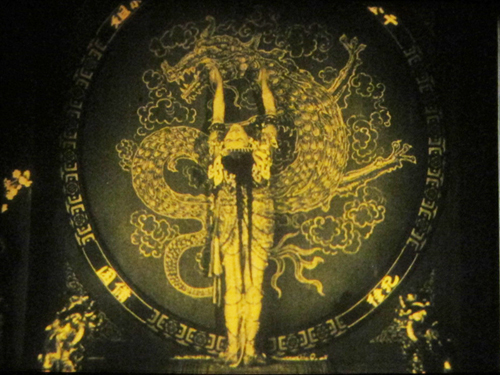
The Red Lantern (1919).
John Ford, silent man
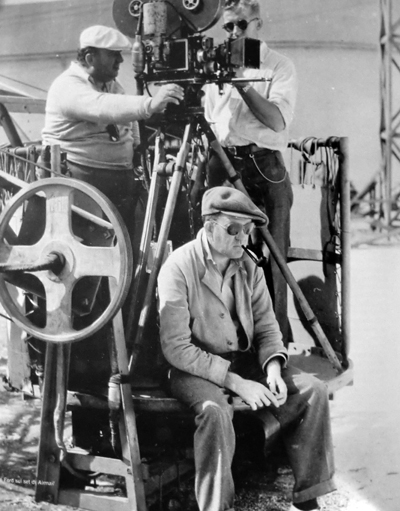
John Ford on the set of Air Mail (1932).
DB here:
This is the busiest installment of Cinema Ritrovato I can recall. We scarcely have time to sleep, let alone blog. The coordinators Peter von Bagh, Gian Luca Farinelli, and Guy Borlée have outdone themselves in offering something for everybody, from early films to postwar French and Italian rarities up through a tribute to Stanley Donen and special screenings of The Leopard and Metropolis. Our attention has been riveted by the 1910 programs and an extensive collection of films directed by Alberto Capellani, a little-known master of silent film.
One headliner is the early Ford series: all his surviving silents, plus a selection of rarely-seen talkies. The first one screened, The Black Watch (1929), concentrates on intrigue in the Khyber Pass during World War I. Captain King is assigned to India while the rest of his Scots regiment is sent to Europe. In India, King masterminds the defeat of the forces of Yasmani, a woman who has been taken as sort of a goddess by her followers. The central section, involving Yasmani’s passion for King and his betrayal of her, seems to me sketchy and rushed; Ford’s real interest, not surprisingly, is in the rites of comradeship among the Black Watch. Twenty-two of the film’s 91 minutes are taken up with the opening dinner celebrating the regiment, conducted while King gets his assignment. Since his mission is secret, he abandons his comrades and suffers their opprobrium. A bookended sequence at the close shows him returning to the Watch as, in the trenches of war, they hold another dinner, complete with ruffles and flourishes.
Some of the central portion was directed by Lumsden Hare, but it too has some striking moments, perhaps most memorably the display of Yasmani’s powers when she conjures up an eerie vision of the European battlefield in a glowing crystal ball. The war sequences have the dank Expressionist look that Murnau brought to Fox and that Ford exploited in Four Sons (1928). There are as well touching train-station farewells between brothers and between father and daughter, all of which seem very Fordian. Overall, Ford finds ways to avoid the multiple-camera shooting common to early talkies, often using offscreen dialogue during reaction shots.
Also fairly free of multicamera work was The Brat (1931). Like many talkies derived from a creaky Broadway play, it entices us with a “cinematic” curtain-opener. Cops (including the young Ward Bond) hustle perps into night court, all captured in a flurry of high and low angles, bursts of deep space, and swift tracking shots. Afterwards things slow down, enlivened by some social satire (the pretentious novelist writes with a quill pen), a few sight gags (an artist’s muscled model who discovers he’s been rendered in a faux-Cubist image) and an all-in grappling fight between a society dame and a girl from the other side of the tracks. According to Ford, the fight got its impact from the fact that the actresses couldn’t stand each other.
The first silent Fords were introduced by Joe McBride. “When the real West ended,” Joe remarked, “the cinematic West began.” Born soon after the closing of the frontier, Ford was fascinated by cowboys and Native Americans. Early filmmakers were to a surprising extent celebrating the stoic Indians uprooted and forced to give up their way of life, and this resonated with Ford. The elegiac quality we find in The Man Who Shot Liberty Valance (1962) and other late films, Joe suggested, was already there in the genre. Ford’s own first Westerns, thanks partly to the presence of Harry Carey, carry an air of resignation to history. Even the fragmentary sequences surviving from The Secret Man (1917), in which Harry must sacrifice his freedom to save a little girl, have a severe melancholy.
Hell Bent (1920) has long been famed for its flashy, unrepeatable shot: A carriage pulled by horses tumbles into a ravine; the camera tilts down to follow the crash; and then the horses, freed at the top, come hurtling back into the frame to pass the wreckage. Otherwise the film is consistently agreeable, suffused with Fordian camaraderie among drunks and respect between hero and villain. This last element is starkly dramatized when Harry and his adversary, having wounded each other in a gun duel, must crawl through the desert together.
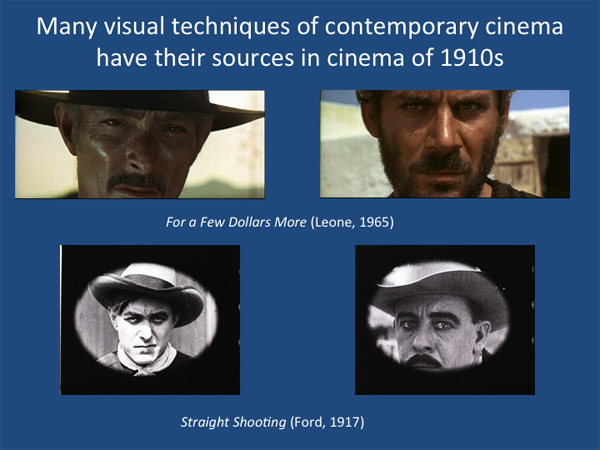
On my first viewing, I didn’t see in Hell Bent the inventiveness and grace notes I admire so much in Ford’s first feature, Straight Shooting (1917). As we’ve mentioned before, this film shows a mastery of the classical Hollywood style that emerged in the late 1910s. It bears comparison with William S. Hart films of the period, high points of filmmaking craft. Late in the plot Ford give us a shootout with ever-tighter framings that could have come out of Leone.
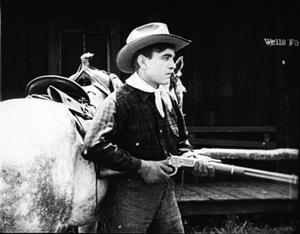
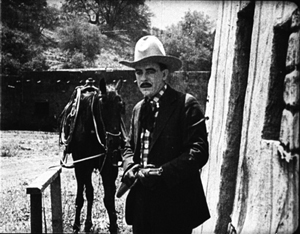
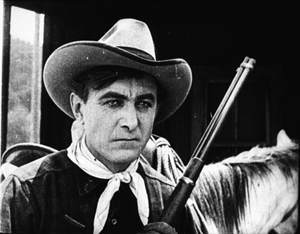
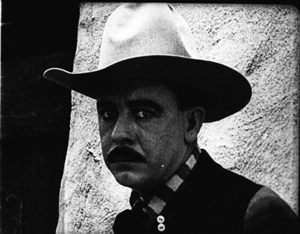
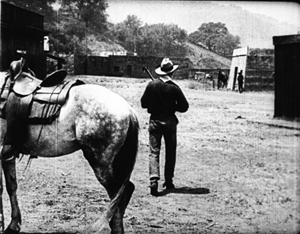
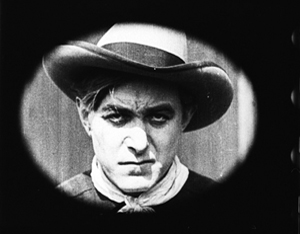
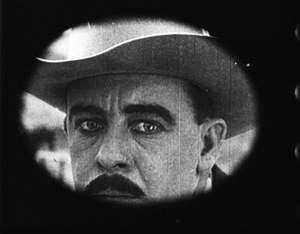
Whether Ford invented this particular piece of cinematic rhetoric we can’t say; too many silent films are lost. But coming from a 23-year-old filmmaker in his first feature, this remains a remarkably assured use of the continuity editing system for 1917.
Ford’s debt to Griffith has often been noted, and in this movie it turns up in unexpected ways. At one point Joan tenderly puts away the plate her dead brother had used, as if to preserve it. Later, Ford recalls the gesture when the cabin is under siege and bullets blow apart other plates on the sideboard. But Ford has already quietly suggested an association between brother Ted and Cheyenne Harry; as Joan kisses the plate before putting it away, Ford cuts to Harry outside, and then back to Joan slipping the plate into a drawer. Using the then-current technique of a “ruminative cut”, the editing suggests that Joan may also be thinking of Harry, and he of her. The idea of Harry replacing Ted is made explicit at the end when Sims plaintively asks Harry, “You be my son.”
The Griffith influence is particularly acute in Straight Shooting’s climax, when the farmers are under siege in the Sims cabin. Horsemen gallop around the cabin as hired gunmen pepper it with bullets. Meanwhile, Cheyenne Harry has persuaded Black-Eyed Pete’s gang of outlaws to rescue the settlers, and Ford gives us a rousing passage of rapid crosscutting. It’s a canonical last-minute rescue, straight out of the climax of The Birth of a Nation (191t5).
Or more particularly, I think, out of The Battle at Elderbush Gulch (1914). Griffith commonly staged interior scenes with doors at the left and right of the frame, letting actors play laterally. The strategy can be considered somewhat theatrical, in that we never see the “fourth wall” that would in reality enclose the characters.
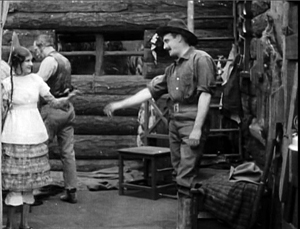
But this leads to problems when you want to show your characters surrounded. In Elderbush Gulch, the settlers are besieged by encircling Indians. At one point, Griffith cuts from the exterior of the cabin to the interior, and to convey the sense of enclosure he has one of the settlers firing “through” the fourth wall, as if over the heads of the audience!
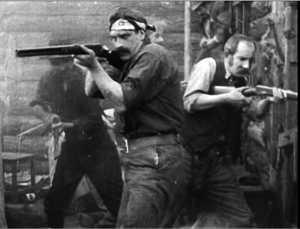
This is an awkward compromise, but at least give Griffith credit for grasping that his dollhouse playing area doesn’t fully render a realistic space. In Straight Shooting Ford provides a more three-dimensional rendering of interiors. Even though most scene in the Sims cabin lacks Griffith’s side walls, the set yields layers of depth, and the famous door in the back of the set opens on to the porch and the farm outside.
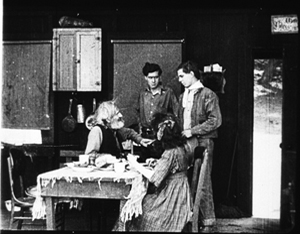
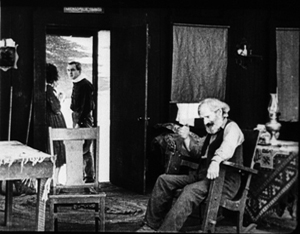
During the gunmen’s siege, we get a strong sense of enclosing space by virtue of the cuts of men firing from different angles. In addition, the cabin interior displays a little more angular depth.
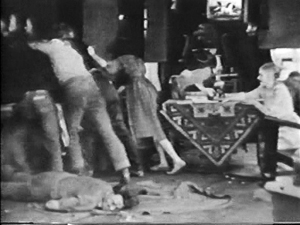
But even Ford can’t escape compromises. We never see the space “behind us” in the Sims’ cabin, and as the farmers take up positions at windows, Ford shows us old Sims readying to fire by turning toward the camera and, like Griffith’s settler, aiming through the fourth wall.
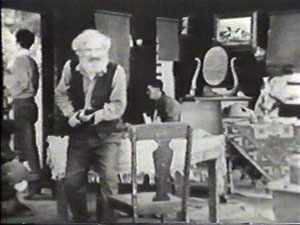
The two shots of Sims in this posture go by fast, and they’re less noticeable because the siege hasn’t quite begun. Still, the anomaly indicates that in this setting Hollywood technique still doesn’t give the sense of a wraparound space that we get in the exterior scenes, like the shootout. A few years after Straight Shooting, American directors would master the ability to build up a four-walled interior through careful cutting. Those techniques would then be exploited for dramatic effect, as in Lubitsch’s Lady Windermere’s Fan (1925).
More to come, but now I must rush off to a morning of early film! If you’re hungry for more in the meantime, visit our category Festivals: Cinema Ritrovato for highlights of earlier years.
His majesty the American, leaping for the moon
DB here:
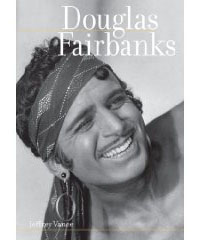 Douglas Fairbanks is remembered today as the nimble, insouciant hero of a string of swashbuckling films: The Mark of Zorro (1920), The Three Musketeers (1921), Robin Hood (1922), The Thief of Baghdad (1924), Don Q Son of Zorro (1925), and The Black Pirate (1926). He is the primary subject of a gorgeously illustrated, solidly researched new biography by Jeffrey Vance with Tony Maietta. Proceeding film by film, the authors interweave his life story with production data and summaries of critical reception. While tracing his career, they make an intriguing case that Fairbanks’ 1920s features more or less founded the modern film of action and adventure.
In the five years before The Mark of Zorro, Fairbanks made twenty-nine features and shorts. Vance and Maietta are enlightening on this period, but they treat it as prologue to the more spectacular work. Now, as if to counterbalance their book, comes a new Flicker Alley DVD collection, Douglas Fairbanks: A Modern Musketeer, gathering ten of the early films along with a very pretty copy of The Mark of Zorro and Fairbanks’ last modern-day movie, The Nut (1921), made because he wasn’t sure that Zorro would be a hit. (It was.) To the DVD package Vance and Maietta have contributed an informative booklet and they offer enlightening conversation in a commentary track for A Modern Musketeer (1917).
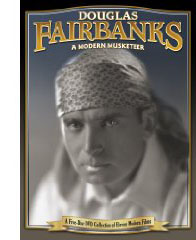 Kristin and I have long been fans of the pre-Zorro titles. Kristin wrote an appreciation of the early films for a Pordenone catalogue, and I studied Wild and Woolly (1917) as an early prototype of Hollywood narration. (1) There’s no denying that the 1920s costume pictures offer dashing spectacle and derring-do. But the 1915-1920 films are something special—lively, lilting, and unexpectedly peculiar. (2)
Before he became Fairbanks, he was Doug, the relentlessly cheerful American optimist. This star image was created very quickly, in films and in public events that made him seem the nicest guy in the country. His manic energy came to incarnate the new pace of American cinema, and his films helped shape the emerging precepts of Hollywood storytelling.
Doug
Consider his contemporaries. William S. Hart keeps his distance; perhaps his severe remoteness comes from secret pain. The result is a man you respect and admire but can hardly love. Mary Pickford, though, is lovable, and so is Chapin, although his cruel streak complicates things. But Doug is quintessentially likable. His early films present us with a brash youth who is all pep and pluck, bouncing with barely contained energy, unselfconscious in his engulfing enthusiasm for life. Today he could be elected President, the ultimate guy to have a beer with. (In real life Fairbanks was a teetotaler.)
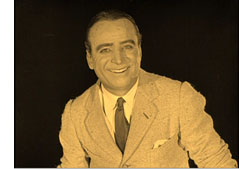 There is no guile in him, no hidden agenda. When he’s brimming with delight, as he often is, he flings his arms out wide. In another actor this would be hamminess, but for Doug it’s simply an effort to embrace the world. Any social embarrassments he commits—and they are plenty—he acknowledges with a puzzled frown before flicking on an incandescent grin. Who else makes movies with titles like The Habit of Happiness (1916) and He Comes Up Smiling (1918)?
But how can such a genial fellow yield any drama? Give him an idée fixe, a cockeyed hobby or life philosophy into which he can pour his adrenaline. Now add a goal, something that his obsession blocks or unexpectedly helps him attain. Toss in the staples of romantic comedy: a good-humored maiden uncertain how to tame this creature of nature, a few old fogeys, some unscrupulous rivals. Hardened crooks may make an appearance as well. Be sure to include some tables, chairs, sofas, or horses for him to vault over, as well as some perches near the ceiling or on the roof; Doug feels most comfortable lounging high up. Add windows, for his inevitable defenestration. (In a poem about him, Jean Epstein wrote, “Windows are the only doors.”) There should also be chases. Other comedy stars run because they must. Doug’s joy in flat-out sprinting suggests that he welcomes the chance to flush a little hyperactivity out of his system. At the story’s climax he must save the day, taming his obsession and achieving his purpose while acceding to the claims of the practical world.
An early example is His Picture in the Papers (1916). In this satire on vegetarianism and the American lust for publicity, Doug works for his father’s health-food firm, even though he prefers thick steaks. But he’s full of ideas for promoting the product. Doug needs money to marry his equally carnivorous girlfriend, but his father will give him the dough only if Doug can pitch their line of dietary supplements. Doug vows to get his picture in every newspaper in town. While he launches a series of high-profile stunts—wrecking his car, entering a prizefight, brawling on an Atlantic City beach—his sweetheart’s father is pursued by a gang called the Weazels, who try to extort money from him.
The two plotlines converge, with Doug stopping a train wreck and winning a place on the front pages. (In a sly dig at the press, each news story contradicts the others.) The movie is a little disjointed, but several scenes are remarkable, not least a boxing match in an actual athletic club before an audience of cheering Fairbanks pals. And there is more than one funny framing, notably a nice planimetric one showing all our principals lined up and reading different newspapers celebrating Doug’s triumph.
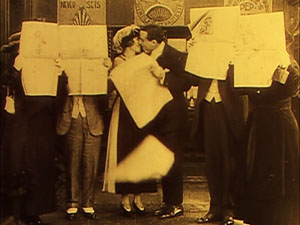
As the title indicates, in The Matrimaniac (1916) Doug’s goal is elopement, which he pursues obsessively. He evades a rival suitor, his girlfriend’s father, a sheriff, and a posse of city officials in order to tie the knot in a gag that must have looked radically up-to-date. Reaching for the Moon gives us a more philosophical Doug, a naive disciple of self-help books that urge him to strive, to concentrate, and above all to keep his eye on the most supreme goal he can imagine. He ends up in New Jersey.
Wild and Woolly (1917) casts Doug as the son of a railroad tycoon. Although he lives in Manhattan, he dreams of being a cowboy. His bedroom boasts a teepee, and he practices his roping skills on the butler. Sent out to Bitter Creek to investigate a deal, he encounters the rugged frontier of his dreams, complete with shootouts, town dances, and hard-drinking cowpokes. But all of this is a show, staged by the locals to make him look favorably on a railroad spur. In another twist, a crooked Indian agent uses the charade to rob the bank and stir up an Indian settlement. Now Doug’s obsessions prove really useful, as his cowboy skills rescue the town.
Wild and Woolly is among the very best of the surviving early Fairbanks titles, and its adroit storytelling is still admirable today. The best-known version was a very poor print, salvaged from the Czech archives and still circulating on barely visible VHS and public-domain DVD copies. Forget those. On the Flicker Alley collection the image quality, while not perfect, allows this trim little masterpiece to be appreciated. (3)
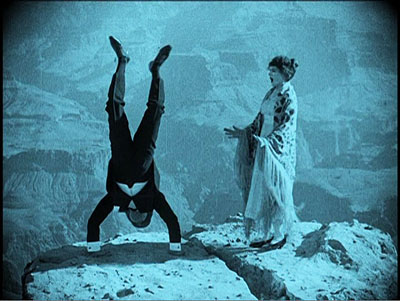
“Always chivalrous, always misunderstood,” reads one intertitle in another gem, A Modern Musketeer. Here Doug is possessed by the spirit of D’Artagnan, simply because while he was in the womb his mother was reading The Three Musketeers. He manages to live up to his heritage as he overcomes a philandering rival and a bloodthirsty Indian. The climactic chase takes place at the Grand Canyon, affording Doug a chance to shinny up and down cliffs and do handstands along a precipice.
Doug never does things by halves. In Flirting with Fate, he is a starving artist, out of money and apparently unloved by his girl. The logical solution is to hire a killer to end his misery. Of course Doug’s fortunes instantly change, and life becomes worth living, but then he must somehow find his assassin and call off the hit.
Many of the early films show the protagonist fully formed as a cross between a cheerleader and a track star. But Fairbanks made a big success on stage playing a sissy. The task in such a plot is to turn him into a red-blooded man. His first film, The Lamb replayed this lamb-into-lion plot, which also served as the basis for Buster Keaton’s first feature, The Saphead (1920).
In the Flicker Alley collection, this strain of Doug’s work is represented by The Mollycoddle (1920). Doug is the descendant of hard-bitten westerners, but growing up in England has made him a fop. Coming to America with a batch of wealthy Yanks, he is a continual figure of fun, waving his monocle and cigarette holder. Once in Arizona, however, he’s confronted with a diamond-smuggling racket. He starts to channel his ancestors and turns into a hell-for-leather hero. He allies with a tribe of exploited Indians to capture the gang, in the process indulging in leaps, falls, canyon-scaling, and fistfights in raging rapids.
The titles often invoke craziness, vide the Matrimaniac, The Nut, and Manhattan Madness (1916). But this motif is carried to an extreme in one of the strangest pictures of the still-emerging Hollywood cinema. When the Clouds Roll By (1919) crams in enough gimmicks for three Doug stories. First, our hero is neurotically superstitious. He will climb over a building to avoid letting a black cat cross his path. He meets a girl who is as superstitious as he is, so after a session at the Ouija board, they seem a good match.
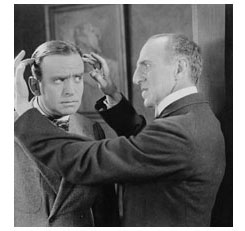 At the same time, however, a psychiatrist is making Doug the subject of a demonic experiment: Can one drive a person to madness and suicide? Through bribes and surveillance, Dr. Metz turns Doug’s life into hell—botching his romance, getting him disowned by his father, and even inducing nightmares. As if all this weren’t enough, the last reel jams in a train crash, a bursting dam, and a flood. Before this overwhelming climax, When the Clouds Roll By isn’t so much funny as eerily paranoiac. The way Dr. Metz’s Mabuse-like scheme enfolds everyone is as anxiety-provoking as anything in a film noir. This dreamlike movie ends on a surrealist note: Doug and his sweetheart get married when flood waters carry a church past them.
Across these films, in fact, the Fairbanks persona starts to disintegrate. Somewhat like those naïve Capra heroes of the 1930s (Mr. Deeds, Mr. Smith) who turn into melancholy victims in Meet John Doe and It’s a Wonderful Life, Doug becomes more brooding and helpless. In Reaching for the Moon, his absurd dream of glory is revealed as just that, a dream. When the Clouds Roll By saves itself from despair through splashy last-minute rescues.
Fairbanks was evidently becoming uncomfortable in cosmopolitan comedy. His taste for large-scale stunts and tests of prowess led him to the costume sagas of the 1920s. In the process, as Vance and Maietta point out, he cleared the way for Keaton and Harold Lloyd. Both comics would sometimes play obtuse idlers in the Lamb mode, and both would take thrill comedy to new heights. But avoiding Fairbanks’ ebullient optimism, Keaton brought a perplexity to every situation, along with an angular athleticism and a geometrical conception of plotting and shot composition. Lloyd frankly presented a hero lacking social intelligence, afflicted with a stammer or shyness or even cowardice, always desperate to fit in. Both men deepened the possibilities of modern-day comedy, thriving in the niche vacated by Fairbanks.
Bug and Mr. E
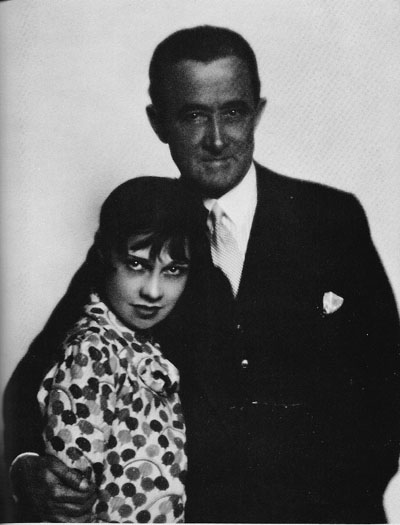
For nine of the early films, Fairbanks had the help of John Emerson and Anita Loos. All three worked on the stories, with Emerson usually directing and Loos writing the scripts and intertitles. The collaboration lasted only about two years, but it yielded some definitive moments in the creation of the Doug mystique.
Emerson found his first success acting and directing on the New York stage. Under Griffith’s supervision he started filmmaking in 1914, with an adaptation of his own successful play, The Conspiracy. I haven’t seen this or most of his other early work, but his 1915 Ibsen adaptation Ghosts, codirected with George Nichols, betrays little of the dynamism that would run through his Fairbanks projects (although The Social Secretary of 1916, without Doug, is lively enough). Emerson continued to direct films and New York stage productions until his death in 1936, at the age of fifty-eight.
Loos was a tiny prodigy. She sold her first scripts at age nineteen, with the third, The New York Hat (1913), directed by Griffith, earning her twenty-five dollars. (Her punctilious account book is reprinted in her 1974 autobiography Kiss Hollywood Goodbye.) After writing scores of shorts, she moved into features in 1916, when, she claims, Emerson discovered her script for His Picture in the Papers. Clearing the project with Griffith and casting Doug Fairbanks, the team proceeded. This, Fairbanks’ third feature, proved a great success and solidified important aspects of his star persona.
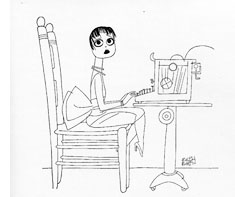 Loos married Emerson, whom she recalled as having “perfected that charisma, which even a bad actor has, of being able to charm his off-stage public.” (4) He called her Bug, she called him Mr. E., and they became a Hollywood couple. They kept themselves before the public eye with interviews and books like How to Write Photo Plays (1920) and Breaking into the Movies (1921). These are full of information about the filmmaking practices of the day.
Why did Emerson and Loos split from Fairbanks? Loos says that that Doug had become somewhat jealous of her notoriety. (5) Further, the couple yearned to return to New York. There Loos would hobnob with the Algonquin club crowd and write Gentlemen Prefer Blondes, a successful serial, book, play, and silent film. Eventually she would write plays and return to Hollywood as an MGM screenwriter.
Although they remained married and collaborated on plays and films, the pair eventually lived apart, the better to ease Emerson’s philandering. “Mr. E.’s devotion was largely affected by the amount of money I earned,” Loos recalled. (6) By her own testimony, she earned plenty. She writes in 1921:
The highest paid workers in the movies today are the continuity writers, who put the stories into scenario form and write the “titles” or written inserts. The income of some of these writers runs into hundreds of thousands of dollars a year . . . . Scenario writing does not require great genius. (7)
Loos is largely credited with bringing the witty intertitle into its own. Expository “inserts” were often neutral descriptions of the action or pseudo-literary ruminations. Loos created intertitles that were amusing in themselves. When Jeff, the hero of Wild and Woolly, comes to Bitter Creek he’s delighted to find a rugged life matching the one he mimicked in his East Coast mansion. So naturally Loos’ title reads, “All the discomforts of home.”
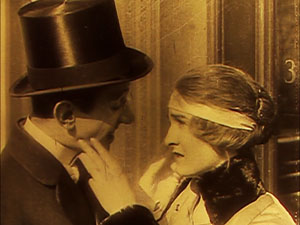
She wedged in puns, satiric jabs, and asides to the audience. The vegetarianism portrayed in His Picture in the Papers makes for anemic romance. Loos’ title prepares us:
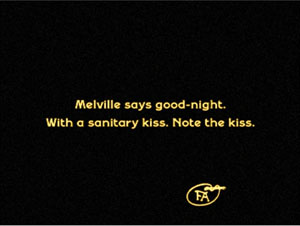
The young suitor and Christine kiss by tapping each other’s cheek with their fingertips.
Later the intertitle stresses the more robust wooing program launched by Doug.
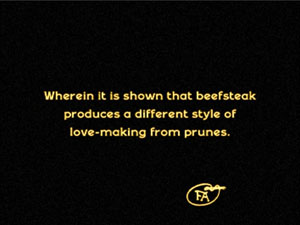
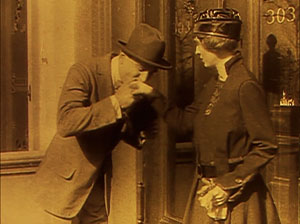
By the time Loos and Emerson left Fairbanks, the look and feel of their contributions had been mastered by others, notably director Allan Dwan, and smart-alec intertitles continued to grace Fairbanks’ modern comedies. Throughout the 1920s, most comedies would strive, not always successfully, for the cleverness Loos brought to the task. My own favorite in her vein comes in the Lloyd vehicle For Heaven’s Sake (1926). Harold is a millionaire courting a girl working in her father’s mission house in the slums, and one of the titles refers to “The man with a mansion and the miss with a mission.” Such niceties largely vanished when movies started to talk.
Cutting edge
We can learn a lot about the history of Hollywood from these films too. In the 1910s, narrative techniques were being put in place: the goal-oriented hero, the multiple lines of action, the need to prepare what will happen later, the use of motifs as running gags. At the start of The Matrimaniac, we see Doug sneaking into a garage and letting the air out of a car’s tires. Only later, after he has eloped with the daughter of the household, do we realize that this was a way to keep her father from pursuing them. In the course of the same film, the elopement is aided by passersby, and Doug keeps scribbling IOUs to pay them. At the end, the parson who has helped the couple the most is rewarded by the biggest payoff, with Doug shoveling bills at him.
The same years saw the consolidation of the “American style” of staging, shooting, and cutting scenes. (For more on this trend, see our earlier entries here and here.) Fairbanks’ films from 1916 to 1920 display a growing mastery of continuity techniques; the style coalesces under our eyes.
The system depended on breaking up master shots into many closer views. This practice was less common among European directors of the time, who might supply inserts of printed matter like letters but did not usually dissect the scene into shots of different scales. In His Picture in the Papers, for instance, we get a master shot (nearer than it would be in a European picture) of Melville paying court to Christine, followed immediately by closer views that show their expressions.

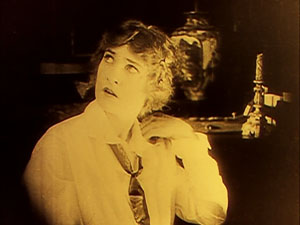
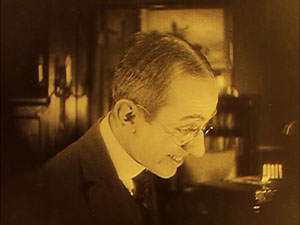
This is a minimal case. Not only are the shots all taken from the same side of the line of action (the famous 180-system) but they are taken from approximately the same angle. Filmmakers sometimes varied the angle more, usually to indicate a character’s point of view but sometimes to bring out different aspects of the action. (See here for examples from William S. Hart.)
Very quickly directors realized that you didn’t need a master shot if you planned your shots carefully. In Flirting with Fate, the artist Augy is chatting with Gladys, while her mother and her rich suitor watch from another part of the room. No long shot presents both pairs.
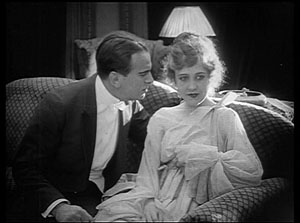
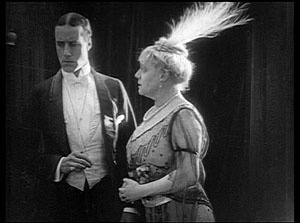
The mother summons Gladys, and when she and Augy rise, director Christy Cabanne cuts to another shot of them, moving into the frame.
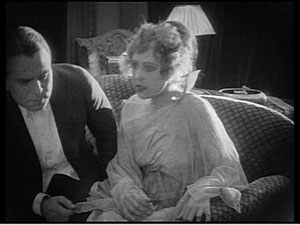
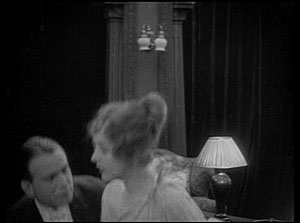
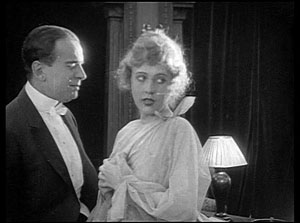
This is a very rare option in most national cinemas of the period, which would simply frame the couple in a way that allowed them to rise into the top of the same shot. Now Gladys hurries out, crossing the frame line. This exit matches her entrance on frame left, meeting her mother.
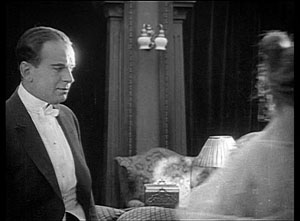
Such a scene is obvious by today’s standards, but a revelation at the time—a way of lending even static dialogue scenes a throbbing rhythm that absorbed viewers. Around the world, notably in the Soviet Union, young directors saw this as the cutting-edge approach to visual storytelling. The new style was as probably as exciting to them as the powers of the Internet are in our time.
Because of analytical editing, the cutting pace of American films of the late 1910s is remarkable, and the Fairbanks films, with their strenuous tempo, are fair examples; the average shot length in these films ranges between 4 seconds and 6.6 seconds. With so many shots, production procedures emerged to keep track of them. To a certain extent shots were written into the scenarios Loos refers to, but directors also broke the action up spontaneously during filming. The cameraman, and later a “script girl,” would log the shots during shooting so that they could be assembled correctly in the editing phase.
Directors were still refining the system, though, as we can see from an awkward passage of shot/ reverse shot in A Modern Musketeer.
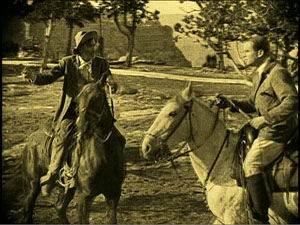
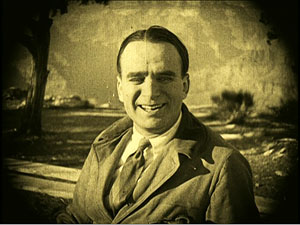
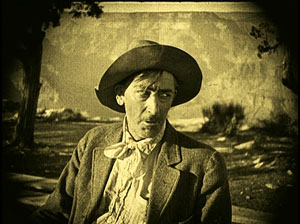
The eyelines are a bit out of whack, but odder still are the identical backgrounds of the two shots. Evidently director Allan Dwan made these shots quickly and closer to the canyon rim, in the expectation that nobody would notice the disparity.
Point-of-view shots were easier to manage, and they could intensify the drama. Later in A Modern Musketeer, the rapacious Chin-de-dah tells the white tourists he’s getting married. To whom? asks Elsie. Instead of answering, “You,” he holds up his knife.
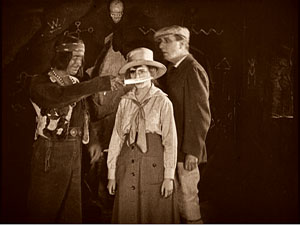
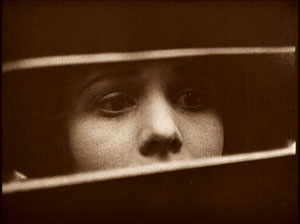
Sometimes you suspect that filmmakers were multiplying shots just for the fun of it. The early Fairbanks films are vigorous to the point of choppiness; action scenes spray out a hail of images, some offering merely glimpses of what’s happening. Wild and Woolly is especially frantic, with the final sequences of kidnapping, gunplay, and a ride to the rescue breathless in their pace. In the course of it, Emerson realizes that fast action needs some overlapping cuts to assure clarity. Doug bursts through a locked door in one shot, and from another angle, we see the door start to open again.
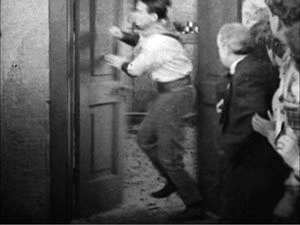
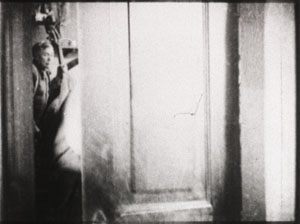
Only a few frames are repeated, but the movement gains a percussive force. Doubtless the Russians studied cuts like this; Eisenstein made the overlapping cut part of his signature style.
By contrast, The Mark of Zorro and its successors have calmer pacing. Doug’s acting got more restrained too, with his bounciness largely confined to the action scenes. Already in 1920, high-end pictures were finding a more academic look, a polished and measured style. Dialogue titles became more numerous, and big sets and other production values were highlighted.
I’ve been able to sample only a few points of interest in the early Fairbanks output. I haven’t talked about Fairbanks’ foray into Sennett-style farce, the cocaine-fueled Mystery of the Leaping Fish (1916), or the bold experimentation of the cinematography in the dream sequence of When the Clouds Roll By. My point is just to note that these films radiate exuberance—not only in their hero but in their very texture. Scene by scene, shot by shot, Doug’s energy is caught by an efficient, pulsating style that was an engaging variant of what would soon become the lingua franca of cinematic storytelling.
For other reading on Fairbanks, you can consult Alastair Cooke’s Douglas Fairbanks: The Making of a Screen Character (New York: Museum of Modern Art, 1940), one of the earliest and still most thought-provoking studies; John C. Tibbetts and James M. Welsh’s His Majesty the American: The Films of Douglas Fairbanks, Sr. (South Brunswick, NJ: A. S. Barnes, 1977), which is wide-ranging and strong on the early films; Booton Herndon’s Mary Pickford and Douglas Fairbanks (New York: Norton, 1977); and Douglas Fairbanks: In His Own Words (Lincoln, NE: iUniverse, 2006), a collection of interviews and essays signed (but probably mostly not written) by the star. I’ve also been enlightened by Lea Jacobs’ essay “The Talmadge Sisters,” forthcoming in Star Decades: The 1920s, ed. Patrice Petro (Brunswick: Rutgers University Press, forthcoming). Online, there is much information at the Douglas Fairbanks Museum site.
(1) Kristin Thompson, “Fairbanks without the Mustache: A Case for the Early Films,” in Sulla via di Hollywood, ed. Paolo Cherchi Usai and Lorenzo Codelli (Pordenone: Biblioteca dell’Immagine, 1988), 156-193; David Bordwell, Narration in the Fiction Film (Madison: University of Wisconsin Press, 1985), 166-168, 201-204.
(2) This set is very well chosen, but there are enough other films surviving from this period to warrant another box. It could include The Lamb (1915), Double Trouble (1915), The Good Bad Man (1916), Manhattan Madness (1916), The Americano (1916), Down to Earth (1917), The Man from Painted Post (1917), His Majesty the American (1919), and The Half Breed (1916), in which Fairbanks plays a biracial hero. On the matter of race, the films in the collection aren’t free of condescension and stereotyping, but there are also moments of affection between Fairbanks and Native Americans. He had extraordinarily dark skin, a fact he apparently took in his stride.
(3) I believe that this print is from a different version than the one I’ve known before; a few shots seem to show slightly different angles. (Perhaps the earlier one was from a foreign negative?) An informative page of the Flicker Alley booklet signals the provenance of the prints. While I’m on the subject, I should mention that occasionally the framing seems a bit cropped, but that could be due to the source material.
(4) Loos, Kiss Hollywood Goodbye (New York: Ballantine, 1974), 2.
(5) Loos’ account of the break with Fairbanks can be found in her memoir, A Girl Like I (New York, 1966), 178. You have to admire a book that ends with the line, “Miss Loos, you sure are flypaper for pimps!”
(6) Loos, Kiss Hollywood Goodbye, 14.
(7) Emerson and Loos, Breaking into the Movies (Philadelphia: Jacobs, 1921), 43.
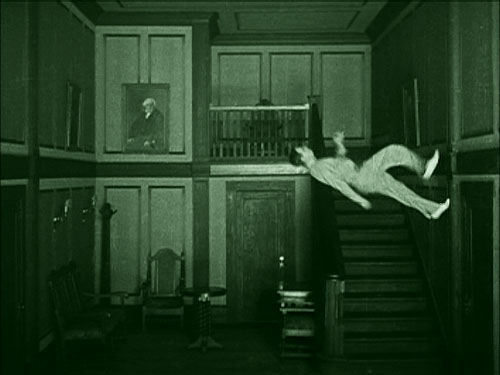
When the Clouds Roll By.
PS 30 Nov: Internets problems and a memory lapse kept me from mentioning two other important books on Anita Loos: Gary Carey’s lively biography Anita Loos (Knopf, 1988) and Anita Loos Rediscovered: Film Treatments and Fiction, ed. and annotated by Cari Beauchamp and Mary Anita Loos (University of California Press, 2003). Both Carey and Beauchamp echo Loos’ claims that the couple split from Fairbanks because he was somewhat envious of the attention they received, while Carey adds that Fairbanks wanted to break out of the “boobish” parts Loos wrote for him (p. 50).
PPS 8 Dec: Mea culpa again. I overlooked Richard Schickel’s book-length essay, His Picture in the Papers: A Speculation on Celebrity in America, Based on the Life of Douglas Fairbanks, Sr. (New York: Charterhouse, 1973). It’s a lively and thoughtful argument that Doug was one of the very first modern celebrities, and one who enjoyed his role as such.